

Thank Roosevelt for Football Weekends
December 20, 2013
By Rob Kaminski
MHSAA benchmarks editor
The next time you find yourself immersed in a tense crosstown football rivalry on a Friday night followed by a Saturday pilgrimage to the nearest college campus and a Sunday afternoon with a remote and your favorite snacks and beverages, take a moment to consider what the weekend would be like if it weren’t for Teddy Roosevelt.
The man who became our 26th President shortly after the turn of the 20th Century following the assassination of William McKinley in 1901 was a football fan like you. Maybe more so.
Today’s game of football has reached a critical crossroads. Player size and speed have increased across the board. Savage use of equipment as weapons rather than protective gear has been glorified on television networks and social media. Leaders of the game at all levels have recognized the need for change, employing new rules and widespread educational efforts to aid in preserving the sport.
History, as they say, is repeating itself.
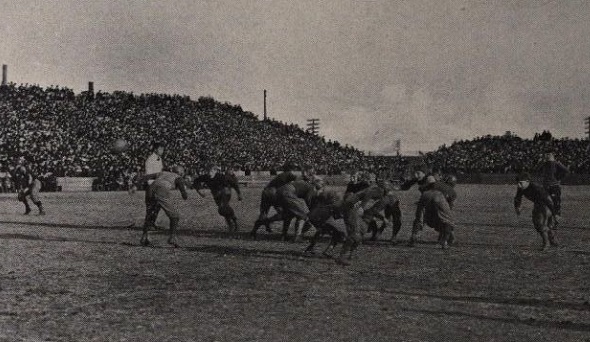
In an ironic twist, it was Roosevelt who saved the then-brutally violent game of football from itself more than 100 years ago. Yes, the same “Rough and Ready Teddy” who led the charge up San Juan Hill during the Spanish-American War and often sparred in the boxing ring while in office from 1901-09 opined that football was becoming so gruesome that he delivered an ultimatum: clean up the game or it would be outlawed.
The Chicago Tribune reported that in 1904 alone, there were 18 football deaths and 159 serious injuries, mostly among prep school players. Football deaths suffered by younger players were reported on a nearly weekly basis, as outraged citizens called on colleges and high schools to banish football outright.
In stepped Roosevelt, who called head coaches and representatives from Harvard, Yale and Princeton – college powers at the time – to the White House in 1905 urging them to eliminate excessive violence and set an example of fair play for the rest of the country. When the casualties actually rose by one during the ensuing season, Roosevelt reacted with greater resolve and convened leading football authorities for the purpose of authoring drastic rules changes. What emerged was an intercollegiate conference which was the predecessor of the NCAA.
Among the most effective changes for the 1906 season were the legalization of the forward pass, the elimination of mass formations, and the creation of a neutral zone. Football fatalities fell to 11 in each of the next two seasons, and severe injuries fell drastically.
Thanks to the introduction of protective equipment and ever-evolving rules changes, football during the 100-plus years to follow has become an exponentially safer game. Yet, the game’s leaders always will need to adjust and react to scrutiny that comes with the territory.
So, as the game once again undergoes rules modifications in the name of safety, give a tip of the cap to President Roosevelt while you enjoy college bowl season and the NFL playoffs and begin to think ahead to the first high school practice of 2014.

Bollman Cousins Making Plenty of Noise as 'Wrecking Balls' for Surging Big Rapids
By
Tom Kendra
Special for MHSAA.com
October 9, 2025
BIG RAPIDS – On Friday nights, the Bollman boys are always in the middle of the action, bringing the muscle and the fight and the power to the Big Rapids football team.
 But for the rest of the weekend, senior Jack Bollman and his first cousin, junior Max Bollman, are happiest when they are able to get away from it all at their family’s deer hunting ranch in nearby Canadian Lakes – appropriately named “The Sanctuary.”
“I just love being out there,” said Jack, a four-year starting running back for the Cardinals. “Our whole family works out there, and it’s just a great environment. It’s our second home, out in nature.”
The Bollmans haven’t spent much time at The Sanctuary lately, as they are laser-focused on what is becoming a special season for Big Rapids (6-0), which earned honorable mention in the latest Division 4 state rankings and heading into Friday’s game at Grant.
The Cardinals are known for their triple-option veer offense, operating out of the shotgun and often with four wideouts. But if the defense gets spread out too thin, the Bollmans will make it pay.
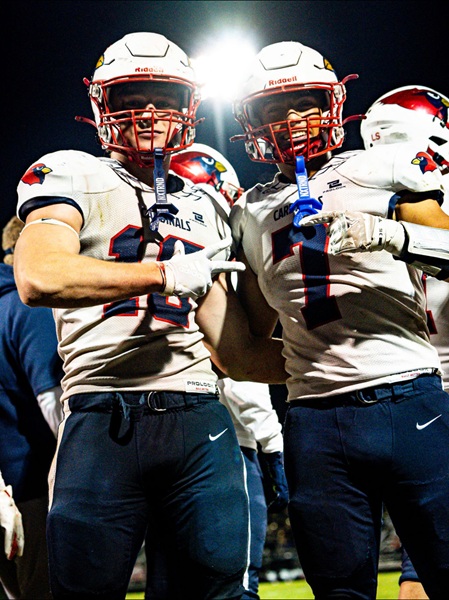
“Jack and I, we look at it as our job to bring the physicality on every play,” said Max, a 6-foot-1, 235-pound defensive end who also plays tight end, primarily in short-yardage and goal-line situations. “We want to be a problem for the other team. Other teams know that we can pass, but we can run over you, too.”
 The Bollmans are part of a golden era of Big Rapids football under 11th-year coach Mike Selzer. The Cardinals – who were 7-3 in 2022, 10-2 and Regional finalists in 2023 and 9-2 last season – are hoping to take a couple more steps this fall with a senior-laden roster.
“We have so much experience this year that our practices are not learning things, but just fine-tuning and adjusting,” said Selzer, who starts 10 seniors on offense and nine on defense. “That experience makes it much easier to make adjustments on the fly during games.”
Big Rapids has overwhelmed its first six opponents, with the closest game a 19-7 win at Paw Paw in the opener. The big Central States Athletic Association Red showdown against Reed City on Sept. 26 turned into a one-sided 40-13 win.
Senior quarterback Cole Haist has completed 59-of-90 passes for 947 yards and 11 touchdowns, and rushed for 249 yards and a team-high nine touchdowns. He throws the ball to a plethora of receivers on the edge, notably seniors Trenton Mossel, Owen Craven, Kurt Wilber and Wyatt Skiera.
But when it comes to short-yardage situations, Max Bollman will check in as a tight end and often lead the way for his cousin, Jack, who is the team’s leading rusher with 56 carries for 429 yards, an average of 7.7 per carry, and six touchdowns.
Big Rapids is looking forward to a big game Week 8 at perennial Division 3 playoff team Coopersville, before pursuing its ultimate goal of a Division 4 championship.
The Cardinals appear to be on a collision course with familiar rival Ludington, which is also unbeaten and features a senior-heavy team led by senior quarterback Cam Gunsell. Big Rapids nipped Ludington, 28-21, in last year’s playoff opener.
In preparation for this postseason, Selzer is working on team-building every Tuesday to try and give his a little edge. This past Tuesday, he brought in Saginaw Valley State assistant coach Jeremy Prudhomme for some trust and team bonding exercises.
“We’ve been climbing every year, and now we want to take those final steps,” said Haist, a three-sport athlete who is in his second year as the team’s starting quarterback. “We have the talent and the ability to go farther. Now we are working on that belief to know we can do it.”
 One bond that is already unbreakable is between the Bollman boys, who have grown up together and played football together since they were little kids.
The duo is especially lethal on defense, as the leaders of a group that has allowed only 33 points all season – fewer than six per game.
Max Bollman, a third-year starter as a junior who already has a Division I college offer from Central Michigan, is the leader of that unit from his edge position, with 24 tackles, five tackles for loss and three sacks. Jack Bollman (5-11, 215) has 14 tackles from his linebacker spot, including four for loss and one sack.
“Max is an off-the-charts kid in terms of strength, and he demands a lot of attention – but he has a motor unlike any kid I have ever coached,” said Selzer, a Wayland native who coached for 11 years at Potterville before taking the Big Rapids job in 2015.
Jonathan Losinski, a senior middle linebacker, is the team’s leading tackler with 26 stops, while Bryce Selzer and Austin Brandt both have 18 tackles.
But the emotional leaders of the Cardinals’ defense are the Bollmans, who are double trouble for every opponent.
“We have a bond, that’s for sure,” said Jack, who is hoping to play college football next year. “We want to be dangerous and blow up plays. Other teams have told us after the game that it’s unbearable to try and block us both on the same play.
“I would say we are like two giant wrecking balls out there, plowing things over.”
 Tom Kendra worked 23 years at The Muskegon Chronicle, including five as assistant sports editor and the final six as sports editor through 2011. E-mail him at [email protected] with story ideas for Muskegon, Oceana, Mason, Lake, Oceola, Mecosta and Newaygo counties.
PHOTOS (Top) At left, Max Bollman lines up from at defensive end, while at right, Jack Bollman finds his way into the end zone against Howard City Tri County. (Middle) Junior Max Bollman (10) and his cousin, senior Jack Bollman (7). (Below) Mike Selzer is in his 11th year as head coach at Big Rapids. (Photos provided by the Big Rapids football program.)