

Thank Roosevelt for Football Weekends
December 20, 2013
By Rob Kaminski
MHSAA benchmarks editor
The next time you find yourself immersed in a tense crosstown football rivalry on a Friday night followed by a Saturday pilgrimage to the nearest college campus and a Sunday afternoon with a remote and your favorite snacks and beverages, take a moment to consider what the weekend would be like if it weren’t for Teddy Roosevelt.
The man who became our 26th President shortly after the turn of the 20th Century following the assassination of William McKinley in 1901 was a football fan like you. Maybe more so.
Today’s game of football has reached a critical crossroads. Player size and speed have increased across the board. Savage use of equipment as weapons rather than protective gear has been glorified on television networks and social media. Leaders of the game at all levels have recognized the need for change, employing new rules and widespread educational efforts to aid in preserving the sport.
History, as they say, is repeating itself.
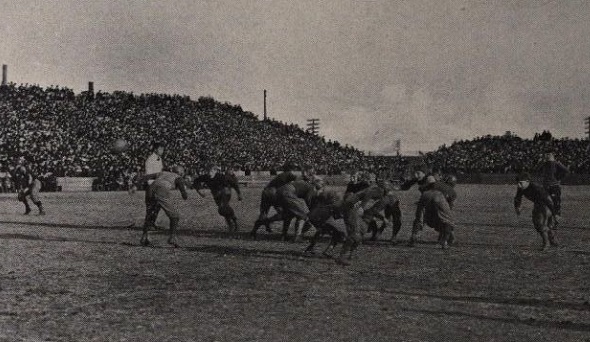
In an ironic twist, it was Roosevelt who saved the then-brutally violent game of football from itself more than 100 years ago. Yes, the same “Rough and Ready Teddy” who led the charge up San Juan Hill during the Spanish-American War and often sparred in the boxing ring while in office from 1901-09 opined that football was becoming so gruesome that he delivered an ultimatum: clean up the game or it would be outlawed.
The Chicago Tribune reported that in 1904 alone, there were 18 football deaths and 159 serious injuries, mostly among prep school players. Football deaths suffered by younger players were reported on a nearly weekly basis, as outraged citizens called on colleges and high schools to banish football outright.
In stepped Roosevelt, who called head coaches and representatives from Harvard, Yale and Princeton – college powers at the time – to the White House in 1905 urging them to eliminate excessive violence and set an example of fair play for the rest of the country. When the casualties actually rose by one during the ensuing season, Roosevelt reacted with greater resolve and convened leading football authorities for the purpose of authoring drastic rules changes. What emerged was an intercollegiate conference which was the predecessor of the NCAA.
Among the most effective changes for the 1906 season were the legalization of the forward pass, the elimination of mass formations, and the creation of a neutral zone. Football fatalities fell to 11 in each of the next two seasons, and severe injuries fell drastically.
Thanks to the introduction of protective equipment and ever-evolving rules changes, football during the 100-plus years to follow has become an exponentially safer game. Yet, the game’s leaders always will need to adjust and react to scrutiny that comes with the territory.
So, as the game once again undergoes rules modifications in the name of safety, give a tip of the cap to President Roosevelt while you enjoy college bowl season and the NFL playoffs and begin to think ahead to the first high school practice of 2014.
Drive for Detroit: Week 6 Preview
September 29, 2016
By Geoff Kimmerly
Second Half editor
Don't think of tonight as the end of another warm September. Instead, consider it the start to a momentous final month of another Michigan high school football regular season.
 Nine games this weekend feature teams with perfect records facing off. Add in that 72 teams statewide can clinch the first automatic playoff berths awarded this fall, and most fans won’t have to drive far to find a game with significant implications.
Check out our preview below of the best games in every corner of the state, powered by MI Student Aid. For the weekend's full schedule, check out the MHSAA Score Center. All games below are Friday unless noted.
Bay & Thumb
Holly (4-1) at Fenton (3-2)
Fenton loaded the front of its schedule with Caledonia and Temperance Bedford and came away with an 0-2 start, but bounced back nicely in pursuit of a sixth straight Flint Metro League title. The Tigers are tied for first with Holly, which also bounced back from an opening-night loss to competitive Berkley and is seeking its first win over Fenton since 2011. Regardless of tonight’s result, Fenton may still hold one more upper hand in the league race – it already has beaten Ortonville Brandon (4-1), Holly’s opponent in Week 9.
Others that caught my eye: Midland (3-2) at Davison (5-0), Flint Carman-Ainsworth (3-2) at Bay City Central (3-2), Corunna (5-0) at Montrose (3-2), Marine City (1-4) at St. Clair (3-2).
Greater Detroit
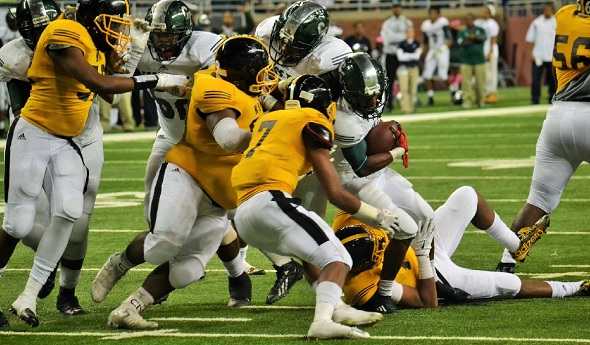
Detroit Martin Luther King (5-0) at Detroit Cass Tech (5-0), Saturday
These Detroit Public School League rivals have lined up for some colossal tilts over the years – see last season’s 31-28 and 27-25 King wins in their first meeting and then PSL championship game. But this might be the most hyped matchup of the series to date. Cass Tech, last season’s MHSAA Division 1 runner-up, has outscored its opponents by a combined 268-45 while giving up scores to only Oak Park and Detroit East English. Then there’s King, which has outscored its opponents 243-6, giving up its only points to Detroit Central in Week 2. This matchup with likely decide the PSL East Division 1 champion; regardless, they’ll likely meet again in the PSL tournament final in Week 9. And regardless of that as well, both could end their seasons playing again at Ford Field in MHSAA Finals for the second year in a row.
Others that caught my eye: Trenton (5-0) at Allen Park (5-0), Redford Union (4-1) at Dearborn Fordson (5-0), Birmingham Groves (5-0) at Farmington Hills Harrison (3-2), Orchard Lake St. Mary's (3-2) at Birmingham Brother Rice (3-2) on Saturday.
Mid-Michigan
Pewamo-Westphalia (5-0) at Laingsburg (5-0)
Few think defense first when it comes to the Pirates, last season’s Division 7 runner-up. But they haven’t given up a point this season since Week 1 to Monroe St. Mary Catholic Central and haven’t given up more than seven in Central Michigan Athletic Conference play since 2014. Laingsburg ended up winning a District title last year after falling to P-W 50-7 in Week 7 and could be best-suited among league opponents to know how to get on the board this week. But the Wolfpack still must slow down P-W star running back Jared Smith as he attempts to go over 1,000 yards rushing for the season tonight despite carrying the ball only 73 times heading into this game.
Others that caught my eye: Saginaw Michigan Lutheran Seminary (4-1) at Ithaca (5-0), Lake Odessa Lakewood (5-0) at Olivet (4-1), Durand (4-1) at New Lothrop (5-0), Williamston (3-2) at Fowlerville (3-2).
Northern Lower Peninsula
Maple City Glen Lake (4-1) at Frankfort (5-0)
Teams without a league loss face off this weekend in all three divisions of the Northern Michigan Football League, but this Leaders matchup is the most intriguing, arguably, based on past history and the past few weeks. Glen Lake and Frankfort have played each other yearly going back at least to the late 1950s, with their meetings often the best of the season in the old Northwest Conference. Glen Lake set up the intrigue this time by handing Charlevoix its first loss this season last week, and big, 49-7. Frankfort won the Leaders last fall, but lost 10-6 to Glen Lake, which played in the Legends division in 2015.
Others that caught my eye: St. Ignace (4-1) at Gaylord St. Mary (5-0), Kalkaska (5-0) at Boyne City (3-2), East Jordan (4-1) at Charlevoix (4-1), Traverse City St. Francis (5-0) at Grayling (3-2).
Southeast & Border
Grosse Ile (5-0) at Milan (5-0)
While Monroe St. Mary Catholic Central has made the most noise out of the Huron League over the last few seasons, these two are regulars in the mix as well. Both have a pair of 10-win seasons this decade and could be on their ways to a third – with this meeting likely deciding the league title as both have two-win leads on the rest of the conference. Milan, last year’s league runner-up, beat Grosse Ile 44-7 in 2015 and still must see St. Mary next week and then Carleton Airport to finish the Huron slate. The Red Devils, meanwhile, have one more win already than all of last season, shut out St. Mary last week, and after tonight finish the league schedule with Airport and Riverview (which are a combined 2-8).
Others that caught my eye: Chelsea (5-0) at Adrian (3-2), Clinton (4-1) at Sand Creek (5-0), Hudson (5-0) at Hillsdale (3-2), Concord (5-0) at Springport (4-1).
Southwest Corridor
Schoolcraft (5-0) at Lawton (5-0)
Lawton also got the highlighted spot from this region last week, against Gobles as both hoped for the opportunity to face Schoolcraft to decide the Southwestern Athletic Conference Central title. Lawton won 31-21 and gets first shot at the Eagles after falling to them 47-0 last season despite also entering that game 5-0. Schoolcraft quietly has built a 16-game regular-season winning streak and hasn’t allowed a SAC Central opponent to get within 21 points since joining the league a year ago.
Others that caught my eye: South Haven (3-2) at Edwardsburg (5-0), Detroit U-D Jesuit (3-1) at St. Joseph (4-1), Portage Northern (3-2) at Stevensville Lakeshore (4-1), Paw Paw (3-2) at Three Rivers (4-1).
Upper Peninsula
Menominee (5-0) at Escanaba (5-0)
The best in the Great Northern U.P. Conference face off to likely decide the championship, although the winner will need another win next week to clinch at least a share of the title. It’s been a while since Escanaba was in this conversation; a win tonight would give the Eskymos their most in a season since 2011. Breaking a 17-game losing streak to Menominee and qualifying for the playoffs too would make a win tonight that much sweeter – the Maroons, in fact, haven’t lost a league game since 2012 and have won 36 straight regular-season games total.
Others that caught my eye: Negaunee (5-0) at Norway (5-0), Iron River West Iron County (3-2) at Calumet (4-1), Hurley, Wis. (5-1) at Hancock (3-2), Bark River-Harris (2-3) at Lake Linden-Hubbell (5-0) on Saturday.
West Michigan
Grandville (5-0) at Rockford (3-2)
It’s hard to give this game top billing over Reed City/Chippewa Hills (see below), but it’s explainable given the Ottawa-Kent Conference Red still has six of seven teams in contention for automatic playoff berths and these two arguably are the best. Grandville is enjoying its most successful run since 2006 – when it still lost to Rockford 28-0 to finish second in the league – and has outscored five opponents by a total of 231-31 after downing contenders Hudsonville 36-6 and East Kentwood 46-3 the last two weeks, respectively. Rockford has fought back gallantly from an 0-2 start that included a forfeit because of a team sickness Week 1. Extending a 21-season playoff streak – and more – looks a lot more possible now.
Others that caught my eye: Reed City (5-0) at Remus Chippewa Hills (5-0), Grand Rapids Christian (5-0) at East Grand Rapids (3-2), Cedar Springs (3-2) at Lowell (5-0), Whitehall (4-1) at Muskegon Oakridge (4-1).
8-Player
New Haven Merritt (5-0) at Owendale-Gagetown (5-0)
These are the top teams in the Mid-Michigan 8-Man Football League, Merritt in the Inland division and Owendale-Gagetown in the Coastal. They are also two of the top teams statewide; Merritt has the fourth highest playoff-point average in 8-player, and Owendale-Gagetown’s is tied for eighth highest. All of this could change this weekend, however; the Bulldogs are 8-0 against Merritt since the Mustangs started their program five years ago. Owendale-Gagetown won last year’s meetings 72-42 and 54-30 – but Merritt, following two straight playoff appearances, is off to its best start ever.
Others that caught my eye: Camden-Frontier (4-0) at Lawrence (5-0), Battle Creek St. Philip (4-1) at Webberville (4-1).
Second Half’s weekly “Drive for Detroit” previews are powered by MI Student Aid, a part of the Student Financial Services Bureau located within the Michigan Department of Treasury. MI Student Aid encourages students to pursue postsecondary education by providing access to student financial resources and information, including various student financial assistance programs to help make college more affordable for Michigan students. MI Student Aid administers the state’s 529 savings programs (MET/MESP) and eight additional aid programs within its Student Scholarships and Grants division. Click for more information and connect with MI Student Aid on Facebook and Twitter @mistudentaid.
PHOTO: Detroit Martin Luther King (yellow jerseys) and Detroit Cass Tech will renew their rivalry Saturday after last facing off in last season’s PSL Final at Ford Field. (Photo courtesy of the Detroit Public School League.)