

Thank Roosevelt for Football Weekends
December 20, 2013
By Rob Kaminski
MHSAA benchmarks editor
The next time you find yourself immersed in a tense crosstown football rivalry on a Friday night followed by a Saturday pilgrimage to the nearest college campus and a Sunday afternoon with a remote and your favorite snacks and beverages, take a moment to consider what the weekend would be like if it weren’t for Teddy Roosevelt.
The man who became our 26th President shortly after the turn of the 20th Century following the assassination of William McKinley in 1901 was a football fan like you. Maybe more so.
Today’s game of football has reached a critical crossroads. Player size and speed have increased across the board. Savage use of equipment as weapons rather than protective gear has been glorified on television networks and social media. Leaders of the game at all levels have recognized the need for change, employing new rules and widespread educational efforts to aid in preserving the sport.
History, as they say, is repeating itself.
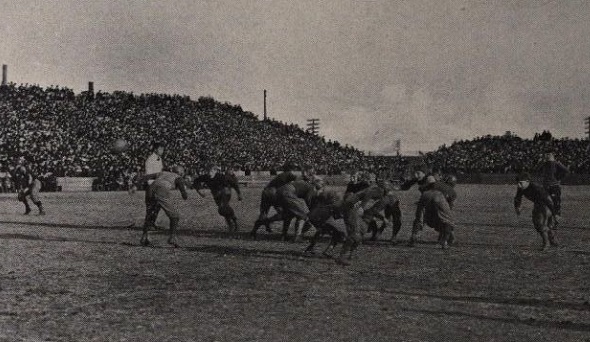
In an ironic twist, it was Roosevelt who saved the then-brutally violent game of football from itself more than 100 years ago. Yes, the same “Rough and Ready Teddy” who led the charge up San Juan Hill during the Spanish-American War and often sparred in the boxing ring while in office from 1901-09 opined that football was becoming so gruesome that he delivered an ultimatum: clean up the game or it would be outlawed.
The Chicago Tribune reported that in 1904 alone, there were 18 football deaths and 159 serious injuries, mostly among prep school players. Football deaths suffered by younger players were reported on a nearly weekly basis, as outraged citizens called on colleges and high schools to banish football outright.
In stepped Roosevelt, who called head coaches and representatives from Harvard, Yale and Princeton – college powers at the time – to the White House in 1905 urging them to eliminate excessive violence and set an example of fair play for the rest of the country. When the casualties actually rose by one during the ensuing season, Roosevelt reacted with greater resolve and convened leading football authorities for the purpose of authoring drastic rules changes. What emerged was an intercollegiate conference which was the predecessor of the NCAA.
Among the most effective changes for the 1906 season were the legalization of the forward pass, the elimination of mass formations, and the creation of a neutral zone. Football fatalities fell to 11 in each of the next two seasons, and severe injuries fell drastically.
Thanks to the introduction of protective equipment and ever-evolving rules changes, football during the 100-plus years to follow has become an exponentially safer game. Yet, the game’s leaders always will need to adjust and react to scrutiny that comes with the territory.
So, as the game once again undergoes rules modifications in the name of safety, give a tip of the cap to President Roosevelt while you enjoy college bowl season and the NFL playoffs and begin to think ahead to the first high school practice of 2014.
In 'Turn & Burn,' Kent III Gives Voice Again to Father's Life Lessons, Coaching Wisdom
By
Geoff Kimmerly
MHSAA.com senior editor
August 29, 2025
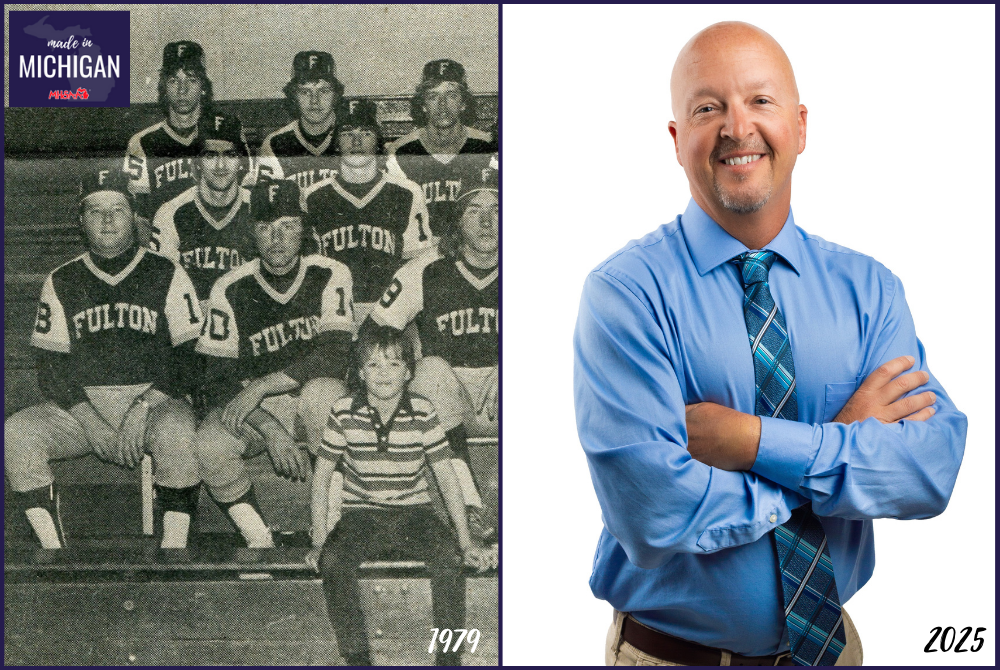
As his son, his player and during their time coaching together, Warren Kent III was front row for the words of wisdom often shared by his father Warren Kent Jr., who coached a multitude of sports at seven schools over more than three decades.
 But as the years have rolled on after his father’s death in 2017, Kent III began to realize something most disheartening – he’d forgotten the sound of his dad’s voice.
In an attempt to regain that memory, Kent III has given us all an opportunity to listen.
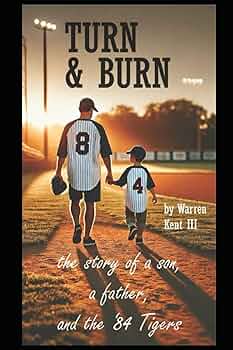
His book – “Turn & Burn” – is the story of a son growing to love baseball under the tutelage of his father, a teacher and coach of the local varsity. The seeds for that love of the game are planted during the summer of 1984 – coinciding with the Detroit Tigers’ most recent World Series championship season.
Technically, the story is fiction. But it’s set in Fulton Township, which lies just west of US-127 between St. Johns and Ithaca, where Kent Jr. was indeed a coach and Kent III grew up and attended Fulton High School. And all of the information on the Tigers’ historic run that season – including game-by-game synopses of all 162 plus eight in the playoffs – is true as well and easily will connect with fans who, like Kent III, grew up during that unforgettable summer.
“That was my thing. I wanted people to get the feelings I had with the ’84 Tigers and sharing that with my dad as I was growing up,” he said. “My outlet is writing, so this is really a catharsis, just to get this out there, to let other people know the love of the Tigers but more the love of my father and things we went through together.”
Kent III was five months old when the Tigers won their 1968 World Series championship, but 16 in 1984. He said his book is about 70 percent factual, but even the imagined is rooted in reality.
The main character in “Turn & Burn” – EJ – is 12 years old because that seemed a more reasonable age to fall in love with the sport, and by 16 Kent III was well into his baseball fandom. The father in the book is a teacher and coach. Kent Jr. was a special education teacher for more than four decades and his son’s baseball coach at Fulton High School but just for freshman year before moving into the stands for the remainder of Kent III’s four-year varsity career.
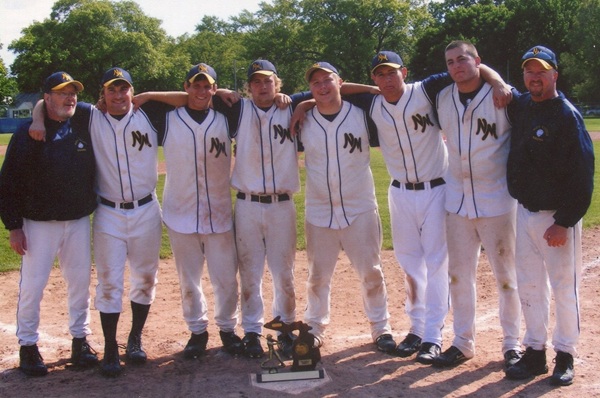
 Kent III began coaching baseball himself when he was 18 and served as North Muskegon’s varsity coach for 15 years, including 11 with Kent Jr. as his assistant. At one point in “Turn & Burn” players write EJ’s dad’s initials on their hands because he had been hospitalized after a heart attack; North Muskegon players did the same when Kent Jr. had a heart attack prior to a Pre-District game in 2005.
“Some of it’s been changed. Some of it’s been realistic,” Kent III said. “(But the dad) is definitely my dad’s voice.
“I put him in charge of the outfielders at North Muskegon, and that was his one motto – ‘Turn and burn.’ The kids could probably tell you that over and over, (that’s) the one thing Coach Kent would always say.”
A source of many of the fatherly pearls of wisdom found in “Turn & Burn” came from a journal-style “father’s legacy” book Kent III had purchased for his dad years before and asked him to fill out. Kent Jr. passed those on not only to his children but during a coaching run that took him to Hudsonville, Ashley, Fulton, Vestaburg, Blanchard Montabella and Greenville, where notably he led the football program to its first playoff appearance in 2000.
Writing has long been a love for Kent III, who taught English and journalism for 32 years – and served as a yearbook advisor for three decades – while at Battle Creek Central and then the final 27 years at Muskegon Mona Shores. Prior to becoming a teacher, Kent III was “Journalist of the Year” at Ferris State while sports editor of the student newspaper and then moved on to study and serve as sports editor of the paper at Michigan State.
He has written for the Big Rapids Pioneer, Lansing State Journal and Battle Creek Enquirer, among others over the years, and after retiring from teaching at Mona Shores this spring took a position with Walsworth Yearbooks helping schools all over the state with their yearbook programs.
 Kent III also is in his 34th year as an MHSAA registered official. He wrote a piece once for Referee Magazine about his experience officiating the 2011 Class D Girls Basketball Final at Breslin Center, home of his beloved Spartans. He’s more recently officiated Basketball Semifinals at Breslin during the 2023 and 2024 seasons and has returned to the baseball diamond as an umpire as well after umping baseball and softball earlier in his career.
Writing a book came to Kent III during the COVID-19 pandemic, as he like many searched for something to occupy spare time. “Turn & Burn” is available exclusively via Amazon; click for details.
The venture was never about making money, but he’s sold 152 books – well above his goal of 100. And while Kent III still has not come across any recordings or voicemails of his father’s voice, “Turn & Burn” has given him a chance to hear Kent Jr.’s words once again.
“The sound, no. But the things and the ways he would say them, yes,” Kent III said. “Everybody else says they can picture his voice. I think it’s because, I’m assuming being his son, my voice probably sounds familiar to his to other people, but I can hear the things he’s saying. And in that book, the way he’s saying them.”
2025 Made In Michigan
Aug. 5: After Answering Call, MCC's Caughey Finds Football Lessons Pay Off in Priesthood - Report
July 31: After Enjoying Pro Golf Stardom, Flynn Relishing Roles as Instructor, Sports Mom - Report
July 29: Marckel Supplies Marketing Magic to Hunter's Heisman-Winning Campaign - Report
July 28: Union City to Omaha: Skirka Takes Murray State Baseball to 1st College World Series - Report
July 22: TC West's Wheelock Still 'Living My Dreams' as CMU Assistant Soccer Coach - Report
July 17: Stevenson's Travels Following Lake Orion Success Include Space Force, Penn, NYC - Report
July 15: 'Who Will Cheer for the Nimrods?' Peterson IV, Watersmeet Found Fans Worldwide - Report
July 10: Feeding 'Drive to Win,' Loy Norrix Grad Morgan Impresses with Strong USBC Showing - Report
July 9: After Blazing Multiple Volleyball Trails, Bastianelli Charting Next Career Path - Report
PHOTOS (Top) At left, Warren Kent III sits in the front row of a team photo as manager for dad Warren Kent Jr.'s 1979 Fulton baseball team; Kent Jr. is sitting far left of second row from bottom. At right, Kent III today. (Middle) "Turn & Burn" is Kent III's first published book. (Below) The Kents anchor a photo with North Muskegon players and their District championship trophy in 2009. (Photos provided by Warren Kent III.)