

Thank Roosevelt for Football Weekends
December 20, 2013
By Rob Kaminski
MHSAA benchmarks editor
The next time you find yourself immersed in a tense crosstown football rivalry on a Friday night followed by a Saturday pilgrimage to the nearest college campus and a Sunday afternoon with a remote and your favorite snacks and beverages, take a moment to consider what the weekend would be like if it weren’t for Teddy Roosevelt.
The man who became our 26th President shortly after the turn of the 20th Century following the assassination of William McKinley in 1901 was a football fan like you. Maybe more so.
Today’s game of football has reached a critical crossroads. Player size and speed have increased across the board. Savage use of equipment as weapons rather than protective gear has been glorified on television networks and social media. Leaders of the game at all levels have recognized the need for change, employing new rules and widespread educational efforts to aid in preserving the sport.
History, as they say, is repeating itself.
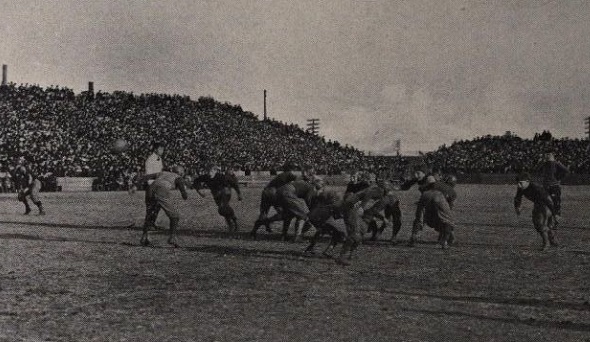
In an ironic twist, it was Roosevelt who saved the then-brutally violent game of football from itself more than 100 years ago. Yes, the same “Rough and Ready Teddy” who led the charge up San Juan Hill during the Spanish-American War and often sparred in the boxing ring while in office from 1901-09 opined that football was becoming so gruesome that he delivered an ultimatum: clean up the game or it would be outlawed.
The Chicago Tribune reported that in 1904 alone, there were 18 football deaths and 159 serious injuries, mostly among prep school players. Football deaths suffered by younger players were reported on a nearly weekly basis, as outraged citizens called on colleges and high schools to banish football outright.
In stepped Roosevelt, who called head coaches and representatives from Harvard, Yale and Princeton – college powers at the time – to the White House in 1905 urging them to eliminate excessive violence and set an example of fair play for the rest of the country. When the casualties actually rose by one during the ensuing season, Roosevelt reacted with greater resolve and convened leading football authorities for the purpose of authoring drastic rules changes. What emerged was an intercollegiate conference which was the predecessor of the NCAA.
Among the most effective changes for the 1906 season were the legalization of the forward pass, the elimination of mass formations, and the creation of a neutral zone. Football fatalities fell to 11 in each of the next two seasons, and severe injuries fell drastically.
Thanks to the introduction of protective equipment and ever-evolving rules changes, football during the 100-plus years to follow has become an exponentially safer game. Yet, the game’s leaders always will need to adjust and react to scrutiny that comes with the territory.
So, as the game once again undergoes rules modifications in the name of safety, give a tip of the cap to President Roosevelt while you enjoy college bowl season and the NFL playoffs and begin to think ahead to the first high school practice of 2014.
1st & Goal: 2025 Week 1 Preview
By
Geoff Kimmerly
MHSAA.com senior editor
August 27, 2025
If you’re looking for storylines for this weekend’s Michigan high school football openers, you’ve landed just in time for launch of the 2025 season.
 There will be 305 games played this weekend with at least one Michigan team – 258 tonight, 46 Friday and one Saturday. Several of the most intriguing will play out at traditional Week 1 showcase events – the Amazon Prep Kickoff Classic at Wayne State and Vehicle City Gridiron Classic at Flint’s Atwood Stadium – but those are just the start of the newsy and noteworthy.
This weekend’s slate also includes two matchups of teams that ended last season playing for MHSAA 11-player championships in Detroit, and a third between a reigning Michigan champion (Detroit Cass Tech in Division 1) and an Ohio state runner-up (Toledo Central Catholic). One of the state's longest running rivalries also gets a reboot.
The great majority of varsity games are scheduled to be broadcast this weekend on the NFHS Network. Click the names of the events bolded above for specific broadcast landing pages for those showcases.
Like most, we’re still at the start of learning about this season’s contenders. But every game has a story, and tune in each week for details building up the biggest matchups all over Michigan. All games are tonight unless noted, and follow the MHSAA Scores page all weekend for scores as they’re submitted.
Bay & Thumb
Frankenmuth (13-1) at Goodrich (13-1)
This is one of those matchups of teams that ended last season at Ford Field, as Goodrich is the reigning Division 4 champion and Frankenmuth finished Division 5 runner-up. This will actually be the fifth-straight season they’ll meet in an opener; Frankenmuth has a 3-1 advantage in the recent series coming off a 22-0 win a year ago. Both teams graduated substantial star power from their backfields and lines, likely making this a high-profile debut for several players expected to fill more significant roles at the varsity level this fall.
Keep an eye on these THURSDAY Marysville (8-2) at Almont (9-1), Mount Pleasant (6-5) at Saginaw Heritage (8-4). FRIDAY Marine City (10-3) at Armada (10-2), Cass City (7-4) at Harbor Beach (11-1).
Greater Detroit
Clarkston (7-4) vs. Belleville (10-2) at Wayne State
The post-Bryce Underwood era will begin at Belleville after he quarterbacked the team to Ford Field three of the last four seasons. He and the Tigers defeated Clarkston 35-28 in their opener a year ago at Wayne State, and Belleville’s only other loss of the season came in a Regional Final. Clarkston will attempt to avenge that 2024 defeat keyed in part by an offense that features power up front and a notable passing attack as well.
Keep an eye on these THURSDAY Walled Lake Western (11-1) at Milford (7-3), Davison (7-3) at Roseville (7-3). FRIDAY Warren Michigan Collegiate (9-2) at Clarkston Everest Collegiate (9-2), Detroit Cass Tech (12-2) vs. Toledo Central Catholic (14-2) at Wayne State.
Mid-Michigan
Haslett (8-4) at DeWitt (12-1)
These two combined for 111 points in their opener last season, a 69-42 DeWitt win, and the scoreboard should be ready again as both return playmakers considered among the best in the state – Haslett’s Kory Amachree and DeWitt’s Trav Moore. Both also are coming off nice playoff runs last fall – DeWitt reaching the Division 3 Semifinals and Haslett winning a Division 4 District championship – adding further anticipation to a rivalry renewed despite the Panthers’ dominance in the matchup over the last two decades.
Keep and eye on these THURSDAY Dexter (10-1) at Brighton (8-3), Lansing Catholic (10-4) at Williamston (3-7), Lansing Everett (6-4) at Lansing Sexton (5-5), Detroit Country Day (3-6) at Portland (11-1).
Northern Lower Peninsula
Maple City Glen Lake (9-2) at Traverse City St. Francis (7-4), Friday
These two are facing off for the first time since 2021, with the Lakers coming off their best season since a 2019 run to Ford Field and the Gladiators also looking to build on a District championship game appearance after most recently reaching the MHSAA Finals in 2022. They were both champions in the Northern Michigan Football League last fall – Glen Lake outright in the Legacy and St. Francis sharing the title in the Legends.
Keep an eye on these THURSDAY Howell (11-1) at Traverse City West (6-4), Midland (9-2) at Cadillac (4-6). FRIDAY Sault Ste. Marie (1-8) at Cheboygan (4-5), Edwardsburg (7-4) at McBain (9-2).
Southeast & Border
Fowler (12-1) at Hudson (10-2)
The Eagles won this season-opening matchup 20-6 a year ago and this time head to Hudson after ending last fall with a one-point Division 8 Semifinal loss to eventual champion Beal City. After losing to Fowler in Week 1 last season, Hudson didn’t fall again until its Division 7 Regional Final against Schoolcraft – which capped its longest playoff run since winning the Division 8 title in 2021.
Keep an eye on these THURSDAY Monroe St. Mary Catholic Central (13-1) vs. Clinton (7-4) at Adrian College, Ottawa Lake Whiteford (5-5) at Blissfield (4-6), Flushing (7-3) at Ann Arbor Pioneer (5-5), Jackson (4-6) at Parma Western (6-4).
Southwest Corridor
St. Joseph (9-2) at Niles (12-2), Friday
This is another season-opening rematch, and last year's game was referred to frequently – after St. Joseph's 30-7 win, Niles didn't lose again until falling to Goodrich in the Division 4 championship game. In fact, the Vikings gave up only 27 more points during the regular season. The Bears went on to enjoy a successful fall as well, sharing their league's championship before falling to eventual Division 3 champion Zeeland West in a District Final.
Keep an eye on these THURSDAY Kalamazoo Hackett Catholic Prep (9-3) at Berrien Springs (7-4), East Lansing (9-4) at Portage Central (8-4), Lawton (8-3) at Decatur (11-2), Union City (9-2) at Parchment (7-3).
Upper Peninsula
Marquette (6-3) at Negaunee (6-4)
This matchup of Upper Peninsula neighbors is a rivalry restored, resparking a series that goes back to 1894. These two faced off 141 times – still ranking third-highest for total games played between two Michigan teams – before taking a break after the 2017 meeting with Negaunee leading the series 70-60-11. The Miners have strung together six straight playoff seasons, while the Sentinels just missed the playoffs last year but finished second in the Big North Conference for the second season in a row.
Keep and eye on these THURSDAY Kingsford (9-1) at Escanaba (5-4), East Jordan (8-3) at Manistique (4-6), Houghton (4-5) at Iron Mountain (11-1). FRIDAY Menominee (10-2) at Marinette, Wis. (2-7).
West Michigan
Byron Center (12-2) at Hudsonville (12-2)
This is another matchup of teams that finished their 2024 playoff runs at Ford Field, Hudsonville runner-up in Division 1 and Byron Center in Division 2. Even with both graduating significant star power after last spring and turning to new quarterbacks this fall, this seems the perfect time for this matchup. Hudsonville's double-digit win total last year was its first since 2007, and Byron Center is a combined 22-4 over the last two seasons.
Keep an eye on these THURSDAY Grand Blanc (9-3) at Muskegon Mona Shores (9-2), Pewamo-Westphalia (9-3) at North Muskegon (11-2), Saline (7-4) at Rockford (7-3), Hudsonville Unity Christian (10-1) at Whitehall (8-4).
8-Player
Britton Deerfield (10-2) at Pittsford (8-3)
This was another of the most high-powered openers a year ago, as Britton Deerfield won 68-58 to kick off the program’s best season. The Patriots later advanced to the Semifinals for the first time with a 60-26 rematch win over the Wildcats, who otherwise claimed a league championship and lost just once more over the remainder of their season.
Keep an eye on these THURSDAY Climax-Scotts (8-2) at Gobles (9-1), Bridgman (5-4) at Martin (8-2), Powers North Central (9-2) at Munising (6-4), Mendon (10-2) at Suttons Bay (6-3).
MHSAA.com's weekly “1st & Goal” previews and reviews are powered by MI Student Aid, a division within the Department of Lifelong Education, Advancement, and Potential (MiLEAP). MI Student Aid encourages students to pursue postsecondary education by providing access to student financial resources and information. MI Student Aid administers the state’s scholarship and grant programs that help make college Accessible, Affordable and Attainable for you. Click to connect with MI Student Aid and find more information on Facebook and Twitter @mistudentaid.
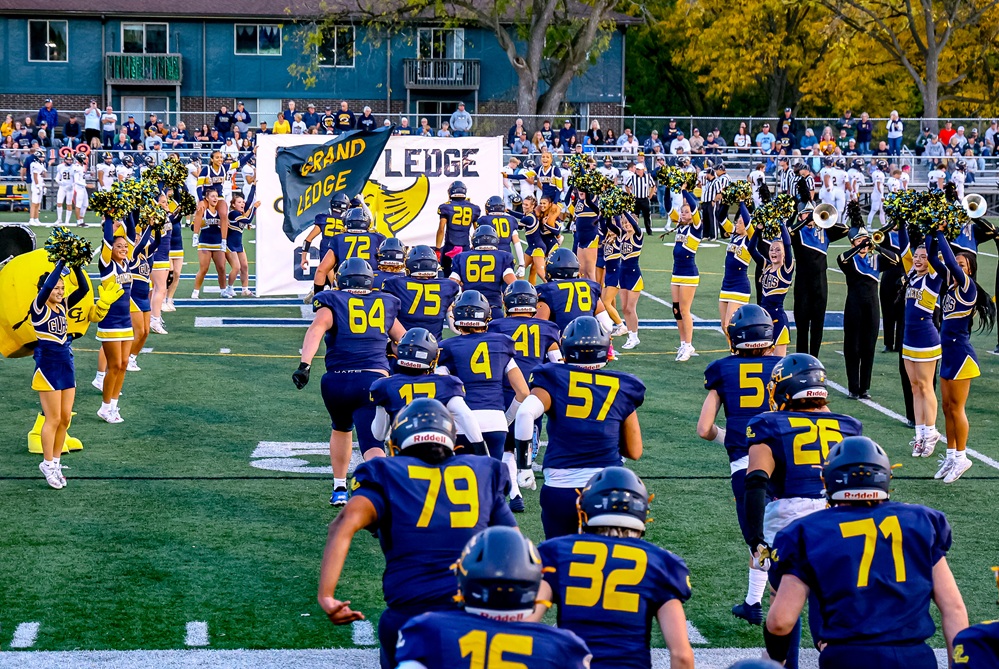
PHOTO Grand Ledge takes the field during a home game last season. (Click for more from High School Sports Scene.)