

Thank Roosevelt for Football Weekends
December 20, 2013
By Rob Kaminski
MHSAA benchmarks editor
The next time you find yourself immersed in a tense crosstown football rivalry on a Friday night followed by a Saturday pilgrimage to the nearest college campus and a Sunday afternoon with a remote and your favorite snacks and beverages, take a moment to consider what the weekend would be like if it weren’t for Teddy Roosevelt.
The man who became our 26th President shortly after the turn of the 20th Century following the assassination of William McKinley in 1901 was a football fan like you. Maybe more so.
Today’s game of football has reached a critical crossroads. Player size and speed have increased across the board. Savage use of equipment as weapons rather than protective gear has been glorified on television networks and social media. Leaders of the game at all levels have recognized the need for change, employing new rules and widespread educational efforts to aid in preserving the sport.
History, as they say, is repeating itself.
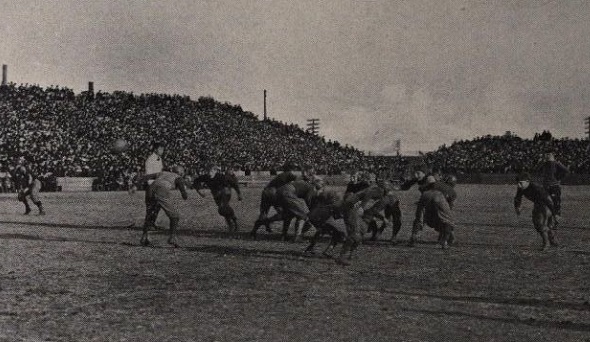
In an ironic twist, it was Roosevelt who saved the then-brutally violent game of football from itself more than 100 years ago. Yes, the same “Rough and Ready Teddy” who led the charge up San Juan Hill during the Spanish-American War and often sparred in the boxing ring while in office from 1901-09 opined that football was becoming so gruesome that he delivered an ultimatum: clean up the game or it would be outlawed.
The Chicago Tribune reported that in 1904 alone, there were 18 football deaths and 159 serious injuries, mostly among prep school players. Football deaths suffered by younger players were reported on a nearly weekly basis, as outraged citizens called on colleges and high schools to banish football outright.
In stepped Roosevelt, who called head coaches and representatives from Harvard, Yale and Princeton – college powers at the time – to the White House in 1905 urging them to eliminate excessive violence and set an example of fair play for the rest of the country. When the casualties actually rose by one during the ensuing season, Roosevelt reacted with greater resolve and convened leading football authorities for the purpose of authoring drastic rules changes. What emerged was an intercollegiate conference which was the predecessor of the NCAA.
Among the most effective changes for the 1906 season were the legalization of the forward pass, the elimination of mass formations, and the creation of a neutral zone. Football fatalities fell to 11 in each of the next two seasons, and severe injuries fell drastically.
Thanks to the introduction of protective equipment and ever-evolving rules changes, football during the 100-plus years to follow has become an exponentially safer game. Yet, the game’s leaders always will need to adjust and react to scrutiny that comes with the territory.
So, as the game once again undergoes rules modifications in the name of safety, give a tip of the cap to President Roosevelt while you enjoy college bowl season and the NFL playoffs and begin to think ahead to the first high school practice of 2014.
Memories Don't Fade for 1st MHSAA Class A Champion Franklin
By
Brad Emons
Special for MHSAA.com
November 8, 2024
Even after 50 years, Tim Hollandsworth recalls Livonia Franklin’s run to the first MHSAA Class A football playoff championship like it was yesterday.
Before 5,506 fans at Western Michigan University’s Waldo Stadium, the unranked Patriots capped a season for the ages by upending heavily favored Traverse City for the 1975 title, 21-7.
“It was a once in a lifetime event, and I guess it just brings back great feelings winning that game obviously,” said Hollandsworth, who went on to become an all-Mid-American Conference linebacker at Central Michigan. “What I remember most was carrying that trophy around on the field. Myself, Jim Casey and the whole team ... we paraded it out Stanley Cup-style in front of our fans, and everybody was going crazy. Just a happy time.”
The championship game was played on a frigid Nov. 22 afternoon in Kalamazoo, just 12 years following the assassination of President John F. Kennedy.
“When I think about that game, the first thing that comes to mind is that it was a cold, cloudy day before the game,” Hollandsworth said. “And as the game started, the sun came out; it was really bright. It turned out to be a bright, sunny day, and we didn’t feel the cold at all. The adrenalin was pumping.”
No. 2-ranked Traverse City, coached by Jim Ooley, entered with a high-powered offense averaging 34 points per game. The Trojans featured the running back tandem of Rick Waters (1,300 yards) and Bruce McLachlan, along with tight end Mark Brammer, a two-time All-American at Michigan State who later played five seasons for the Buffalo Bills in the NFL.
Franklin took a 7-0 lead in the first quarter when Dennis Smith, the holder on a 30-yard field goal attempt by Sam Williams, couldn’t secure the snap from center but alertly got up and tossed a 17-yard TD pass to Rick Lee.
The Patriots then went up 14-0 in the second quarter on a 3-yard TD run by Casey, who went on to play four seasons at Ball State as a defensive back.
Traverse City cut the deficit to 14-7 before halftime on a 2-yard TD run by McLachlan, but the Patriots put it away in the final quarter on a 9-yard TD run by Casey, who finished the game with a hard-earned 105 yards on 24 carries.
Hollandsworth, who also starred in the backfield with Casey, severely twisted his ankle in the first half and was limited to playing only defense for the remainder of the game. Fortunately for Franklin, Tom Smith took his place and helped continue the offensive surge.
 “It was just the fact that everybody was just stepping up when they had to have them,” Casey said. “I think it kind of exemplified everything we did throughout the year to get there. That’s what was so cool about the whole deal.”
Meanwhile, Waters – who later became Hollandsworth’s friend and teammate at CMU – led the Trojans’ rushing attack with 85 yards rushing on 19 carries.
Franklin’s defense played a pivotal role in the win with four interceptions – one each by Hollandsworth, Chuck Hench, Jerry Pollard and Casey (his 10th of the season).
Williams, the Patriots’ star tight end and middle linebacker and the son of former Detroit Lions “Fearsome Foursome” defensive end Sam Williams Sr., also batted down a key fourth-down pass in the end zone to thwart a Traverse City scoring threat.
“It’s funny about the whole game ... you forget about the details, it’s crazy,” Casey said. “It was everybody coming together. There may have been some mistakes along the way. That just happens during the game and we hung in there, did what it took to score enough points to win.”
The game was played on artificial turf, not real grass, which was also a first for both teams.
“I think it had been raining the day before ... anyhow, the field was soaked,” Casey said. “And all it takes is to fall on a field that is soaked on an Astroturf field and everything, and all your clothes are soaked. I remember in the first half – I couldn’t wait for halftime to go inside and warm up.”
During the practice week prior to the title game, the Patriots were able to get acclimated when athletic director and assistant coach George Lovich made a deal to practice on the University of Michigan’s artificial surface.
“We had to get new shoes because nobody had played on artificial turf in high school back then,” Casey said. “They had a bunch of used shoes from the (U-M) team. They threw them in a big old box and they let us practice one night on their Astroturf. We went in and got our shoes and we were ready to play – excited about that. It was just different compared to regular grass. It felt super-fast.”
With only four spots per Class up for grabs in the inaugural MHSAA playoffs, five unbeaten Class A teams did not make the postseason including Warren Fitzgerald and Mount Clemens Chippewa Valley from Region 1, Trenton in Region 3, and Grand Rapids Union and Marquette from Region 4.
On the final Saturday of the regular season at Eastern Michigan’s Rynearson Stadium, No. 1-ranked Birmingham Brother Rice (Region 2) was upset in the Catholic League championship, 7-0, by Dearborn Divine Child, which went on to claim the Class B title.
That allowed the 8-1 Patriots, who had lost to rival Livonia Stevenson 13-9 in Week 2, to sneak into the playoffs just ahead of the previously-unbeaten Warriors.
“We were all in the stands watching that game,” Hollandsworth said. “And our coach, Armand Vigna, had all our points figured out right to the point where he said if Brother Rice were to lose, we were in. So, we’re sitting in the stands and Detroit Southwestern is off to our right a little bit higher in the stands. When Divine Child won that game, we were just going crazy and you could see Southwestern wondering who we were and what was going on.”
During the build-up to the Class A Semifinal game against Franklin, Southwestern coach Joe Hoskins was quoted in the Detroit newspapers as saying, “Livonia who?”
Southwestern was led by all-state QB Mike Marshall (MSU), along with junior tackle Luis Sharpe (UCLA), an eventual first-round NFL pick who played 13 seasons with the St. Louis, Phoenix and Arizona Cardinals.
And in that Semifinal at Pontiac’s Wisner Stadium before 5,000 fans, Franklin upended the No. 3-ranked Prospectors, 12-9, as Casey ran for 145 yards on 27 carries. Hollandsworth added a 1-yard TD to cap a nine-play, 72-yard drive and give his team the lead 9-7 at the half.
Southwestern got an 18-yard TD pass from Marshall to Andrew Williams and scored on a two-point safety when the Patriots fumbled the kickoff to start the second half.
Williams, however, booted a pair of field goals, including the game-winning 28-yarder to break a 9-9 deadlock for the Patriots after they were aided by a pass interference call followed by an unsportsmanlike conduct penalty, which took the ball to the Southwestern 18.
In protest, Hoskins took his team off the field and had to be coaxed by MHSAA officials to bring his players back to finish the game.
“I think we were excited about the playoffs because we were undefeated the year before, so were looking forward to getting into the playoffs,” Hollandsworth said. “It was deflating when we lost; it was low-scoring, tough battle versus Stevenson. All the Livonia games (vs. Churchill and Bentley) were tough battles. It was the first game that Sam Williams was out. He got hurt in the (Dearborn) Fordson game before that (the opener) and Sam was not only our tight end, and starting middle linebacker, but he was also our punter and kicker. I think we passed up some field goals in that Stevenson game because we were so unsure of our kicking game.”
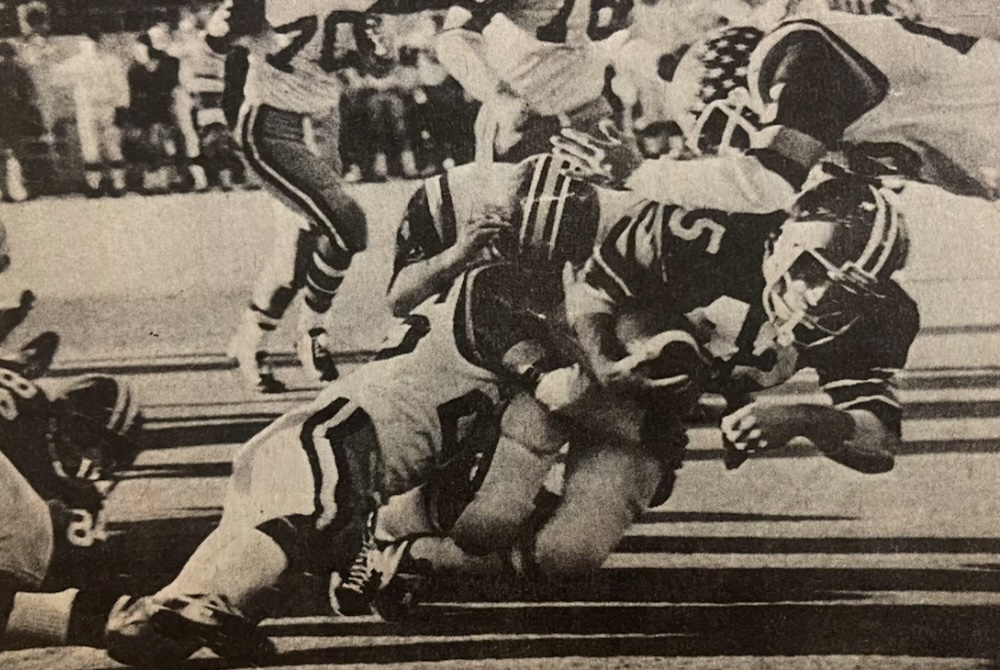
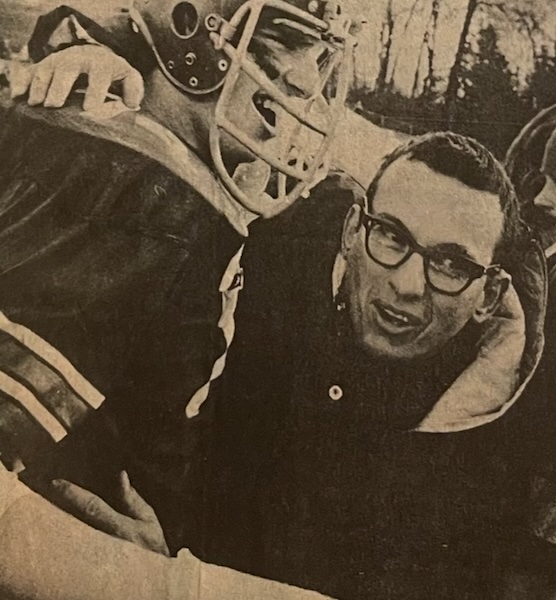
PHOTOS (Top) Livonia Franklin’s Jim Casey (45) plows ahead during the 1975 Class A Final as Traverse City tacklers converge. (Middle) Franklin coach Armand Vigna, right, shares an embrace with lineman Rick Kruger in the moments after their team’s championship victory. (Photos courtesy of Hometown Life, which includes the former Livonia Observer).