

Thank Roosevelt for Football Weekends
December 20, 2013
By Rob Kaminski
MHSAA benchmarks editor
The next time you find yourself immersed in a tense crosstown football rivalry on a Friday night followed by a Saturday pilgrimage to the nearest college campus and a Sunday afternoon with a remote and your favorite snacks and beverages, take a moment to consider what the weekend would be like if it weren’t for Teddy Roosevelt.
The man who became our 26th President shortly after the turn of the 20th Century following the assassination of William McKinley in 1901 was a football fan like you. Maybe more so.
Today’s game of football has reached a critical crossroads. Player size and speed have increased across the board. Savage use of equipment as weapons rather than protective gear has been glorified on television networks and social media. Leaders of the game at all levels have recognized the need for change, employing new rules and widespread educational efforts to aid in preserving the sport.
History, as they say, is repeating itself.
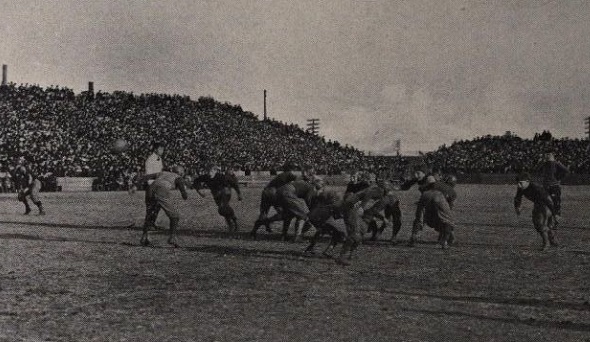
In an ironic twist, it was Roosevelt who saved the then-brutally violent game of football from itself more than 100 years ago. Yes, the same “Rough and Ready Teddy” who led the charge up San Juan Hill during the Spanish-American War and often sparred in the boxing ring while in office from 1901-09 opined that football was becoming so gruesome that he delivered an ultimatum: clean up the game or it would be outlawed.
The Chicago Tribune reported that in 1904 alone, there were 18 football deaths and 159 serious injuries, mostly among prep school players. Football deaths suffered by younger players were reported on a nearly weekly basis, as outraged citizens called on colleges and high schools to banish football outright.
In stepped Roosevelt, who called head coaches and representatives from Harvard, Yale and Princeton – college powers at the time – to the White House in 1905 urging them to eliminate excessive violence and set an example of fair play for the rest of the country. When the casualties actually rose by one during the ensuing season, Roosevelt reacted with greater resolve and convened leading football authorities for the purpose of authoring drastic rules changes. What emerged was an intercollegiate conference which was the predecessor of the NCAA.
Among the most effective changes for the 1906 season were the legalization of the forward pass, the elimination of mass formations, and the creation of a neutral zone. Football fatalities fell to 11 in each of the next two seasons, and severe injuries fell drastically.
Thanks to the introduction of protective equipment and ever-evolving rules changes, football during the 100-plus years to follow has become an exponentially safer game. Yet, the game’s leaders always will need to adjust and react to scrutiny that comes with the territory.
So, as the game once again undergoes rules modifications in the name of safety, give a tip of the cap to President Roosevelt while you enjoy college bowl season and the NFL playoffs and begin to think ahead to the first high school practice of 2014.
1st & Goal: 11-Player Finals Preview
By
Geoff Kimmerly
MHSAA.com senior editor
January 21, 2021
We made it.
This season’s “Drive for Detroit” – as we often call it – started in August, stopped, started again, and stopped again in November.
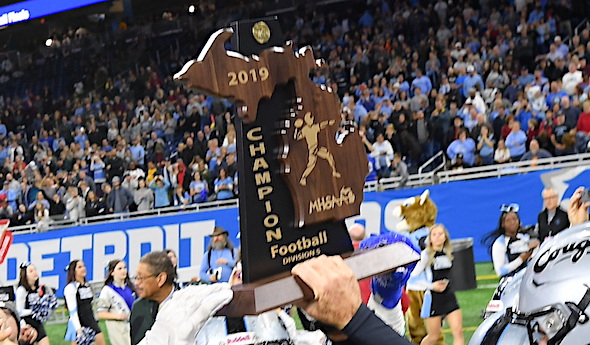
But we’ve arrived at Ford Field with eight 11-player championship games left to cap the longest, and certainly one of the most unforgettable seasons in MHSAA football history.
This weekend’s lineup includes four 2019 champions aiming to repeat, and seven contenders hoping to claim the state’s ultimate high school football prize for the first time.
Here’s the schedule:
FRIDAY
Division 8: Centreville (10-0) vs. Ubly (9-2), 10 a.m.
Division 2: Muskegon Mona Shores (11-0) vs. Warren De La Salle Collegiate (7-4), 1 p.m.
Division 6: Montague (11-0) vs. Clinton (10-1), 4:30 p.m.
Division 4: Cadillac (8-2) vs. Detroit Country Day (8-2), 7:30 p.m.
SATURDAY
Division 7: New Lothrop (10-0) vs. Traverse City St. Francis (9-2), 10 a.m.
Division 1: Davison (11-0) vs. West Bloomfield (10-1), 1 p.m.
Division 5: Grand Rapids Catholic Central (10-0) vs. Frankenmuth (11-0), 4:30 p.m.
Division 3: DeWitt (11-0) vs. River Rouge (9-1), 7:30 p.m.
Spectators remain limited for this weekend’s games at Ford Field. But all eight will be broadcast by FOX Sports Detroit – click for the full cable schedule plus more links to watch online and listen live.
Rankings below are derived from where teams finished the regular season in their divisions based on playoff point average. Teams that are “unranked” finished outside of the top 10.
 Division 1
DAVISON
Record/rank: 11-0, No. No. 10
Coach: Jake Weingartz, third season (30-5)
League finish: First in Saginaw Valley League Red
Championship history: Division 1 champion 2019.
Best wins: 27-3 over No. 6 Rockford in Semifinal, 47-6 (District opener) and 37-6 over Lapeer, 20-7 over Detroit Catholic Central in Regional Final, 48-19 (District Final) and 46-21 over Grand Blanc.
Players to watch: QB/DB Dion Brown Jr., 6-0/180, sr. (248 yards/3 TDs passing, 387 yards/4 TDs receiving); RB/DB Carter Cryderman, 5-11/195, sr. (848 yards/11 TDs rushing, 132 yards/1 TD receiving); WR/DB Payton Pizzala, 6-0/185, sr. (118 yards/ 1 TD receiving); TE/DE Harrison Unger, 6-2/235, sr.
Outlook: Reigning Division 1 champion Davison handed lone losses this season to Detroit Catholic Central and Rockford on its way back to Ford Field. Brown has been one of the heroes of the playoffs; with all-state QB Brendan Sullivan off to Northwestern as an early enrollee, Brown has moved over from leading receiver to guide the Cardinals to their best two wins of the season. Senior running back Te’Avion Warren is emerging as another postseason star – he ran for a team-high 30 times for a team-best 163 yards and a two scores against the Rams, giving him 506 yards and seven TDs rushing this season. Unger made the all-state first team and keys a defense giving up just 6.9 points per game – he’ll play at Air Force after high school. Cryderman on offense made the all-state second team, and Pizzala on defense earned honorable mention.
WEST BLOOMFIELD
Record/rank: 10-1, No. 9
Coach: Ron Bellamy, 11th season (77-40)
League finish: Second in Oakland Activities Association Red
Championship history: Division 1 runner-up 2017.
Best wins: 35-34 (2OT) over No. 3 Belleville in Semifinal, 63-6 over Sterling Heights Stevenson in District Final, 28-0 over Lake Orion.
Players to watch: RB Donovan Edwards, 5-11/195, sr.; RB/DB Dillon Tatum, 5-10/185, jr.; DB Maxwell Hairston, 6-0/175, sr.; DT Jaden Green, 6-0/265, sr. (Statistics not provided.)
Outlook: West Bloomfield handed both Stevenson and then Belleville their lone losses to reach this weekend, and after the Lakers had fallen in Regional Finals the last two seasons. Edwards, an all-state first teamer and Michigan recruit, is arguably the most electrifying running back in the state. The Lakers’ lone defeat came in Week 6, 24-21 in overtime to eventual OAA Red champion Clarkston – and after that game, West Bloomfield’s defense posted four straight shutouts. Hairston and Tatum both made the all-state second team as defensive backs, and Green earned an honorable mention on the line. Senior punter Sammy Lafata also earned an all-state honorable mention, averaging 37.5 yards per punt through the Regional Final. Hairston will play next at Kentucky, and senior safety Gavin Hardeman will play at Air Force.
 Division 2
MUSKEGON MONA SHORES
Record/rank: 11-0, No. 4
Coach: Matt Koziak, 10th season (83-29)
League finish: First in Ottawa-Kent Conference Green
Championship history: Division 2 champion 2019, runner-up 2018 and 2014.
Best wins: 43-30 over No. 9 Traverse City Central in Semifinal, 24-21 over No. 2 East Lansing in Regional Final, 28-25 over No. 8 Grand Rapids Forest Hills Central in District Semifinal, 35-21 over Detroit Martin Luther King, 21-14 over Division 3 No. 6 Muskegon.
Players to watch: QB/DB Brady Rose, 5-7/172, sr. (1,244 yards/20 TDs rushing, 985 yards/11 TDs passing); WR/DB Keondre Pierce, 5-11/175, sr.; TE/LB Karsen Marihugh, 5-11/236, sr.; OL/DL Mason Klos, 6-1/273, sr.
Outlook: Mona Shores won three playoff games by eight or fewer points and a fourth with a big comeback, which showed an impressive amount of resolve as the Sailors navigated one of the toughest paths to get to this weekend. Rose became an instant star taking over at quarterback for last season’s championship game and running for 90 yards and three touchdowns and throwing for 122 yards and a score. He made the all-state first team this season, Marihugh and Pierce made the second team, and Klos earned an honorable mention. Junior running back Elijah Johnson is another player to watch in the backfield – he’s run for 814 yards and 11 touchdowns.
WARREN DE LA SALLE COLLEGIATE
Record/rank: 7-4, unranked
Coach: Dan Rohn, first season (7-4)
League finish: Third in Detroit Catholic League Central
Championship history: Division 2 champions 2018, 2017 and 2014, runners-up up 2008 and 2006.
Best wins: 26-20 (OT) over Oak Park in Semifinal, 36-0 over No. 1 Port Huron in District Final, 45-3 over Warren Mott in Regional Final.
Players to watch: QB Brady Drogosh, 6-4/195, soph. (949 yards/9 TDs passing); QB/LB JC Ford, 5-9/175, sr. (484 yards/3 TDs rushing); RB/LB Brett Stanley, 5-8/180, sr. (699 yards/9 TDs rushing); WR Alton McCullum, 6-0/195, jr. (236 yards/2 TDs receiving). (Statistics through Regional Finals).
Outlook: After finishing 2-4 against a regular-season schedule that included three opponents that went 6-0 and a fourth 5-1 – and losing a pair of those games by a combined six points – De La Salle has put together a playoff run that included only one close game. Before the Semifinal, the Pilots had outscored their first four playoff opponents by a combined 172-23. Rohn previously led Grand Rapids West Catholic to Division 5 championships in 2010, 2013, 2014 and 2015 and is a combined 157-57 during his head coaching career. Stanley earned an all-state honorable mention this season.
 Division 3
DEWITT
Record/rank: 11-0, No. 2
Coach: Rob Zimmerman, 22nd season (221-45)
League finish: League did not keep standings because of shortened season.
Championship history: Finished runner-up five times (most recently 2013).
Best wins: 14-0 over No. 6 Muskegon in Semifinal, 43-0 over No. 5 Mason in District Final, 43-3 over Warren De La Salle Collegiate, 37-3 over Division 5 No. 4 Portland, 64-38 over Grand Ledge.
Players to watch: QB/DB Tyler Holtz, 5-11/195, jr. (2,219 yards/31 TDs passing, 3 TDs rushing); WR/DB Lukas Bresser, 6-3/180, sr. (612 yards/11 TDs receiving); WR/DB Thomas McIntosh, 6-5/200, jr. (707 yards/13 TDs receiving, 4 interceptions); RB/LB Andrew Debri, 5-11/215, sr. (312 yards/9 TDs rushing, 69 tackles/2 interceptions); QB/LB Grant Uyl, 5-11/210, sr. (56 tackles).
Outlook: DeWitt has made at least the Regional Finals the last five seasons and the Semifinals the last three, and last weekend’s Muskegon win avenged a seven-point Semifinal loss to the Big Reds in the same round in 2019. Zimmerman has led the program to double-digit wins 12 of the last 15 seasons and five of the six championship game trips. An offense scoring 45 points per game often gets the headlines, and for good reason. But the defense is giving up just five points per game and hasn’t allowed any since Stevensville Lakeshore put up six in the regular-season finale. Holtz, McIntosh and Debri all made the all-state first team, Debri at linebacker, with Bresser and Uyl earning honorable mentions.
RIVER ROUGE
Record/rank: 9-1, unranked
Coach: Corey Parker, 11th season (107-30)
League finish: Does not play in a league.
Championship history: Division 3 champion 2019, Division 5 runner-up 2015.
Best wins: 30-22 over No. 1 Chelsea in Semifinal, 33-30 over Detroit Martin Luther King in Regional Final, 38-20 over Riverview in District Semifinal, 40-21 over New Boston Huron in District Final.
Players to watch: QB Mareyohn Hrabowski, 6-4/214, sr.; DB Armorion Smith, 6-2/190, sr.; DL Pius Odjugo, 6-2/340, sr.; DL Davonte Miles, 6-5/280, jr.; OL Jalen Johnson, 6-2/310, sr. (Statistics not provided.)
Outlook: The reigning champion shut out five of six opponents during the regular season, with its only loss to eventual Division 2 Regional finalist East Lansing. Hrabowski starred in last season’s Division 3 championship game victory over Muskegon and can do damage running and passing; he made the all-state second team this fall. He works behind what might be the state’s most sizable offensive line, with the five starters averaging 6-foot-2 and 307 pounds. Johnson is one of that group and also made the all-state second team, and senior Chance Moore earned an honorable mention. Also earning accolades, Miles and Smith both made the all-state first team, while Odjugo made the second and senior receiver Tayshaun Massey-Johnson earned an honorable mention. Hrabowski will play next at Western Michigan, Smith at Cincinnati, Odjugo at Central Michigan, Johnson at Ball State and Moore at Morgan State.
 Division 4
CADILLAC
Record/rank: 8-2, unranked
Coach: Cody Mallory, sixth season (26-33)
League finish: Third in Big North Conference
Championship history: Has never played in an MHSAA Final.
Best wins: 28-26 over No. 1 Edwardsburg in Semifinal, 27-23 over Ada Forest Hills Eastern in Regional Final, 34-14 over Sault Ste. Marie in District Final.
Players to watch: QB/DB Aden Gurden, 6-0/170, jr. (945 yards/13 TDs rushing, 263 yards/1 TD passing); RB/LB Noah Cochrane, 5-11/180, sr. (540 yards/7 TDs rushing); RB/DB Collin Johnston, 5-9/180, jr. (243 yards/2 TDs rushing, 91 tackles); RB/DB Dan Gray, 5-11/160, sr. (61 tackles, 2 interceptions).
Outlook: It’s fair to say Cadillac stunned many who follow high school football with last week’s win over the offensively-powerful Eddies, but it’s hard to think of a better way for the Vikings to earn their first trip to the Finals. They’re enjoying an impressive turnaround – they were 1-8 only two seasons ago before improving to 7-5 in 2019. Their strength is defense, where Johnston and Gray earned all-state honorable mentions. Plenty of power running the ball helps on both sides, of course; the Vikings are rushing for 300 yards per game with four players scoring at least five times on the ground. Cadillac’s losses this season were to eventual Division 2 semifinalist Traverse City Central and also larger Traverse City West.
DETROIT COUNTRY DAY
Record/rank: 8-2, unranked
Coach: Dan MacLean, 23rd season (179-79)
League finish: Does not play in a league.
Championship history: Three MHSAA titles (most recent 1999), six runner-up finishes.
Best wins: 12-0 over No. 5 Williamston in Semifinal, 38-0 over No. 3 North Branch in Regional Final, 20-10 over No. 10 Madison Heights Lamphere in District Final, 21-14 (District Semifinal) and 10-0 over Pontiac Notre Dame Prep, 37-17 over Paw Paw.
Players to watch: TE/LB Billy Abdallah, 6-3/216, sr.; WR/DB Danny MacLean, 6-0/212, sr.; OL/DL Caleb Tiernan, 6-7/280, sr.; RB/DL Nick Wachol, 6-0/212, sr.; OL/DL Will Leggon, 6-3/290, sr.
Outlook: Country Day was able to get in only four regular-season games, but has surged through the postseason and looks to be in stride. The defense has been especially impressive, giving up a combined 36 points over five playoff games and bringing a two-game shutout streak into this weekend. Tiernan, who also will play next at Northwestern, made the all-state first team and plays on both sides of the ball, as does Leggon, who earned all-state honorable mention. Abdallah made the all-state second team and Danny MacLean and Wachol earned honorable mentions, all three for their work on defense as well. Senior Jacob Yarberry is an offensive playmaker of note; he’s the leading rusher and has scored five times on offense and once on a punt return. Junior quarterback Brandon Mann has run for six touchdowns and thrown for another.
 Division 5
GRAND RAPIDS CATHOLIC CENTRAL
Record/rank: 10-0, No. 1
Coach: Todd Kolster, ninth season (99-12)
League finish: First in O-K Gold
Championship history: Five MHSAA titles (most recent 2019), two runner-up finishes.
Best wins: 49-14 over No. 7 Freeland in Semifinal, 58-7 over Muskegon Oakridge in Regional Final, 41-6 over No. 10 Belding in District opener, 28-27 (OT) over Division 4 No. 4 Grand Rapids South Christian, 42-28 over Cedar Springs.
Players to watch: WR Jace Williams, 6-5/198, sr. (814 yards/19 TDs receiving); QB Joey Silveri, 6-0/205, jr. (1,839 yards/29 TDs passing, 7 TDs rushing); TB Nick Hollern, 5-9/195 sr. (1,057 yards/17 TDs rushing); SS Nolan Ziegler, 6-3/205, jr.; OL/DL Brady Redmer, 6-0/205, jr.
Outlook: The reigning Division 4 champion won three of the last four titles in that division and will look to add its first in Division 5. Only rival South Christian has come closer than 24 points of the Cougars this season, with 2019 Finals star Silveri putting up big numbers and Williams becoming one of the most prolific receivers in MHSAA history – his 19 touchdowns catches are tied for 15th most for one season and have come in just nine games (one win was a forfeit). He and Ziegler made the all-state first team, while Silveri made the second and Hollern and Redmer earned honorable mentions. Ziegler will continue next season at Notre Dame, and Williams will play at Miami (Ohio).
FRANKENMUTH
Record/rank: 11-0, No. 2
Coach: Phil Martin, eighth season (79-14)
League finish: First in Tri-Valley Conference East
Championship history: Has never played in an MHSAA Final.
Best wins: 31-7 over No. 6 Marine City in Regional Final, 31-7 over No. 9 Essexville Garber, 41-3 over No. 7 Freeland, 35-14 over Lansing Catholic in Semifinal.
Players to watch: QB Davin Reif, 5-8/170, sr. (842 yards/8 TDs passing, 963 yards/17 TDs rushing); RB Cole Lindow, 5-9/170, jr. (1,082 yards/14 TDs rushing); TE/DE Ethan Jacobs, 6-2/185, sr. (206 yards/2 TDs receiving, 49 tackles/9 sacks/2 interceptions); S Cole Jankowski, 6-1/175, jr. (6 interceptions); Kyle Main, 6-5/315, sr.
Outlook: Frankenmuth has played in seven Semifinals since making its first in 1987, and this time advanced to the season’s final weekend for the first time. Reif and Lindow combine to lead a rushing attack averaging 294 yards per game – but what jumps off the page perhaps more is the defense has allowed 302 rushing yards all season (on 267 carries). Passers haven’t fared much better; combined Frankenmuth yields just under 115 yards and 6.8 points per game. Main and Jacobs (as a punter) made the all-state first team, while Reif, Lindow and Jankowski earned honorable mentions. Seniors Konnor Roche and Ben Reinhert are two more to watch on defense – Roche leads the Eagles with 73 tackles and has 18 tackles for loss at linebacker, and Reinhert has 19 tackles for loss and 13 sacks from the other defensive end spot.
 Division 6
MONTAGUE
Record/rank: 11-0, No. 4
Coach: Patrick Collins, 17th season (158-45)
League finish: First in West Michigan Conference
Championship history: Division 6 champions 2009 and 2008, two runner-up finishes.
Best wins: 41-16 over No. 9 Montrose in Regional Final, 36-7 over No. 2 Muskegon Catholic Central in District Final, 50-7 over No. 6 Clare in District Semifinal, 34-31 (2OT) over Whitehall, 42-6 over Muskegon Oakridge.
Players to watch: QB/DB Drew Collins, 6-3/208, sr. (1,894 yards/22 TDs passing, 661 yards/16 TDs rushing); WR/DB/K Andrew Kooi, 5-9/170, jr. (426 yards/4 TDs passing, 362 yards/5 TDs receiving, 3 TDs rushing, 59-63 XP/2 FG); OL/DL Hayden McDonald, 6-3/285, jr. (65 tackles), OL/DL Walker Martin, 6-3/285, sr. (51 tackles)
Outlook: After missing the Finals by a one-point Semifinal defeat last season, Montague is back at championship weekend after finishing Division 6 runner-up in 2018. Drew Collins made the all-state first team and leads an attack that runs and passes to nearly equal yardage; he’s the second-leading rusher behind junior Dylan Everett (719 yards/16 TDs). The defense, minus the double-overtime win over Whitehall, gave up an average of only 6.9 points per game over its other 10. Martin and McDonald also made the all-state first team and start on both the offensive and defensive lines, and Montague also can rely on all-state first-team kicker Kooi. Also notable, Montague has intercepted 19 passes, with sophomore Izac Jarka picking off nine.
CLINTON
Record/rank: 10-1, No. 7
Coach: Jeremy Fielder, third season (27-5)
League finish: Second in Lenawee County Activities Association
Championship history: Division 6 runner-up in 2015 and 2013.
Best wins: 40-6 over No. 8 Constantine in Semifinal, 13-12 over No. 3 Warren Michigan Collegiate in Regional Final, 16-13 over No. 5 Blissfield in District Final, 21-14 over Hillsdale.
Players to watch: RB/LB Bradyn Lehman, 5-10/180, soph. (998 yards/11 TDs rushing); RB/LB Brayden Randolph, 5-11/180, sr. (843 yards/10 TDs rushing); RB/S Davey Campbell, 5-8/160, sr. (674 yards/8 TDs rushing); OL/DL Tyler Bowles, 6-0/280, sr.
Outlook: Clinton’s return to Ford Field included the rematch win over Blissfield, which won their first meeting 28-14 to eventually decide the league title. Another tough-running offense has allowed Clinton to earn a few postseason championships, however. In addition to Lehman, Randolph and Campbell, junior George Ames has rushed for 852 yards and 11 scores as the team has 3,885 yards and 54 touchdowns running the ball (and has thrown only 28 passes). Randolph made the all-state first team at linebacker, while Bowles made the second team and Campbell earned honorable mention also on defense. Junior kicker Jonathan Baughey earned an all-state honorable mention as well, making 36 of 42 extra points and a field goal so far this season.
 Division 7
NEW LOTHROP
Record/rank: 10-0, No. 2
Coach: Clint Galvas, 13th season (128-15)
League finish: First in Mid-Michigan Activities Conference
Championship history: Division 7 champion 2018, Division 8 champion 2006.
Best wins: 36-21 over No. 6 Schoolcraft in Semifinal, 41-7 over No. 1 Detroit Loyola in Regional Final, 44-15 over Division 6 No. 9 Montrose, 49-6 over Durand.
Players to watch: QB/DL Cam Orr, 6-4/230, sr. (1,882 yards/27 TDs passing, 730 yards/18 TDs rushing); RB/DB Will Muron, 5-11/180, sr. (798 yards/8 TDs rushing, 603 yards/10 TDs receiving, 3 TDs on special teams); RB/LB Julius Garza, 6-0/180, sr. (209 yards/2 TDs rushing, 431 yards/7 TDs receiving); OL/DL Will Taylor, 6-3/250, sr. (Garza’s stats are through the Regional Final only.)
Outlook: After seeing last season end with a one-point Regional Final loss to eventual champion Pewamo-Westphalia, New Lothrop has stormed back winning all of its games by at least two touchdowns. The Hornets have won 26 of their last 27 games, going back to the start of that last championship playoff run. Orr sets the pace for an offense averaging nearly 49 points per game, although he made the all-state first team as a lineman for a defense giving up 9.2 points per contest. Muron was the offensive star of the Semifinal win, and he also made the all-state first team on defense. He’s also returned a kickoff and two punts for scores. Taylor was named to the all-state second team, and Garza earned an honorable mention.
TRAVERSE CITY ST. FRANCIS
Record/rank: 9-2, unranked
Coach: Josh Sellers, 11th season (120-17)
League finish: First in Northern Michigan Football Conference Legends
Championship history: Six MHSAA titles (most recent 2009), three runner-up finishes.
Best wins: 13-12 over Cass City in Semifinal, 44-32 over Charlevoix in District Final, 21-20 over Jackson Lumen Christi, 42-20 over Grayling.
Players to watch: RB/DB Owen Mueller, 5-9/178, sr. (565 yards/5 TDs rushing); RB/DT Aidan Schmuckal, 6-0/205, sr. (483 yards/11 TDs rushing); OL/DL/K Bryce Kempf, 6-3/220, jr. (35-35 XP/1 FG); OL/DE Casey Donahue, 6-3/210, sr. (Schmuckal and Kempf’s stats through Regional Final only.)
Outlook: The Gladiators are back at Ford Field for the first time since that last title run but after making the Semifinals four times over the last nine seasons. Sellers was coach for the 2003 and 2005 championships teams; he left to coach in Tennessee after the 2007 season but took St. Francis’ program back over in 2015. There’s some interesting history to this Finals matchup; St. Francis in 2018 gave the Hornets their only regular-season loss of the last four years. The offense has a number of contributors, and the running attack has gained more than 2,200 yards over 10 games on the field. Donahue made the all-state first team, while Schmuckal on defense and Kempf as a kicker earned honorable mentions.
 Division 8
CENTREVILLE
Record/rank: 10-0, No. 7
Coach: Jerry Schultz, first season (10-0)
League finish: First in Southwest 10 Conference
Championship history: Has never played in an MHSAA Final.
Best wins: 8-0 over Sand Creek in Regional Final, 32-14 over Reading in District Final, 16-0 (District Semifinal) and 14-8 over White Pigeon, 36-0 over Mendon.
Players to watch: WR/DB Tristan McElroy, 6-1/160, sr. (299 yards/4 TDs receiving, 5 interceptions); RB/OLB Gunner Bunning, 5-8/150, sr. (268 yards/4 TDs rushing); QB/FS Sam Todd, 6-1/185, sr. (438 yards/7 TDs passing, 1,005 yards/13 TDs rushing); FB/DE Jared Spencer, 6-3/195, sr. (399 yards/4 TDs rushing).
Outlook: Centreville is a combined 25-6 over the last three seasons after a run of nine straight finishing below .500. Schultz took over the program this fall after serving as defensive coordinator at Niles for four seasons, and has brought Centreville not only to its first championship game but also delivered its first Regional Final and Semifinal trips. While no opponent finished among the top 10 in its division in playoff point average, Sand Creek, Reading and Mendon all finished between Nos. 11-15 in Division 8. Todd earned an all-state honorable mention at quarterback, while the defense has given up a Michigan high school-best 3.2 points per game (credit to the Kalamazoo Gazette’s Patrick Nothaft for that research).
UBLY
Record/rank: 9-2, unranked
Coach: Eric Sweeney, first season (9-2)
League finish: Third in Greater Thumb Conference East
Championship history: Division 7 runner-up 2008.
Best wins: 43-0 over Johannesburg-Lewiston in Semifinal, 42-0 over Flint Beecher in District Final, 36-6 over Carson City-Crystal in Regional Final, 20-14 (OT) over Unionville-Sebewaing in District Semifinal.
Players to watch: RB/LB Carson Heleski, 6-1/190, sr. (1,135 yards/20 TDs rushing); RB/DT Colin Oberski, 6-1/180, jr. (565 yards/8 TDs rushing); RB/S Logan Mueller, 6-1/165, jr. (676 yards/6 TDs rushing); QB/S Evan Peruski, 5-11/165, fr. (238 yards/2 TDs passing, 498 yards/8 TDs rushing). (Statistics through Regional Final only.)
Outlook: Sweeney moved up after two seasons leading the junior varsity and has Ubly headed to Ford Field for the first time in more than a decade, and after the Bearcats missed the Finals last season by a one-point Semifinal loss. They finished 13th in Division 8 in playoff-point average after early losses to Harbor Beach and Sandusky. While the offense is certainly impressive, especially running the ball – Ubly averaged 306 yards rushing per game over its first 10 – the defense shut out a Johannesburg-Lewiston team that was averaging 44 points per game and a Beecher team that was scoring 32 points per contest. Heleski earned an all-state honorable mention, and you’ll certainly hear more about Peruski, the rare freshman starting quarterback to bring his team this far.