

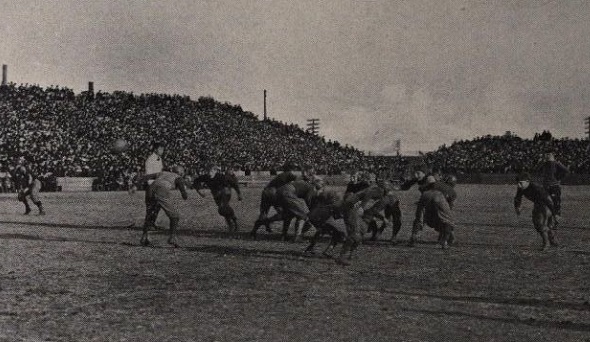
Thank Roosevelt for Football Weekends
December 20, 2013
By Rob Kaminski
MHSAA benchmarks editor
The next time you find yourself immersed in a tense crosstown football rivalry on a Friday night followed by a Saturday pilgrimage to the nearest college campus and a Sunday afternoon with a remote and your favorite snacks and beverages, take a moment to consider what the weekend would be like if it weren’t for Teddy Roosevelt.
The man who became our 26th President shortly after the turn of the 20th Century following the assassination of William McKinley in 1901 was a football fan like you. Maybe more so.
Today’s game of football has reached a critical crossroads. Player size and speed have increased across the board. Savage use of equipment as weapons rather than protective gear has been glorified on television networks and social media. Leaders of the game at all levels have recognized the need for change, employing new rules and widespread educational efforts to aid in preserving the sport.
History, as they say, is repeating itself.
In an ironic twist, it was Roosevelt who saved the then-brutally violent game of football from itself more than 100 years ago. Yes, the same “Rough and Ready Teddy” who led the charge up San Juan Hill during the Spanish-American War and often sparred in the boxing ring while in office from 1901-09 opined that football was becoming so gruesome that he delivered an ultimatum: clean up the game or it would be outlawed.
The Chicago Tribune reported that in 1904 alone, there were 18 football deaths and 159 serious injuries, mostly among prep school players. Football deaths suffered by younger players were reported on a nearly weekly basis, as outraged citizens called on colleges and high schools to banish football outright.
In stepped Roosevelt, who called head coaches and representatives from Harvard, Yale and Princeton – college powers at the time – to the White House in 1905 urging them to eliminate excessive violence and set an example of fair play for the rest of the country. When the casualties actually rose by one during the ensuing season, Roosevelt reacted with greater resolve and convened leading football authorities for the purpose of authoring drastic rules changes. What emerged was an intercollegiate conference which was the predecessor of the NCAA.
Among the most effective changes for the 1906 season were the legalization of the forward pass, the elimination of mass formations, and the creation of a neutral zone. Football fatalities fell to 11 in each of the next two seasons, and severe injuries fell drastically.
Thanks to the introduction of protective equipment and ever-evolving rules changes, football during the 100-plus years to follow has become an exponentially safer game. Yet, the game’s leaders always will need to adjust and react to scrutiny that comes with the territory.
So, as the game once again undergoes rules modifications in the name of safety, give a tip of the cap to President Roosevelt while you enjoy college bowl season and the NFL playoffs and begin to think ahead to the first high school practice of 2014.

NFHS Voice: Fall Fridays for HS Football
October 28, 2019
By Karissa Niehoff
NFHS Executive Director
Some of the top football matchups featuring Ohio teams Friday, Oct. 18, were Mentor vs. Shaker Heights, Cleveland St. Ignatius vs. Cincinnati Archbishop Moeller, Cincinnati St. Xavier vs. Massillon Washington and Northwestern vs. Ohio State.
That’s correct, Northwestern University vs. Ohio State University, on Friday night. While the game was in Evanston, Illinois, and not Columbus, it was televised on the Big Ten Network. Ohio State, one of the nation’s top-ranked college teams with one of the strongest fan bases, played on Friday night in direct competition with the several hundred high school games across the state.
And that wasn’t the only college football game on Friday night. There were three other FBS (I-A) matchups, including an Atlantic Coast Conference game between Pittsburgh and Syracuse. Through the first eight weeks of the season, there have been about 25 major college football games on Friday night.
A number of high schools in Ohio moved their games earlier in the hope of finishing before the start of the Ohio State-Northwestern game. Others moved their games to Thursday or Saturday. At least one school – Ursuline Academy in greater Cincinnati – urged its fans to not watch the Ohio State game:
“Please make a statement to Ohio State by NOT watching their Friday night game this week. Friday nights are for HS football. Let’s keep it that way. Support your local team. We play Boardman, and would love to have you in our stands, but that’s not the point. Support HS football.”
High schools should not have to adjust their schedules to accommodate colleges playing on Friday nights. High school coaches, administrators and fans are opposed to colleges playing on Friday nights. The NFHS and its member state associations are opposed. Even leaders in the Ohio State administration did not initially support the idea of the Buckeyes playing on Friday night. Friday nights are for high school football and should remain that way.
Two years ago, the NFHS membership adopted the following resolution:
“Be it RESOLVED that every Friday night during the fall in America is ‘High School Football Night.’
“Be it FURTHER RESOLVED that college and professional football teams should refrain from scheduling contests on Friday nights. Such restraint would be an investment in their own future success. It would also demonstrate that high school football has value well beyond the field of play. Schools, communities and scholastic teams for girls and boys all benefit when football is strong.
“THEREFORE, the National Federation of State High School Associations urges all parties to observe the central premise of this resolution.”
In addition to the Big Ten Conference, teams in the Pac-12, Mountain West, Atlantic Coast and American conferences, as well as Conference USA, have played on Friday nights. When these current television contracts expire, it is the desire of everyone within the high school community that new deals would preserve Friday nights for high school football.
Friday nights offer communities a traditional time and place to congregate and support their students. As was the case last week in Ohio, a college game on Friday night impacts interest and attendance at high school games.
Let’s maintain Friday nights in the fall for high school football. It is a win-win for everyone.
Dr. Karissa L. Niehoff is in her second year as executive director of the National Federation of State High School Associations (NFHS) in Indianapolis, Indiana. She is the first female to head the national leadership organization for high school athletics and performing arts activities and the sixth full-time executive director of the NFHS, which celebrated its 100th year of service during the 2018-19 school year. She previously was executive director of the Connecticut Association of Schools-Connecticut Interscholastic Athletic Conference for seven years.