

Together, Unity Earns 1st Championship
November 24, 2018
By Geoff Kimmerly
Second Half editor
DETROIT – Hudsonville Unity Christian’s varsity carried 22 players during the regular season.
The Crusaders had six on the playoff roster who weighed more than 200 pounds – and one who weighed more than 210.
And talk about small, Unity is by far the smallest school in an Ottawa-Kent Conference Green that sent four teams to the playoffs and champion Zeeland East to the Division 3 Semifinals.
So before Saturday’s Division 5 Final at Ford Field, coach Craig Tibbe reminded his now 47 players (including moved-up freshmen and sophomores) they hadn’t been picked to make it this far – and probably weren’t the choice to win this game.
But the Crusaders absolutely belonged in their first MHSAA Football Final – and deserved to hoist their first championship trophy in this sport after handing Portland its first and only defeat this fall, 42-7 in a game Unity controlled from just about the opening kickoff.
“We’re not supposed to win. But our coaches put a gameplan in for us to win,” Crusaders senior defensive back Noah Wiswary said. “And every week, we go to practice and we can’t hit because we only have 20 guys that can play, so we can’t hurt each other. But we work on our gameplan. We know what we’ve got to do to get to our spots. And we do what we’re supposed to do.”
As noted, the championship was the first in football for Unity Christian, which has had great success in other sports, especially soccer, where the Crusaders girls have won 10 MHSAA titles and the boys have won five.
The football program got its start only in 2003, with this season’s 12-2 finish setting a record for wins and also including the Crusaders’ second trip to the Semifinals after they first advanced that far two years ago.
 Tibbe’s pregame challenge ran parallel with the pep talks offered throughout a playoff run that might have been the toughest road of any team in any division over the last five weeks.
Unity Christian – which was ranked No. 10 in Division 4 by The Associated Press during the regular season before slotting in Division 5 for the playoffs – downed reigning Division 5 champion Grand Rapids West Catholic and four teams ranked among the top six in the division. In addition to No. 2 Portland (13-1), the Crusaders eliminated No. 1 Saginaw Swan Valley in the Semifinal, No. 4 Kalamazoo United in the Regional Final and No. 6 Muskegon Oakridge in the District Final.
Against Oakridge, Unity Christian trailed by 27 before charging back for a 40-37 win. Like Portland, Kalamazoo United and Swan Valley also were undefeated before Unity dealt them their only loss.
“They’ve done that each week. They’ve pulled for each other,” said Tibbe, who has led the program since its start. “I’m proud of what they’ve become as a group of guys.
“Part of that comes from we have to battle all the way through the teams we’re playing each game of the season, (and) low numbers, but they learn to fight. And I thought they did a nice job again today.”
It didn’t take long to get rolling. Both Unity and Portland boasted strong running attacks this fall – what they planned to do Saturday was no secret. But the Crusaders built a 28-0 lead five minutes into the second quarter having rushed for 173 yards while allowing the Raiders only one first down to that point.
The Crusaders ran for 279 yards on 50 carries total, with junior quarterback Isaac TeSlaa rushing for 97 yards and two touchdowns and also competing 3 of 4 passes for 70 yards and a score to senior TJ VanKoevering. Junior Hayden Large and seniors Max Buikema and Mason Odehal also ran for touchdowns.
The defense – led by junior defensive back Nick Tibbe’s nine tackles – pitched a shutout as Portland’s only points came on senior Jacob Veale’s 91-yard kickoff return touchdown with four minute to play in the third quarter.
Portland ran for more than 3,000 yards over their first 13 games, but for only 95 on 29 carries Saturday. Senior defensive back Hunter Hohman led the defense with 10 tackles and a forced fumble.
“Obviously we got beat up a little bit up front, both sides of the ball,” Portland coach John Novara said. “Their offensive and defensive lines played great. They’re a super athletic football team, and they’ve just got athletes all over the place … probably the most athletic football team we’ve played all season. We don’t get (shut down) too many times, but they did it to us today.”
Portland did tie its program record with 13 wins this fall, its fourth straight with double-digit victories. The playoff run was the Raiders’ longest since they won their first title in 2012.
“It’s still kinda surreal that we’re here. We had to replace a ton from last year. We had no skill kids coming back, and the kids really stepped up,” Novara said. “We started out really slow this season. … (But) I think we made a great playoff run. I know we were 13-0, but we got a ton better during the playoffs.”
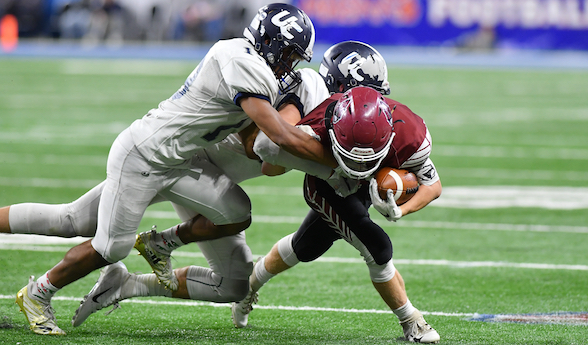
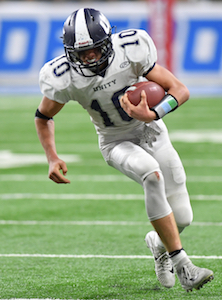
PHOTOS: (Top) A pair of Unity Christian defenders make a tackle during Saturday’s Division 5 Final at Ford Field. (Middle) Crusaders quarterback Isaac TeSlaa braces for contact.
Friday's Game-Winner Latest, Greatest Highlight for Adrian Kicker Hassan
By
Doug Donnelly
Special for MHSAA.com
September 30, 2025
When Zack Hassan was a freshman, he decided to play two sports at Adrian High School – soccer and football.
 Because he was a soccer player, the Maples’ football coaches decided he would be a good candidate to be a kicker.
“I had never really kicked a football before, but they thought I could because I played soccer,” Hassan said. “I thought, ‘Sure, why not?’”
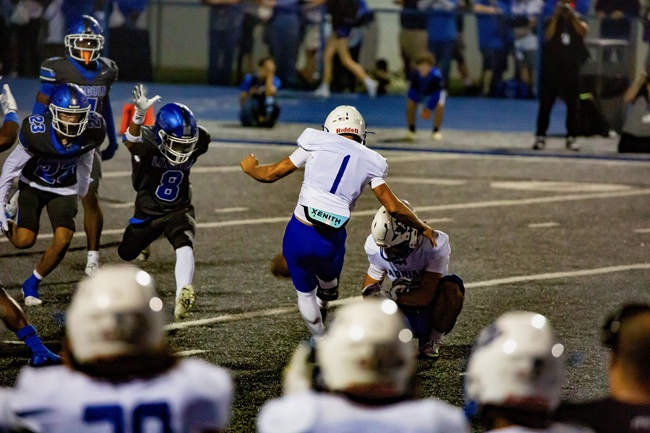
Fast forward four years and Hassan is no longer a soccer player. He not only is the Adrian kicker – he is eying a college football scholarship and Friday had the biggest moment of his career when he booted a 37-yard field goal as time expired to give Adrian its biggest football win in years.
“I love the pressure moments,” Hassan said. “I like having all of the eyes on me and going out there and kicking.”
Hassan also played receiver and defensive back the last couple of years, but is focused entirely on kicking this season because of a knee injury suffered toward the end of basketball season. He’s delayed surgery because he didn’t want to miss his senior year of football.
“I could have played receiver this season, but I wanted to be safe,” Hassan said. “I had a choice. I could have had surgery before the season or in the middle, but I just wanted to finish out my last year.”
The injured knee part of his kicking leg – but that’s probably for the best if he had to be injured at all.
“As a kicker its almost better because I don’t have to worry about planting,” he said. “That would be constant impact on it. It’s not super bad. I think I will recover quickly. I should be 100 percent by April or May. I should probably try to save the leg, but I enjoy kicking. I like to kick as much as possible in practice.”
Hassan handles all placekicking duties for Adrian, but doesn’t punt. Maples coach Joel Przygodski said Hassan would make a good punter, though.
“He has a strong leg,” he said. “He regularly kicks off to the 10-yard line. It’s a nice weapon to have.”
Hassan’s family moved to Adrian from Sylvania, Ohio, when he was in middle school.
“When I was growing up, I thought I was going to be a basketball player,” he said.
After he joined the varsity football team as a freshman, he decided he liked kicking.
“After freshman year I thought maybe I could get some free tuition out of this,” he said.
 He’s made two college visits already – to Baldwin Wallace in Ohio and Macalester College in Saint Paul, Minn., which has offered him a scholarship. He’s headed back to Macalester in a few weeks to check out what it’s like on game day.
“They are a very good school to get an education,” said Hassan, who has a grade point average above 4.0.
Hassan’s siblings stayed on the soccer route. His older sister was a college goalkeeper and his younger sister plays soccer for Adrian.
On Friday, Adrian was locked in a 0-0 tie with unbeaten Ypsilanti Lincoln. In the fourth quarter the two teams exchanged punts, swapping field position. Adrian got the ball back with fewer than 40 seconds left.
“As coaches, we talked about whether or not we wanted to play it safe, play for overtime,” Przygodski said.
After an incomplete pass on first down, running back Luke Bruggeman carried the ball up the middle and broke a tackle to put the ball past midfield. He even got out of bounds to stop the clock.
“I was thinking, okay, we are in business,” Przygodski said.
After quarterback Jaxon Dowling connected with receiver Adam Parker to reach the Lincoln 25-yard line, Przygodski knew the Maples had a chance. Hassan was warming up.
“We were telling him to be ready,” Przygodski said.
Hassan had missed two field goals earlier in the game. One of those attempts was from 48 yards out.
“My coaches just told me to get ready and told everyone else to stay away from me,” Hassan said.
With less than 1.5 seconds to play, Adrian reached the 20-yard line and called timeout. Hassan trotted out onto the field. The snap was a little slower than he was used to, he said, but he lined up perfectly and hit the 37-yarder, sending the Maples into a frenzy and stunning the home crowd of about 3,000 people at Lincoln’s homecoming.
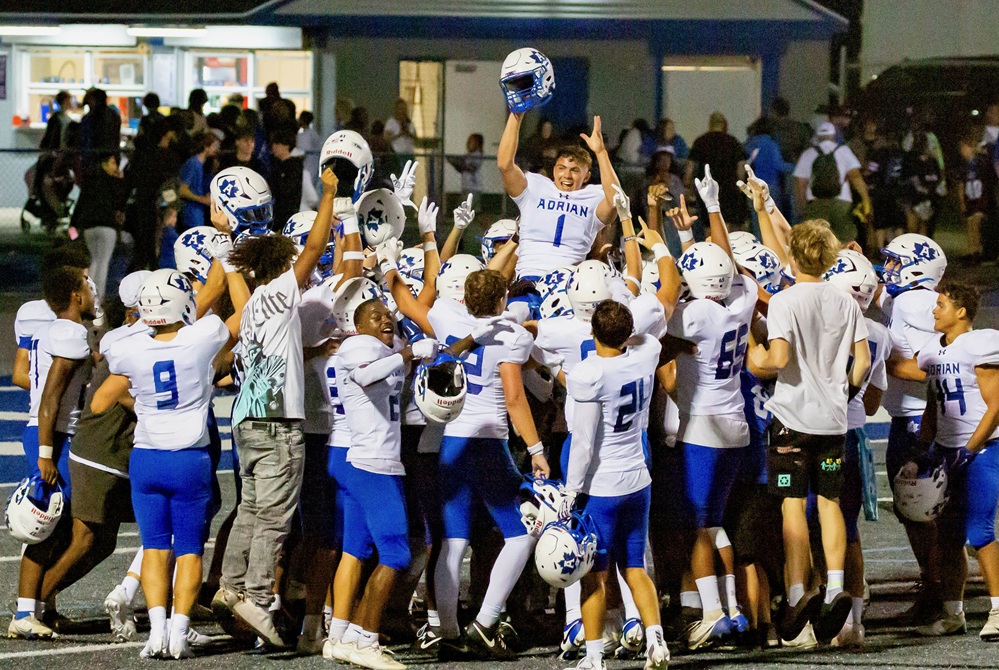
Hassan was carried off the field by teammates – and not because of an injury.
“After we shook hands, we went into huddle and everyone was like, ‘Lift him up, lift him up,’” he said.
The win was a big one for Adrian, which continues to make strides under Przygodski’s leadership. Adrian is 4-1 with chief rival Tecumseh coming up this week. The Maples have a lot of momentum for the rest of the season.
“Going into the season we were really unsure how we were going to be, because we lost a lot of seniors last year,” Hassan said. “It’s good. We’ve had a lot of people step up. We are turning a lot of eyes right now.”
 Doug Donnelly has served as a news and sports reporter at the Adrian Daily Telegram and the Monroe News for 30 years, including 10 years as city editor in Monroe. He's written a book on high school basketball in Monroe County and compiles record books for various schools in southeast Michigan. He is now publisher and editor of The Blissfield Advance, a weekly newspaper. E-mail him at [email protected] with story ideas for Jackson, Washtenaw, Hillsdale, Lenawee and Monroe counties.
PHOTOS (Top) Adrian kicker Zack Hassan is carried by his teammates after making the game-winning field goal Friday against Ypsilanti Lincoln. (Middle) Hassan steps into his winning kick. (Photos by Marnette Sutherland.)