

Transformed Shores Continues to Rise
September 8, 2015
By Tom Kendra
Special for Second Half
This is not your father’s Muskegon Mona Shores football team.
Or even your older brother’s.
 This is not the team that went its first 51 years of football without making the MHSAA playoffs and whose only traffic jams leaving its parking lot occurred early in the third quarter – when the band was done performing.
Heading into one of the state’s marquee Week 3 matchups at home against perennial Division 1 powerhouse Rockford, Shores is looking to snap a 10-game losing streak against the Rams, which has included some forgettable affairs like a 49-7 loss in 2000 and 10-7 loss last fall, the Sailors’ lone regular-season defeat.
“Great job tonight,” Mona Shores coach Matt Koziak told his huddled players last Thursday night, allowing them a few seconds to enjoy their 2-0 start and a dominating 55-14 win over host Fruitport, before quickly shifting gears.
“But now we have Rockford coming to our place. We can’t make the mistakes we made tonight, or they will make us pay for it. We have to play top-notch.”
The emergence of Mona Shores as a power has changed the landscape of football, not only in the Muskegon area, but West Michigan as a whole. As other Muskegon-area schools struggle with declining enrollment – most notably Muskegon High, Muskegon Heights and Muskegon Catholic Central – Mona Shores is now the largest school in Muskegon County and a legitimate force, bursting onto the state scene with a memorable run to last year’s Division 2 championship game at Ford Field.
After putting up 55 points in back-to-back wins over Holland West Ottawa and Fruitport to open the season (and with their defense not allowing a single point), the Sailors are showing that the 2014 season was far from a flash in the pan.
“Last year we were the hunters; now we’re the hunted,” explained senior quarterback Tyler Trovinger, who set a school record with six TD passes in the Week 2 win over Fruitport. “We have to be great because no one is looking past us anymore.”
The Sailors’ fortunes, and attitudes, began to change in 2011 with the hiring of Koziak as head football coach. He turned out to be the perfect choice, as a 1994 Mona Shores graduate who cut his coaching teeth at Muskegon High School under Tony Annese, serving as offensive coordinator when the Big Reds won MHSAA titles in 2006 and 2008 and as head coach for one year in 2009.
His words upon taking the Mona Shores job in 2011 were prophetic:
“I'm tired of people badmouthing my school,” Koziak told The Muskegon Chronicle at that time. “I’ve heard people say the Shores kids are cake-eaters. It’s not true. There are a lot of blue-collar kids and families there. I’m excited to change the football culture.”
While Koziak knew Shores football history, he also was smart enough to recognize changes that needed to be made – beginning with the installation of the spread option, veer attack which was so effective across town at Muskegon High.
The most notable player was quarterback Tyree Jackson, who Koziak inserted into the starting lineup as a 5-foot-9 freshman. After struggling mightily and making people question whether the new coach was running the wrong system, Jackson sprouted to 6-4 and started throwing to targets like Asantay Brown and Marquon Sargent.
 Brown is now a starting safety at Western Michigan University, Sargent is at Grand Valley State University and Jackson is a freshman quarterback at the University of Buffalo, but the Mona Shores system and the athletes haven’t missed a beat.
Trovinger (5-11, 200 pounds) has stepped into Jackson’s big shoes and possesses a cannon for an arm and terrific running ability.
Trovinger’s passing options are nothing short of an embarrassment of riches. Three of the starters in the Sailors’ four-wide attack have already made Division I college commitments – Hunter Broersma (6-2, 190) and Darece Roberson (5-9, 165) to Western Michigan and Kobe Burse (6-3, 205) to Miami of Ohio – with the fourth starter being dangerous Deandre Oakes-Owens (6-0, 175), an all-league selection as a defensive back last season.
“We have a ton of weapons, no doubt,” Trovinger said. “When we’re all focused, we’re a force to be reckoned with.”
The defense is led by two more senior standouts who could possibly sign with Division I schools. Dom Shermeta (6-0, 215) is a Chris Spielman clone at middle linebacker and a battering-ram fullback, and Christian Boyd (6-2, 280) is a run-stuffer at left defensive tackle.
Koziak said a big part of the Shores turnaround is the supportive administration, notably seventh-year athletic director Ryan Portenga, the outspoken, energetic and unapologetic leader of the Shores athletic program.
Portenga has written a book about the Mona Shores football turnaround and the storybook 2014 season, entitled: “Flipping Football: A True Story of Resilience and Transformation.” The book, which costs $20, will be released Friday, in conjunction with the Rockford game.
“It’s a story that needed to be told,” said Portenga, who noted that half of the proceeds from the sale of the book will go to the Shores athletic program.
So … with all of this talent, all this excitement, all this momentum (even a book!), are the Sailors ready to take the next step and knock off the biggest kid on the block – Rockford? Or will the Rams’ mystique win out again?
It’s the same question Muskegon-area residents were asking last October, when the upstart Sailors traveled to historic Hackley Stadium to face the Big Reds, which had downed Shores 14 games in a row. Shores matched the athletes for Muskegon and made believers out of many in a convincing 48-27 victory.
While every eye in Muskegon was on that game, many eyes from around the state will now be on Sailor Stadium when a senior-laden Rockford team comes to town Friday, looking to swat away the latest challenger to its perch atop the West Michigan football heap.
Rockford (1-1) is coming off a 47-0 romp over visiting Holt, and will bring its usual big offensive line, bevy of running backs and unparalleled special teams – especially senior kicker and punter Quinn Nordin, who has committed to sign with Penn State University.
The Rams have extra motivation as coach Ralph Munger has 299 career coaching victories over his 36-year career, the first 12 spent at Frankenmuth and the past 24 at Rockford. His next win would make him the 11th coach in state history to register 300 wins.
Shores is not motivated to deny Munger, but rather to avenge last year’s 10-7 loss at Rockford. In that game, Roberson scored on a 79-yard run on the first play from scrimmage, but failed to score again, fumbling twice in the fourth quarter.
With a huge crowd expected for the rematch, Koziak said his players will be motivated to come out and not let another game against the Rams slip away.
“We talked about how Rockford beat us last year,” said Koziak, who is assisted on the varsity level by Brian Sikkenga, Holsey James and Aaron James, Chris Hilliker and Kyle Brott. “They have that in the back of their minds that they let one get away, and that’s motivation for them.
“I think there’s a new energy for football with what we’ve been able to build the last four years. The community has waited forever for this. They’re ecstatic.”
 Tom Kendra worked 23 years at The Muskegon Chronicle, including five as assistant sports editor and the final six as sports editor through 2011. E-mail him at [email protected] with story ideas for Muskegon, Oceana, Mason, Lake, Oceola, Mecosta and Newaygo counties.
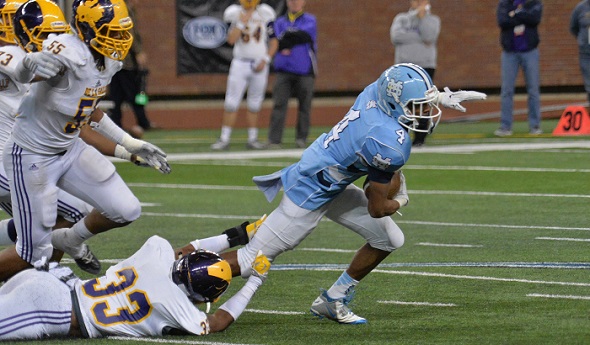
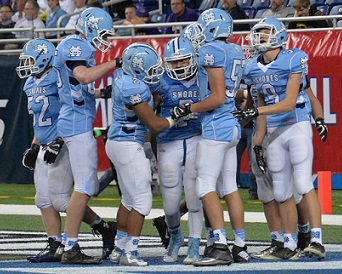
PHOTOS: (Top) Mona Shores’ Darece Roberson strides for additional yardage during last season’s MHSAA Division 2 Final against Warren DeLaSalle. (Middle) Tyler Trovenger, surrounded by teammates, celebrates his third-quarter touchdown catch at Ford Field. He moved to quarterback this fall.
Drive for Detroit: District Finals in Review
November 12, 2013
By Geoff Kimmerly
Second Half editor
There will be at least four new MHSAA football champions when this season ends later this month in Greenville and then Detroit.
One opportunity was an opening of circumstance, as reigning Division 8 champ Harbor Beach moved into Division 7 for this season's playoffs. But reigning Division 3 winner Grand Rapids Christian lost this weekend in a District Final, joining Division 5 Portland and 8-player Deckerville among teams whose drives to defend have come to an end.
Three weeks remain in the 11-player season, with four 8-player Regional champions meeting this week to decide who will face off in the championship game Nov. 22 at Legacy Field.
Read on for some of the most intriguing results of last week's action as the field was whittled to 68 teams still alive.
Division 1
Hudsonville 19, Rockford 14
Hudsonville (8-3) was one of the state’s most successful programs last decade, but this is its first season with a winning record since 2008. The recent struggle coincided in part with six straight losses to Rockford (9-2) – including a 28-19 regular-season defeat this fall in Week 6. But this District title leaves the Eagles as best in Division 1 from the always-strong west side of the state. Click to read more from the Grand Rapids Press.
Also noted:
Detroit Cass Tech 28, Warren Mott 19: The reigning champ Technicians (11-0) kept rolling in handing Mott (10-1) its first and only defeat.
Temperance Bedford 36, Saline 29: Bedford (11-0) also beat Saline (9-2) by 16 points in Week 5 in the game that eventually decided the Southeastern Conference Red title.
Detroit Catholic Central 37, Walled Lake Western 27: The Shamrocks (9-2) earned their fifth straight District title, while ending a streak of two straight for Western (9-2).
Division 2
Muskegon 28, Lowell 21
Big Reds quarterback Deshaun Thrower had to gut out the last few minutes after suffering a slight injury, but to that point he’d thrown for two touchdowns and run for a third as Muskegon (10-1) avenged a Week 4 loss to the Red Arrows (10-1) to claim a second straight District title. The victory also evened the recent playoff series between the two at 3-3 over the last six seasons. Click to read more from the Muskegon Chronicle.
Also noted:
Detroit Martin Luther King 28, Detroit East English 20: Only a few more points separated these two than when King (9-1) also edged East English (7-4) by six in Week 2.
Detroit U-D Jesuit 14, Oak Park 8: The Cubs (7-4) continued their comeback season with a first District title since 2001, while Oak Park (6-5) also can celebrate making it this far for the second straight season.
Portage Central 40, Battle Creek Lakeview 7: This matchup of Southwestern Michigan Athletic Conference champions didn’t end up close, with West winner Portage Central (11-0) getting out front big and Lakeview (10-1) never able to catch up.
Division 3
Zeeland West 48, Grand Rapids Christian 35
So ended the title defense of reigning champion Grand Rapids Christian, which did finish 8-3 despite graduating a large group of standouts from last season’s team and not having superstar receiver Drake Harris all season because of an injury. Zeeland West (10-1) – the Division 4 champion only two seasons ago – now looks like a favorite to emerge from this side of the bracket. Click to read more from the Grand Rapids Press.
Also noted:
Stevensville Lakeshore 31, St. Joseph 21: Usually-powerful Lakeshore (8-3) was something of an afterthought after finishing fourth in the SMAC West, but no longer after taking down league runner-up St. Joseph (9-2) despite losing by 12 to the Bears in Week 3.
Melvindale 35, Milan 31: Melvindale (9-2) has bounced back from two straight losing seasons to post its best record since 2009, and its best win likely was this first loss for Milan (10-1).
Eaton Rapids 24, Tecumseh 20: Eaton Rapids’ first-ever playoff run has grown to three weeks, thanks to the Greyhounds (7-4) winning a bit of a shocker over Tecumseh (8-3).
Division 4
Detroit Country Day 49, Pontiac Notre Dame Prep 27
Country Day (8-3) won close over Notre Dame Prep on the way to Ford Field in 2012, and came up big this time to run its 2013 winning streak to eight. The Yellowjackets have three high-major Division I college prospects on offense, and they continued to shine while ending another solid run for Notre Dame (8-3). Click to read more from the Oakland Press.
Also noted:
Marine City 35, Richmond 21: Richmond (9-2) won the Blue Water Area Conference while Marine City (10-1) finished second in the Macomb Area Conference Gold – but the postseason is the Mariners’ time, and they won a 10th game for the 13th time in 15 seasons.
Battle Creek Pennfield 35, Dowagiac 21: Coming off an upset win the week before, Dowagiac (7-4) couldn’t knock off another league champion in Kalamazoo Valley Association power Pennfield (10-1).
Cadillac 35, Ogemaw Heights 27: Ogemaw Heights (7-4) made this much closer than the teams’ Week 5 meeting, but couldn’t catch the Big North Conference champion Vikings (11-0).
Division 5
Muskegon Oakridge 22, Reed City 20
Oakridge (10-1) is back in the Regional Final for the first time since 2010 after holding off a late charge and stopping a two-point conversion attempt that would’ve tied the score. It was another in a heartbreaking string, however, for Reed City (10-1), which came into the District Final undefeated for the third straight season, but fell short of claiming its first District title by less than a field goal for the second consecutive year. Click to read more from the Muskegon Chronicle.
Also noted:
Monroe St. Mary Catholic Central 44, Ann Arbor Gabriel Richard 40: The Huron League runner-up Falcons (10-1) won their first District title in six seasons while keeping Gabriel Richard (8-3) from winning its third in four years.
Millington 33, Frankenmuth 29: The Tri-Valley Conference East rivals met in the playoffs for the first time since 2005, with the Cardinals (9-2) catching the league champion Eagles (9-2) at the end to split the season series and move on.
Livonia Clarenceville 31, Detroit University Prep 22: Clarenceville (10-0) is a District champion and undefeated this late for the first time since 2001, when it reached the Silverdome; University Prep ended its longest run ever at 8-3.
Division 6
Montrose 20, Saginaw Nouvel 6
Montrose vs. Madison Heights Madison has been one of the most anticipated potential Regional Finals in this playoffs, and Montrose took care of its end by jumping to a 20-0 lead and hanging strong on defense in this District Final. The win gave the Rams (11-0) their third District title in four seasons, while dropping a strong Nouvel team to 9-2. Click to read more from the Flint Journal.
Also noted:
Madison Heights Madison 27, Flint Beecher 20: Madison (11-0) nearly missed out on the big Regional matchup thanks to a solid Beecher team that ended 8-3 and won eight games for the fourth time in seven seasons.
Schoolcraft 28, Watervliet 26: Like last week, the KVA continued to look strong with co-champion Schoolcraft (10-1) eliminating Southwestern Athletic Conference South champion Watervliet (10-1).
Clinton 39, Grass Lake 14: Clinton (11-0) is 20-1 over the last two seasons and has yet to allow an opponent within single digits this fall, including Cascades Conference co-champion Grass Lake (9-2).
Division 7
Pewamo-Westphalia 20, Carson City-Crystal 14
The best season in Carson City-Crystal history ended thanks to a late comeback by P-W (10-1), which won its third straight District title. The Eagles, who won 10 games for the first time and entered this one undefeated, did drive into Pirates territory late but fell short as time expired. Click to read more from the Lansing State Journal.
Also noted:
Ishpeming 34, Iron River West Iron County 0: The reigning champion Hematites (11-0) never let this matchup of undefeated teams turn into much of a game; West Iron finished 10-1.
Southfield Christian 28, Madison Heights Bishop Foley 24: Southfield Christian (10-1) extended the best season of its eight-year history with its closest victory this fall; Bishop Foley, at 7-4, did end with its best record since 2006.
Lake City 56, Lincoln Alcona 14: Lake City’s lone loss to Beal City continues to become a distant memory as the Trojans (10-1) pile up wins like this one over previously-undefeated Lincoln Alcona (10-1).
Division 8
Mendon 13, Climax-Scotts 0
It’s an unfortunate circumstance of geography that these two always meet before the final rounds of the playoffs – Mendon (11-0) eliminated Climax-Scotts (9-2) for the third straight season, and the latter’s only other loss was to a team that generally makes the playoffs in Division 5 (Flint Powers). Make that now 526-19 in favor of Mendon over its combined opponents this season. Click to read more from the Kalamazoo Gazette.
Also noted:
New Lothrop 41, Waterford Our Lady 28: The Hornets (11-0) have piled up four straight seasons of double figure wins and have yet to allow an opponent to come within single digits, including Catholic League Intersectional champion Our Lady (8-3).
Crystal Falls Forest Park 16, L’Anse 9: The dream of returning to Ford Field nearly ended as a nightmare for Forest Park (11-0) as it just edged the Purple Hornets (8-3).
St. Ignace 20, Johannesburg-Lewiston 14: The Saints (9-2) battled through to earn a rematch from last season’s Semifinal against Beal City; Johannesburg-Lewiston (8-3) did finish its third season in four with at least eight wins.
8-Player (Regional Finals)
Lawrence 58, Battle Creek St. Philip 28
Only two weeks ago St. Philip beat Lawrence 54-50, but Lawrence (8-2) obviously learned quickly from that day’s mistakes – just as it has all season in its first as an 8-player program. St. Philip finished only its second season of 8-player, but with its best record, 10-1, since 1985. Click to read more from the Kalamazoo Gazette.
Also noted:
Peck 31, Carsonville-Port Sanilac 7: Peck (11-0) scored its second-fewest points of the season but also turned in one of its best defensive performances of the fall in holding the Tigers (7-4) to their second-fewest points as well.
Kinde-North Huron 64, Owendale-Gagetown 22: North Huron (8-3) advanced to its first football Semifinal in any division while ending Owendale-Gagetown’s best season since 1979 at 9-2.
Rapid River 50, Engadine 21: Engadine (6-5) got hot at the end of the regular season, but Rapid River (11-0) has one of the most impressive resumes of any team left in any division.
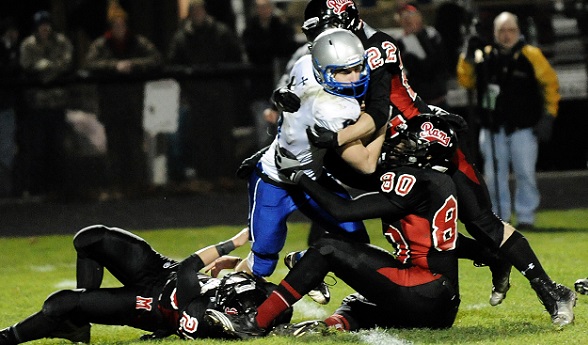
PHOTO: A trio of Montrose defenders brings down a Saginaw Nouvel ballcarrier during last weekend's District Final win. (Click to see more from High School Sports Scene.)