

Veteran Coach Shows Wayne the Way
By
Tom Markowski
Special for Second Half
September 16, 2015
WAYNE – Donald Anderson watched the Wayne Memorial football program lose game after game after game.
As a fan of high school football and a resident of Westland, Anderson, at times, just shook his head. As a former coach, Anderson thought about the possibility of doing something about it.
 Few Class A programs have had less success than Wayne. The Zebras have made the playoffs twice and have yet to win a playoff game. Wayne’s last winning season came in 2006, when it finished 5-4. From 2010-2013, Wayne won one game. The Zebras were 2-7 last season.
Wayne is a member of the Kensington Lakes Activities Association and competes in the South division with such well-respected and successful programs like Canton, Livonia Churchill and Plymouth. Even its sister school, Westland John Glenn (the schools are part of the Wayne/Westland school district), has been a playoff team on a regular basis.
As a point of fact, four members of the KLAA South (Canton, John Glenn, Livonia Franklin and Plymouth) have reached an MHSAA Final.
Wayne’s road to rise is not an easy one.
But they have begun the climb.
“We’re getting better. We moved it well against Plymouth (in a 36-13 loss last week). We just don’t have a lot of firepower," Anderson said.
“We’ve got a good young squad. We have just seven seniors, and we don’t have a JV. We have just 12 sophomores and I didn’t want to take away from our freshmen, because they’re good, and we can build on that.”
 Last April the Wayne/Westland school district had openings for a head varsity football coach, at both John Glenn and at Wayne. Anderson applied for both and was hired at Wayne. This season he became the school’s fourth head coach in as many years.
Anderson, a Detroit Cody graduate and former NFL player (he was the 32nd player taken in the 1985 NFL Draft after playing four years at Purdue University), has had success as an assistant or head coach at every school he’s been at since he starting coaching in 1989.
Anderson was the defensive coordinator at Cody before becoming the head coach in 1995. In 1999, he went to Detroit Henry Ford as an assistant under Mike Marshall before going to Detroit Northwestern in 2003 as an assistant under Michael Crayton. In 2009, Anderson became the head coach at Northwestern. The school closed after the 2009-10 school year, and Anderson decided, at that time, enough was enough.
He’s been a spectator ever since. Until this season.
“I was still involved,” he said. “I was in consultations with other schools. They wanted to pick my mind. I had a lot of opportunities to coach. It wasn’t the right time. I’ve lived in Westland since 2009. I live between Wayne and Glenn, and I’ve been watching Wayne for a while. I decided to give it a shot. The subject just drew me in. When the opportunity came, I said let’s try it.”
But coaches at Wayne don’t last long. Why would a person, 52 years old and a successful businessman, take a position there when he passed up other coaching opportunities?
A big part was wanting to help local athletes pursue their dreams at the college level. But there also was the challenge.
“I like a task," Anderson said. "It’s like when I left Henry Ford and went to Northwestern. People thought I was crazy. Low and behold, look who’s on my staff.”
 Marshall is now Anderson’s assistant, as is Charles Spann, a former head coach at Detroit Chadsey and Detroit Pershing. It’s people like Marshall and Spann who waited for Anderson to get back into coaching to return to the sidelines themselves.
Both Marshall and Spann won Detroit Public School League titles as head coaches. Now they’re trying to help a friend experience the same.
There are definite reasons for optimism. Anderson sees a lot of potential in 6-foot-3, 215-pound sophomore Reggie Micheaux, a receiver and defensive end. "He can go up and get it, and he's a big target," the coach said.
Running backs Jarvis Martin and Malik Bryant, the latter also a defensive back, are among others who are impressing early.
Anderson said former players like himself are different. They have their pride. Their egos push them into circumstances others wouldn’t tread.
But for Anderson, it’s more than his ego he’s trying to satisfy. Ten years ago he was diagnosed with kidney failure. He went through dialysis until he received a kidney transplant five years after the diagnosis. After two years, his new kidney failed. Anderson has received kidney dialysis, three days a week, since 2012. With all of that comes a different perspective.
The winning, for now, has had to wait. Wayne is 0-3. Still, those 13 points represented the most they’ve scored against Plymouth since 2007.
It doesn’t get any easier with Canton (3-0) next, but the Zebras will continue to build.
“It’s about passing it on,” he said. “God has been good to me. It’s about helping others.”
 Tom Markowski is a columnist and directs website coverage for the State Champs! Sports Network. He previously covered primarily high school sports for the The Detroit News from 1984-2014, focusing on the Detroit area and contributing to statewide coverage of football and basketball. Contact him at [email protected] with story ideas for Oakland, Macomb and Wayne counties.
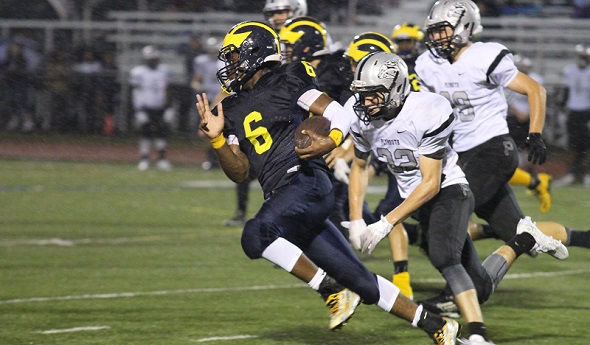
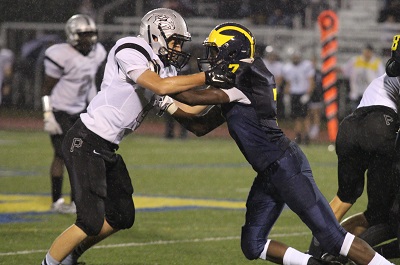
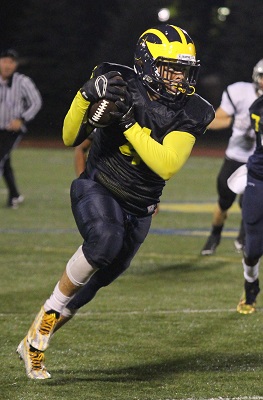
PHOTOS: (Top) Malik Bryant breaks past pursuing Plymouth defenders during last week's game. (Middle) Jarvis Martin works against a Plymouth player. (Below) Kyle Brooks turns upfield. (Photos courtesy of Wayne Memorial athletic department/Kathy Hansen Photography.)

#TBT: Searching for The Hinker Bell
September 28, 2017
By Geoff Kimmerly
Second Half editor
Menominee will host Escanaba on Friday in the 121st meeting between two of the Upper Peninsula’s largest high schools and proudest football programs – but with the trophy celebrating the game still missing after it first disappeared more than half a century ago.
The two teams from 1948-1962 played for the The Hinker Bell, a locomotive bell that hasn’t been seen since 1963.
A decade ago, Escanaba Daily Press sports editor (and now Second Half correspondent) Denny Grall wrote about a newfound search for The Hinker Bell. But the mystery continues, and Grall’s story below tells of many of the twists and turns that to that point that had come in trying to locate it.
ESCANABA — Another search is underway to find the Hinker Bell.
The former locomotive bell went to the winner of the Escanaba-Menominee football game for about 15 years but has been missing for more than 40 years. It came from a locomotive owned by the Bay de Noquet Company and used on the LS&I Railroad that operated in Delta and Menominee counties.
The locomotive was built in 1906 by Baldwin Locomotive Works in Philadelphia and the bell was believed to have been cast in the railroad foundry, according to a 1953 newspaper clipping.
In 1948, one of the locomotive owners presented the bell to his friend, John Hinker of Menominee, an ardent sports fan who donated materials for the press box at Menominee’s Walton Blesch Field.
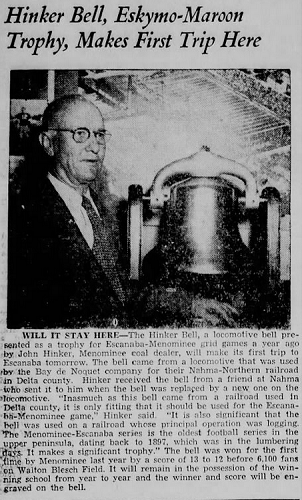 Hinker gave the bell to then Menominee coach Mickey McCormick and indicated proper use for the bell would be as an award for the gridiron rivalry.
Now Hinker’s great great nephew is trying to find the bell, which has not been seen since Escanaba’s current high school opened in 1963.
Tim Waters of Land O’ Lakes, Wis., who has launched the search, became interested by researching his family tree. “It is a big trophy (between 80 and 150 pounds by various estimates) and it is odd that it is missing,” Waters said in a recent telephone chat.
“One theory is that it is in somebody’s hunting camp or a home and they are using it as their own trophy,” said Waters.
“We have a pretty good investigation going on and all help is appreciated. If somebody does have it, we’re not looking to prosecute them. We’re just looking to get the darn thing back. Nobody will be in trouble.”
Waters refuted the old idea the bell was melted down. He has contacted numerous bell collectors, and they said a junk yard would have known it was worth a lot more than melted metal.
“The bell was not destroyed. We’ve come to that conclusion,” he said. “It was not put in a scrap yard.”
Waters contacted Coplan Iron and Metal of Escanaba and learned that bells were not melted or crushed and said the firm never accepted a bell with engravings matching the Hinker Bell.
Waters learned those businesses would sell them for the weight value to people who wanted them for yard ornaments/dinner bells, or to collectors.
“It is a treasure and it needs to be found,” said Waters.
Waters said the last known photo of the bell was with then EHS football coach Al Sigman and Esky players John Fisher and Phil Davidson in 1960. Escanaba beat Menominee from 1959-63 but could not find the bell in 1964 when the Maroons won. No one he has talked to remembers seeing the bell present at the first three games during the tenure of coach Jerry Cvengros.
The current Escanaba High School opened in 1963 and Bay de Noc Community College then occupied the old facility, which has since been demolished.
“Records indicate there was no report (of a missing bell) filed by Escanaba school district to the police department,” Waters said.
“The Hinker Bell is part of U.P. Michigan’s history, as is football and the railroads,” Waters said. “The people of Escanaba and Menominee deserve to have this trophy returned to their high schools.”
Waters, who has never seen an Escanaba or Menominee football game but is planning to rectify that omission this season, is hoping students at the two schools will join in the treasure hunt and talk about it with their parents and grandparents.
He has already contacted EHS athletic director Rob Ryan, who plans to thoroughly search the school basement.
He would like to find a photo of the bell to help collectors in their search. “Each bell was for a special locomotive,” said Waters.
“If they have a good picture we can pass it around and say we are looking for this bell. If they can pinpoint what this bell was on, they can help get the word out.”
He has also extended the search to the website at upfootball.com, which has generated interest but no bell. “If the bell is in the area still today, I don’t think it will take long to surface,” he said.
“If we don’t find this bell, we are going to try to make up a replacement as close as possible if the two schools are interested in that,” he said.
Waters is hoping that real estate agents, postal workers, delivery personnel, construction workers, etc., may have seen the bell during their travels and can help retrieve it.