

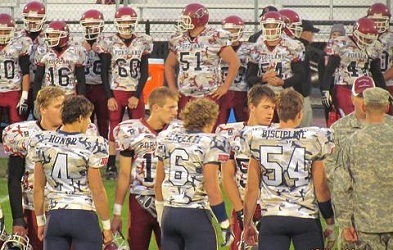
(VIDEO) Wounded Warrior Project: DeWitt vs Portland
October 13, 2011
DEWITT -- The meeting of two state-ranked teams always will ratchet up a typical football night. Both communities, naturally, want to see which is better on the field.
But during the hour before the opening kickoff Oct. 14 of DeWitt’s game against Portland, those teams and their supporters together recognized a grander cause. The night was dedicated to the Wounded Warrior Project, which aids U.S. soldiers (and their families) who have suffered service-related injuries and illnesses.
Rain washed out some planned attractions, but the evening certainly was memorable. Both teams wore camouflage jerseys and each sent its captains to the pre-game coin toss with an honorary captain representing the military. A number of other service personnel were involved – including a local color guard that presented a 30-foot flag for the national anthem.
It’s understandable if people’s visions of wars and our military are focused an ocean away. But connections hit close to home. DeWitt’s honorary captain, Lansing’s U.S. Army Spc. Jacob Shumway, recently returned from a deployment and has been in the service for two and a half years. He’s a 2003 Lansing Everett graduate, and his mother Susan Land is the principal at Lansing Eastern. His cousins Ethan and Collin Rennaker start for DeWitt, and he walked alongside them for the pregame flip. Shumway plans to attend Lansing Community College and study digital graphic design.
Both teams are considered contenders for their respective state titles next month; DeWitt is ranked No. 7 in Division 3, while Portland is No. 4 in Division 5. And they played like it – Portland prevailed 22-20 in overtime.
A great game, no question. But similarly significant was a preliminary figure of more than $11,000 raised for the WWP.
For more about the Wounded Warrior Project visit http://www.woundedwarriorproject.org.

It’s About the Base
May 8, 2018
Former Southeast Conference Commissioner Roy Kramer, whom Michiganders like to claim as our own for his East Lansing High School and Central Michigan University coaching roots, seized the opportunity of an acceptance speech for an award he received recently from the Tennessee Chapter of the National Football Foundation, College Football Hall of Fame and Knoxville Quarterback Club to deliver a sobering message regarding the game he loves so much – football.
His concerns were for the survival of football on college campuses “where their games will never be on television and will be played in front of less than 10,000 fans.” Which is the situation for 90 percent of the nation’s college football programs.
He also said, “I’m even more concerned about games on Friday night.” Mr. Kramer has been a long-time opponent of Friday night telecasts of college football games because they do poorly both at the gate and in television ratings, and they conflict with the tradition of approximately 6,000 high school football games played locally on Friday nights.
We Michiganders are sometimes criticized for our “conservative” views about the boundaries of a sensible scope for educational athletics. We come by this naturally, on the shoulders of people like Roy Kramer who, even after years in the glitz and glamour of elite college football, maintains his concern for more modest college programs as well as high school football.
It is this base of the game, not the few at the pinnacle, that is the future of a game under siege in dozens of courthouses and state houses across the U.S. – and worse, a game being questioned in many thousands of homes where football was once the game of choice.