

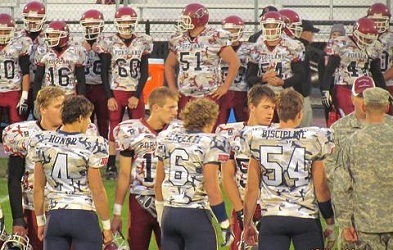
(VIDEO) Wounded Warrior Project: DeWitt vs Portland
October 13, 2011
DEWITT -- The meeting of two state-ranked teams always will ratchet up a typical football night. Both communities, naturally, want to see which is better on the field.
But during the hour before the opening kickoff Oct. 14 of DeWitt’s game against Portland, those teams and their supporters together recognized a grander cause. The night was dedicated to the Wounded Warrior Project, which aids U.S. soldiers (and their families) who have suffered service-related injuries and illnesses.
Rain washed out some planned attractions, but the evening certainly was memorable. Both teams wore camouflage jerseys and each sent its captains to the pre-game coin toss with an honorary captain representing the military. A number of other service personnel were involved – including a local color guard that presented a 30-foot flag for the national anthem.
It’s understandable if people’s visions of wars and our military are focused an ocean away. But connections hit close to home. DeWitt’s honorary captain, Lansing’s U.S. Army Spc. Jacob Shumway, recently returned from a deployment and has been in the service for two and a half years. He’s a 2003 Lansing Everett graduate, and his mother Susan Land is the principal at Lansing Eastern. His cousins Ethan and Collin Rennaker start for DeWitt, and he walked alongside them for the pregame flip. Shumway plans to attend Lansing Community College and study digital graphic design.
Both teams are considered contenders for their respective state titles next month; DeWitt is ranked No. 7 in Division 3, while Portland is No. 4 in Division 5. And they played like it – Portland prevailed 22-20 in overtime.
A great game, no question. But similarly significant was a preliminary figure of more than $11,000 raised for the WWP.
For more about the Wounded Warrior Project visit http://www.woundedwarriorproject.org.

Wrong End of the Microscope
October 14, 2016
Those who love and lead high school football in Michigan may be looking through the wrong end of the microscope.
Attention to large schools, varsity programs and the postseason is a waste of time if we fail to closely examine smaller schools, lower level programs and the start of the season.
Are we adequately nurturing our roots and promoting the future of the game? Do high school coaches spend more time with civic and parent groups describing the benefits and defending the safety record of school-sponsored football than they do airing their grievances against other coaches in the media?
Do we understand how increasing the number and enrollment ranges of 8-player football programs affects our smallest schools, whether they conduct 11- or 8-player programs? Do we see where and how the same proposal can serve one school very well but another school terribly?
Do we understand what's happening in junior high/middle school programs? Do we play enough games to be attractive to kids and their parents, and do the practice policies and playing rules of this level promote an extra degree of participant health and safety?
Do we understand how starting practice so much earlier than academic classes in the fall may turn off kids and parents, especially at lower levels of play; and are we keeping up with rapidly changing calendar changes of member schools?
Ultimately, the future health of varsity high school football programs depends on the outcome of these kinds of questions, answers and efforts ... and has little to do with the size and system of the postseason playoffs. And positive efforts will be negatively affected by coaches airing dirty laundry in public.