

Warriors Continue Fight Against Cancer
September 26, 2014
By Geoff Kimmerly
Second Half editor
An exemplary effort that has raised more than $200,000 for cancer research and awareness will continue tonight at Walled Lake Western when the Warriors take on Waterford Mott in its annual “Warriors for Warriors” game.
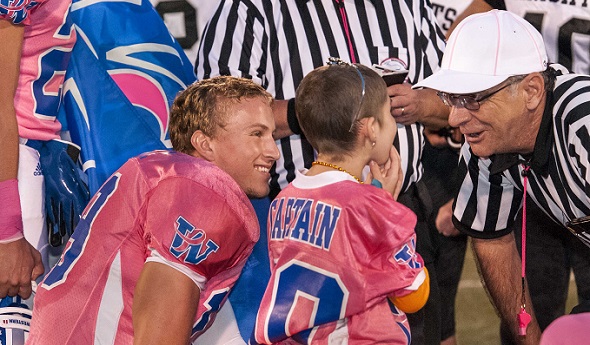
This is the fourth season Western has hosted the event, which benefits the Susan G. Komen Detroit Race for the Cure, St. Baldrick’s Foundation for Pediatric Cancer and the American Cancer Society. Fans will be wearing pink shirts designed for the event, with more than 1,000 sold as of two weeks ago.
Last fall, “Warriors for Warriors” was recognized by the NFL and featured in a 30-second commercial shown during NFL football games, and the team was hosted and honored by the Detroit Lions (see below).
“We continue to be grateful for the selfless dedication of parents, staff members, community members and all of the countless volunteers who support the fourth annual Pink Out effort,” Walled Lake superintendent Kenneth Gutman said. “Breast cancer and all cancers continue to challenge thousands of people, and we will continue to work together to eradicate it.”
A “Warriors’ Survivors Parade” will kick off the event at 6 p.m. and include patients, survivors and others who wish to honor those who are fighting or have died after battling cancer of any form. The parade will continue into the stadium.
Prior to the 7:30 p.m. kickoff, Western’s players, wearing pink jerseys sponsored in honor of those who have fought the disease, will line the field from end zone to end zone with jersey honorees and their families. More than 170 people have been honored during the first three years of the event.
The game’s honorary captain is Commerce Elementary fifth-grader Sydney Balzer, who has fought leukemia twice and founded a community service project, Colors for Cancer Kids.
For information, click for the Warriors for Warriors website and follow the effort on Twitter @WLW_W4W.
PHOTO: Walled Lake Western’s Kyle Bambard and 7-year-old Akayla Hodgins call the coin flip during the 2013 Warriors for Warriors game.

Committees Fail Critical Issues
June 7, 2013
Typically, each sport committee meets once each year for three to five hours, during which time it considers proposals that come from schools, leagues and the state’s coaches association for the sport; and the proposals most often deal with allowing more regular-season events and more qualifiers to the MHSAA postseason tournament.
Occasionally there is a proposal that might improve sportsmanship. But much more often the proposals would increase conflicts between academics and athletics and/or strain overstressed local budgets. And almost never is there a proposal that would address the health and safety of participants (the Wrestling Committee has been an occasional exception and the Competitive Cheer Committee is a routine exception).
While coaches associations must shoulder some of the blame because they’ve brought MHSAA committees “trivial” topics, at least in comparison to the tougher health and safety topics, much of the cause of MHSAA committee ineffectiveness is that the committees don’t meet long enough or often enough to research serious problems and develop well-thought-out solutions. That is forgivable because it is difficult to get commitments from busy people all across Michigan to be absent from their regular jobs and travel dozens or even hundreds of miles, and to do so multiple times each year – which is what it takes to more fully understand complex problems and more carefully construct solutions. Meetings have to be few and they have to be efficient.
However, facing the worst publicity football has seen since the mid-1970s, we knew we had to supplement the football committee process. We did so by appointing a special Football Task Force of optimum size and experienced, representative makeup to meet on however many occasions are necessary during 2013 to accomplish three purposes:
- Review practice policies to improve acclimatization of players and reduce head trauma.
- Review competition rules to reduce head trauma and the frequency of the sport’s most injurious game situations.
- Develop promotions that extol the value of football to students, schools and communities and the safety record of school-based football.
The promotional efforts have begun to be rolled out; game rule modifications are being investigated; and four proposals for changing football practice policies have been prepared. They will be the topic of our next posting.