


West Catholic Adds to Ford Field Fame
November 26, 2016
By Geoff Kimmerly
Second Half editor
DETROIT – November has become a regular part of the Grand Rapids West Catholic football schedule. Trips to Detroit are turning into a Thanksgiving weekend tradition.
But what the Falcons accomplished again Saturday was not lost on them.
Grand Rapids West Catholic won its fifth MHSAA football championship and became just the sixth school to win four straight, downing familiar playoff foe Menominee 43-7 in the Division 5 Final at Ford Field.
“There’s no word to describe it. Year after year, competing like that, getting to play 14 games – we’re very, very lucky and blessed,” said senior Sam Neville, who with David Fox played on all four champions. “That’s double what most people get to play over the course of their high school careers.”
This string was as impressive as any of the other three, for a few reasons.
West Catholic finished 12-2, despite playing without junior quarterback Gaetano Vallone for six weeks after he injured an elbow on opening night.
The Falcons, with a Week 3 loss to Zeeland West and a Week 9 defeat to Allendale, were then forced to play all of their playoff games on the road. They navigated a path highlighted by previously undefeated Portland, handed second losses to Lansing Catholic and Algonac and also beat another league champion in Berrien Springs.
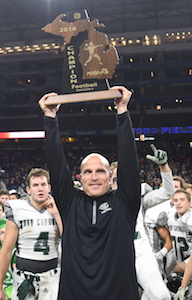
They did so under the leadership of a new coach. Joe Hyland was hired this spring after the resignation of Dan Rohn, who had led the team to the first three titles of this streak. Hyland had been highly successful coaching in South Carolina before coming to West Catholic as a teacher and guidance counselor in fall 2015, but as with any change, there was a transition.
And then there was that Finals familiarity. The Falcons defeated the Maroons in 2013’s Division 5 Final to start this streak, and also in a Semifinal in 2014 and Regional Final last fall. It would be hard to find two high school programs 450 drive miles apart that know each other more.
“There’s a lot of people in our community and even statewide who talked about ‘November, November,’ but our discussions were always about today,” Hyland said. “And just feeling like if you do the right thing now, the rest will work out. And if we get beat by a good team on our best day, then you shake their hand and look them in the eye and congratulate them. But we really felt like on our best day, that wasn’t going to happen.”
Saturday had to be one of them.
Junior kicker Liam Putz started the scoring just 2:41 into the game with an MHSAA Finals-record 47-yard field goal, a yard longer that Josh Wuerful’s for Traverse City High against Detroit Catholic Central in the 1988 Class A championship game.
By the end of the first quarter, Vallone had thrown two touchdown passes. By halftime, he’d connected on four. The first, a 91-yarder to senior Brett Myers, was the fourth longest pass play in Finals history.
 Vallone finished 13 of 20 passing for 311 yards, the fifth most in Finals history. He spread the ball nicely with five receivers catching at least one pass; Neville had six catches for 117 yards and two scores, Meyers three for 143 yards and his long touchdown and senior Aaron Hall caught four balls for 66 yards and the other passing TD.
The 5-foot-10, 170-pound quarterback also ran for a team-high 83 yards and a score on 13 carries. His 394 total yards rank sixth on the Finals all-time list.
Menominee did achieve a little history as well. In addition to playing in their fifth Final, the Maroons scored their points on a 76-yard blocked field goal return by senior Hunter Hass – the first blocked field goal return touchdown in Finals history. The kick was blocked by senior Sam Larson, and Hass picked up the loose ball and ran down the left sideline for the score.
“All week we were practicing to block their punt, and it just so happened that we blocked their field goal,” Hass said. “I saw the ball. I just picked it up and ran into the end zone, just trying to get some points to get some momentum going for our team.”
But the rest of the afternoon was a struggle. The Maroons (12-2) gained only 163 yards and tied a Finals record held by two others teams with seven turnovers – three coming on fumbles.
They also played once more without all-state tailback Keifer Rasner, who missed the end of the season with an injury.
“When you turn the ball over that many times to a good team, you don’t have much of a shot,” Menominee coach Joe Noha said. “But I’m really proud of my guys. We really hung in there. We’ve had a lot of things happen in the last couple of weeks, but I’m really pleased with our effort and our fortitude to get here. And once you get here, finishing is difficult. Today was not our day.”
The MHSAA Football Finals are sponsored by the Michigan National Guard.
PHOTOS: (Top) Grand Rapids West Catholic’s Zane Timmer tries to break away from a Menominee tackler Saturday in the Division 5 Final. (Middle) Falcons coach Joe Hyland raises the championship trophy.
Cvengros Leaves Lasting Impact
By
Geoff Kimmerly
MHSAA.com senior editor
April 1, 2014
Retired Associate Director Jerry Cvengros, who served at the Michigan High School Athletic Association for more than 13 years after three decades at Escanaba High School, died Monday evening in Lansing. He was 80.
As lead assistant to Executive Director John E. “Jack” Roberts from August 1988 until retiring in January 2002, Cvengros served as director of football and briefly hockey in addition to coordinating the Program of Athletic Coaches Education (PACE), presenting annual in-service training for administrators and serving as MHSAA liaison to statewide principals, athletic directors and coaches associations.
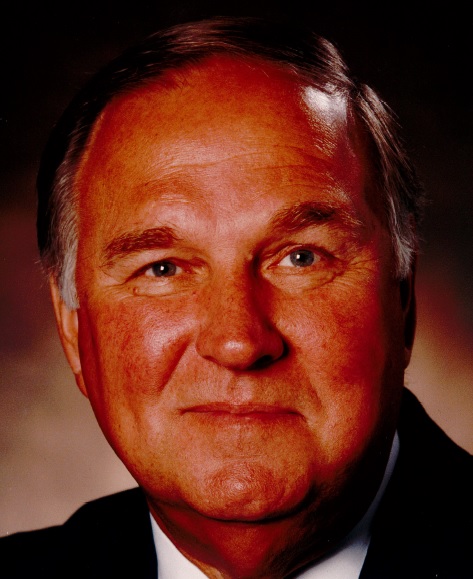 He came to the MHSAA after 30 years at Escanaba, where he taught, coached, served as athletic director and later principal during a tenure stretching from August 1958 through July 1988. While at Escanaba, Cvengros also represented Upper Peninsula Class A and B schools on the MHSAA Representative Council from 1983-88 and served as the Council’s president from 1986-88.
Cvengros received the MHSAA’s Charles E. Forsythe Award in 2000 in recognition of his many and significant contributions to interscholastic athletics.
“During his lifetime, Jerry Cvengros impacted every area of interscholastic athletics as a coach, athletic director, principal and then associate director of the MHSAA," Roberts said. “He was the perfect combination of fairness, toughness and diplomacy, able to draw on a vast knowledge of MHSAA rules and an understanding of educational athletics fostered by his various experiences.
“Jerry was known and respected statewide for his dedication, and his contributions have had a lasting impact.”
Cvengros built an elite football program at Escanaba as varsity head coach from 1962-84, leading the Eskymos to a 161-42-3 record, a Class A runner-up finish in 1979 and the MHSAA championship in 1981. That team remains the only Class A/Division 1 team from the Upper Peninsula to win an MHSAA football title. Cvengros was inducted into the Michigan High School Football Coaches Association Hall of Fame and served on its original Board of Directors.
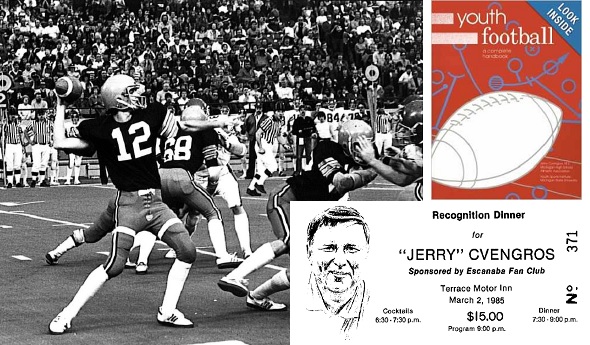
His 1979 team fell to Detroit Catholic Central 32-7, but he brought the Eskymos back to the Finals for a 16-6 win over Fraser two seasons later. Cvengros' championship lineup included quarterback Kevin Tapani, who would go on to pitch for the Minnesota Twins among five major league clubs, and tailback Dean Altobelli, who later played at Michigan State University. The title run included a 15-14 Semifinal win over Dearborn Fordson that included a savvy two-point conversion call by Cvengros, who wanted to avoid overtime after a late score drew Escanaba to within a point of tying the score.
As the MHSAA’s director of football, Cvengros was instrumental in creating the current playoff format that expanded the field from 128 to 256 teams beginning with the 1999 season. He also co-authored “Youth Football: A Complete Handbook,” a guide to coaching at that level.
Among many additional honors, Cvengros was inducted into the Upper Peninsula Sports Hall of Fame and Michigan High School Coaches Association Hall of Fame and received the Distinguished Service Award from the Michigan Interscholastic Athletic Administrators Association. The National Federation of State High School Associations twice awarded Cvengros with a Citation – the NFHS’ highest honor – for his service as a coach and then as a member of the MHSAA staff.
Since his retirement, Cvengros and his wife Shelley have continued to reside in Okemos. A visitation will take place beginning at 10 a.m. Monday, April 7, at St. Martha Parish in Okemos, with a funeral Mass to follow at 11 a.m.
Cvengros was a 1951 graduate of Ironwood High School and went on to study and play football at the University of Wisconsin in Madison. He earned his bachelor’s degree in secondary education and teaching from the University of Wisconsin-Superior and a master’s from Northern Michigan University.
He taught English, history and physical education at Escanaba High School and also coached basketball and track and field. He became the school’s athletic director in 1970, added the duties of activities director in 1975 and became principal in 1983.
Cvengros is survived by his wife and children Michael, Steven and David, and seven grandchildren. He was preceded in death by his daughter Lee Ann (Cvengros) Swasey in May 2013.
PHOTOS: (Clockwise from left) Escanaba quarterback Mike Beveridge fires a pass during the 1979 Class A Final; Cvengros co-authored a book on coaching youth football; Cvengros was celebrated once more in Escanaba following his final season as football coach.