


We’ve Got This Right
March 1, 2013
This year's Super Bowl was an occasion for an unusual amount of commentary on the state of football safety, especially concussions.
One group called on state high school associations and football coaches associations to eliminate contact outside the defined interscholastic season. That would mean spring football practice, and during summer leagues and camps, and at all-star games.
Michigan is one of a large majority of states where schools do not allow spring football practice. Michigan is one of a minority of states where schools do not allow contact at summer camps, for which we are often criticized by out-of-state camp promoters. And Michigan is one of a smaller minority of states where schools prohibit students, coaches, officials and administrators from being involved in all-star games involving undergraduates.
While we are well ahead of the curve on out-of-season contact policies, we are in the mainstream of state high school associations studying what the appropriate limits should be on contact during early season football practice and throughout the remainder of the season. We have a task force that appears headed toward recommending that the Representative Council prescribe only one contact session per day during early season practice and only two contact practices per week after games begin.
There will be other ideas percolating and then simmering with these before any are proposed to the MHSAA Football Committee and Representative Council.
Drive for Detroit: Week 1 in Review
September 2, 2014
By Geoff Kimmerly
Second Half editor
Opening night of MHSAA football season never disappoints.
This weekend’s first games of 2014 again produced plenty of discussion fodder. But they also included a couple interesting rarities worth pointing out.
- We figured Stevensville-Lakeshore’s 2-0 win over Battle Creek Central on Thursday had to be a forfeit when the score came in. Actually, Lakeshore’s defense scored a safety with less than a minute to play.
- Although we don’t tout a team’s losing streak, we certainly can celebrate the end of one – so congrats to Pinconning, which won for the first time since Week 7 of 2010, 27-8 over Caro; Clio, which won for the first time since Week 8 in 2009 by beating Mount Morris 24-14; and to Bay City All Saints for its first win since Week 7 of 2011, 45-14 over Bellevue.
Those two certainly raised a few eyebrows among the 300-plus scores reported from Thursday-Saturday. Read below for more of the most significant results from every corner of Michigan.
Greater Detroit
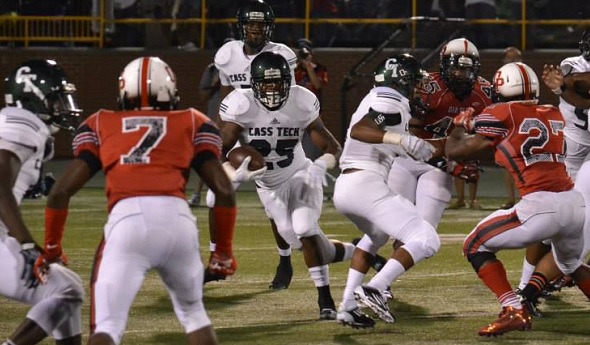
Detroit Cass Tech 27, Oak Park 26
Those following live or over the Twittersphere had to think Cass Tech was in trouble early as it trailed by two scores. But the Technicians came back to take the final lead with 2:16 to play at Wayne State University. The game featured two of the state’s top running backs – Cass Tech’s Mike Weber and Oak Park’s John Kelly – and an impressive debut by Technicians sophomore quarterback Rodney Hall. Click to read more from MLive-Detroit.
Also noted:
Orchard Lake St. Mary's 21, Southfield 19 – The Eaglets are coming off a rare playoff miss but began bouncing back by beating a Bluejays team coming off its third straight postseason appearance.
Clarkston 24, Macomb Dakota 21 – The reigning MHSAA Division 1 champion looked strong in beginning its title defense, edging a Dakota team that had won 17 straight regular-season games.
Birmingham Groves 42, Birmingham Seaholm 19 – Groves won this battle of rivals for the first time since 2011 and after falling to Seaholm by seven and six points, respectively, the last two seasons.
Dearborn Fordson 41, Temperance Bedford 21 – Fordson is seeking a ninth-straight playoff berth and got rolling by beating a Bedford team that suffered its only 2013 loss in the Regional Final.
West Michigan
Muskegon 21, Detroit Catholic Central 14
This ended up everything it was billed as Muskegon scored during the final minutes to survive in arguably the most anticipated opener of this season. The Big Reds are back-to-back MHSAA Division 2 runners-up and Detroit Catholic Central has finished second in Division 1 the last three seasons. Both have a number of new key contributors, but both also are again considered contenders to reach Ford Field this November. Click to read more from the Muskegon Chronicle.
Also noted:
Grand Rapids Christian 28, Grand Rapids South Christian 14 – The Eagles have won this clash of Grand Rapids titans five seasons running, even more impressive since South Christian has played at Ford Field to finish the last two.
East Grand Rapids 17, Grand Rapids Catholic Central 14 – The Pioneers also face Lowell, Muskegon, Forest Hills Central, Caledonia and Grand Rapids Christian among others, making every win count that much more as they look to return to the playoffs after a two-year hiatus.
Muskegon Orchard View 22, Montague 16 – Although Montague dropped down just a bit in finishing 6-4 last season, this was one of the biggest stunners statewide last weekend with Orchard View seeking its first winning season since 2009.
Muskegon Mona Shores 31, Saline 28 – Coming off its first playoff appearance, the Sailors appear headed for a return after edging another 2013 playoff qualifier.
Bay and Thumb
New Lothrop 28, Traverse City St. Francis 20 (3 OT)
New Lothrop hasn’t lost a regular-season game since Week 9 of 2009 – a stretch of now 37 – although St. Francis did its best to break the streak. Neither team scored during the first overtime, and both scored during the second overtime but missed extra points. Click to read more from the Traverse City Record-Eagle.
Also noted:
Montrose 52, Reese 7 – These teams combined for 20 wins last season, and Montrose is off to a great start on a fourth straight of at least 10 victories.
Saginaw Swan Valley 42, Saginaw Nouvel 0 – Alex Grace added another 195 yards to his more than 5,000 gained for the Vikings over the last two seasons.
Midland Dow 46, Mount Pleasant 16 – The Chargers broke a seven-game losing streak to Mount Pleasant and should be among favorites in the Saginaw Valley Association Blue.
Flint Carman-Ainsworth 26, Grand Blanc 14 – The Cavaliers followed up their best finish ever (11-2) by opening with a third straight win over this nonleague rival.
Mid-Michigan
Ithaca 38, Clare 13
Ithaca stands alone with the most consecutive high school football wins in the United States. The Yellowjackets ran their streak to 57 straight, while Iowa City Regina (Iowa) – which also had won 56 in a row – fell by a point, 29-28, to Solon (Iowa) on Friday. Clare entered this season with eight straight playoff appearances and should be a favorite to remain atop the Jack Pine Conference. Ithaca has won four straight MHSAA Division 6 championships and debuted a new starter at quarterback – junior Jacob Smith, younger brother of graduated all-stater Travis – and he threw for 245 yards and four touchdowns. Click to read more from the Lansing State Journal.
Also noted:
Grand Ledge 28, Grand Rapids Forest Hills Central 24 – This says a lot about the Comets’ hoped-for turnaround this fall after they finished 4-5 a year ago; Forest Hills Central also went 4-5 in 2013, but against a similarly rigorous schedule.
DeWitt 39, Linden 0 – The Panthers return much of the team that made last season’s Division 3 Final, but this score was a little higher than most probably expected against a Linden team DeWitt beat in the playoffs the last two seasons by a combined 14 points.
Okemos 28, Mason 14 – Could this first win over the rival Bulldogs since 2011 be a sign of things to come for a Chieftains team returning 17 starters after finishing 3-6 in 2013?
Lansing Sexton 35, Detroit East English 26 – The Big Reds have MHSAA title aspirations, and beating a strong East English team at Wayne State University was a powerful step.
Upper Peninsula
L'Anse 16, Houghton 14
L’Anse opened newly-dedicated Volunteer Field with a pair of late defensive stands to beat Houghton for the sixth straight opening night. The Purple Hornets are coming off consecutive 8-3 seasons, but fielded a number of new contributors who held strong against a Houghton team that made the playoffs last season for the first time since 2001. Click for read more from the Houghton Daily Mining Gazette.
Also noted:
Escanaba 24, Alpena 18 – Coming off its worst finish (3-6) in six seasons, Escanaba started this fall by avenging a 15-7 loss to Alpena in last season’s opener.
Cedarville 52, Posen 0 – This was little like last season’s 42-40 nail-biter opener also won by Cedarville before both went on to make the 8-player playoffs.
Iron River West Iron County 28, Munising 6 – Make that 12 straight seasons West Iron has started 1-0, and 12 straight regular-season wins dating to Week 8 of 2012.
Ishpeming Westwood 40, Stephenson 16 – Rebounding Westwood is halfway to equaling last season’s win total with this win over a program that’s made the playoffs four of the last five years.
Southwest and Border
Edwardsburg 42, Three Rivers 40 (2 OT)
Edwardsburg’s 2013 ended with a disappointing four-point loss in its first playoff game – which also ended up being the Eddies’ only loss of last season. They were faced with a similar situation Thursday – but made a series of big plays to come out on top. The Eddies blocked a field goal to help send this game into overtime and scored the winning points on their lone complete pass of the evening. Edwardsburg has beaten Three Rivers in three straight; this season the two are in separate divisions of the Wolverine B Conference for the first time. Click to read more from the Kalamazoo Gazette.
Also noted:
Gobles 33, Watervliet 32 – Watervliet didn’t lose last season until the playoffs, but Gobles bounced back big after missing the playoffs in 2013 and falling to the Panthers 43-14 in last fall’s opener.
Fennville 18, Lawton 0 – Fennville is seeking its first winning season since 2010, and shutting out a Lawton team coming off its fifth straight playoff appearance is a great start.
Plainwell 28, Dowagiac 13 – Plainwell has won two straight over Dowagiac after seven straight losses to the Chieftains.
Portage Northern 28, Battle Creek Lakeview 24 – Northern’s last football game before Thursday was a 31-7 playoff loss to Lakeview last fall.
Lower Up North
Traverse City Central 34, Marquette 13
Central opened last season with a 31-23 loss to Marquette – the first of four defeats by eight or fewer points as the Trojans finished 5-4 and missed the playoffs by a win. This time, Central’s offense rolled to more than 400 yards with two backs each running for more than 100. Click to read more from the Traverse City Record-Eagle.
Also noted:
Hillman 39, Rudyard 33 – The Tigers opened with a close one, scoring the game-winner with 27 seconds to play as they pursue their ninth straight playoff berth.
Traverse City West 31, Midland 14 – The Titans opened with a nice turnaround after falling to Midland 16-0 in last season’s opener; Midland went on to win 10 games.
Petoskey 53, Sault Ste. Marie 14 – The Northmen lost two games last season by a combined four points and missed the playoffs for the second straight, but hope this fourth straight win over Sault Ste. Marie is a jump start back toward the postseason.
Charlevoix 13, Elk Rapids 12 – For the second straight year, the Rayders were coming off a 1-8 finish but opened with an upset of a team coming off a playoff berth.
PHOTO: Detroit Cass Tech's Mike Weber (25) breaks toward an opening against Oak Park at Wayne State University. (Photo courtesy of Detroit Public School League.)