

Whiteford's Mensing Bringing Successful System to Westland John Glenn
By
Doug Donnelly
Special for MHSAA.com
April 26, 2022
Jason Mensing insists that when he showed up at Ottawa Lake Whiteford a decade ago he had thoughts of a state championship on his mind.
 It seemed a tall task. The Bobcats had enjoyed pockets of success throughout school history but had just won just five playoff games and one conference football championship over the previous 45 years.
Still, the Tecumseh native and former Adrian College football player was determined.
“We believed if we could imprint our system and develop a strength program and teach the fundamentals and continue to grow, we’d have success,” Mensing said.
The formula was magic. Whiteford went 8-2 that first season under Mensing and tied a school record with nine wins in Year 2. By 2015, the Bobcats were in the MHSAA Semifinals for the first time. In 2016, Whiteford played at Ford Field for the first time. In 2017, Whiteford won a Division 8 championship. The Bobcats were a combined 93-24 during his decade running the program, including 11-2 this past fall.
“The reality is we do believe in our system,” Mensing said.
After 10 years, Mensing announced this week that he would be taking his system elsewhere. He will become the next head football coach at Westland John Glenn, a Class A school west of Detroit. The Rockets haven’t had much success in recent years, but school officials are excited to have Mensing on board.
“I’m excited to see what Jason can bring to our school and our program,” said John Glenn Principal Eric McCalla. “He is a culture builder. That’s one of the things we need here.”
McCalla is very familiar with Mensing. McCalla coached football for 16 years at Grass Lake and Manchester. At Grass Lake, McCalla’s team scrimmaged against Mensing’s for several years.
“It was definitely a great hire for us,” McCalla said. “We needed a different direction, and we feel confident that he is the right person for the job.”
Mensing, who will step down as athletic director and director of student advancement at Whiteford at the end of the school year, planned on meeting the John Glenn football players and parents this week. He will start immediately to build a coaching staff and relationships.
“They’ve struggled the last couple of years, but there is a solid history there,” Mensing said. “The first thing is I want is to bring stability and consistency to the program. They’ve had three football coaches in four years. We have to create an atmosphere where playing football is fun, create a culture where kids are excited about being part of the program.”
John Glenn has known football success. During the 1990s, John Glenn made several deep runs in the playoffs, reaching the Finals in 1993 and the Semifinals two more times.
The Rockets open the season Aug. 25 against Hartland in a nonleague game and play a challenging schedule in the always-tough Kensington Lakes Activities Association. They finished 2-7 last season and are seeking their first winning finish since 2014.
 “There’s no doubt that we play a tough schedule,” McCalla said. “In any given year we play one if not two or even three teams ranked in the top five or top 10. It’s a tough football conference.
“I think the first thing he can do is instill confidence in our kids. That is an important first step – and not just the kids, but the parents and the community. Having confidence in our program.”
Mensing was an academic All-American at Adrian College, where his father Henry Mensing coached and served as athletic director. Jason Mensing has made four other coaching stops during his 19-year career and picked up a lot of playoff appearances and coach of the year awards, and a built a lot of relationships.
He led Addison to the playoffs in his first season as varsity coach. He spent one year at Grayling, and won an Associated Press Class B Coach of the Year award during his three years at Owosso. He returned to Lenawee County to coach Tecumseh during the mid-2000s. In his one year away from high school football, he coached at Siena Heights University.
Whiteford lured him from the college level in 2012.
It wasn’t long before the milestone games and victories began piling up. Ironically, two Bobcats playoff losses were important steps in the team’s ascension. The first was a 2013 loss to New Lothrop in the Division 8 Regional Final. The Bobcats had beaten Sterling Heights Parkway Christian 59-6 and Detroit Allen Academy 61-20 in two home District games, then went on the road to face the Hornets, a powerhouse program.
“That loss was really big,” he said. “It showed us how far away we were but showed us what we needed to do to get there.”
Whiteford won seven games the following year, and in 2015 the Bobcats won three playoff games for the first time in school history, including a victory over a strong Climax-Scotts team. They lost the following week to Waterford Our Lady of the Lakes, but again, Mensing said, it was a loss that showed them the way.
“It was the moment we knew we belonged,” he said.
The Bobcats have ‘belonged’ ever since, proving not to be a one-and-done type program.
The 2017 team scored an incredible 737 points and punted just twice all season. The closest any opponent came was 16 points. Whiteford defeated Mendon in the Semifinals and Saginaw Nouvel in the Division 8 championship game.
Even in 2019 when the Bobcats went just 5-5, they upset a powerful Sand Creek team. Last year Whiteford reached the Division 8 Semifinals and led Hudson 22-0 at halftime before losing to the eventual champion, 28-22.
“There were some ups and downs,” Mensing said. “There were times we implemented things that didn’t necessarily work. Overall, though, we kept growing.
“When I look back at those years, the focus we started on growth and getting better year after year worked. We had 10 years of consistent growth. I do feel we are significantly more mature and better of a program than we were when I got here in 2012.”
Now, Mensing turns his attention to John Glenn, a school six times the size of Whiteford. He believes in the system he’s bringing with him and in the students at John Glenn.
“He’s a kid guy,” McCalla said. “We need people who are going to be there for our kids, not just football players, but all of our students. It’s not just about football, but life lessons.”
 Doug Donnelly has served as a sports and news reporter and city editor over 25 years, writing for the Daily Chief-Union in Upper Sandusky, Ohio from 1992-1995, the Monroe Evening News from 1995-2012 and the Adrian Daily Telegram since 2013. He's also written a book on high school basketball in Monroe County and compiles record books for various schools in southeast Michigan. E-mail him at [email protected] with story ideas for Jackson, Washtenaw, Hillsdale, Lenawee and Monroe counties.
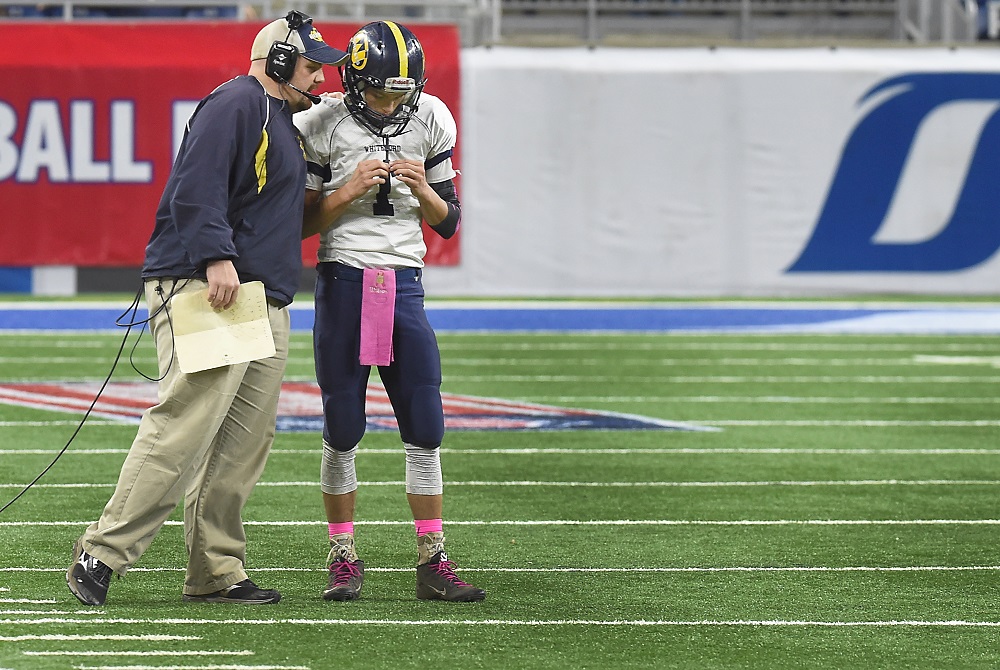
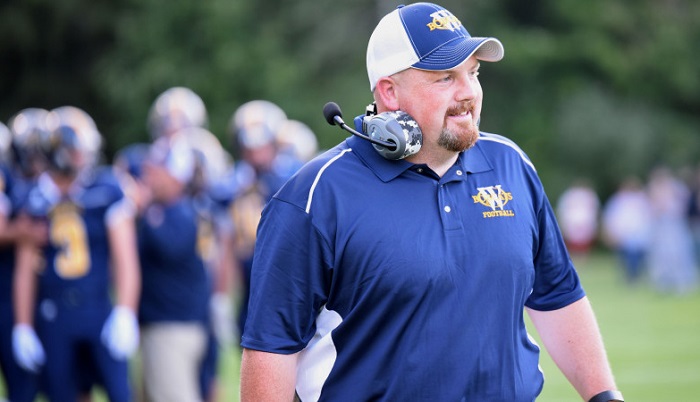
PHOTOS (Top) Coach Jason Mensing confers with a Whiteford player during one of the team’s two runs to Ford Field. (Middle) Mensing will be leaving the program after 10 seasons with the Bobcats. (Top photo by Tom Hawley/Monroe News; middle by Cari Hayes.)
Divine Child Delivers in Defining Moments to End 40-Year Championship Wait
By
Paul Costanzo
Special for MHSAA.com
November 28, 2025
DETROIT – Marcello Vitti knew his teammates had his back.
After fumbling near midfield with five minutes to play and his Dearborn Divine Child team clinging to a one-point lead, Vitti’s faith was rewarded as the Falcons forced a four-and-out from the Hudsonville Unity Christian offense.
Then he paid them back.
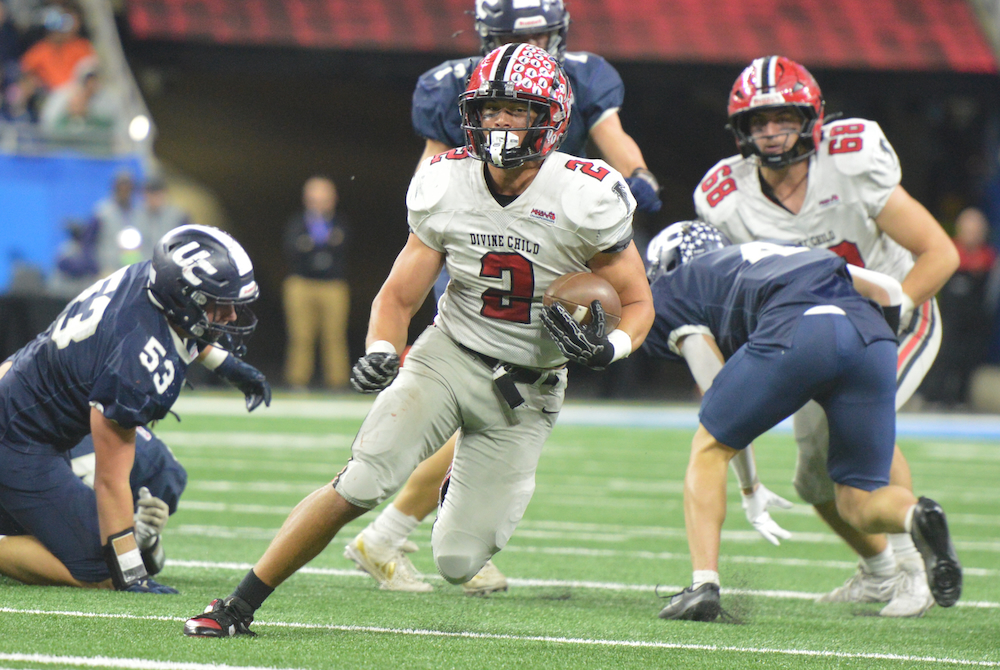
The senior running back rushed for 20 yards and a pair of first downs on the final drive, including the game clincher, as Divine Child picked up a 23-22 victory Friday in the Division 4 Football Final at Ford Field.
“I knew that I was going to have to make plays to win this game,” said Vitti, who rushed for 120 yards and a touchdown. “I fumbled at the end, and I knew that my team’s got my back. This team isn’t good because of me. We have a lot of guys that do their jobs and maybe a little bit extra. There’s so many good guys and good players, Division I, Division II players on our team that they make me that much better.”
The title is the third in program history for the Falcons, and first since 1985.
To win it, Divine Child (13-1) had to survive a back-and-forth battle with several plays that felt as if they could be game-defining in the moment.
Vitti’s fumble felt like it could have been that, as Unity Christian took over near midfield with an offense that had been rolling through the second half.
 The Crusaders (12-2) had gained 205 yards on 35 plays on their first three second-half drives, scoring a pair of touchdowns and getting inside the 5 on the other.
But after the turnover, Divine Child’s defense stiffened up, holding Unity Christian to two yards and forcing a turnover on downs.
“I do want to say, congratulations to Unity Christian,” Divine Child coach Chris Laney said. “I think they replaced 18 starters going into this year, and (coach Craig Tibbe) does a tremendous job; that scheme gives you nightmares. But, I wasn’t the one that coined it, but defense wins championships, and we had a great defense this year. Great defensive staff. The kids bought in, they really checked their egos this year at the door and played within our scheme defensively.”
Divine Child had its lead thanks to a five-yard touchdown rush by Vitti and a 2-point conversion run on which he broke multiple tackles and pushed through several defenders at the goal line with the help of his teammates.
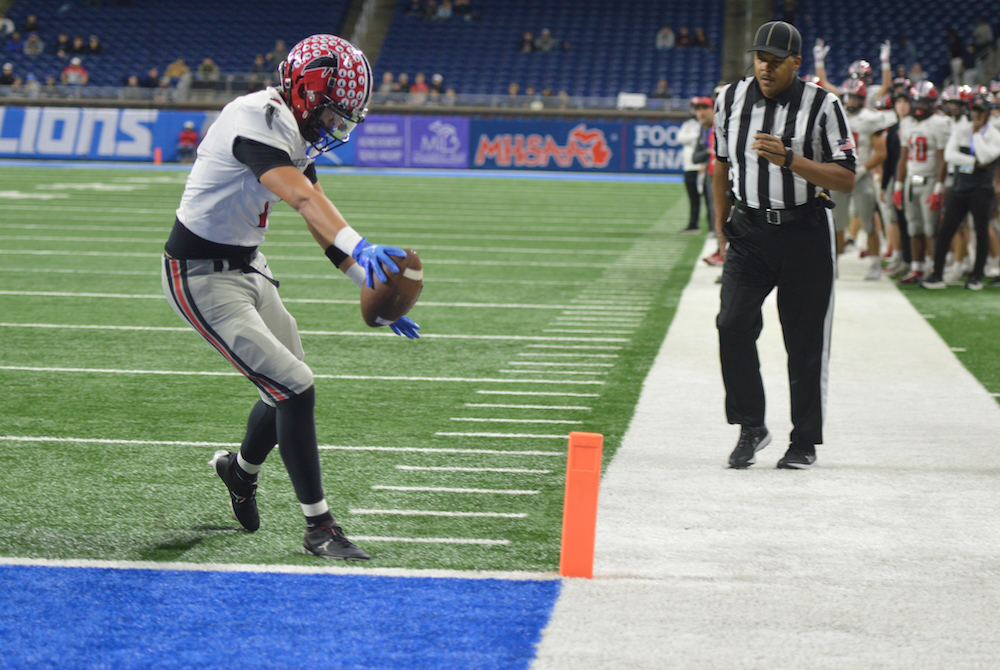
All of that was set up by a toe-tapping catch from sophomore Rayshawn Thomas on the sideline on a pass from fellow sophomore Drew Sheridan. Initially, it was called incomplete, but was overturned on replay.
“To be honest, I thought I had my foot down,” Thomas said. “Then I saw that I had my foot down (on the big screen) and I was like, ‘Oh my God, I caught it.’”
Unity Christian answered with a 10-play, 69-yard drive capped off with a two-yard touchdown run from Jared DeVries.
The Crusaders lined up to kick an extra point to tie the game, but faked it. The pass was intercepted by Divine Child’s Adam Garcia, preserving the one-point lead.
“Silly stuff, isn’t it?” Tibbe said. “I’d like a do-over, for sure. They defended it well. I look at myself, I’m kicking myself, asking, ‘Why did you get so cute?’ Just pound the ball. They hadn’t stopped these guys. These guys had just been tearing it up, then I go and do something like that. So, yeah, I would like a do-over there.”
Tibbe’s offense was strong throughout the game, gaining 332 yards on the ground and averaging five yards per carry. That was led by Lucas Elliott, who had 115 yards, and DeVries, who had 90 yards and a pair of touchdowns, including the game’s first score. Joshua Bremer added 60 yards, and had the fumble recovery in the fourth quarter.
 Quarterback Justin Febus rushed for 48 yards and a touchdown, which, following a DeVries conversion run, gave his team a 16-15 lead early in the third quarter.
“I’m super proud of how we hung,” Tibbe said. “The fact that we were right there with this team says a lot about these guys. There’s probably a couple times in this game where it didn’t look great, but they didn’t quit. They kept chugging along.”
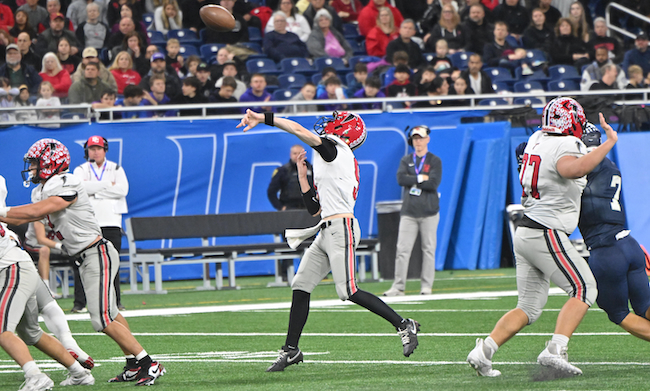
The offensive output was needed to keep up with Divine Child’s balanced attack, led by Vitti and Sheridan. The left-handed quarterback completed 13 of his first 15 passes in the game, and finished 19-of-25 for 241 yards and a pair of first-half touchdown throws to Antonio Solares-Vitti. He did it all with his non-throwing shoulder in a brace thanks to an injury suffered in the Regional Final against Harper Woods.
“My mindset, honestly, the past two weeks was do whatever it takes to win,” Sheridan said. “Harper Woods, we didn’t really throw the ball, I got injured. Last week, I made plays when they had to be made. Marcello made plays, Ray made plays, Giancarlo (Vitti), Antonio, they’ve all been making plays for me. So, for me, it’s been about rehabbing and getting better. Today, the mindset was, it was just a next-play mentality. If we don’t have a good play, we had to make up for it the next play. And the guys made plays for me today.”
Solares-Vitti had seven catches for 88 yards, including a big 13-yarder on the final drive. Thomas had four for 64.
Marcello Vitti led the defense with 14 tackles, while Andre Davis Jr. had 12 and Giancarlo Vitti had an interception.
Unity Christian’s defense was led by DeVries’ 10 tackles, while Febus and Jack Portenga each had eight.
PHOTOS (Top) Dearborn Divine Child’s Marcello Vitti (2) breaks through the line during Friday’s Division 4 Final. (Middle) Antonio Solares-Vitti stretches across the goal line for a score. (Below) Divine Child quarterback Drew Sheridan tosses a pass.