

Whiteford's Mensing Bringing Successful System to Westland John Glenn
By
Doug Donnelly
Special for MHSAA.com
April 26, 2022
Jason Mensing insists that when he showed up at Ottawa Lake Whiteford a decade ago he had thoughts of a state championship on his mind.
 It seemed a tall task. The Bobcats had enjoyed pockets of success throughout school history but had just won just five playoff games and one conference football championship over the previous 45 years.
Still, the Tecumseh native and former Adrian College football player was determined.
“We believed if we could imprint our system and develop a strength program and teach the fundamentals and continue to grow, we’d have success,” Mensing said.
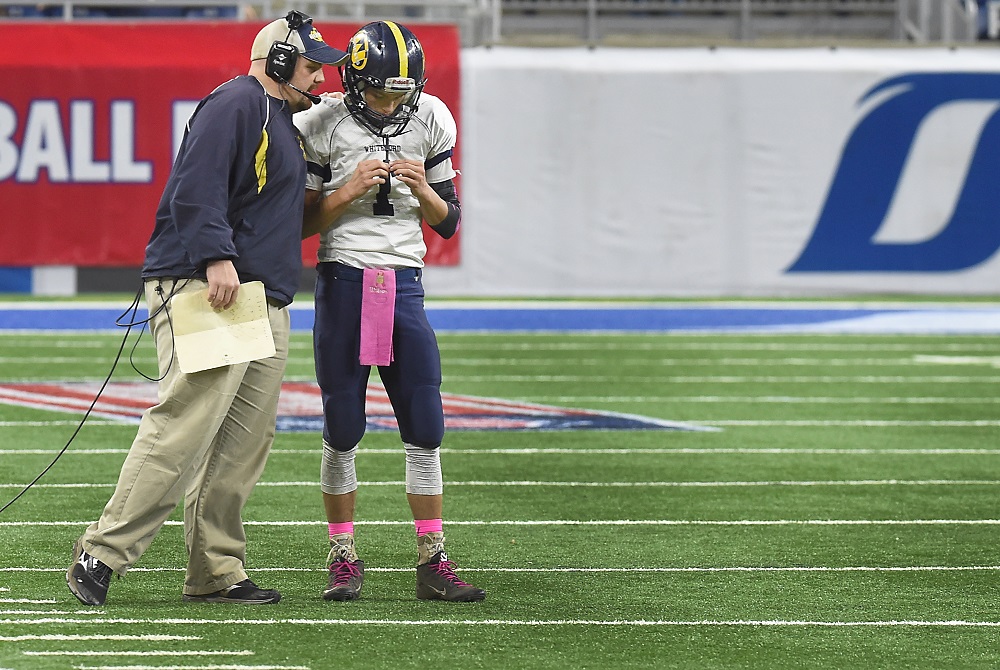
The formula was magic. Whiteford went 8-2 that first season under Mensing and tied a school record with nine wins in Year 2. By 2015, the Bobcats were in the MHSAA Semifinals for the first time. In 2016, Whiteford played at Ford Field for the first time. In 2017, Whiteford won a Division 8 championship. The Bobcats were a combined 93-24 during his decade running the program, including 11-2 this past fall.
“The reality is we do believe in our system,” Mensing said.
After 10 years, Mensing announced this week that he would be taking his system elsewhere. He will become the next head football coach at Westland John Glenn, a Class A school west of Detroit. The Rockets haven’t had much success in recent years, but school officials are excited to have Mensing on board.
“I’m excited to see what Jason can bring to our school and our program,” said John Glenn Principal Eric McCalla. “He is a culture builder. That’s one of the things we need here.”
McCalla is very familiar with Mensing. McCalla coached football for 16 years at Grass Lake and Manchester. At Grass Lake, McCalla’s team scrimmaged against Mensing’s for several years.
“It was definitely a great hire for us,” McCalla said. “We needed a different direction, and we feel confident that he is the right person for the job.”
Mensing, who will step down as athletic director and director of student advancement at Whiteford at the end of the school year, planned on meeting the John Glenn football players and parents this week. He will start immediately to build a coaching staff and relationships.
“They’ve struggled the last couple of years, but there is a solid history there,” Mensing said. “The first thing is I want is to bring stability and consistency to the program. They’ve had three football coaches in four years. We have to create an atmosphere where playing football is fun, create a culture where kids are excited about being part of the program.”
John Glenn has known football success. During the 1990s, John Glenn made several deep runs in the playoffs, reaching the Finals in 1993 and the Semifinals two more times.
The Rockets open the season Aug. 25 against Hartland in a nonleague game and play a challenging schedule in the always-tough Kensington Lakes Activities Association. They finished 2-7 last season and are seeking their first winning finish since 2014.
 “There’s no doubt that we play a tough schedule,” McCalla said. “In any given year we play one if not two or even three teams ranked in the top five or top 10. It’s a tough football conference.
“I think the first thing he can do is instill confidence in our kids. That is an important first step – and not just the kids, but the parents and the community. Having confidence in our program.”
Mensing was an academic All-American at Adrian College, where his father Henry Mensing coached and served as athletic director. Jason Mensing has made four other coaching stops during his 19-year career and picked up a lot of playoff appearances and coach of the year awards, and a built a lot of relationships.
He led Addison to the playoffs in his first season as varsity coach. He spent one year at Grayling, and won an Associated Press Class B Coach of the Year award during his three years at Owosso. He returned to Lenawee County to coach Tecumseh during the mid-2000s. In his one year away from high school football, he coached at Siena Heights University.
Whiteford lured him from the college level in 2012.
It wasn’t long before the milestone games and victories began piling up. Ironically, two Bobcats playoff losses were important steps in the team’s ascension. The first was a 2013 loss to New Lothrop in the Division 8 Regional Final. The Bobcats had beaten Sterling Heights Parkway Christian 59-6 and Detroit Allen Academy 61-20 in two home District games, then went on the road to face the Hornets, a powerhouse program.
“That loss was really big,” he said. “It showed us how far away we were but showed us what we needed to do to get there.”
Whiteford won seven games the following year, and in 2015 the Bobcats won three playoff games for the first time in school history, including a victory over a strong Climax-Scotts team. They lost the following week to Waterford Our Lady of the Lakes, but again, Mensing said, it was a loss that showed them the way.
“It was the moment we knew we belonged,” he said.
The Bobcats have ‘belonged’ ever since, proving not to be a one-and-done type program.
The 2017 team scored an incredible 737 points and punted just twice all season. The closest any opponent came was 16 points. Whiteford defeated Mendon in the Semifinals and Saginaw Nouvel in the Division 8 championship game.
Even in 2019 when the Bobcats went just 5-5, they upset a powerful Sand Creek team. Last year Whiteford reached the Division 8 Semifinals and led Hudson 22-0 at halftime before losing to the eventual champion, 28-22.
“There were some ups and downs,” Mensing said. “There were times we implemented things that didn’t necessarily work. Overall, though, we kept growing.
“When I look back at those years, the focus we started on growth and getting better year after year worked. We had 10 years of consistent growth. I do feel we are significantly more mature and better of a program than we were when I got here in 2012.”
Now, Mensing turns his attention to John Glenn, a school six times the size of Whiteford. He believes in the system he’s bringing with him and in the students at John Glenn.
“He’s a kid guy,” McCalla said. “We need people who are going to be there for our kids, not just football players, but all of our students. It’s not just about football, but life lessons.”
 Doug Donnelly has served as a sports and news reporter and city editor over 25 years, writing for the Daily Chief-Union in Upper Sandusky, Ohio from 1992-1995, the Monroe Evening News from 1995-2012 and the Adrian Daily Telegram since 2013. He's also written a book on high school basketball in Monroe County and compiles record books for various schools in southeast Michigan. E-mail him at [email protected] with story ideas for Jackson, Washtenaw, Hillsdale, Lenawee and Monroe counties.
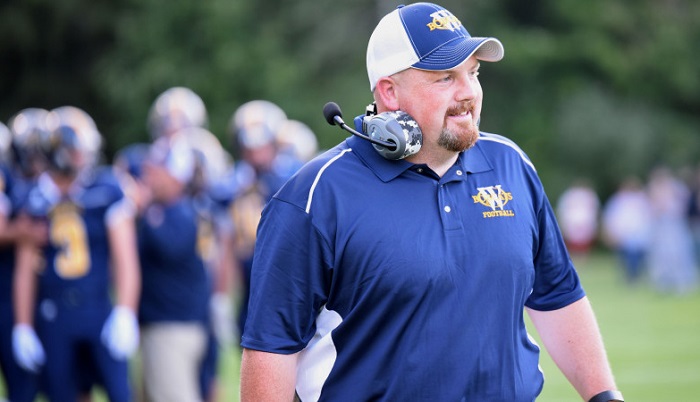
PHOTOS (Top) Coach Jason Mensing confers with a Whiteford player during one of the team’s two runs to Ford Field. (Middle) Mensing will be leaving the program after 10 seasons with the Bobcats. (Top photo by Tom Hawley/Monroe News; middle by Cari Hayes.)

1st & Goal: 2025 Week 4 Preview
By
Geoff Kimmerly
MHSAA.com senior editor
September 19, 2025
Could Week 4 be the one we look back on as the most important this regular season?
 It’s certainly possible.
The two biggest games this weekend might take place about 35 miles apart, as likely league title favorites in both the Detroit Public School League Blue and Catholic High School League Central face off. And several more conferences also eventually may recall tonight as the one that decided which schools add a trophy in October.
Scores for every game across the state this weekend will be posted on the MHSAA Scores page as they conclude. Tune into several on the NFHS Network, including those with “WATCH” linked below.
Bay & Thumb
Richmond (3-0) at Armada (3-0) WATCH
This decade has seen Armada join the contenders in the Blue Water Area Conference; the Tigers finished second last season with only a one-point loss to champion Almont. Richmond could be on its way to becoming a factor again. The Blue Devils last week defeated Croswell-Lexington, avenging last year’s 41-10 loss in defeating the Pioneers for the first time since 2019. Richmond also opened this season by avenging a 2024 loss to St. Clair – and hasn’t defeated Armada since 2019 as well.
Keep an eye on these FRIDAY Saginaw Swan Valley (2-1) at Bay City John Glenn (3-0) WATCH, Owosso (3-0) at Clio (3-0) WATCH, Holly (2-1) at Linden (3-0) WATCH, Bay City Western (2-1) at Midland Dow (2-1) WATCH.
Greater Detroit
Orchard Lake St. Mary’s (3-0) at Detroit Catholic Central (3-0)
Cass Tech/King this week should be another classic, but this is a rare instance when another Metro Detroit game carries similar clout. St. Mary’s is the reigning Division 2 champion but lost three Catholic High School League Central games last season including 27-22 to eventual champion DCC. The Shamrocks already have a win this fall over 2024 CHSL Central runner-up Toledo Central Catholic, but OLSM already has avenged last year’s loss to Warren De La Salle Collegiate – rebounding from a 10-point loss for a 39-point victory.
Keep an eye on these FRIDAY Detroit Cass Tech (3-0) at Detroit Martin Luther King (2-1), Sterling Heights Stevenson (3-0) at Macomb Dakota (3-0) WATCH, Gibraltar Carlson (3-0) at Trenton (2-1) WATCH, Dearborn Heights Robichaud (3-0) at Redford Union (2-1) WATCH.
Mid-Michigan
Grand Ledge (3-0) at Holt (2-1) WATCH
Grand Ledge has won three straight in this rivalry, starting with its Division 1 District Final matchup in 2022. But the Rams can make a nice statement to kick off the Capital Area Activities Conference Blue schedule, especially as they are seeking their first playoff berth since that fall. The Comets opened league play last week by downing East Lansing 45-27 after having fallen to the Trojans the last two seasons. Holt’s loss came in its season opener to reigning CAAC Red champion Mason.
Keep an eye on these FRIDAY Ovid-Elsie (2-1) at Durand (2-1) WATCH, Haslett (2-1) at Mason (1-2), Kalkaska (3-0) at Mount Pleasant Sacred Heart (2-1), Fowlerville (2-1) at Williamston (3-0) WATCH.
Northern Lower Peninsula
Kingsley (2-1) at Boyne City (3-0)
These two and Traverse City St. Francis shared the Northern Michigan Football League Legends championship last season, and all of that started with Kingsley’s 26-20 win over Boyne City. The Stags have won four straight against the Ramblers, including the last two with both back in the same NMFL division, but Boyne City last year didn’t lose again until the Division 6 Semifinals and has given up only 27 points total over its first three games this fall. Kingsley took a Week 2 loss to much-improved Gaylord but bounced back big last week against Grayling.
Keep an eye on these FRIDAY Mount Pleasant (3-0) at Traverse City Central (2-1), East Jordan (2-1) at Maple City Glen Lake (2-1) WATCH, Beal City (3-0) at McBain (2-1) WATCH, Shepherd (3-0) at Ogemaw Heights (2-1) WATCH.
Southeast & Border
Dexter (3-0) at Saline (3-0) WATCH
This matchup has played a major role in deciding the Southeastern Conference Red title the last three seasons. Dexter has scored at least 48 points in all three of its games so far this fall, including during a 50-27 opening win over Brighton. Saline started this season with a 37-28 win over Rockford and then has reached 50 points the last two weeks – while not allowing any.
Keep an eye on these FRIDAY Michigan Center (3-0) at Manchester (2-1) WATCH, Riverview (2-1) at Monroe Jefferson (3-0), Hastings (2-1) at Parma Western (1-2), Chelsea (3-0) at Tecumseh (2-1) WATCH.
Southwest Corridor
Battle Creek Pennfield (2-1) at Battle Creek Harper Creek (2-1)
Pennfield is 2-1 for the first time since 2021 and after winning one game all of last season, and last week’s 23-20 victory came over a Buchanan team that made the playoffs a year ago. A win over Harper Creek would be the Panthers’ first since 2020. The Beavers are reigning Interstate 8 Athletic Conference champions and bounced back from a Week 2 loss to Cedar Springs by downing Coldwater in a league opener.
Keep an eye on these FRIDAY Portage Central (3-0) at Battle Creek Central (2-1), Marshall (2-1) at Dowagiac (2-1), Plainwell (2-1) at Three Rivers (3-0) WATCH, Centreville (2-1) at White Pigeon (3-0) WATCH.
Upper Peninsula
Menominee (3-0) at Calumet (3-0) WATCH
The Maroons are marching again and looking to extend a winning streak over Calumet to four, with the last two wins coming in Western Peninsula Athletic Conference Copper play. Those two victories both came by at least 40 points, but the Copper Kings should make this a much closer game, off to their best start since 2019 and riding the momentum of a 33-18 win last week over Negaunee.
Keep an eye on these FRIDAY Kingsford (2-1) at Negaunee (2-1) WATCH, L’Anse (3-0) at Manistique (1-2) WATCH, Escanaba (3-0) at Sault Ste. Marie (0-3) WATCH, Houghton (1-2) at Ishpeming Westwood (0-3) WATCH.
West Michigan
Grand Rapids Northview (3-0) at Holland Christian (3-0) WATCH
It would be easy to argue East Kentwood/Rockford is a bigger game area-wide. But the Ottawa-Kent Conference Red looks full of those this season, and this O-K Black matchup may end up having larger league title implications. These two and Grand Rapids Catholic Central all have started 3-0, with two more teams 2-1. Northview defeated the Maroons last season 35-20 on the way to winning the league and finishing the regular season undefeated.
Keep an eye on these FRIDAY East Kentwood (3-0) at Rockford (2-1) WATCH, Muskegon Oakridge (3-0) at Ludington (3-0), Zeeland East (3-0) at Hudsonville Unity Christian (3-0), Cedar Springs (3-0) at Grand Rapids Kenowa Hills (3-0) WATCH.
8-Player
Martin (3-0) at Gobles (3-0) WATCH
This has become one of the most intriguing rivalries in all of 8-player over the last two seasons, with Gobles winning regular-season matchups both times but Martin then winning playoff rematches. The Tigers have continued their offensive surge of the last two seasons, putting up nearly 52 per game over their first three including 54 in a 22-point win over Climax-Scotts. Martin has averaged 55 points per over its first three games, but perhaps more notably hasn’t given up more than 20 in any contest.
Keep an eye on these FRIDAY Brown City (3-0) at Deckerville (3-0) WATCH, Fulton (3-0) at Portland St. Patrick (3-0), Colon (2-1) at Climax-Scotts (2-1), Britton Deerfield (2-1) at Concord (2-1) WATCH.
MHSAA.com's weekly “1st & Goal” previews and reviews are powered by MI Student Aid, a division within the Department of Lifelong Education, Advancement, and Potential (MiLEAP). MI Student Aid encourages students to pursue postsecondary education by providing access to student financial resources and information. MI Student Aid administers the state’s scholarship and grant programs that help make college Accessible, Affordable and Attainable for you. Click to connect with MI Student Aid and find more information on Facebook and Twitter @mistudentaid.
PHOTO East Kentwood's Ahman Edmonds bursts into the open during his team's Week 3 win over Jenison. (Click for more from High School Sports Scene.)