

All-time Hoops Winner Leads Another
By
Tim Robinson
Special for MHSAA.com
March 20, 2018
HARTLAND — When asked how many seasons he’s coached basketball, Don Palmer always is up front.
 The reactions are variations of shock and awe.
“How many seasons? 104?” a reporter asked after his most recent victory March 8.
“Seventy,” Palmer said.
“Seventy?” said the reporter, not suspecting a number that high.
Told the same number, Hartland senior Graysen Cockerham could only giggle in disbelief.
“That’s crazy,” sophomore Whitney Sollom said, joining in the laughter.
Seventy is quite a number at first blush, considering Palmer is only 67 years old.
But he coached boys and girls at Milford for 29 years and has been a head coach for 41 overall, the last nine at Hartland.
He has won 935 games, 588 with the girls, which has enabled him to become the winningest overall basketball coach in state history. The old record, 922, is believed to have been held by Ed Mehlberg of Auburn Hills Oakland Christian. As it turns out, both Palmer and Mehlberg were inducted into the Michigan High School Coaches Association Hall of Fame last September.
Palmer has coached countless players and their children as well as against coaches and their sons. On this year’s team he coached Sollom, whose mother, Dianne Hall, played against Milford while at Walled Lake Western; and Kamryn Gerecke, whose mother, Lori Montante, is Milford’s second-leading scorer all-time.
He’s won with and without talent on offense. And on defense, opposing coaches have learned to prepare in advance.
“I learned to do some prep work for those games,” former Brighton coach Jason Piepho said. “We would mix in different defenses in practice throughout the year. You couldn’t prepare for him for just two games a year, because you didn’t know what he would throw at you.”
Piepho learned that first-hand while playing for Howell a quarter-century ago.
“I remember the first time I played against him,” he said, laughing. “I was Howell’s point guard, and they threw a box-and-one against me. It was frustrating. It was the first time I’d seen that defense.”
Coach to the core
His Hartland girls finished 20-6 this winter, advancing to last week’s Class A Quarterfinals before falling to Wayne Memorial.
Palmer started coaching at Milford in 1974, the year he graduated from Michigan State University.
“I coached football a couple of years, freshman football,” he said. “I liked it, but I always wanted to be a head coach, so when the (girls basketball) job became open at Milford, I applied and got it. About a year later, the boys job came open and I applied and got it.”
For the next 29 years, until girls basketball moved to the winter beginning with the 2007-08 season, Palmer coached both sports.
 “It became a lifestyle,” he said. “We had girls in the fall and boys in the winter. We would do our boys (offseason) stuff in June and the girls stuff in July, and it just kept going.
“When they switched the seasons, I had to make a choice,” he said. “I chose girls because that’s where I started. It gave me a chance to be a coach at a young age. So that’s where my allegiance was. As I grow older, I could never do two seasons back-to-back.”
Palmer’s Milford teams of both genders were known for defense and an offense that could be described as patient or painfully slow, depending on one’s perspective.
“When we started out with the boys, it was a program that struggled mightily,” he recalled. “We would do whatever we had to do to stay in games, whether that be ball control or setting the tempo.”
“I think the biggest thing that Don has done is that he adapts how he plays the game to his talent,” said Lee Piepho, who coached girls basketball at Howell. “Sometimes you don’t like what he does in terms of his strategy, but his idea is, ‘I’m going to play whatever strategy on the court to help my team win the game. If that’s standing out there and holding the ball, putting my arm under it and go into the quarter tied at zero or leading 2-0, I’m going to do that.’”
Last season, Palmer adjusted to a team than loved to run up and down the floor and was good at it.
“I don’t mind the running game,” he said. “You weren’t holding (that team) back. You were doing a disservice if you did.”
Both Piepho and Palmer are fiery competitors, but Palmer once made Piepho laugh during a game.
“One night we were playing Milford with Sara (Piepho’s daughter, a point guard at Howell),” Lee recalled. “I got a little upset with Sara and I pulled her out of the game and was talking to her and Don hollered over, ‘If you don’t want her, I’ll take her.’
“We had her graduation party and invited Don over, and he brings Sara a pair of Milford practice shorts.”
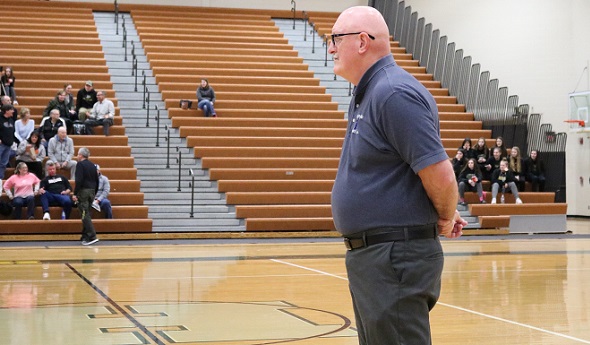
Palmer, at 6-foot with a shaved head and glasses, is an intimidating presence on the sideline during games. HIs players soon learn to look beyond that persona.
“I think most people, from a distance, see him and think he’s crazy,” Cockerham said. “But as players, we know he cares and wants us to be the best we can be. We appreciate it, because we need a coach to push us, and that’s exactly what he does. He expects nothing but the best for us, and that’s the way he gets it out of us.”
Mike McKay coached under Palmer at Milford for many years. He now is the varsity coach at Grand Blanc.
“He can be intense,” he said. “But off the court he does things he doesn’t want recognition for but does them for the betterment of his players. He takes care of the whole program.”
New challenge, no let up
After 32 seasons coaching at the only place he’d ever worked, Palmer’s contract was not renewed at Milford after the 2008-09 season.
He wasn’t out of coaching for long.
“When I left Milford, the Hartland coach, Brian Ives, had to leave because of work obligations,” Palmer said.
After years of struggling, the Hartland program was on the rise.
“We could beat them at the varsity level, but just barely,” Palmer said of coaching against the Eagles near the end of his Milford tenure. “The lower levels were just getting murdered. So we could see it coming.
“I told my coaches, ‘There’s going to be no excuse for not winning. None,’” Palmer recalled.
The Eagles have thrived under Palmer. In his nine seasons, his teams have won 20 or more games three times and got to the Quarterfinals twice over the last four seasons. He won 62 percent of his games at Milford. In nine seasons at Hartland, the Eagles have won 78 percent of their games.
“There just doesn’t seem to be any let up for a while,” he said, referring to the talent stream at Hartland. Indeed, five sophomores and two freshmen saw extensive time during the postseason for the Eagles this year.
But, he jokes, some old habits die hard.
“Even now, frequently, I’ll still write ‘Milford’ in a scorebook or something like that,” Palmer said. “I’m much, much better now. I’m a Hartland guy and a Livingston County guy, but it took a while. I coached 61 seasons over there. That’ll always be my school, but I do think that getting hired at Hartland was the best thing that happened to me under those circumstances. It’s been fabulous.”
Palmer’s coaching tree is expansive, and his list of admirers much more so.
“When we were winning and making runs in the state tournament, he went to all of our games,” Jason Piepho said. “He was always a coach you could call and talk to about things in your program. He’s an open book, willing to help and mentor. He’s what you want in a high school coach.”
“There are a lot of challenges that come with coaching,” McKay said. “A lot of people don’t like hearing the truth, and it’s hard to tell them. But he’s always honest and up front with his players and staff. He’s a first-class person and coach, and I admire him and try to emulate what he does.”
McKay just finished his second season with the Bobcats, and they beat Hartland in December in a key victory.
 “I didn’t like losing, but losing to him took the sting away a little bit because he was so happy and it was a big win for his program,” Palmer said. “So that helped. I’m proud of him, and he’s turning it around and he’ll be fine.”
Told this, McKay replied, “That tells you all you need to know about Don. He’s a class act. It was a great win for our program, but bittersweet for me. I look on him as a second father, and you always want to please your father. I know how badly he wanted to win and compete and how much I do, too.”
Howell girls coach Tim Olszewski had previously coached the Howell boys against Palmer’s Milford teams. In his last regular-season game as Howell coach, Olszewski’s Highlanders beat Milford 97-86.
“He was so mad at me,” Olszewski said, laughing. “He and his players were all red-faced, for different reasons.
“He’s a great coach and I love listening to him talk and pick his brain for things. He’s very well deserving of the record. Hopefully he’ll be around a lot longer.”
March continues
A lot has changed since Palmer’s first season as a varsity coach with the Milford girls back in 1977.
“As we kind of march on in time, you’ve got people playing 60 games in the summer,” Palmer said. “I think if we get in 30 games, that’s plenty. I do think this: More than ever, you’ve got to let kids be kids a little bit. We’re going to that specialization stuff, and I don’t think that’s great.
“People love to go to the next level, but it becomes a job,” he continued. “So this is the time to be a kid. This is the time to enjoy sports. Basketball is always my love, but I enjoyed football. I enjoyed track, and I think kids, well, it’s just how it is. There are outside forces. Everyone says they have a college athlete, and the percentages say they don’t.”
Specialization, he adds, not only cuts into individual opportunities to learn, but also hurts teams that could use those athletes.
“Unless you have a gigantic high school, all of your athletes have got to play a couple of sports, or you don’t survive,” he said.
As he gets older, Palmer sees the end of his career approaching, although he’s not there yet.
“I just go year-by-year,” he said. “Part of the compromise my wife and I made for me to continue (coaching) is that we’re going to travel a little bit more. She likes that, and so we’ve got some plans. After the season is over, we’re going to take a trip to Dallas. I’m a Kennedy assassination buff, and she just wants to see Dallas.”
Asked if he will be back next year, he nods his head.
“Right now, that’s the feeling, I guess,” he said. “If everything works out, I would like to at least finish with Whitney. That’s a gift, to coach a kid like that. But eventually you have to make a decision. Right now, my energy is up, but when the season is over, I go into a meltdown for a month where I don’t do much. Just don’t have the energy. It takes more and more out of you every day.
“But it’s still fun when you’re in the heat of battle. It’s still fun.”
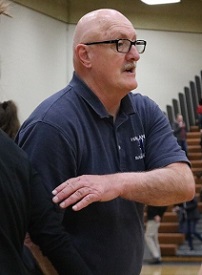
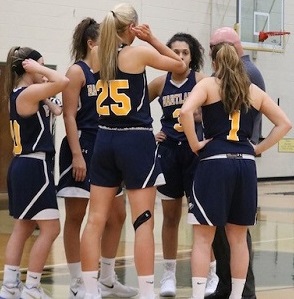
PHOTOS: (Top) Hartland girls basketball coach Don Palmer stands for the national anthem before a game at Howell last month. (Middle) Palmer, also during the game against the Highlanders. (Below) Palmer talks with his team during a timeout. (Photos by Tim Robinson.)
Eagles' Ace Has Scoring Record in Sight
February 8, 2018
By Doug Donnelly
Special for Second Half
ERIE – The Liedel family barn in Erie has been home to some great basketball battles the past few years.
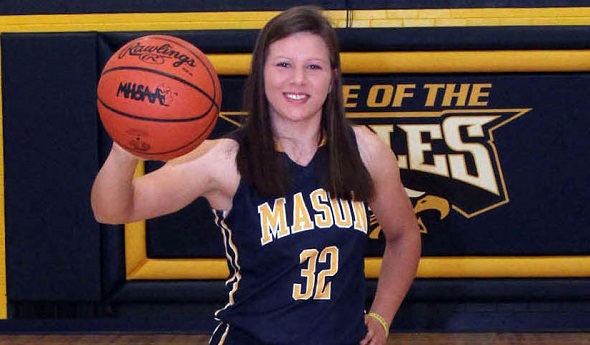
 It’s also the home court for soon-to-be all-time Monroe County Region scoring champ Mary Liedel.
A senior, Liedel is in her fourth season playing for Erie Mason. She will enter Friday’s scheduled game against Onsted with 1,657 career points – just eight points shy of the all-time Monroe County Region record of 1,665 points set by Petersburg-Summerfield’s Melissa Taylor during the 1990s.
It’s ironic the 5-foot-10 senior guard could set the record against Onsted. It’s against the Wildcats that she scored 51 points in a game last year to break the Monroe County single game mark.
“I just love the game,” Liedel said. “There is just something about it. God gave me the talent to go out and play basketball, and I want to return the favor for Him. I just play my heart out for Him.”
Those games in her barn, against some of her nine siblings, helped turn Liedel into a superstar scorer.
“In our barn, we always play one-on-one,” Mary said. “My brother, Joey, and I play a lot of one-on-one. He’s really helped my game.”
Joey is a sophomore and the leading scorer on the Eagles boys basketball team. Mary has led the Eagles in scoring since her freshman year. After averaging 8.8 points a game that season, her scoring average ballooned to 24.2 points a game as a sophomore. Still, she saw room for improvement.
“My shooting percentage wasn’t where I wanted it to be,” she said. “I worked hard on that all summer. My game has grown tremendously. Even last year I didn’t shoot very well on 3-pointers. I worked hard all summer shooting to get that percentage up.”
Her junior year, she scored 585 points and was named Player of the Year by The Monroe News and second team all-state by The Associated Press. She was held below double figures just once all season. Besides the 51-point outburst, she had games of 44, 33, 32 and 30 – all while shooting 40.1 percent from the floor and 66.1 percent from the free throw line. She got to the free throw line 242 times. Three times she attempted at least 20 free throws in a game.
Blissfield head coach Ryan Gilbert called her the “ultimate competitor.”
“She’s a very humble person,” Gilbert said. “Her ability to finish around the rim and through contact is the best I have seen since I have been here.”
Another area of her game that she wanted to improve was rebounding. That mission was accomplished as she had 14 double-doubles as a junior, including a career-high 22 rebounds in one game.
Onsted head coach Brandon Arnold said that 51-point game was remarkable. Liedel was 23-for-29 from the free throw line and made 13 field goals.
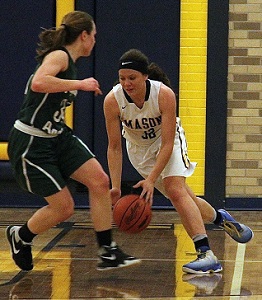 “On that night she was un-guardable,” he said. “She was hitting from the 3-point line as well as her shots in the paint. She put her team on her back. She finished well, used her body to create contact, and made a lot of free throws.”
This season started out with an impressive 46-point performance against Ypsilanti Lincoln when she made all seven of her 3-point attempts. While averaging 22.5 points a game, she has increased her rebounding to 11.5 a game and also leads the team in steals, blocked shots and assists.
“I think I’m stronger and I jump higher, and I’m playing down low a lot more,” she said of her rebounding.
Tuesday, against Hillsdale, Liedel had what might be her best all-around game. She recorded her first ever triple-double with 30 points, 13 steals and 10 rebounds.
“I think it was for sure one of my best games,” she said. “I had a good defensive game with a lot of steals.”
Erie Mason head coach Josh Sweigert called it one of her most complete games.
“That game just shows what a complete player she is,” he said. “Not only did she score 30 points, but she also accumulated 13 steals by being in the right place and using her great understanding of the game to make those plays.”
Liedel is the fourth player in Monroe County Region history to pass 1,600 career points. Taylor scored two more points than Whiteford’s Karen Hubbard totaled during the 1970s, and Kiara Kudron also scored more than 1,600 points for New Boston Huron. With at least five games remaining, Liedel is likely to set a new standard that will be hard for any athlete to catch.
The Eagles have steadily improved as a team during Liedel’s time on the court, from three wins her sophomore year to a 12-4 record this season. Erie Mason won’t win the Lenawee County Athletic Association crown – Ida has already wrapped it up – but is focused on winning a District.
“That would definitely be cool,” she said. “We have a good team and a good chance. We’re really focused on that. It’s been really fun this season.”
Liedel has been in contact with some small colleges in Michigan as she considers continuing her playing career.
“I for sure want to play at the next level,” she said. “I’m just undecided where right now.”
Sweigert has had a front row seat to watch Liedel as the Eagles head coach. He continues to be impressed by her talent and work ethic.
“Mary is one of the hardest working players I have ever seen,” he said. “She is the first one in the gym and the last one to leave. She pushes herself and her teammates during practices to be the best that they can be. It would be very easy to be satisfied with where she is due to the success that she has had, but that is just not how she is. She wants to be the best player that she can be.”
As for becoming the career scoring leader in Monroe County, Liedel says that isn’t something she’s concentrating on.
“I could care less about the stats, or points or breaking records,” she said. “I just go out and try and do everything I can for us to win as a team. I’d do anything for the team.”
 Doug Donnelly has served as a sports and news reporter and city editor over 25 years, writing for the Daily Chief-Union in Upper Sandusky, Ohio from 1992-1995, the Monroe Evening News from 1995-2012 and the Adrian Daily Telegram since 2013. He's also written a book on high school basketball in Monroe County and compiles record books for various schools in southeast Michigan. E-mail him at [email protected] with story ideas for Jackson, Washtenaw, Hillsdale, Lenawee and Monroe counties.
PHOTOS: (Top) Erie Mason’s Mary Liedel is drawing closer to setting her area’s career scoring record. (Middle) Liedel works to get past a defender. (Photos by Angie Ayers.)