

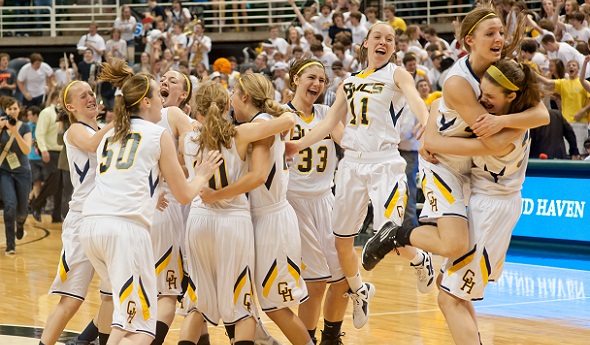
Class A: Comeback Classic
March 17, 2012
EAST LANSING – Shar’Rae Davis had one thought when she received the ball with only a few seconds remaining and Grand Haven’s first championship on the line in Saturday’s MHSAA Class A Final.
She saw the rim on Breslin Center’s north basket. And she knew she had 12 seconds to reach it.
“I didn’t even see the rest of my team. So I was like, I’ve got to score,” Davis said. “That was my mentality.
Not only did Davis race the length of the court; she drove to finish the third-longest comeback in MHSAA Girls Basketball Finals history.
Davis completed her lay-up with six seconds to play. Grosse Pointe South couldn’t connect on its final last-second attempt. And the only thing Davis was a second late for was the start of the celebration: Grand Haven 54, Grosse Pointe South 53.
“When I made the basket, I thought it was tied or something. I was looking around for the timeout. Nothing was happening,” she said. “Then I saw Abby (Cole) jump, everyone run at me. I still didn’t believe it. I had to look at the score.”
Believe it: Grand Haven won its first MHSAA championship after surviving a harrowing double-overtime Quarterfinal against East Lansing, and a late rush by 2011 champion Inskter in Friday’s Semifinal.
But Saturday’s comeback topped them both.
Starting at the end of the first quarter, Grosse Pointe South led for 24 minutes, 5 seconds straight. The Blue Devils’ advantage reached 18 points with 1:51 to go in the third quarter.
“Obviously things weren’t looking good for us down 18. It was another nightmare,” Buccaneers coach Katie Kowalczyk-Fulmer said. “But there was a lot of time left on the clock. And we just talked about getting back into it one possession at a time. You can’t get it all at once. We couldn’t foul just to foul because we knew if the game was going to come down to free throws and we put them at the line, we wouldn’t have a chance.”
Instead, she directed her players to deliver the ball repeatedly to Cole.
The 6-foot-5 junior scored nine of her 18 points over the final 9:38 of the game, including seven straight free throws as the Devils tried to keep her from getting any closer to the hoop (she also had eight rebounds and eight blocks). Davis scored 14 of her game-high 19 points during that 27-10 run.
But those efforts still nearly weren’t enough.
Reeling a bit after giving up the big lead, Grosse Pointe South got a jolt of hope from freshman guard Cierra Rice. Grand Haven took its first lead in two quarters with 1:10 to play, and held a two-point advantage with 24 second to go when Rice dropped in a lay-up, was fouled, and made the free throw to give the Devils back a one-point edge.
But after Davis’ ensuing full-court scoring run, the last attempt by the Devils didn’t fall.
Only Farmington Our Lady of Mercy in 1982 (19 points) and Detroit Cass Tech in 1987 (20) made bigger championship game comebacks than Grand Haven – both to win Class A titles as well.
“We knew we could do anything because of that Quarterfinal game,” Grand Haven senior Alex Law said of the 42-40 win over East Lansing. “It was crazy, but that gave us so much confidence. I was like, ‘Let’s go, we can do this. We’ve got this. It’s our last game. Let’s do it right.’”
Grand Haven finished 27-1, losing only to East Kentwood – a loss the Buccaneers avenged later in the season. They were ranked No. 1 heading into the postseason.
Grosse Pointe South (23-4) was only an honorable mention heading into playoffs. But that didn’t make Saturday any less heart-breaking.
Four Blue Devils scored at least 10 points, led by Rice with 14 and junior Claire DeBoer with 13. Three grabbed at least 10 rebounds – Senior Caitlin Moore had 12 to go with her 12 points, and senior Catherine Palazzolo had 10 to go with her 10 points as Grosse Pointe South outrebounded the taller Buccaneers by 19.
But nine of the Blue Devils 19 turnovers also came during that final Grand Haven run, caused in large part by the Bucs’ “monster” press defense, as they call it. It produced monstrous – and championship – results.
“The past couple of games when the pressure got on, we haven’t always handled it well. And they making the adjustment and really going inside, throwing into the big girls, definitely hurt,” Blue Devils coach Kevin Richards said. “What can you say? We made plays all but right at the very end. We had a great effort and the gameplan worked. We just need to have a little bit better ball security.”
Click for the box score. Watch the game and both teams' postgame press conferences at MHSAA.tv.
PHOTOS: (Top) Grand Haven celebrates its first MHSAA championship. (Photo courtesy of Terry McNamara Photography.)
Countdown to Calvin: Girls Report Week 2
December 17, 2018
By Geoff Kimmerly
Second Half editor
Calendar year 2018 is drawing to a close, but anticipation is just starting to ramp up as girls basketball teams head into the holidays.
 For many, there won’t be much of a break as they prep to play in a number of showcase events around the state.
Saturday saw the Best of Michigan Classic at Detroit Edison and a number of top Division 1 and 2 teams compete – we highlighted a few of those below. Similar events will follow over the next three weeks, before the schedule shifts to league competition and taking the next steps toward playing meaningful games at the end of February and into March.
Countdown to Calvin is powered by MI Student Aid and based on results and schedules posted for each school at MHSAA.com. To offer corrections or fill in scores we’re missing, email me at [email protected].
Week in Review
The countdown of last week’s five most intriguing results:
1. Detroit Renaissance 61, Ypsilanti Arbor Prep 38 – The Phoenix bounced back from an opening loss to Harper Woods Chandler Park to down Division 3 contender Ypsilanti Arbor Prep at the Best of Michigan Classic at Detroit Edison.
2. Columbus Africentric Early College (Ohio) 65, Detroit Edison 60 – We don’t usually highlight a Michigan team’s out-of-state loss, but falling by only five to an Ohio power with a University of Tennessee recruit featured by Sports Illustrated last month is still quite a showing.
3. East Lansing 45, DeWitt 41 – With the first of two regular-season meetings this close, it’s a good bet these two will determine a league champion and possibly more again this winter.
4. Southfield Arts & Technology 68, Flint Carman-Ainsworth 55 – A&T is a two-point loss to Saginaw Heritage from a 4-0 start, and Carman-Ainsworth is another well-respected team from Division 1.
5. Corunna 54, Goodrich 53 – Last week was an early indication this could be a special season for the 4-0 Cavaliers. In addition to beating the always-contending Martians, Corunna finished with an overtime win over Flint Hamady.
Watch List
With an eye toward March, here are two teams in each division making sparks:
DIVISION 1
• Brighton (3-0) – After three straight 14-win seasons, the Bulldogs could be candidates to take another step and enter Kensington Lakes Activities Association West play as one of three unbeaten teams. Brighton opened with a two-point win over Marquette at Petoskey and has followed with two double-digit wins including a 23-pointer over Okemos last week.
• Wayne Memorial (2-0) – The Zebras graduated a Miss Basketball finalist from last season’s Class A semifinalist team but haven’t missed a beat. They opened last week nearly doubling up Division 2 hopeful Williamston and then beat Illinois power Chicago Whitney Young 71-56 at the Best of Michigan Classic.
DIVISION 2
• Comstock (3-0) – The Colts have one of the state’s sharpest shooters in 1,000-point scorer Daisy Ansel and should have high aspirations after last season’s 19-2 run. Comstock is looking to first three-peat in the Berrien-Cass-St. Joseph Conference Red and finished its week with a 58-31 win over reigning league runner-up Niles Brandywine.
• Edwardsburg (4-0) – The Eddies haven’t lost a league game the last two seasons and earned their first Wolverine Conference South win this winter against Three Rivers on Friday. Edwardsburg, coming off a 22-2 run, has three wins by 20 or more points so far – with the fourth victory a three-pointer over Southwestern Michigan Athletic Conference West co-leader Portage Central.
DIVISION 3
• Adrian Madison (4-0) – Last season saw the end of Madison’s six-season hold on the Tri-County Conference title; the Trojans finished second. But they bounced back into league play last week with a big win over Sand Creek coming off solid nonconference showings versus Blissfield and Hudson.
• Ishpeming Westwood (5-0) – The Patriots opened with an overtime win over Menominee and have just kept rolling. Last week’s 66-40 win over rival Ishpeming avenged last season’s District loss, and at this rate Westwood soon should be circling Jan. 18 and Feb. 15 dates with also-unbeaten Negaunee.
DIVISION 4
• Martin (3-0) – The Clippers improved five wins last season to 13-11 and tied for fourth in the Southwestern Athletic Conference Lakeshore. Over this season’s first two weeks, Martin has beaten Saugatuck – the other fourth-place team from last winter – and avenged two losses to last season’s runner-up Coloma with a 46-40 victory.
• Onaway (3-0) – The Cardinals are making their move early after finishing 10-10 last season. They beat Posen by 10 in their opener after losing twice to the Vikings last winter, and last week’s 40-26 win over Central Lake further avenged an early 2017-18 defeat.
Can't-Miss Contests
Be on the lookout for results of these games coming up:
Thursday – Plymouth (3-0) at Brighton (3-0) – These two look early like possible favorites in the KLAA West; Plymouth was second in the former Black and Brighton third in the Gold last season.
Thursday – Macomb Dakota (4-0) at Grosse Pointe North (3-1) – These two shared the Macomb Area Red title last season before North won their Regional meeting by two on the way to making the Class A Semifinals.
Friday – Freeland (3-1) at Saginaw Heritage (3-0) – Heritage is, of course, the reigning Class A champion, and Freeland is always one of the best from the Saginaw area as well.
Saturday – Detroit Edison (3-1) vs. Detroit Country Day (1-2) at Lawrence Tech – Country Day won Class B last season, and Edison won C and could be the Yellowjackets’ biggest obstacle in the new Division 2.
Saturday – Ypsilanti Arbor Prep (4-1) at Muskegon Oakridge (3-0) – The Gators’ tour of the state’s best heads west, where Oakridge is yet to have a game closer than 17 after going 22-4 a year ago.
Second Half’s weekly “Countdown to Calvin” reports are powered by MI Student Aid, a part of the Student Financial Services Bureau located within the Michigan Department of Treasury. MI Student Aid encourages students to pursue postsecondary education by providing access to student financial resources and information, including various student financial assistance programs to help make college more affordable for Michigan students. MI Student Aid administers the state’s 529 savings programs (MET/MESP) and eight additional aid programs within its Student Scholarships and Grants division. Click for more information and connect with MI Student Aid on Facebook and Twitter @mistudentaid.
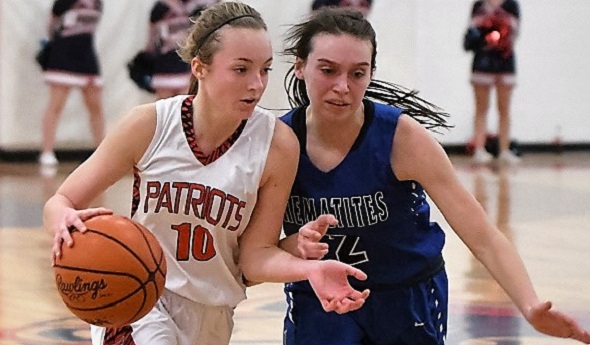
PHOTO: Ishpeming Westwood's Madelyn Koski (10) drives to the basket last week with Ishpeming's Emma Poirier (2) defending. (Photo by Cara Kamps.)