

Edison Claims Rematch, Chance to Repeat
March 15, 2018
By Geoff Kimmerly
Second Half editor
GRAND RAPIDS – All nine Detroit Edison players who saw the floor in last season’s Class C championship win over Pewamo-Westphalia were back for Thursday’s Semifinal at Calvin College’s Van Noord Arena.
But there was a clear difference in the rematch after the Pioneers won last year’s meeting by two points.
Edison freshman guard Damiya Hagemann might not have been the only reason her team advanced this time with a 50-39 victory. But there’s no question she brings another dimension to a roster that includes one of the state’s best juniors in Rickea Jackson, a top sophomore in Gabrielle Elliott and a number of other contributors who have helped the Pioneers become known as arguably the best team in the state, regardless of class.
Hagemann had 13 points, three assists, two steals and only two turnovers – providing a noticeable boost to go with Jackson’s 25 points and seven rebounds.
“She adds everything – an ability to attack the rim, she brings the mental toughness, physical toughness,” Jackson said. “Overall, she’s a really great guard. And the chemistry we have together, it makes the game easier.”
Edison (23-1) will face Ypsilanti Arbor Prep in Saturday’s 4 p.m. championship game.
The Pioneers never outscored P-W (25-1) by more than four points in a quarter Thursday. But overall, the Pirates’ 39 points were their second-fewest this season. P-W entered the game outscoring its opponents by nearly 41 points per game.
 “It’s tough to lose in the Finals and Semifinals, but what a great story to play a team that’s going to go down with probably one of the best four-year runs in Michigan state basketball (history),” P-W coach Steve Eklund said. “And we’re going to be able to say we battled with them twice. Three of those girls are going to play Big Ten basketball or play in the WNBA someday, and we’ll say we played them one day and we were right there with them.”
Elliott also grabbed 10 rebounds as Edison as a team outrebounded P-W 35-23. Sophomore guard Shaulana Wagner – the player who moved to the bench with Hagemann’s arrival this season – grabbed seven more in 18 minutes as the most active of the team’s subs.
“She’s a wonderful kid. She told me when Damiya came it didn’t mater if she started or not,” Edison coach Monique Brown said. “We talked heavily about starting roles. … Their job and role was to come in and change the magnitude of game, and they accepted that role. Although she’s not starting, she plays starting minutes. She’s out there at the end of the game, every time we have a close game.”
There have been only a few. P-W played the Pioneers closer than all but four opponents this season – especially impressive considering Edison’s schedule included five games against teams playing at Calvin this weekend in Class A, B or C.
But the Pirates had a hard time coming closer, in part because they struggled with usually reliable 3-point shooting. P-W made only 4 of 19 long-range shots Thursday, as opposed to about 40 percent coming into the game.
Emily Spitzley, one of only two seniors on the team, led with 14 points, seven rebounds and four assists. Sophomore Ellie Droste added 11 points.
After falling in its District opener in 2015, P-W went on to win its District in 2016 before launching the two straight runs to Finals weekend.
“Just thinking back on the four years I’ve had playing with this team, I wouldn’t trade it for the world,” Spitzley said. “From where we were freshman year to now, it’s totally flip-flopped. We got so much better and really built a name for ourselves, being a top team in the state and playing with the best teams out there.”
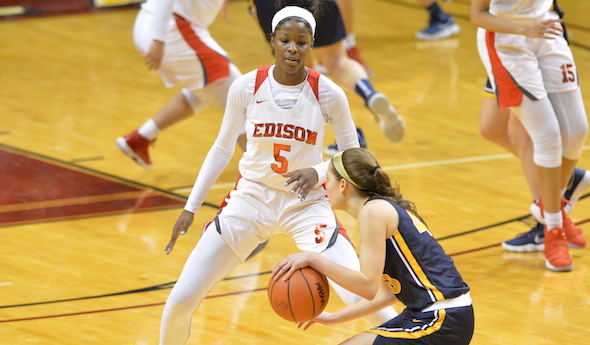
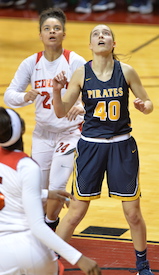
PHOTOS: (Top) Edison's Rickea Jackson applies defensive pressure during Thursday's first Class C Semifinal. (Middle) P-W's Ellie Droste (40) and Edison's Shaulana Wagner get in position for a possible rebound.
Breslin Bound: Girls Report Week 3
December 17, 2012
By Geoff Kimmerly
Second Half editor
As a general rule, basketball teams evolve plenty between the first games of December through the final regular-season contests in February.
But these pre-break matchups matter just as much in the win-loss columns. And a number of games are being played right now that will surely make a difference as this season draws to a close.
This week's report includes some of the teams that have came out on the winning ends of key December battles. (Results and records based on those reported to Score Center at MHSAA.com)
1. Inkster (4-0) – The Vikings are a regular at Breslin Center and made the Class A Semifinals last season, so another great start is hardly surprising. But it's proof why Inkster remains a force – last week’s wins were 51-45 over improved Detroit Mumford and 57-51 over always-powerful Detroit Pershing.
2. Waterford Our Lady (3-1) – The reigning Class D champion has bounced back quickly from an opening-night loss to West Bloomfield. Last week, Our Lady beat Livonia Ladywood 50-38 and Mount Pleasant Sacred Heart by the same score.
3. Detroit Martin Luther King (3-0) – This is another team always in the Class A mix, and it got a big win Saturday – 56-48 over returning Class A Semifinalist Ann Arbor Huron, which earlier in the week had defeated Detroit Country Day 65-58. King also beat Detroit East English 61-7.
4. Johannesburg-Lewiston (5-0) – The Cardinals lost only two regular-season games last season, both times to Ski Valley Conference rival Gaylord St. Mary. But they got a little bit of revenge last week with a 50-48 win over St. Mary after also beating East Jordan 57-43.
5. Holt (5-0) – The Rams are again setting up nicely to contend in the strong Capital Area Activities Conference Blue. They beat nonleague foe St. Johns 52-48 and then Lansing Everett 48-39 to keep early pace with other frontrunners Grand Ledge and East Lansing.
6. Napoleon (5-1) – Napoleon’s 15-7 finish in 2011-12 included splits against Michigan Center and Grass Lake. The Pirates got an early upper hand on both last week, beating Michigan Center 49-45 and Grass Lake 47-42.
7. Traverse City St. Francis (4-1) – The Gladiators opened last season 14-1, with that lone loss to Cadillac – which they beat last week 55-50. St. Francis also defeated Kalkaska 44-36 on Friday.
8. Pewamo-Westphalia (3-2) – The Pirates got off to a rough start with opening-week losses to Class B Williamston and Lakewood. But back in familiar territory in the Central Michigan Athletic Conference, they've won three straight – including 51-42 last week over returning Class D Semifinalist Portland St. Patrick.
9. North Farmington (3-1) – The Raiders are coming off a 10-12 season that included a pair of losses to Pontiac. But North Farmington earned the early edge this time with a 59-58 win over Pontiac, followed by a 58-48 win over West Bloomfield.
10. Powers North Central (5-1) – After opening with a 13-point loss to returning Class D Semifinalist Crystal Falls Forest Park, North Central hasn't fallen again. The Jets beat Stephenson 62-51 and Munising 50-22 to get nearly halfway to last season’s win total of 11.
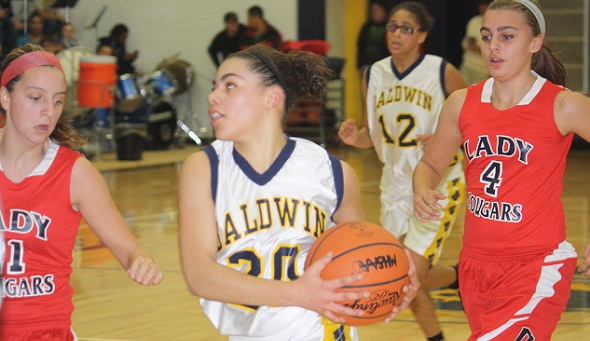
PHOTO: Big Rapids Crossroads (in red) defeated Baldwin on Thursday to move to 4-0 this season. (Click to see more at HighSchoolSportsScene.com.)