

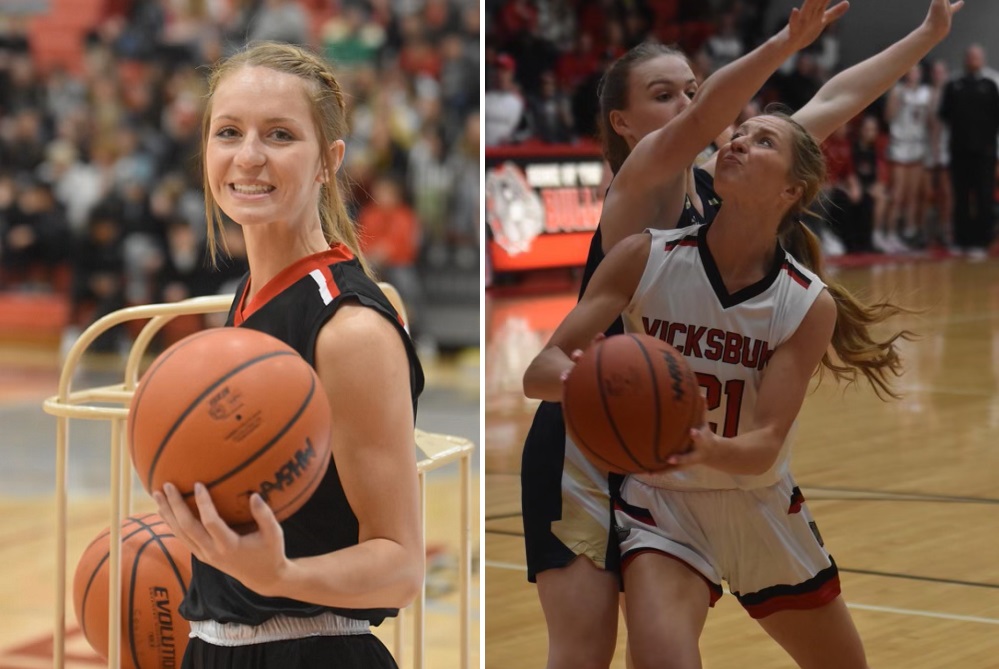
Fearful Start Behind Her, Abnet Continuing to Amaze for Undefeated Vicksburg
By
Pam Shebest
Special for MHSAA.com
February 7, 2023
VICKSBURG – It is not often that a mother calls her child’s concussion a blessing, but it certainly was for Vicksburg senior Tristin Abnet.
 The concussion, sustained her freshman year during a volleyball game, led to tests which led to the discovery of a brain tumor.
Luckily, the tumor was benign and, after the surgery and a long recovery, Abnet is one of two seniors on the undefeated girls basketball team that has set a program record this winter for most wins in a season at 16 and counting, eclipsing the previous mark of 15.
And when it comes to Abnet’s journey over the last three years, Bulldogs coach Tim Kirby said it’s been nothing short of amazing.
After taking a hit during a volleyball game, “I actually got a concussion and I ended up with a headache for about a month or so,” Abnet said.
“I didn’t think too much of it because I always got injuries and always got over them. But this one scared me a little bit.”
It was not until she was playing in a college exposure softball tournament that November that she realized something more was going on.
“Tristin was an up-and-coming softball athlete throughout the country,” her dad, Cheyenne, said. “She won many national championships up to her freshman year (in travel softball).
“We were playing at a college exposure tournament, and she was the youngest on the team. The third day (of the tournament) she started crying because her headache was so bad. She asked me if I would take her out.”
Her mother, Kristina, added, “That was so unlike T. She would battle through anything.”
At that moment, they knew something was terribly wrong.
“She was only making it through maybe two days of school every week because of headaches,” Kristina said. “We took her to her family doctor (in November), and they weren’t comfortable with everything.
“Her doctor (Rosa Maira) said she felt it necessary to do further imaging. Had she not, we’d still never know.”
 The wait during the imaging dragged on, causing a bit of concern for her parents.
“They kept her for so long, and I said there’s something wrong – Mother’s intuition,” Kristina said.
“Then they came out and took us back and showed us what they found and asked to do further testing. Everything snowballed after that.”
Finding out about the tumor, “My world crashed,” Kristina said, with tears in her eyes. “(In 2011) I had a lot of tumors, desmoid tumors, and to think of the battle I went through and the fact that it was on her brain, it was tough.”
In March, doctors performed a biopsy, finding Tristin’s tumor was a low-grade glioma, which is benign.
“We all lost it that day,” Kristina said. “We had our entire family there for her first surgery in March. We left (the hospital) three days later, and then COVID hit.”
With classes online, “She ended up not having to go back to school that year, so that was a blessing too.”
The surgery to remove the tumor was scheduled for August 2020, and during the months between the biopsy and surgery, Tristin said, “I didn’t want to freak myself out because I knew it was coming, I knew what was going to happen and there was nothing I could do about it.”
Her dad said Tristin “never cried in front of me from the day at the tournament all the way to the day of her surgery.
“She was so, so strong, and she was just a little girl. I never saw a tear until they were ready to wheel her away for the surgery.”
One worry for Tristin was the chance of losing her hair to facilitate the craniotomy.
“First they told me they were going to shave my head halfway back and then, as I was getting wheeled back, there were two girl nurses talking about what they were going to do with my hair, so I knew they weren’t going to completely shave my head,” Abnet said.
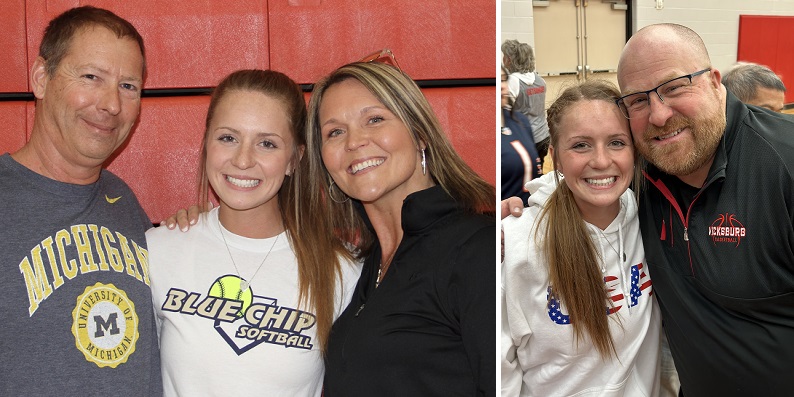 The surgery lasted 13 hours at Helen DeVos Children’s Hospital in Grand Rapids, and three days later she was headed home to her bedroom decorated by friends and family.
At first, Tristin was allowed no competition for six months after the surgery. But after a CT scan, doctors added another two months before giving her the OK to play.
“There are (three) metal plates there, that’s why she could not go back to sports for such a long time because that plate had to heal,” her dad said.
Although she could not play basketball her sophomore year, she found a way to stay involved: She became the varsity team manager.
“As a sophomore she literally was here for every practice and every game, even though she wasn’t allowed to participate,” Kirby said.
“At the end of the season, her team unanimously voted her “best teammate” on the entire team, and she couldn’t play. I think that’s a testament to the kind of person she is and the impact she had on the team.”
After taking a year off and after major surgery, Abnet had a lot of catching up to do, both physically and mentally, during her junior year, her coach said.
“Last year, you just wanted to make sure you kept her safe,” Kirby noted. “This year, I haven’t worried about it as much because she’s been through it and we’re all more comfortable with it.
“She knows what her limitations are. Last year, I was a little more leery about it.”
Tristin worked her way back into shape.
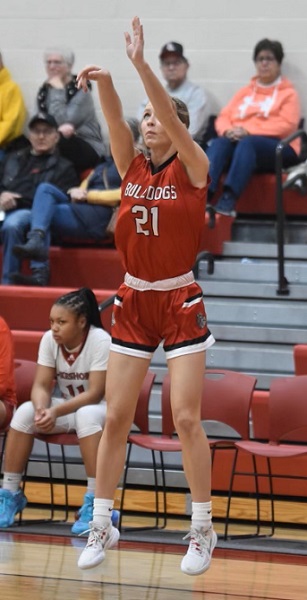 “She goes to the gym four days a week,” her mom said. “She’s literally built up about 10 pounds of muscle.
“She lost 35 pounds after her brain surgery. She went from being a fit athlete to being very tiny, very fragile.”
Those first few games back last year were also nail-biters.
“I was absolutely terrified,” her mom said. “One hit to her head and her forehead could concave.”
They were a bit daunting for Tristin as well.
“I was super, super nervous because I didn’t want to get hit in the head and have to go through that surgery again,” she said.
Her dad added that the surgery changed her.
“She’s not the athlete she was four years ago; she’s not, and that’s fine,” Cheyenne said. “It took me a while as Dad, as (softball) coach, to understand that. I’m proud of her.”
Through it all, she never let her grades suffer and carries a 4.13 GPA.
She is also called the team “mom,” taking snacks to road games and putting out reminders every day in the team’s group chat.
“She inspires me every single day,” Kirby said. “When you’re a young team, you have to have that leadership. She’s a great leader for us. She bonds everybody together.”
That bonding is one thing that is so special about the Bulldogs, Kirby said.
“They work hard every day and they share the basketball like nobody I’ve ever seen before,” he explained. “Every night, someone else leads us in scoring.
“I’ve had seven different girls lead us in scoring this year, and I don’t have anyone averaging 10 points a game right now.”
Amanda Laugher joins Abnet as the team’s seniors. The young roster also includes juniors Brooklynn Ringler, Emma Steele and Maddison Diekman and sophomores Scarlett Hosner, Kendra Cooley, Emily Zemitans, Makayla Allen and Hannah Devries.
As for the school record, that was not the team’s goal at the beginning of the season.
“Our goal this year is to win the (Wolverine) Conference championship,” Kirby said. “Vicksburg has never won a conference championship in girls basketball. That was our No. 1 goal this year.
“We host our District this year, so we’re hoping maybe to follow up a conference championship with a District championship. You get to that point, and it’s all gravy.”
 Pam Shebest served as a sportswriter at the Kalamazoo Gazette from 1985-2009 after 11 years part-time with the Gazette while teaching French and English at White Pigeon High School. She can be reached at [email protected] with story ideas for Calhoun, Kalamazoo and Van Buren counties.
PHOTOS (Top) Vicksburg’s Tristin Abnet is glad to be back on the court, and intense going to the basket. (2) Stitches stretched across Abnet’s scalp as three metal plates and a hinge were applied to her skull. (3) Abnet is surrounded by support including parents Cheyenne, left, and Kristina, and coach Tim Kirby. (4) Abnet launches a jumper during a game with Stevensville Lakeshore. (Photos courtesy of the Abnet family.)
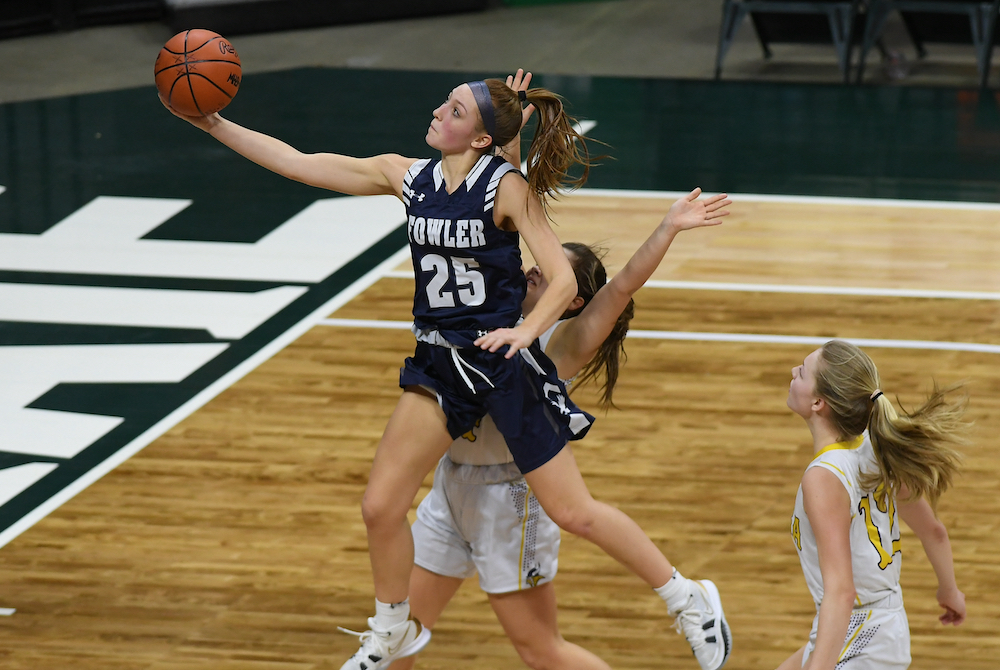
Riley Sisters, Fowler Hold Off Baraga Rush to Earn Repeat Opportunity
By
Dean Holzwarth
Special for MHSAA.com
March 17, 2022
EAST LANSING – With Thursday night’s Division 4 Semifinal hanging in the balance, Fowler coach Nathan George knew who he could count on.
In fact, he knew two players he could look lean on in tense moments, and they happen to be from the same family.
Emma and Mia Riley made clutch free throws during the final minute to stave off a furious comeback attempt from upset-minded Baraga.
The Eagles hung on to defeat the Vikings 51-45 at the Breslin Center and advance to the Finals for the second straight year as they seek to repeat as Division 4 champions.
“They play a lot of basketball, so there’s not a lot of situations where they get truly overwhelmed,” George said. “So I had confidence in them that they were going to hit free throws. It got crazy late, but we were lucky the ball bounced our way and we were able to put the game away.”
Mia Riley, a senior, delivered a double-double with a game-high 24 points and 11 rebounds, while Emma, a junior, had 17 points and nine rebounds.
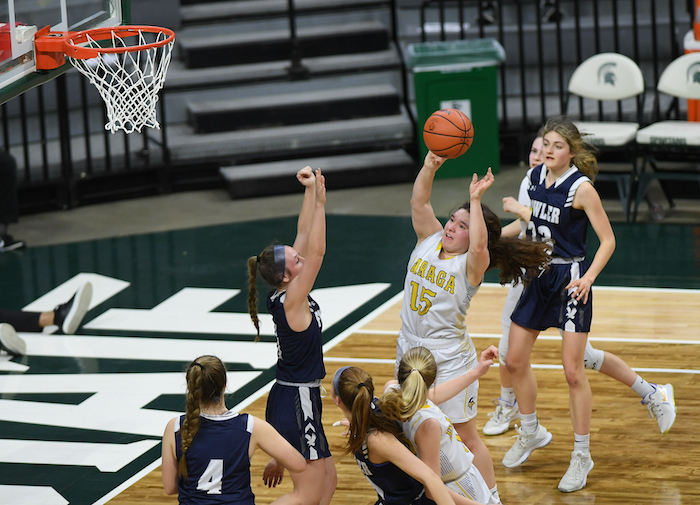 Clinging to a one-point lead (45-44) with 54 seconds left, Mia Riley made a pair of free throws to extend the lead.
After Baraga’s Reide Osterman made 1 of 2 free throws, it was Emma Riley’s turn with 29 seconds left, and she too calmly knocked down both to give the Eagles a four-point cushion.
“It’s like everything you’ve ever practiced for and it makes all that hard work pay off when you can be in that position and finally get the chance to prove yourself,” Mia Riley said. “That was the time to step up, and I’m thankful that I did it.”
Said Emma Riley: “It was pretty scary to be up there and just knowing that we needed the free throws, but we just had to do exactly what we always practice and they should fall.”
Fowler (23-3) will have the opportunity to repeat as Division 4 champion facing Plymouth Christian Academy in Saturday’s 10 a.m. Final.
“Since we've been here before, we’re somewhat used to playing at the Breslin so it’s kind of a comforting thing to know that we’ve been here and we’ve done it before,” Mia Riley said. “We can do it again, and we have those capabilities. It’s a lot nicer since we can have the stands filled and it's not so quiet like last year.”
Fowler built a commanding first-quarter lead as its defense forced turnovers that led to easy baskets on the other end.
Avery Koenigsknecht knocked down a 3-pointer at the buzzer to cap a 12-0 run as the Eagles held a 17-4 advantage.
Baraga trimmed the deficit to 28-18 by halftime and got as close as one from the lead twice during the decisive fourth quarter.
“Give Baraga a lot of credit because they played a good game and probably worked harder than us overall,” George said. “That's something I didn’t expect, and we need to be much more focused and play with more energy come Saturday. I fully believe we will, but I hope this was a wake-up call for the girls and I know it was for me.”
Baraga (23-2) was making its first trip to the Semifinals since 1992, and was the only Upper Peninsula school to make it this far this week.
First-year coach Tyler Larson was proud of his team’s effort in nearly erasing the early double-digit deficit and upsetting the reigning champion.
“Just a tough one,” Larson said. “We didn’t come out the way we wanted to, but we kept it close enough where we could hang around in the second half.
“It was like a boxing match with taking turns swinging and landing punches. We climbed our way back, and I’m very proud of the way the girls handled a little adversity on such a big stage. We just fell a little short in the end.”
Osterman, a senior, led the Vikings with 17 points and nine rebounds, while sophomore Makenna Hendrickson added eight points and eight rebounds.
PHOTOS (Top) Fowler’s Mia Riley (25) drives the lane during Thursday’s Division 4 Semifinal win at Breslin Center. (Middle) Baraga’s Kylie Michaelson (15) gets a shot up over the Eagles’ defense. (Click for more from Hockey Weekly Action Photos.)