

No Disappointment for Arbor Prep
March 17, 2016
By Geoff Kimmerly
Second Half editor
EAST LANSING – She needed about a month. But by the end of last April, Nastassja Chambers got over Ypsilanti Arbor Prep’s loss in the 2015 Class C Semifinals.
 This weekend, she and her teammates are one step closer to avoiding disappointment – and then some.
The Gators set themselves up for a first championship in school history Thursday by returning to the Semifinals and downing Ithaca 72-44 at the Breslin Center.
Arbor Prep learned its share of lessons from last season’s four-point loss to eventual runner-up Flint Hamady. And they played all season to earn Saturday’s opportunity to face Traverse City St. Francis for the Class C title.
“That motivated us a lot. We’ve been talking about it all year,” Chambers said of the Hamady loss. “Every game we scheduled this year was to prepare us for now. So we made the schedule even harder than last year so we’d be ready this year. (And) we’ve been here before, so we’re not that nervous.”
Top-ranked Arbor Prep did play, arguably, the toughest schedule of any team in Class C this season. The Gators (23-2) beat two top-five teams in Class B and filled the schedule with larger schools including the reigning champions in Class B and Class A.
After a first quarter Thursday played nearly to a draw – Arbor Prep led at the end by one, 16-15 – the Gators unleashed what they’d learned over the last 12 months and a lot of what they’ve become known for over the last few seasons.
Arbor Prep outscored Ithaca 50-15 over the second and third quarters, taking advantage of 20 turnovers over those 16 minutes by scoring 30 points off those takeaways.
“That’s our style of play,” Chambers said. “We get the ball up the court, push it and run. We do good on the 3-on-2 fastbreak, the 2-on-1 fastbreak – that’s our bread and butter.”
Ithaca also suffered an unfortunate loss during the second quarter that surely affected ball security when senior point guard Brooklyn Dolloff was sidelined with a painful sprained ankle.
She had totaled four points – making both of her shots – two rebounds and an assist in her seven minutes, numbers that would’ve translated well over an entire game. Her absence also forced Ithaca – playing in its first Semifinal after also winning its first Regional title – to shift players into less familiar positions and roles.
 “It was very upsetting. My coach even said, when it first happened, that I was more upset that I was going to be out than (because of) the pain,” said Dolloff, a three-year varsity player. “I really wanted to be there for my team.”
Arbor Prep, meanwhile, hit its stride. Although Ithaca made 50 percent of its shots for the game, it got off only 34 – half as many as the Gators.
Arbor Prep coach Rod Wells said his team focused on shooting this winter after making only 33 percent of its attempts from the floor during the 2015 Semifinal. This time, the Gators made 42 percent in addition to cutting their turnovers from 12 last season to seven.
“Energy, anticipation and just playing together. The ladies trust each other now,” Wells said. “We’ve been talking about trust all year. When you put pressure on the ball you can feel like you’re on an island. But the ladies understand that someone’s got your back.
“They remember the pain last year. I remember waking up Saturday morning and I didn’t know what to do. That feeling, they were feeling the same way. We just put it into our practices. Every time they ran a sprint or something, and didn’t reach our goal, we talked about it. Our goal was to get to Breslin, but not just get here – we’ve seen how it looks. But to win it.”
Chambers had 24 points, six assists and seven steals, making 10 of her 15 shots from the floor. Junior guard Ro’zhane Wells added 11 points, and junior guard Adrienne Anderson had 10 points, four steals and three assists.
Sophomore center Kayla Belles had 16 points, seven rebounds and three assists to lead the Yellowjackets (24-3), and junior center Maddie Brock added 11 points.
Ithaca entered the postseason ranked No. 7 and had its best season despite finishing only 5-16 three years ago, and then losing coach Bob Anderson midseason this winter when he retired due to health issues.
“We talked about it in the locker room; we said this feeling is not a good feeling. It kinda stinks,” said Ithaca coach Jessie Rayburn, who took over for Anderson after assisting him prior to his departure. “However, all the feelings leading up to it were pretty cool. And our community is awesome.”
The Girls Basketball Finals are presented by Sparrow Health System.
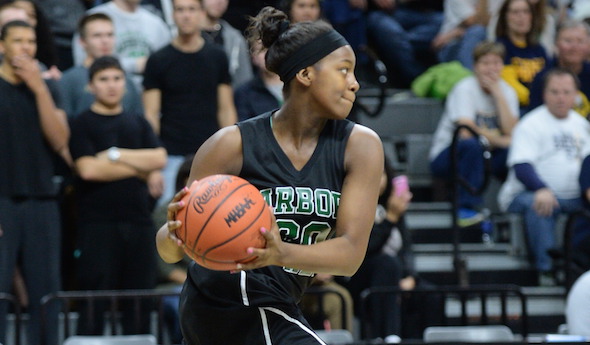
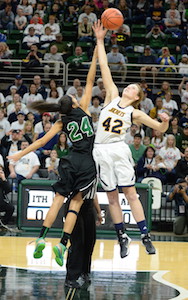
PHOTOS: (Top) Arbor Prep’s Cydney Williams pushes the ball upcourt during Thursday’s Class C Semifinal. (Middle) The Gators’ Kayla Knight (24) and Ithaca’s Kayla Belles grab for the opening jump.
Breslin Bound: Girls Report Post-Break
January 8, 2013
By Geoff Kimmerly
Second Half editor
Many of the girls basketball teams impressing us most this season are those we're used to watching march to the Breslin Center every winter.
But others are popping back on the radar in a big way for the first time in a few years – and this week's list includes a few of those as well.
The following 10 teams were among those most impressive while school was out these last few weeks. Records and scores are based on those submitted to the MHSAA.com Score Center.
1. Muskegon Oakridge (11-0) – Oakridge now has won 24 straight regular-season games including a pair at this season’s Oakridge Holiday Tournament, an event it did not win a year ago.
2. Southfield-Lathrup (7-0) – The Chargers have been expected to dominate, and they’re making good on that forecast. Their only close game was still a 51-45 win over a solid Ypsilanti Arbor team.
3. Flat Rock (8-0) – The Rams showed signs of this ability going 16-7 last season. A 47-44 win over a strong Eaton Rapids team is among those most impressive so far this winter.
4. Center Line (6-0) – After opening last season 3-0 and finishing with just four wins total, the Panthers have won all of their games this winter by at least 20 points.
5. Goodrich (7-1) – On one hand, Goodrich lost for the first time since the end of the 2010-11 season. On the other, that loss came to Twinsburg, Ohio, meaning the Martians still haven’t lost to an in-state team in more than a year – and beat Class A power East Lansing the day before that defeat.
6. Grosse Pointe South (6-0) – It’s been hard not to mention this reigning Class A Semifinalist yet. And 15 and eight-point wins on back-to-back days over Livonia Ladywood and Brownstown Woodhaven made it even tougher to wait any longer.
7. Freeland (6-0) – Michigan State recruit Tori Jankoska and her teammates are favorites to make another run at Class B after reaching the Semifinals last season. A one-point win over Grosse Pointe Woods University Liggett should build some momentum for that effort.
8. Calumet (6-1) – This volleyball school is showing some skills on the basketball court as well and is already halfway to last season’s win total. On Thursday, Calumet handed L’Anse its first loss this winter.
9. Saginaw Valley Lutheran (5-1) – The Chargers have been elite for a few seasons now, and can add a 69-40 win over much larger Saginaw Arthur Hill to recent accomplishments. Their only loss this season was to Freeland on opening night.
10. Saginaw Nouvel (6-1) – The frequently-powerful Panthers are off to another nice run. They bounced back from that lone loss, to undefeated Reese, with a 46-44 win over Dearborn Divine Child.
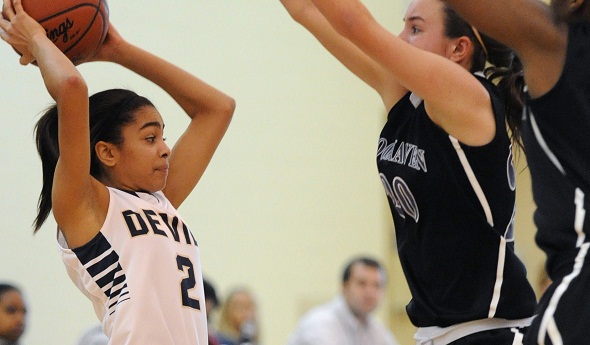
PHOTO: Grosse Pointe South's Aliezza Brown looks for an open teammate while being guarded by multiple Brownstown-Woodhaven players during a win at the end of December. (Click to see more at HighSchoolSportsScene.com.)