

Performance: Muskegon's Mardrekia Cook
January 27, 2016
 Mardrekia Cook
Muskegon senior – Basketball
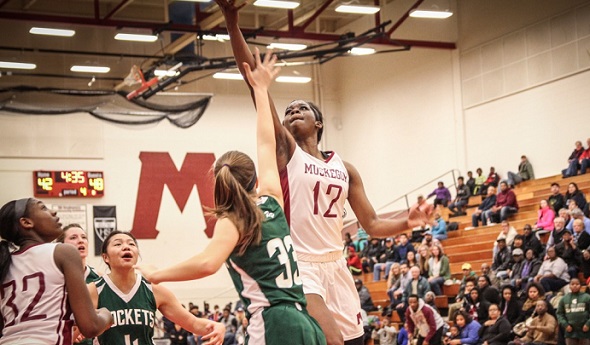
During her four seasons at Muskegon, Cook has contributed at every position and in a variety of ways. Her variety of skills and strength as a leader, in addition to elite talent, all were on display last week during one of the most statistically impressive two-game stretches of a memorable career – earning her the Michigan National Guard “Performance of the Week.”
Cook, a 6-foot point guard who also has played on the wing and in the post for the Big Reds, had 26 points and 22 rebounds as Muskegon came back from a 15-point deficit to defeat East Kentwood 50-47 on Jan. 19. She finished the week with 21 points, 11 rebounds and 11 assists Friday in a 72-27 win over Grand Rapids Union. Muskegon is 8-2 this winter and tied for second in the Ottawa-Kent Conference Black, and 52-28 over her four seasons with two league and one District championship.
 She averaged 22 points and 14 rebounds per game as a junior, when she went over 1,000 points for her career. This winter, she’s taken those contributions to another level, averaging 27 points and 16 rebounds per contest. After earning all-state honorable mention as a freshman and sophomore, Cook made the first team last season and is a likely frontrunner for the Miss Basketball Award, which will be given to the state’s top senior in March after a vote by the Basketball Coaches Association of Michigan. Cook has signed to continue her career at Michigan State University and carries a 3.3 grade-point average. She is considering studying sports administration or sports medicine.
Coach Rodney Walker said: “She has taken the needed approach to learning on and off the court. She has accepted the responsibility of being a role model in the community and for future Lady Reds. She has learned how to play all five positions, and that has helped her understand the game. She has owned the responsibility of running our team as the primary point guard. … Mardrekia is one of the most caring, unselfish, and complimentary players for her teammates. And fans watching her play may not understand anything about her humble spirit! I truly believe that she has so much more room to grow. She has not reached her full potential yet. Once she attends Michigan State University, and matures, she will begin to transform into one of the most unbelievable players that we have ever seen in the girls game.”
Performance Point: “I just go out with the mindset of winning, willing to do anything to help my team win. I never really go into a game with a gameplan like, ‘Mardrekia, these games you could drop 50 points.’ A lot of people want me to make a statement and drop 50 – but if you can have 20 points, 22 rebounds, 11 assists, I’ll take that over 50 points. Scoring just shows you can score; that shows you’re an all-around player. I didn’t have any idea that number (of rebounds against East Kentwood) was that high. After the game, our stat keeper came up to me and said I had a monster game. I just like to be all over the place (and) I love to rebound.”
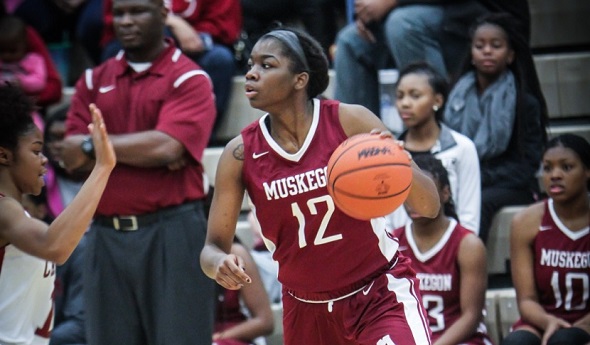
Complete player: Walker noted how Cook combines strong ball handling skills with the ability to get to the basket, but also see the floor and get all of her teammates involved – products of a high basketball IQ. Cook’s favorites of her many skills are her ability to penetrate and rebound. “I’ve always had the strength of going to the hole and finding gaps. And rebounding, I can jump. I don’t even think I boxed out (against East Kentwood). I just out-jumped everybody. I can probably put my wrist over the rim; I’ve gotten a dunk down before.”
 Watching and learning: “When you watch basketball, you observe all the spots. You have to have a high IQ, see the whole floor at times. Stephen Curry, Maya Moore, Kevin Durant … I just love them. I love that Stephen Curry isn’t that big – he’s actually really small – but he’s got so much heart, the definition of heart. Kevin Durant is an all-around player. He can push the point, he can shoot, play inside. And Maya Moore is not human for a girl; she can do everything and she’s won at every level.”
Spartans will: “I just love it there. A lot of people talk about family, but they don’t really mean it. But when I went (to visit MSU) around summer time, everybody – football players, volleyball players, basically every sport – was in the weight room mixed up, pushing together, wanting every sport to dominate.”
Big Reds rising: “I’ve never been so confident in my players. I see us going really far and I would love to play on Michigan State’s floor before I get there. Definitely my goal is to get there. We still have work to do, but I see us getting pretty far.”
– Geoff Kimmerly, Second Half editor
Every week during the 2015-16 school year, Second Half and the Michigan National Guard will recognize a “Performance of the Week" from among the MHSAA's 750 member high schools.
The Michigan Army National Guard provides trained and ready forces in support of the National Military Strategy, and responds as needed to state, local, and regional emergencies to ensure peace, order, and public safety. The Guard adds value to our communities through continuous interaction. National Guard soldiers are part of the local community. Guardsmen typically train one weekend per month and two weeks in the summer. This training maintains readiness when needed, be it either to defend our Nation's freedom, or protecting lives and property of Michigan citizens during a local natural disaster.
Previous 2015-16 honorees
Jan. 20: Sage Castillo, Hartland wrestling - Read
Jan. 13: Rob Zofchak, Dexter swimming & diving - Read
Jan. 6: Tyler Deming, Caro wrestling – Read
Dec. 15: Jordan Weber, East Jordan boys basketball – Read
Dec. 8: Kaitlyn Geers, Kent City girls basketball – Read
PHOTOS: (Top) Muskegon’s Mardrekia Cook finishes a drive against Muskegon Reeths-Puffer. (Below) Cook directs the Big Reds’ offense as point guard, but has played on the wing and post as well during her high school career. (Photos courtesy of the Muskegon girls basketball program.)
Breslin Bound: Girls Report Week 3
December 17, 2012
By Geoff Kimmerly
Second Half editor
As a general rule, basketball teams evolve plenty between the first games of December through the final regular-season contests in February.
But these pre-break matchups matter just as much in the win-loss columns. And a number of games are being played right now that will surely make a difference as this season draws to a close.
This week's report includes some of the teams that have came out on the winning ends of key December battles. (Results and records based on those reported to Score Center at MHSAA.com)
1. Inkster (4-0) – The Vikings are a regular at Breslin Center and made the Class A Semifinals last season, so another great start is hardly surprising. But it's proof why Inkster remains a force – last week’s wins were 51-45 over improved Detroit Mumford and 57-51 over always-powerful Detroit Pershing.
2. Waterford Our Lady (3-1) – The reigning Class D champion has bounced back quickly from an opening-night loss to West Bloomfield. Last week, Our Lady beat Livonia Ladywood 50-38 and Mount Pleasant Sacred Heart by the same score.
3. Detroit Martin Luther King (3-0) – This is another team always in the Class A mix, and it got a big win Saturday – 56-48 over returning Class A Semifinalist Ann Arbor Huron, which earlier in the week had defeated Detroit Country Day 65-58. King also beat Detroit East English 61-7.
4. Johannesburg-Lewiston (5-0) – The Cardinals lost only two regular-season games last season, both times to Ski Valley Conference rival Gaylord St. Mary. But they got a little bit of revenge last week with a 50-48 win over St. Mary after also beating East Jordan 57-43.
5. Holt (5-0) – The Rams are again setting up nicely to contend in the strong Capital Area Activities Conference Blue. They beat nonleague foe St. Johns 52-48 and then Lansing Everett 48-39 to keep early pace with other frontrunners Grand Ledge and East Lansing.
6. Napoleon (5-1) – Napoleon’s 15-7 finish in 2011-12 included splits against Michigan Center and Grass Lake. The Pirates got an early upper hand on both last week, beating Michigan Center 49-45 and Grass Lake 47-42.
7. Traverse City St. Francis (4-1) – The Gladiators opened last season 14-1, with that lone loss to Cadillac – which they beat last week 55-50. St. Francis also defeated Kalkaska 44-36 on Friday.
8. Pewamo-Westphalia (3-2) – The Pirates got off to a rough start with opening-week losses to Class B Williamston and Lakewood. But back in familiar territory in the Central Michigan Athletic Conference, they've won three straight – including 51-42 last week over returning Class D Semifinalist Portland St. Patrick.
9. North Farmington (3-1) – The Raiders are coming off a 10-12 season that included a pair of losses to Pontiac. But North Farmington earned the early edge this time with a 59-58 win over Pontiac, followed by a 58-48 win over West Bloomfield.
10. Powers North Central (5-1) – After opening with a 13-point loss to returning Class D Semifinalist Crystal Falls Forest Park, North Central hasn't fallen again. The Jets beat Stephenson 62-51 and Munising 50-22 to get nearly halfway to last season’s win total of 11.
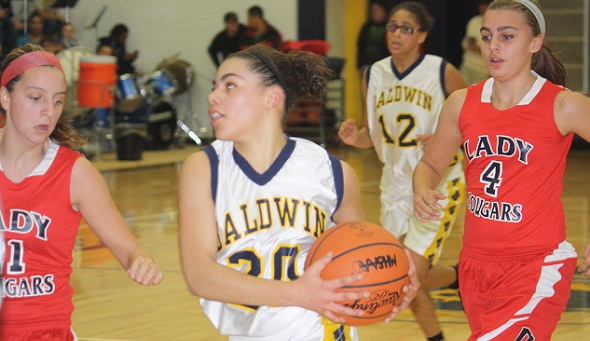
PHOTO: Big Rapids Crossroads (in red) defeated Baldwin on Thursday to move to 4-0 this season. (Click to see more at HighSchoolSportsScene.com.)