

Renaissance Rises Again in Detroit PSL
By
Tom Markowski
Special for Second Half
February 16, 2017
DETROIT – Detroit Renaissance has had one of the top girls basketball programs in the Detroit Public School League for some time.
 The Phoenix reached an MHSAA Final (Class B) for the first time in 1996. In 2005, Renaissance won its only title (also in Class B) with Diane Jones serving as head coach and current head coach Kiwan Ward a member of her staff. Renaissance reached the Class A Final in 2010 and 2011, also with Ward as an assistant coach.
The Phoenix are 14-3 this winter, having lost to Detroit Martin Luther King in a PSL semifinal 56-47 on Feb. 8. They are enjoying another successful season even after graduating one of the top players in the state in 2015-16, now-Penn State freshman Siyeh Frazier, and despite the challenges of a changing landscape in PSL girls hoops.
While Ward believes the distance between the PSL’s most and least successful programs has grown in recent years, Renaissance remains stable. In her sixth season as head coach, Ward has 11 varsity players and continues to field a competitive junior varsity while others in the league are having a tough time doing the same.
“We have good chemistry,” senior Victoria Wright said of this year’s team. “It’s our defense that helps us win. The bond we have on and off the court is special. We always have a good time together.”
All eight of the Phoenix's league wins this winter were by double figures, and in six of those wins they held opponents to 25 or fewer points.
Renaissance’s only other losses this season were twice to Detroit Mumford, which will play King for the PSL title Saturday. (Renaissance and Mumford both finished 8-2 in league play to tie for first in the PSL West Division 1, but Mumford because of its sweep of the Phoenix earned the league title and a top seed in the PSL Big D Tournament.)
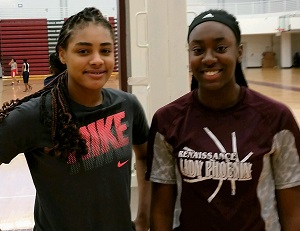 Despite graduating Frazier, the Phoenix returned three starters from last season’s 14-5 team and are more balanced this winter. They are led by seniors Wright and Nina Reynolds; Wright is averaging 14 points and eight rebounds per game, and Reynolds is averaging 12 points and 10 rebounds.
In addition to its PSL success, Renaissance also owns a 15-point win from December over Southfield Arts & Technology, the leader in the Oakland Activities Association Red and another expected Class A contender.
A game of that caliber has helped the Phoenix as the degree of parity in girls basketball in the PSL has shifted of late, creating challenges for some of the strongest programs.
It’s the drop-off in many others that has hurt teams like Renaissance, Detroit Cass Tech, Detroit King and Detroit Mumford that remain the most competitive. There are just four PSL programs that sponsor a junior varsity, which leads to scheduling difficulties, as Ward has seen players leave for schools outside the city.
Ward said she doesn’t blame parents for sending their children to other Wayne County schools with open enrollment. Ward said uncertainty within the Detroit Public Schools as to which schools will remain open and which will close has parents on edge.
It’s reported that as many as 24 schools in DPS will close this year. Rumors abound which schools will close, but at this time they are just that: rumors.
“Look at it from a broader point of view,” Ward said. “The talent is watered down (in the PSL). I remember when I (played) at Detroit Benedictine. We looked forward to playing PSL teams. Every game was competitive. No disrespect to anyone, but it’s hard for the girls to get geeked-up when you beat someone 74-11.”
That was the score when Renaissance won in the first round of the PSL playoffs, defeating a former league power now in the midst of a tough run.
It’s different for the boys, where competition remains high. Sure, there aren’t powerhouse teams like Detroit Southwestern and Detroit Cooley of the late 1980s and early 1990s (although Detroit Western and Henry Ford both won their first MHSAA boys titles over the last two seasons), but there aren’t nearly the number of one-sided games in league play as there are for the girls.
 “There are eight to 10 teams on the boys side that are good,” Ward said. “With Cass Tech being down this year, we have like three good teams.”
Wright said she hopes to continue playing at the next level, possibly at Coastal Carolina. She said playing teams like King, Mumford and Southfield Arts & Technology brings out the best in her and her teammates.
Last season King defeated Renaissance in the PSL final, 68-66, to win its fifth consecutive league title.
“When you win by so much, it’s tough to play those games,” she said. “The competitive nature just isn’t there. It’s not that we’re not trying hard.
"It makes a big difference when you play those tougher teams."
Still, the top of the PSL remains strong – Renaissance included. King is expected to contend for its sixth Class A title under coach William Winfield and after finishing runner-up a year ago. Mumford also could make noise again in Class B.
Ward isn’t concerned about her program. It’s the others she’s worried about.
The Phoenix will finish their regular season next week against Detroit Country Day and Romulus before starting District play.
“The future in the PSL is uncertain,” Ward said. “For us, we’ll continue to get better.”
 Tom Markowski is a columnist and directs website coverage for the State Champs! Sports Network. He previously covered primarily high school sports for the The Detroit News from 1984-2014, focusing on the Detroit area and contributing to statewide coverage of football and basketball. Contact him at [email protected] with story ideas for Oakland, Macomb and Wayne counties.
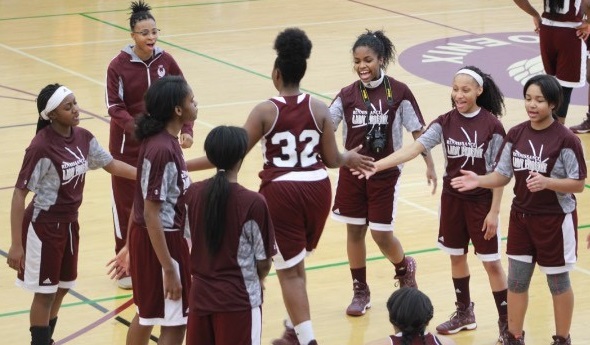
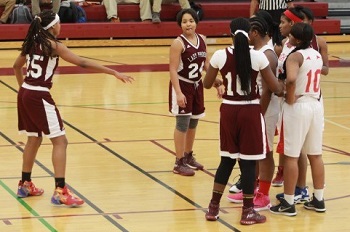
PHOTOS: (Top) Detroit Renaissance starters are introduced during a game this season. (Middle) Nina Reynolds (left) and Victoria Wright. (Below) The Phoenix set up their defense. (Photos courtesy of the Detroit Renaissance girls basketball program.)

Be The Referee: Alternating Possession
December 18, 2019
This week, MHSAA assistant director Brent Rice offers a "You Make the Call" regarding alternate possession, or lack thereof, on the basketball court.
Be The Referee is a series of short messages designed to help educate people on the rules of different sports, to help them better understand the art of officiating, and to recruit officials.
Below is this week's segment - Alternating Possession - Listen
With the basketball season now underway, let’s test your rules knowledge with this "You Make The Call."
A game starts with the jump ball. The possession arrow gets set after one team establishes possession. However, on this jump ball, a player for each team tangles for the rock and creates a held-ball situation. You make the call. Remember, alternate possession does not apply yet.
In this case of dual possession of the original jump ball, without the possession arrow being set, a second jump ball of the two players involved is the result, and the game clock does not reset to the beginning of the period.
Past editions
Dec. 12: Ratings - Listen
Dec. 5: Video Review Success - Listen
Nov. 28: More Injury Time - Listen
Nov. 21: Football Review - Listen
Nov. 14: Sideline Safety - Listen
Nov. 7: Officials Playlist - Listen
Oct. 31: Most Important Line - Listen
Oct. 24: Automatic 1st Downs - Listen
Oct. 17: Catch Momentum - Listen
Oct. 10: Golf Rules Changes - Listen
Oct. 3: No Tackle Box - Listen
Sept. 26: You Make the Overtime Call - Listen
Sept. 19: Swimming Finishing Touch - Listen
Sept. 12: Curbing Gamesmanship By Substitution - Listen
Sept. 5: Football Safety Rules Changes - Listen
Aug. 29: 40-Second Play Clock - Listen