

Two Years After Losing Title Chance, Hemlock Ends 2022-23 with Biggest Win
By
Paul Costanzo
Special for MHSAA.com
March 18, 2023
EAST LANSING – As Regan Finkbeiner exited the court Saturday during the final seconds of Hemlock’s MHSAA Division 3 Final triumph, she was hit with a mix of emotions.
The senior guard let the happy one take over, screaming in celebration to the Huskies student section, which screamed back in acknowledgement.
“I didn’t know if I was crying happy tears or sad tears because I’m done with basketball after this,” Finkbeiner said. “I don’t really know how I was feeling. I was crying because I was happy, crying because I was sad. I was just proud. Just proud of our community that was all there. I’m just glad that I’m ending it on a win.”
Finkbeiner had a game-high 19 points to lead Hemlock to a 59-43 win against Blissfield. It was the first girls basketball title for the Huskies, who were making their first appearance in the Finals.
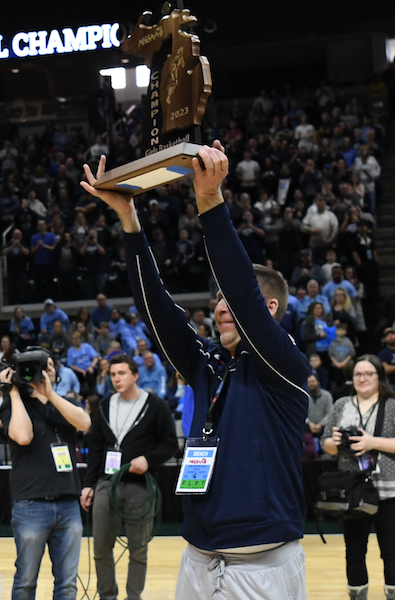 “It’s kind of surreal,” Hemlock coach Scott Neumeyer said. “I’m just so proud of this team, especially the seniors. I was really happy for how they approached this whole tournament run. We had a brutal, brutal schedule to get here. I’m just happy for how they persevered and how they led this team.”
Prior to this season, Hemlock (26-3) had made just two trips to the Semifinals, the latest cut short before it could start due to COVID-19 after the team had advanced to championship weekend in 2021.
This year’s team took nothing for granted, and Neumeyer praised the business-like approach.
“People offered to do pep assemblies for them, to get them charter buses and limos and all this stuff,” Neumeyer said. “And they were like, ‘Nope, we’re taking the yellow school bus and we’re going down to the Breslin. We’re taking our lunch pail, and we’re going to work.’ And that’s the way I like it.”
That was apparent in the Final against Blissfield, as – outside of foul trouble – the Huskies did the things that win big games.
They forced 17 turnovers while committing just six. They were 22 of 25 from the free throw line, including 15 of 17 in the fourth quarter to salt the game away.
Much of that came from senior guard Chloe Watson, who hit 11 of her 13 free throw attempts in the game, on her way to 18 points.
Watson and Finkbeiner also were able to dribble away much of the fourth quarter as Blissfield was chasing a double-digit deficit.
“Chloe and Regan just played a great game of keep away,” Neumeyer said. “I’m going to record that and show my kids how to keep the ball away from people for about five minutes. They also knocked down free throws, and that’s no accident, because these guys work on free throws like crazy.”
Lauren Borsenik added 16 points and seven rebounds for the Huskies before fouling out early in the fourth quarter. She and her sister Hannah, who had four points and seven rebounds, gave the Huskies a balance that proved too much for Blissfield.
 “Their competitiveness – they are warriors on the court, and they play with a little bit of an edge,” Neumeyer said of the Borsenik sisters, both juniors who joined Hemlock this season. “I thought today was a very physical game, and I’m not sure without them that we don’t lose that street fight, if you will, because it was a very physical game.”
The game was close through the first half, as Hemlock held a 25-20 lead at the break. But the Huskies stretched the lead to double digits in the third quarter, and kept Blissfield at arm’s length the rest of the way.
“There was a lot of moments where I thought we were one play away to get back into the game,” Blissfield coach Ryan Gilbert said. “Just a big play away, then get a stop and a score. We were talking about that in the huddle. Then it just kind of slowly mounted. We ran out of gas.”
Julia White led Blissfield in her final game with 14 points and 14 rebounds. Junior guard Avery Collins had 17 points to lead the Royals in scoring.
Blissfield finished 28-2 and was making its first Finals appearance since 1973.
“I couldn’t have asked for a greater senior season,” Blissfield senior forward Sarah Bettis said. “We had kind of been building for this year forever, and people had been telling us that we were going to go far. We didn’t really make it our focus, we just took it one game at a time, but ultimately it led us here. I’m really grateful for this program. It’s meant everything to me since kindergarten. I remember just waiting for the day that I could finally play and put on the uniform. It’s still a little surreal; it doesn’t feel like it should be over.”
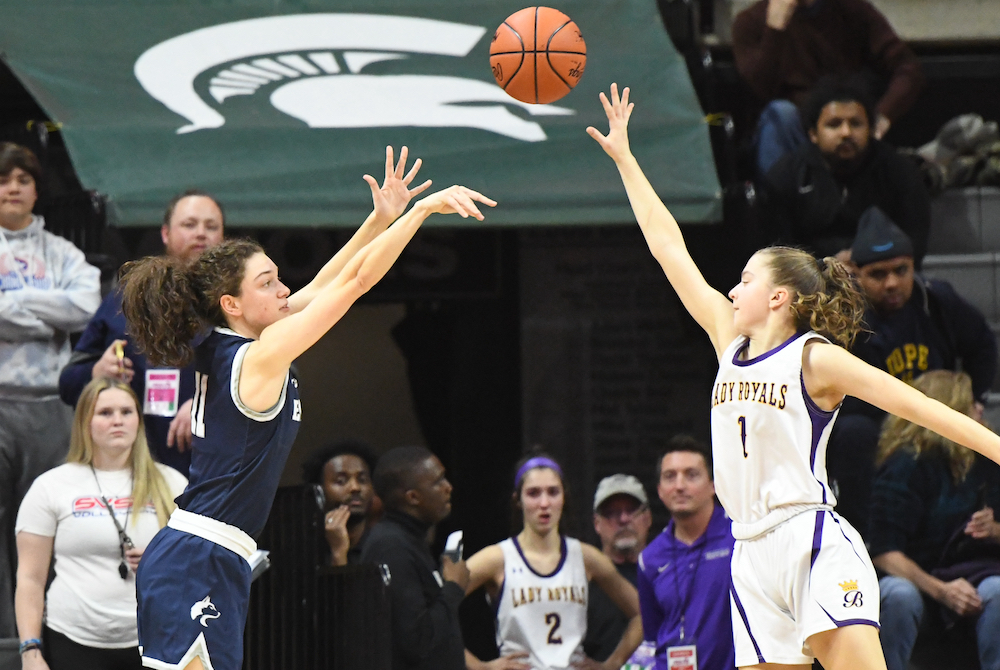
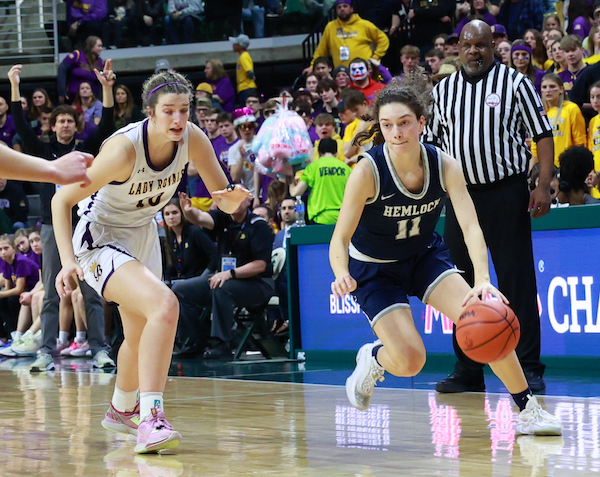
PHOTOS (Top) Hemlock's Chloe Watson (11) sends up a jumper with Blissfield's June Miller defending Saturday at Breslin Center. (Middle) Huskies coach Scott Neumeyer holds up the championship trophy to his team and fans. (Below) Watson dribbles away from pressure as Blissfield's Sarah Bettis (10) pursues.
Breslin Bound: Girls Report Week 2
December 11, 2012
By Geoff Kimmerly
Second Half editor
We're only two weeks into this girls basketball season. But there are plenty of teams that already can take pride in strong starts that either are continuing on last season's success or showing a nice turnaround after a rough run.
Some of those are highlighted in this week's report. Remember, what's below isn't any sort of statewide ranking – merely a top-10 list of notables from last week.
Records and results are through Sunday and based on those found at MHSAA.com. Click on Score Center to follow scores throughout the week and enter those of the games you attend.
1. Concord (3-0) – Most of the key pieces to last season’s Class C Semifinalist team are back, and they earned a pair of close wins. Concord edged Michigan Center 36-32 – after also beating Michigan Center in overtime in the District opener last season – and then got past Homer 37-35.
2. L’Anse (4-0) – The Purple Hornets are again off to a nice start – with a bonus. According to the Houghton Daily Mining Gazette, L’Anse’s 60-56 win over Houghton gave Houghton its first loss to a team from the state’s four northernmost counties since Nov. 2, 1999. Click to read more from the Daily Mining Gazette.
3. Westland John Glenn (2-0) – The Rockets got off to a strong start with a 66-34 win over Grosse Pointe North and then a 63-56 victory over Dearborn Divine Child. Divine Child is coming off a trip to the Class B Semifinals.
4. Grand Rapids South Christian (3-0) – Two of the Sailors four losses last season came to Grand Rapids Catholic Central. They haven’t played GRCC yet, but did edge Grand Rapids Christian 50-46 just three days after the Eagles beat GRCC by six.
5. Marshall (3-1) – This returning Class B Quarterfinalist added a strong week to a solid start. First, Marshall topped Richland Gull Lake 48-44 – Gull Lake won its Class A District last year – and then the Redhawks finished the week with a 46-33 win over Battle Creek Central.
6. Pontiac (2-0) – The Phoenix were a .500 team last season, but are off to a quick start thanks to two close wins. Pontiac beat Waterford Mott 49-45 and then Harper Woods Chandler Park 57-55.
7. Manchester (4-0) – The Flying Dutchmen have beaten every opponent by at least 10 points this season, including Onsted 59-40 and Napoleon 64-34 last week. Napoleon entered 3-0.
8. Bloomfield Hills Marian (2-0) – Marian is off to a solid start after beating annual Class A power Canton 44-30. Marian opened by beating Grosse Pointe North two weeks ago.
9. Athens (3-0) – The reigning Class D runner-up is off to a fast start again. Athens opened last week by beating Climax-Scotts 55-44, then survived a close one against Reading, 37-31.
10. Saginaw Heritage (2-2) – The Hawks bounced back from two losses during the first week to even their record by beating Arthur Hill 54-35 and Bay City Western 51-14. Heritage lost to Arthur Hill by 17 in their game last season.
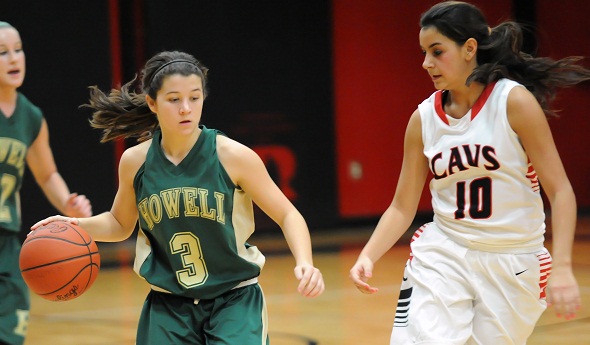
PHOTO: Howell junior Meredith Wood works to get around a defender as the Highlanders pushed toward their first win of the season, 60-48 over Carrollton on Thursday. (Click to see more at HighSchoolSportsScene.com.)