

Freyhof, Otsego Celebrate Finals Wins
November 7, 2015
By Bill Khan
Special for Second Half
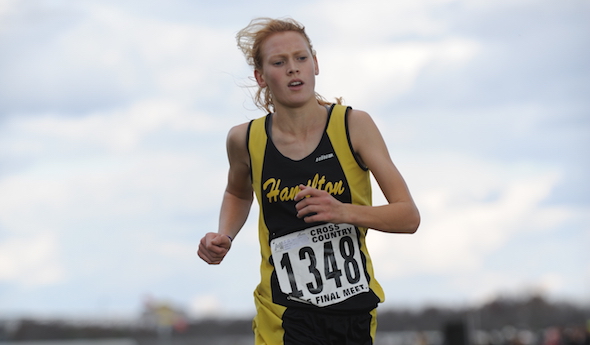
BROOKLYN — Erika Freyhof didn't say a whole lot when talking about herself, even on the day she won the MHSAA Lower Peninsula Division 2 cross country championship.
What really got her to light up and open up was when the topic shifted to her team.
 Hamilton's girls, who had three straight top-four finishes from 2009-11, were back in the Finals after missing out the last three years. Ending an even longer drought — like forever — was the Hamilton boys, who had never qualified for the Finals.
Even the modest finishes by those teams — 17th for the boys, 19th for the girls — couldn't dampen Freyhof's enthusiasm on Saturday at Michigan International Speedway.
"Our team made it, which was awesome," Freyhof said. "We had only six girls at our Regional, because one of them is injured, and we made it as a team. That's amazing. And the boys made it, which is like the first time in school history. So our whole cross country team was so excited. It was awesome."
And what about her championship performance?
"I really wanted to just go out and win," she said.
Freyhof has moved up the Division 2 ranks during her three trips to MIS. She was 15th in 19:07.6 as a freshman in 2013 and seventh in 18:45.4 as a sophomore last year.
"All of the ones in front of me last year were seniors," Freyhof said. "That was exciting when they graduated, so I could get a chance."
Her only loss in 12 meets this season was a second-place finish to Division 1 champion Madison Troy of Grandville in the Otsego Bulldog Invitational on Oct. 3.
There was only one senior in the top 11 of this Final, so there will be plenty of runners looking to build on their experience at MIS to take a shot at Freyhof's title next year.
 Finishing second was Holland Christian sophomore Kayla Windemuller in 18:22.5. Linden junior Alia Frederick was third in 18:30.6.
"Last year I became the fastest freshman at my school," said Windemuller, who was 47th last season. "I just wanted to keep on improving. I figured out I love running. I just wanted to keep pushing myself to see what I could do. I started running in Girls on the Run in sixth grade. I ran in seventh grade, but I hated it so much I didn't want to do it again. Then someone convinced me to do it my freshman year."
Otsego won its first team championship by a comfortable margin, scoring 97 points. East Grand Rapids was second with 180, while two-time defending champion Grand Rapids Christian was third with 199. Linden was fourth with 205.
Otsego has moved up in the top three the last three seasons, placing third in 2013 and second in 2014. The Bulldogs returned six of their seven runners from last year's finals squad, while adding freshman Sydney Kubiak, who was the team's No. 4 runner on Saturday.
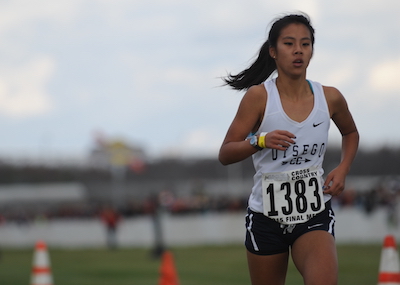
Leading Otsego from near the front of the pack were juniors Megan Aalberts (fifth, 18:38.8) and Sophia Hirzel (sixth, 18:42.1). Also scoring for the Bulldogs were sophomore Maddie Marciniak (27th, 19:02.8), Kubiak (39th, 19:19.4) and sophomore Gracie VerHage (45th, 19:26.5).
The MHSAA Cross Country Finals are sponsored by the Michigan National Guard.
PHOTOS: (Top) Hamilton’s Erika Freyhof cruises the final stretch on the way to her first MHSAA individual title (Middle) Otsego’s Sophia Hirzel finishing sixth overall, just behind teammate Megan Aalberts, as they led the Bulldogs to their first MHSAA team championship. (Click for more from RunMichigan.com.)
West Ottawa's Olson Aims to Add XC Title to Growing List of Achievements
By
Dean Holzwarth
Special for MHSAA.com
August 24, 2022
HOLLAND – Arianna Olson won her first individual state title when she outran the field in the 3,200 meters at last spring’s Lower Peninsula Division 1 Track & Field Finals.
 Less than three months later, the West Ottawa senior standout is gearing up to accomplish the same feat on the cross country trails.
“That was my first state title in running, but it was something I wasn’t completely sure of because there’s a lot of good girls in the state,” Olson said. “Since I started running, the 3,200 is more of my event, and things went really well for that.”
Olson has blossomed into one of the most talented distance runners in the state and garnered three top-10 finishes in three years at the Finals.
She finished runner-up as a freshman and eighth as a sophomore, and was among the favorites again last year on the way to placing third at the LPD1 Final at Michigan International Speedway.
She was unbeaten during the regular season, setting a new personal record (16:45), and she also won a Regional championship.
“I think last year at state I was prioritizing more of the postseason, and my big goal was to qualify for nationals, so that was a few weeks after,” Olson said. “That was the priority in training, and I tapered before state, but it wasn’t the best training the week before. I knew I had more chances after the state meet.”
Olson’s performance, coupled with freshman Helen Sach’s fifth-place effort, helped West Ottawa finish as Division 1 runner-up behind Ann Arbor Pioneer.
“Third is still excellent, but the goal was to win an individual title and a team title and we came up short on both sides,” Panthers cross country coach Kyle Barnes said. “There were a combination of things that went into that, but she hasn’t won a cross country title so that is certainly on her radar. Michigan has a lot of good runners, so she is going to have her hands full to do that this year.”
A month after last fall’s Finals, Olson set out to prove herself at the national level, and did just that in San Diego. Olson competed in the Eastbay Nationals, which featured the top 40 distance runners in the country. She placed fourth at a Midwest qualifier in Wisconsin to qualify.
Olson finished 13th in California with a time of 17:43.04 to gain All-American honors.
 The following month, Olson was named as the Gatorade Michigan Cross Country Player of the Year.
She was the first West Ottawa athlete to earn the prestigious honor, which also recognizes academic achievement and exemplary character off the field.
“That was cool because it doesn’t only take into account athletics, but also the academics and service side of it,” said Olson, who carried a 4.0 GPA.
“I was really happy about that because it wasn’t just about athletics, it was recognizing the whole part of being a student-athlete.”
In June, Olson took part in another national event. She traveled to Seattle to compete in the Brooks PR Invitational and placed seventh in the 3,000 run.
“It was another good opportunity to race at a national-level meet, and I think at both national events it was good to get to know some of the other girls that I’m competing against,” Olson said. “It’s getting harder to find competitive races that have big pack running, and sometimes you have to be creative to find that in the regular season. Nationals is a good opportunity to push myself with the other girls and see what I can do.”
Barnes said Olson has benefited from competing against elite competition.
“All of that is valuable information, and getting those types of experiences and running against that level of competition is invaluable for her,” he said. “We talk about if she banks that information and learns from the positives and negatives, then she will continue to get better.”
Barnes took over the West Ottawa program when Olson was a freshman, and knew her potential after she set several middle school records.
“She works her butt off, and she was one of the first athletes to come through the program when I took over,” he said. “She has helped to build a culture within our program. She does all the right things, and the results speak for themselves.”
While Olson is aspiring to finish up as a champion in November, she’s taking her final season in stride.
“Cross is my favorite over track & field, so it’s about making the most of it with one more year with my team and just pushing really hard,” she said. “This season won’t necessarily be based on my times, but just running the courses to the best of my ability and knowing that at the end I’ve given my full effort.”
Olson, who is undecided on her college choice, will run her first race with her teammates Friday at Grand Rapids South Christian.
 Dean Holzwarth has covered primarily high school sports for Grand Rapids-based WOOD-TV for five years after serving at the Grand Rapids Press and MLive for 16 years along with shorter stints at the Ionia Sentinel and WZZM. Contact him at [email protected] with story ideas for Allegan, Kent and Ottawa counties.
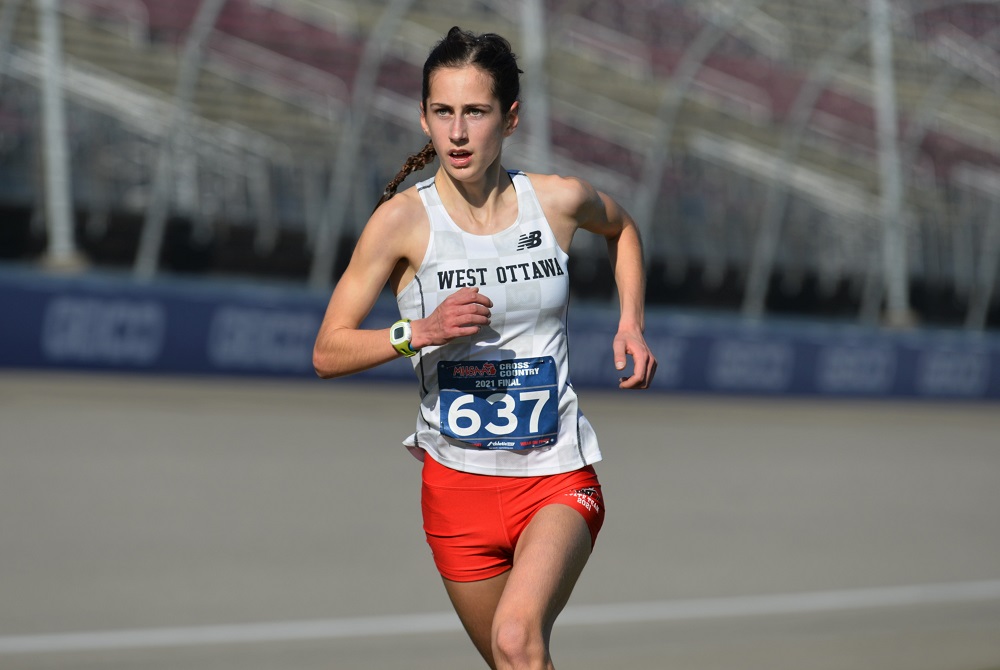
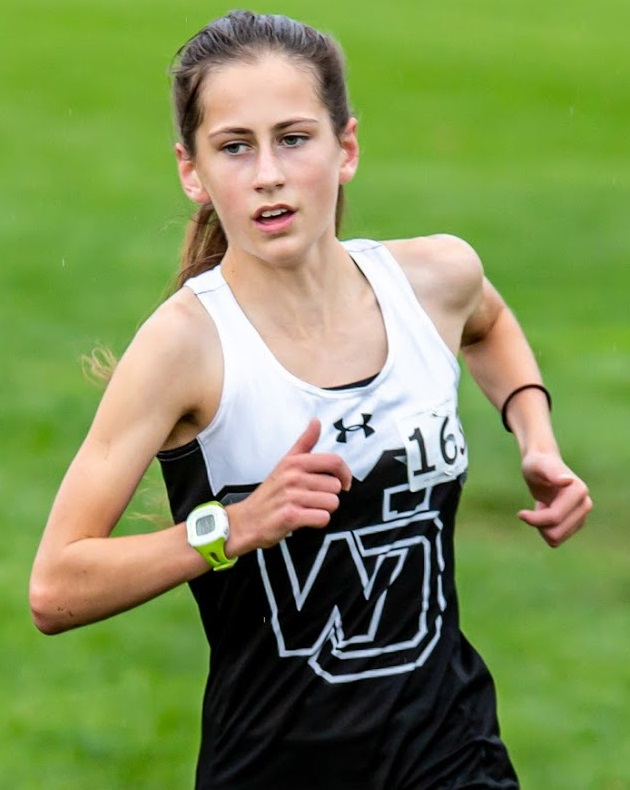
PHOTOS (Top) West Ottawa’s Arianna Olson approaches the finish during last season’s LPD1 Final at Michigan International Speedway. (Middle) Olson rounds a corner during another 2021 race. (Top photo by Run Michigan; middle photo by Laura Veldhof Photography.)