

History in the Making - New and Old
By
Geoff Kimmerly
MHSAA.com senior editor
October 24, 2013
Last week’s MHSAA Lower Peninsula Girls Golf Finals marked the 42nd anniversary of the association’s sponsorship of the sport, and we've been researching some of the first and finest performances from the tournament's history – coincidentally, as a current player added a small touch with a big shot Saturday.
 Read on to learn more about that feat and the first team to hoist an MHSAA girls golf championship trophy. And speaking of trophies, we've also got the story behind one of the oldest football traveling prizes still making the rounds in the Upper Peninsula.
An Ace Arrives
Fenton’s Madi Shegos finished her 2013 Finals by making history at Michigan State’s University’s Forest Akers East, a frequent MHSAA Finals site over the last two decades.
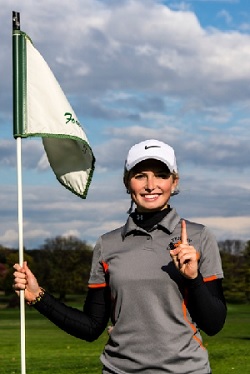 The course redesigned its 18th hole from a short par-4 to a par-3 this season. And Shegos became the first to score it a hole-in-one, doing so during the second round of the Division 2 Final.
Retired longtime East Lansing coach George Jones, also a longtime assistant at the Finals and the taker of the photo at right, added: “Madi Shegos did something almost every golfer around the world never gets a chance to do or if given the chance, doesn't do.
“Sure, every par three at Forest Akers and nearly every other par three around the world has had an ace, but on Friday Madi was the very first to accomplish this on the newly-constructed 18th hole on the East Course. No one else will ever be the first. This honor goes to Madi Shegos, a sophomore at Fenton High School.”
Shegos improved six strokes during her second round to shoot a 103 on Saturday as Fenton finished fifth in Division 2 for the second straight season.
First to Reign
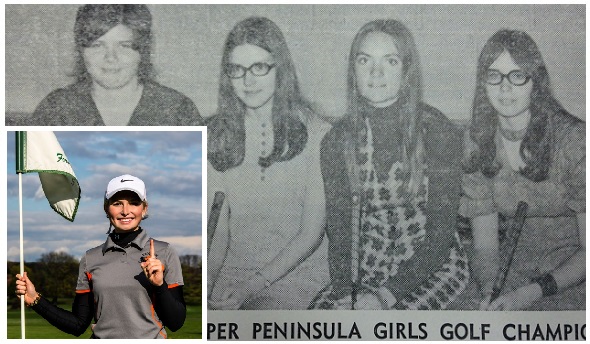
Although Lower Peninsula girls golf was played during the spring for its first 35 years, and Upper Peninsula girls golf remains in the spring to this day, the first girls MHSAA championship tournament actually took place during the fall of the 1972-73 school year – with Pickford claiming the first title by winning the Upper Peninsula Final by three strokes over Escanaba on an October day at Lake Bluff Country Club.
Thanks to some quick work by Pickford athletic director Chuck Bennin and one of the four players on that championship team who now teaches at the high school, we'll soon be adding results of that tournament to our growing archives at MHSAA.com.
Here's a quick flashback from that inaugural 9-hole event: The Panthers were led by Patsy Nayback’s 49, which was good for second place individually. Joni Hamilton and sisters Bonnie and Kathleen MacDonald rounded out the lineup and are pictured above. Ishpeming’s Marge Farley shot a 44 to finish as medalist.
Another fun fact from that October day: The Escanaba Daily Press reported that in the boys MHSAA Final, Pickford’s Kevin Hamilton recorded an eagle on the par-5, 472-yard third hole, with his second shot running through a sand trap, up the green and into the cup.
The Lower Peninsula Girls Finals teed off for the first time the following spring, with Bloomfield Hills Lahser defeating East Grand Rapids by a stroke at Grand Ledge’s Troy Hills Golf Course.
Wanted: More Finals Archives
For the majority of MHSAA sports, we’ve published on MHSAA.com results, box scores, etc., for most of our Finals dating to at least the late 1990s. For years prior, we've begun filling in with what we can gather from our formerly-published Books of Champions and MHSAA Bulletins.
But realizing there are complete copies of results out there in scrap books, trophy cases, newspaper archives and the like, we’d love to gather as many as possible to add to the site.
If you’ve got results from an MHSAA Finals in any sport that aren't showing at MHSAA.com or that can augment our current collection, please email me at [email protected].
First of many
Certainly the most prevalent prize awarded for winners of Michigan’s high school football trophy games is some version of a “little brown jug.” And this weekend, the oldest of the jugs will be on the line when Newberry faces Sault Ste. Marie.
They first played for the trophy in 1925, with the original jug replaced by the current version in 1934. Sault Ste. Marie leads the series 58-33-5 including 46-28-5 in games for the Jug.
Below is an excerpt from a brief history of the trophy researched by Ron Pesch:
In the state’s Upper Peninsula, Newberry High School first played Sault Ste. Marie on the gridiron in 1911 and, for the most part, they have squared off annually since 1923. To commemorate the battle between these schools, legend has it that in 1925, a Newberry druggist donated a Jug to serve as a trophy. The prize was to be retained by the winning team until the next meeting would determine ownership. The idea, of course, came from the Michigan-Minnesota rivalry.
In 1934, for reasons unknown, a new jug debuted. Fittingly, that game between the rivals ended in a 7-7 tie.
Over the years, the rivalry has generated many classic contests between the larger school from the Soo and the smaller Newberry district. The series was interrupted in 1940 and 1959, and then went on a five-year hiatus between 1999 and 2003. As school officials recognized the importance of the series to the residents of the area, the rivalry was resumed in 2004 when the Blue Devils joined Newberry in the Straits Area Conference.
PHOTOS: (Background) The members of the 1972 Pickford girls golf team, as they appeared in the January 1973 MHSAA Bulletin. (Foreground and below) Fenton’s Madi Shegos stands with the flag after drilling the first hole-in-one at the redesigned No. 18 at Forest Akers East during last weekend’s Lower Peninsula Division 2 Final.
NFHS Voice: Planning with Patience
May 30, 2020
By Karissa Niehoff
NFHS Executive Director
For several weeks, Americans have been awaiting answers to several questions. When will restaurants restart dine-in services? When will hair salons and gyms be open? When will people be able to congregate for worship services? And, of course, when will education-based sports and performing arts programs return?
And the answer to the all-important last question is the same as the first three – it varies from state to state.
If there was ever any doubt about the popularity and interest in high school sports and performing arts – and how much these programs have been missed during the past three months – it was erased last week as the NFHS released its Guidance for Opening Up High School Athletics and Activities document.
The response was non-stop through the mainstream media as well as our social media platforms as the first nationwide discussion about the return of high school sports and other activities was in full swing.
Since that disappointing week in mid-March when it seemed like all of life came to a halt, millions of people – from high school students, coaches, parents, administrators, officials and fans – have been looking forward to the return of school-based sports and other activity programs. And the guidance document offered some hope that soon the light at the end of tunnel will not be the oncoming train we have felt for many weeks.
Now, state high school associations are developing timetables and protocols for return of activities in their states. And those guidelines will be different from state to state. This is not a one-size-fits-all plan. Depending on the specific circumstances of a state with respect to the containment of the virus, its progression through the various phases of returning to activities could be much different than another state.
As the guidance document developed by the NFHS Sports Medicine Advisory Committee noted, our hope is that students can return to school-based athletics and activities in any and all situations where it can be done smartly. When it comes to education-based sports and performing arts within our nation’s schools, nothing is more important than the health and safety of the participants AND the individuals conducting those programs.
Some individuals have expressed concern that our guidance document is too cautious, noting that some non-school youth programs have already restarted in some areas.
In one state this past week, a non-school sports program was allowed to restart because the “data shows children are less affected by the coronavirus.” While the preponderance of evidence shows that to be true, plans in education-based activities will include also protection for adults who coach, officiate and administer those events, which may be seen as a more conservative approach.
Within high school sports, the drive of coaches and dreams of parents cannot run ahead of player safety. Last week, a successful high school football coach with three previous state titles was suspended for allegedly holding practices. And there have been reports of parents considering moving to another state with fewer COVID-19 cases to enhance the chance of their son playing football and earning a college scholarship.
The NFHS, through its Sports Medicine Advisory Committee, took action in developing its Guidance for Opening Up High School Athletics and Activities document. The various state high school associations are taking action in the coming weeks in developing plans for a return to activities at the state level.
Now, we would ask parents and other fans to take action – and that action is patience. The urge to return to normal is understandable, but the path back to where we were three months ago will take time, and that “time” will not happen at the expense of the safety and well-being of everyone involved in high school sports and performing arts programs.
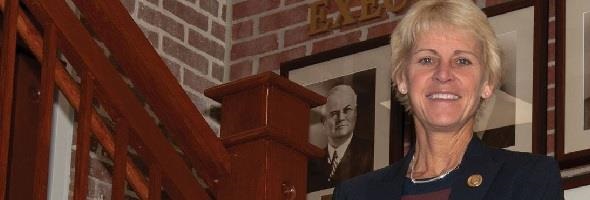
Dr. Karissa L. Niehoff is in her second year as executive director of the National Federation of State High School Associations (NFHS) in Indianapolis, Indiana. She is the first female to head the national leadership organization for high school athletics and performing arts activities and the sixth full-time executive director of the NFHS, which celebrated its 100th year of service during the 2018-19 school year. She previously was executive director of the Connecticut Association of Schools-Connecticut Interscholastic Athletic Conference for seven years.