

Performance: Anchor Bay's Ally Gaunt
May 3, 2019
 Ally Gaunt
New Baltimore Anchor Bay senior - Soccer
Anchor Bay’s three-year starting goalkeeper continued to build on her substantial legacy last week, tying the school career record with her 32nd shutout against then-No. 3 ranked Utica Eisenhower to earn the Michigan Army National Guard “Performance of the Week.” She became the school’s sole record holder the next game as Anchor Bay shut out Port Huron Northern 5-0 on Friday.
Gaunt tied and broke the record of 2015 graduate Emily Zweng, who went on to Oakland University, and with the 32nd shutout also earned a spot in the MHSAA record book. She’s now up to 29th all-time with 34 career shutouts and has led Anchor Bay to a combined 41-5-10 record over three seasons including 5-1-4 this spring. The Tars also have won two District titles with her guarding the net. In fact, Gaunt has never given up more than two goals in a game at the high school level – and in 13 games, she’s allowed just one – and she has a career goals-against average of 0.52.
 Anchor Bay coach Kevin Grammens considers Gaunt one of the best keepers in Macomb County history, and she earned Division 1 all-state honorable mention as a sophomore and made the second team a year ago. When she’s not playing, she’s still in the game as a youth soccer referee and goalie trainer. Gaunt also played basketball as a freshman and sophomore on sub-varsity teams and carries a 3.7 grade-point average. She’s signed to continue her academic and soccer careers at Saginaw Valley State. A fan of numbers and math, she plans to major in accounting and finance and eventually become a certified public accountant.
Coach Kevin Grammens said: “Ally is usually the first player to arrive at practice and the last to leave. She is a student of the game and true believer in the growth mindset. She soaks in the mental skills training that we teach in our program and intently trains the finer details of her position with her goalkeeper coach, Keith Jarema. She is humble and is first to acknowledge that she cannot set records on her own. We've played tremendous team defense the past three years in front of her and have had and currently have fantastic, selfless players willing to play defense to benefit the team.”
Performance Point: It was a great week. It means a lot, but it’s not everything – to be fair, it’s just a record,” Gaunt said. “The season that we’ve had this year, it’s been a process. And to get that with this team, it means a lot. We graduated our back line – all four of them graduated last year, so we had to rebuild it. We had to start from scratch basically the first day of tryouts, and from then till now it’s grown tremendously. We were ready for battle, and we definitely stepped up. I knew Coach Grammens had a plan, and we had to stick with it. And I trust him, and it worked out.
Success to the successor: “My sophomore and junior year (Zweng) came back for the District games and a few of the other games, and I talked to her. She gave me some pointers, and it was really beneficial just to hear it from another player that set the record here at Anchor Bay, (made the NCAA Tournament) at Oakland.”
 At home in goal: “I love it back there. You can see the entire field. You can see the plays developing before they happen. Just (from) practice, you see it, what we work on, and when it shows in games it shows practice really helps. I can see in goal what we’re trying to do.”
Our time: “My communication is better than it was two years ago. My physical aspects are better than they were two years ago. Every day we’re working on both physical and mental stuff, and it’s very helpful to get something every single day that’s beneficial. Being a senior – there’s six of us, and we all want to do something great here. ‘Leave the jersey in a better place’ is our biggest motto on the team for the seniors, and I truly believe all six of us can do it and are doing it. … Coach Grammens here at Anchor Bay has helped me become the leader I am. We have a binder with a bunch of different articles on how to be mentally strong, and reading those and going through with him helping us individually to become a better person grows our leadership skills as well.”
Problem solver: “I like the structure of (math), knowing there’s not only one way to do a problem to get the correct answer. Within the team, within soccer, you have to be able to see a problem from more than one angle – if there’s two people on the team and something happens, you have to be able to see both angles to be a good leader and try to diffuse the situation. I believe math helps with that because with numbers, you can see it that way.”
- Geoff Kimmerly, Second Half editor
Every week during the 2018-19 school year, Second Half and the Michigan Army National Guard recognizes a “Performance of the Week" from among the MHSAA's 750 member high schools.
The Michigan Army National Guard provides trained and ready forces in support of the National Military Strategy, and responds as needed to state, local, and regional emergencies to ensure peace, order, and public safety. The Guard adds value to our communities through continuous interaction. National Guard soldiers are part of the local community. Guardsmen typically train one weekend per month and two weeks in the summer. This training maintains readiness when needed, be it either to defend our nation's freedom or protect lives and property of Michigan citizens during a local natural disaster.
Past 2018-19 honorees
April 25: Kali Heivilin, Three Rivers softball - Read
March 28: Rickea Jackson, Detroit Edison basketball - Read
March 21: Noah Wiswary, Hudsonville Unity Christian basketball - Read
March 14: Cam Peel, Spring Lake swimming - Read
March 7: Jordan Hamdan, Hudson wrestling - Read
February 28: Kevon Davenport, Detroit Catholic Central wrestling - Read
February 21: Reagan Olli, Gaylord skiing - Read
February 14: Jake Stevenson, Traverse City Bay Reps hockey - Read
February 7: Molly Davis, Midland Dow basketball - Read
January 31: Chris DeRocher, Alpena basketball - Read
January 24: Imari Blond, Flint Kearsley bowling - Read
January 17: William Dunn, Quincy basketball - Read
November 29: Dequan Finn, Detroit Martin Luther King football - Read
November 22: Paige Briggs, Lake Orion volleyball - Read
November 15: Hunter Nowak, Morrice football - Read
November 8: Jon Dougherty, Detroit Country Day soccer - Read
November 1: Jordan Stump, Camden-Frontier volleyball - Read
October 25: Danielle Staskowski, Pontiac Notre Dame Prep golf - Read
October 18: Adam Bruce, Gladstone cross country - Read
October 11: Ericka VanderLende, Rockford cross country - Read
October 4: Kobe Clark, Schoolcraft football - Read
September 27: Jonathan Kliewer, Grand Rapids Forest Hills Northern soccer - Read
September 20: Kiera Lasky, Bronson volleyball - Read
September 13: Judy Rector, Hanover-Horton cross country - Read
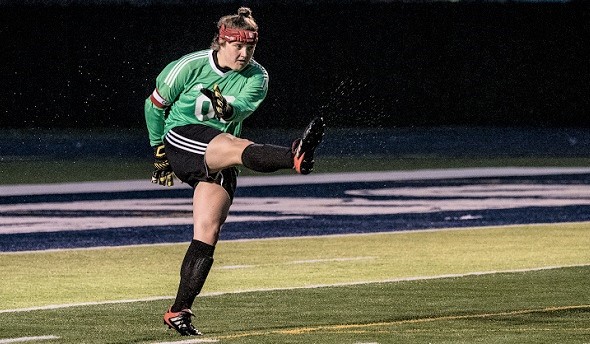
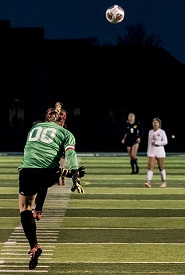
PHOTOS: (Top) Anchor Bay goalkeeper Ally Gaunt sends a kick downfield during a game this season. (Middle) Gaunt launches another toward waiting teammates. (Photos courtesy of the Anchor Bay girls soccer program.)
Preview: Champs Seek to Extend Streaks
June 11, 2015
By Geoff Kimmerly
Second Half editor
The setting is new – at least somewhat – as the MHSAA Girls Soccer Finals return to Michigan State University this spring for the first time since 2012. The format is new, as two Finals will be played Friday and Saturday.
But most of the favorites are familiar as three teams compete to repeat as champions.
Grandville Calvin Christian is playing for its fourth straight title in Division 4, while Richland Gull Lake is looking to make it three straight in Division 2 and Hudsonville Unity Christian is playing for its second straight title but ninth total overall.
The narrative is the opposite in Division 1, where both teams are playing for the first title in program history.
Below is this weekend’s schedule, followed by glances at all eight finalists.
Friday
Hudsonville Unity Christian vs. Detroit Country Day, 1 p.m.
Richland Gull Lake vs. Fenton, 4 p.m.
Saturday
Grandville Calvin Christian vs. Lansing Christian, 1 p.m.
Saline vs. Grand Blanc, 4 p.m.
Tickets cost $8 per day and include admission to baseball and softball games that day also at MSU’s Old College Field. Radio broadcasts of all games can be heard online at MHSAAnetwork.com. All games will be streamed live online at MHSAA.TV and viewable on subscription basis.
All statistics below are through at least the regular season, with most through teams' Regionals. (Click for links to brackets and scores.)
DIVISION 1
GRAND BLANC
Record/rank: 18-5-5, unranked
Coach: Greg Kehler, 17th season (260-80-47)
League finish: Third in Kensington Lakes Activities Association West.
Championship history: Division 1 runner-up 2004.
Players to watch: Annie Walker, sr. F (29 goals, 10 assists), Lara Wheeler, fr. F (17 goals, 5 assists); Amy Puidokas, jr. GK (0.60 goals-against average, 8 shutouts).
Outlook: Grand Blanc is on its best tournament run since making the Semifinals in 2005 after eliminating No. 1 Rochester Hills Stoney Creek, No. 10 Northville and then No. 5 Troy Athens in its last three games. Walker made the all-state first team last season and is again the scorer to stop, with 2014 all-state honorable mention Lexi Trudeau, a junior, among those moving the ball into striking position.
SALINE
Record/rank: 21-0-3, No. 6
Coach: Dana Restrick, sixth season (record at school N/A)
League finish: First in Southeastern Conference Red.
Championship history: Has never played in an MHSAA Final.
Players to watch: Sofia Sweier, sr. GK (0.17 goals-against average, 20 shutouts); Taylor Mulder, sr. F (41 goals, 11 assists); Amanda Zylstra, sr. D (3 goals, 5 assists).
Outlook: Saline is 40-3-6 over the last two seasons and won its first Regional title last week. No. 3 East Kentwood in the Quarterfinal was the eighth straight opponent to be shut out by the Hornets, who have given up only four goals this season. Sweier and Zylstra made the all-state second team last season, and Mulder made the third.
DIVISION 2
FENTON
Record/rank: 15-4-3, honorable mention
Coach: Matt Sullivan, 11th season (record at school N/A)
League finish: Second in Flint Metro League.
Championship history: Has never played in an MHSAA Final.
Players to watch: Brennan Sullivan, sr. M (1 goal, 3 assists); Brianna Costigan, jr. M (9 goals, 11 assists); Abigail Quesnelle, soph. GK (0.60 goals-against average, 14 shutouts).
Outlook: Fenton has reached the Semifinals three of the last seven seasons, but after two one-goal heartbreak losses that ended those first two trips, broke through by beating No. 6 Trenton this week. The Tigers also eliminated No. 4 Warren Regina and No. 8 Linden during the tournament and have won 11 of their last 12 games. Fenton scored 26 goals during the regular season, but has put 17 in the net in six tournament games. Costigan made the all-state second team last season, and Sullivan earned an honorable mention.
RICHLAND GULL LAKE
Record/rank: 24-1-1, No. 2
Coach: Jeff Corstange, fourth season (82-8-4)
League finish: First in Southwest Michigan Athletic Conference East.
Championship history: Three MHSAA titles (most recent 2014), four runner-up finishes.
Players to watch: Hannah Phommavongsa, sr. F (16 goals, 8 assists); Amanda Pavletic, sr. M (14 goals, 8 assists); Olivia Sullivan, sr. D (1 goal, 4 assists); Kirsten Taylor, sr. F (24 goals, 11 assists).
Outlook: Gull Lake has won two straight MHSAA championships and is loaded with veterans as it goes for a third. Taylor made the all-state third team last season, and Phommavongsa, Sullivan and Pavletic earned honorable mentions. Gull Lake defeated No. 10 DeWitt and honorable mention Middleville Thornapple Kellogg during this run, with the lone loss by a goal midseason to Division 1 Grand Rapids Forest Hills Central. Junior keeper Regan Troff took over in net this spring and has saved 96 percent of the shots against her.
DIVISION 3
DETROIT COUNTRY DAY
Record/rank: 18-3-2, No. 3
Coach: Bob Bukari, 29th season (record at school N/A)
League finish: Does not play in a conference.
Championship history: Five MHSAA titles (most recent 2004), four runner-up finishes.
Players to watch: Isabel Nino, soph. D/GK; Jenna Staudt, sr. D/M; Dagny Hill, soph. M; Libby Ronchetto, sr. M/D (Statistics not submitted).
Outlook: Country Day has finished runner-up three times since its last title, but has plenty of key players who experienced last season’s run. Hill and Staudt made the all-state second team in 2014, Nino made the third and Ronchetto earned honorable mention. The Yellowjackets eliminated No. 6 Grosse Ile and then edged No. 2 Flint Powers Catholic in a shootout to advance to this weekend.
HUDSONVILLE UNITY CHRISTIAN
Record/rank: 23-1, No. 1
Coach: Randy Heethuis, 26th season (487-87-28)
League finish: First in Ottawa-Kent Conference Green.
Championship history: Eight MHSAA titles (most recent 2014), three runner-up finishes.
Players to watch: Bethany Balcer, sr. M (38 goals, 13 assists); Maddy VanDyke, jr. D (5 goals, 2 assists); Casandra Besteman, sr. M (3 goals, 3 assists); Elly Brummel, sr. D (4 goals, 5 assists).
Outlook: Unity Christian bounced back from a rare Finals miss by winning its eighth title last spring and second in three seasons. Unity Christian downed the reigning champion, Grand Rapids South Christian, in the Regional Final and also eliminated No. 4 Grand Rapids Catholic Central. Balcer – one of five players with at least 10 goals – and VanDyke are returning all-state first-teamers, while Brummel made the second team and Besteman earned honorable mention.
DIVISION 4
GRANDVILLE CALVIN CHRISTIAN
Record/rank: 21-3, No. 2
Coach: Tim TerHaar, 15th season (255-64-20)
League finish: First in O-K Silver.
Championship history: Division 4 champion 2014, 2013 and 2012.
Players to watch: Allison Keizer, sr. GK (0.88 goals-against average, 14 shutouts); Morgan Buursma, sr. D (20 goals, 4 assists); Hilary Curry, sr. M (24 goals, 16 assists); Emily VanVliet, sr. M (11 goals, 26 assists).
Outlook: Calvin Christian can become just the second team in MHSAA history to win four straight girls soccer championships, following the Unity Christian teams of 2005-10. Keizer and Buursma made the all-state first team last season, while Curry made the third team and VanVliet earned honorable mention. Four Calvin Christian players have scored at least 20 goals this season – junior forwards Whitney Koets (28) and Natalie Honeycutt (22) are the other two.
LANSING CHRISTIAN
Record/rank: 20-4, honorable mention
Coach: Joel Vande Kopple, ninth season (129-41-9)
League finish: Tied for first in Greater Lansing Activities Conference.
Championship history: Division 4 runner-up 2011.
Players to watch: Kasey Jamieson, fr. F (47 goals, 15 assists); Emily Voss, sr. F (27 goals, 16 assists); Rachelle Trafford, sr. GK (0.74 goals-against average, 15 shutouts).
Outlook: Lansing Christian has reached at least the Semifinals four of the last five seasons, giving the Pilgrims as much late-round experience as most left this weekend. Voss made the all-state third team in 2014 and provides an excellent one-two scoring punch with Jamieson, who also had both goals in the Semifinal win over Grosse Pointe Woods University Liggett to push her first-season total to 49.
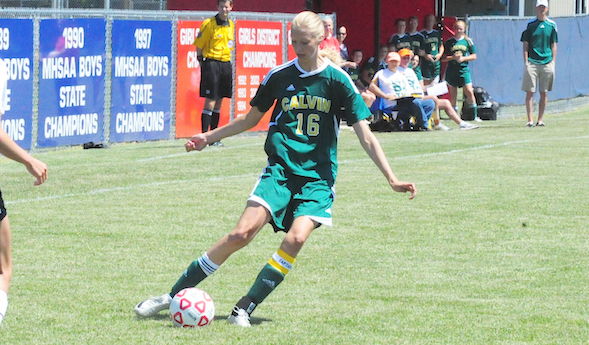
PHOTO: Grandville Calvin Christian's Emily VanVliet controls possession during last season's Division 4 Final win.