


Be the Referee: Swim Finishing Touch
September 19, 2019
This week, MHSAA officials coordinator Sam Davis explains a new rule in swimming that allows for more flexibility when determining when a competitor has finished a race.
Be The Referee is a series of short messages designed to help educate people on the rules of different sports, to help them better understand the art of officiating, and to recruit officials.
Below is this week's segment - Swimming Finishing Touch - Listen
There’s a swimmer-friendly rules change being made in that sport this season. The definition of a legal finish has been changed to allow a competitor to touch any part of the finish end of the lane.
Previously, a swimmer had to contact the touch pad for a legal finish. The touch rule has also been changed to apply during relay races – where prior to this season only the final swimmer had to touch the finish end of the pool.
While the changes may provide some flexibility for swimmers, it does put additional responsibility on lane judges and back-up hand timers to be ready for those occurrences when a swimmer does not contact the touch pad.
Sept. 12: Curbing Gamesmanship By Substitution - Listen
Sept. 5: Football Safety Rules Changes - Listen
Aug. 29: 40-Second Play Clock - Listen
Marquette Boys Run Finals Streak to 7 as Kingsford Becomes Top Challenger
By
Jason Juno
Special for MHSAA.com
February 21, 2026
MARQUETTE — Marquette’s dominance of Upper Peninsula Swimming and Diving Finals continued Saturday.
The Sentinels won their seventh-straight championship and 33rd U.P. meet in all. The one change this year was in the runner-up position. Marquette finished ahead of Kingsford 298-200, breaking a five-year streak of second-place finishes by Houghton.
Marquette swept the girls and boys team titles for the fifth-straight season. The Sentinels may not have had quite the depth they’re used to having, but it was still enough to keep the hardware coming.
“We didn’t fill events for the first time in several years,” Marquette coach Nathan McFarren said. “That’s a big deal. You have to have two to three in each event to have that depth. We didn’t have the depth — we were small but mighty. I would say most of our events, we had two people finishing at least in the top eight. That was the difference.
“Houghton and Kingsford had some solid wins, Sault Ste. Marie. Overall, the wealth was spread out pretty well, but I think it just came down to that depth.”
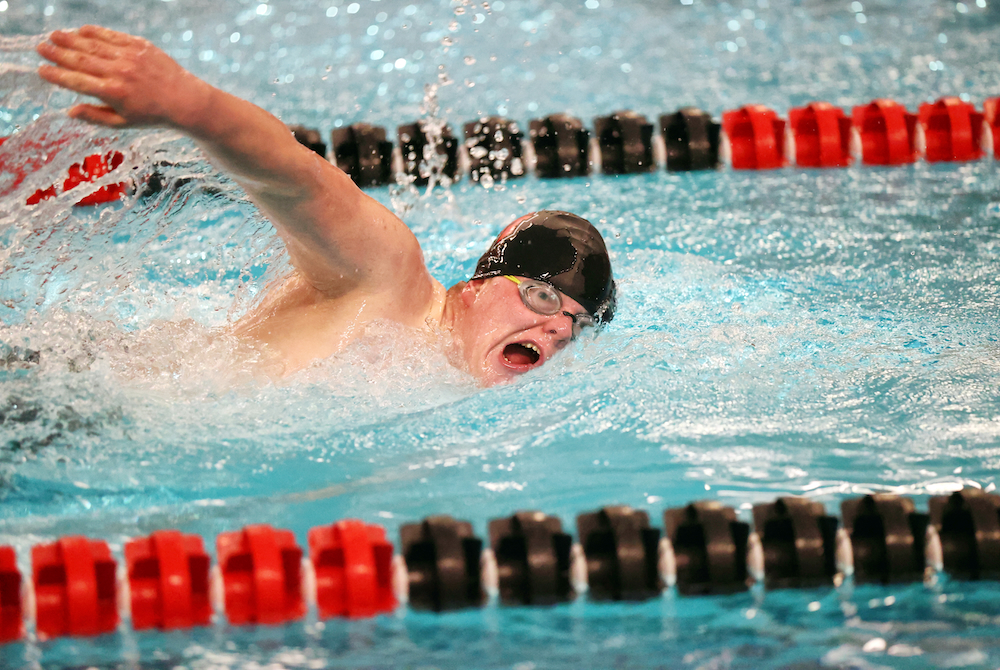
Junior Beau Deiter picked up Marquette’s only individual win on the boys side. He won the 500-yard freestyle in 5:32.94.
“I didn’t know what was going to happen going into it,” he said. “Me and Lenden Ellis from the Sault, we were seeded right next to each other. We were two milliseconds apart. I did not know what was going to happen. I was behind going into the first little bit, but then I got to a pace and I just stuck with it.”
His freshman brother, Lucas, placed second in 5:34.02.
“That was a fun one,” McFarren said. “Lucas, as a freshman, he was in fourth place with 12.5 yards to go and he took over the Sault boys to get second place with his brother. That was pretty special.”
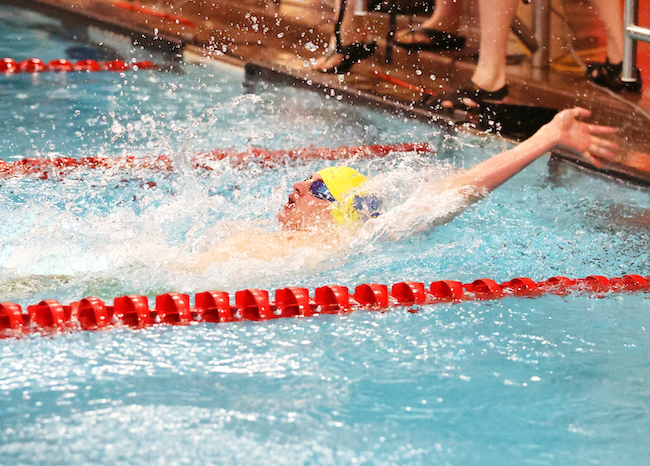 Kingsford’s Bryce Johnson won one individual U.P. title last season, and he made it two as a sophomore this year. He was the only swimmer to finish in under a minute in both the 100-yard butterfly and the 100-yard backstroke.
He finished the butterfly in 58.73 seconds, nearly three seconds ahead of runner-up Gavin Mills of Marquette. His 58.44 time in the backstroke was nearly five seconds ahead of Jack Pozega of Marquette in second place (1:03.28).
Johnson repeated as U.P. champion in the butterfly, going much faster than last year’s 1:03.50.
“It feels awesome, two in a row now,” he said. “I was super nervous, especially with Marquette, they’re my biggest competitor. I was behind at first, and then I caught up later in the season and I found my way to the top.”
Johnson first finished in under a minute in the backstroke in a late January meet – that was the first time anyone had done so in the U.P. since 2023, the Iron Mountain Daily News reported. That’s his best race, his coach Jim Lindstrom said, and he was also a member of Kingsford’s winning 200 medley relay (1:45.25).
Gladstone senior Tyler Soderman won both the 50 freestyle (23.03) and the 100 freestyle (50.92).
Kingsford junior Thomas Gibbons took first in both the 200 IM (2:16.29) and the 100 breaststroke (1:04.37). He won the breaststroke by just over five seconds and the IM by nearly six. Gibbons was also on the winning 200 medley relay team.
“He had two personal bests today, especially in the breaststroke,” Lindstrom said. “He brought a 1:08 down to a 1:04. He’s really doing well.”
Sault Ste. Marie’s Ryker Medrick won the 200 freestyle (1:58.08). He was also a part of the victorious 400 freestyle relay team (3:42.23).
Marquette won the 200 freestyle relay (1:38.25).
PHOTOS (Top) Marquette's Beau Deiter swims to the 500-yard freestyle championship at Saturday's Upper Peninsula Finals. Kingsford's Bryce Johnson reaches the wall first in the backstroke. (Click for more by Jarvinen Photos.)