

Be the Referee: Swim Turn Judges
By
Sam Davis
MHSAA Director of Officials
November 8, 2022
Be The Referee is a series of short messages designed to help educate people on the rules of different sports, to help them better understand the art of officiating, and to recruit officials.
Below is this week's segment – Swim Turn Judges - Listen
Did you know the officials in swimming do more than make sure everyone dives in at the same time?
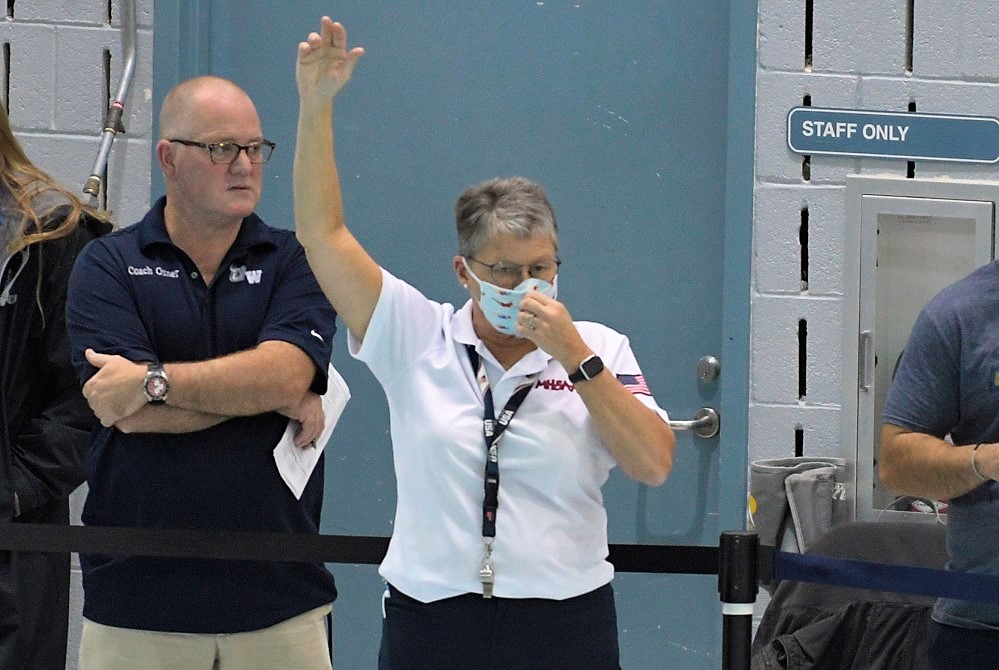
Each race has a turn judge who is positioned in line with the end wall. Their job is to make sure each swimmer is executing the proper stroke during his or her turn.
For example, if you are swimming the individual medley and are in the backstroke lap, you must turn while using the backstroke. You can’t go into the breaststroke while turning. If you do, the turn judge will signal to the referee by placing one hand overhead with an open palm, and then report it to the referee after the conclusion of the race.
The referee will then decide if the turn was legal or if the swimmer should be disqualified.
Previous Editions:
Oct. 25: Soccer Referee Jersey Colors - Listen
Oct. 18: Cross Country Tie-Breaker - Listen
Oct. 11: Soccer Shootouts - Listen
Oct. 11: Safety in End Zone - Listen
Oct. 4: Football Overtime Penalty - Listen
Sept. 27: Kickoff Goal - Listen
Sept. 20: Soccer Timing - Listen
Sept. 13: Volleyball Replays - Listen
Sept. 6: Switching Sides - Listen
Aug. 30: Play Clock - Listen
Aug. 23: Intentional Grounding Change - Listen
What's My Why: Official Ron Torbert
August 26, 2026
Ron Torbert, Hanover, Md.
Ron Torbert is a current NFL referee who worked Super Bowls LVI (2022) and LIX (2025). He has been on the NFL staff since 2010, starting as a side judge before being promoted to referee in 2014.
Prior to his time in the NFL, Ron worked in the Big Ten, MAC and GLIAC, and was an MHSAA-registered football official from 1989-2001. He is a graduate of Michigan State University and Harvard Law School and also the current chair of the National Association of Sports Officials (NASO) Board.
Nobody else in the stadium feels what we feel, and there’s something kinda special about being part of that small-knit community.
That’s what kept me coming back and coming back. I don’t play golf, but somebody said it’s like hitting that one golf shot – you’re not a very good golfer but you hit that one shot that brings you back for the next round. Being out on the field brings me back for the next game,
Once I figured out what it took to get good at it, now I want more, and that’s what keeps me coming back. It’s always a challenge of being better next week than I was last week.
“What’s My Why” is a weekly feature telling the stories of MHSAA-registered officials in their own words. If you’re an MHSAA official and would like to share your reason why, please submit a 15 to 45-second video, taken horizontally, to director of officials Sam Davis at [email protected].
What's My Why
Aug. 19: Kari Seitz, Mill Valley, Calif. - Watch
Aug. 13: Mike Pereira, Sacramento, Calif. - Watch
Aug. 5: Dino Paganelli, Wyoming - Watch
Aug. 3: Stacy Smith, Caledonia - Watch
July 22: Jason Nickleby, Lake Elmo, Minn. - Watch
July 15: Sam Davis, Lansing - Watch
July 9: Candace Cox, Quincy - Watch
July 1: Robert Williams, Redford - Watch
June 24: Will Godfrey, Jackson - Watch
June 19: Jarrett Skorup, Midland - Watch
June 12: Brady Driver, Sturgis - Watch
June 8: Cindy Tyzo, West Bloomfield - Watch
June 3: Jeff Spedoske, DeWitt - Watch
June 1: Mike Carrier, Commerce Township - Watch
May 27: Stan Wright, Warren - Watch
May 26: Murray Rose, Zeeland - Watch
May 22: Mike VanLaan, Alto - Watch
May 18: Clint Abbott, Newaygo - Watch