

#TBT: Inkala Celebrated as Athlete, Coach
June 25, 2015
By Geoff Kimmerly
Second Half editor
The mid-Michigan and statewide tennis communities are mourning the death last weekend of longtime Okemos girls coach Al Inkala, who led the Chieftains to four MHSAA championships over a 20-season tenure that ended in 2013. He was 66 years old.
From 1994-2004, his Okemos girls tennis teams finished either first or second at their MHSAA Finals all but 1996, and his 1998-2001 teams won four straight Division 2 titles. But those were his only final chapters to a high school career that began as one of the most accomplished athletes of his time from the Upper Peninsula, where he played football, basketball, tennis, baseball and ran track for Wakefield before graduating in 1967.
A 6-foot-5 center, Inkala was a Class C all-state basketball selection as a senior, leading the Cardinals to the MHSAA Class C Semifinals with 33 points in an 85-60 Quarterfinal win over Gaylord. A three-year varsity basketball player, Inkala scored a school-record 540 points as a senior and a school-record 1,160 for his career. He also scored a school-record 42 points against Baraga during the 1966-67 season as Wakefield strung together its first undefeated regular-season finish. Inkala was second in his league in scoring after finishing first as a junior and made the all-U.P. Class C team after both of those seasons.
 Inkala also was selected for the top senior basketball award for the Michigan-Wisconsin Conference by the largest margin ever accorded for the award to that point, and based not only on his athletic proficiency but also good sportsmanship.
His prowess extended far beyond the basketball court. In tennis, Inkala was undefeated at singles as a senior until his second match of the U.P. Finals – in those days, there was only one division in the Upper Peninsula, and only one flight for singles and one for doubles at all MHSAA Finals – as he led Wakefield to a fifth-place team finish. He was the singles champion in the Michigan-Wisconsin Conference.
Inkala ran four events – the 220-yard dash, 120-yard high hurdles and half-mile and mile relays – in helping Wakefield to its Regional track &field title in 1967. Wakefield then finished second as a team at the U.P. Class C Final, with Inkala taking fifth in the high hurdles.
As noted above, Inkala also played baseball and football; on the football team, he played both offense and defense and was the punter. Inkala also served as his class president, sung in the school chorus and was part of the conservation club at Wakefield High, about a 20-minute drive from the Wisconsin border.
He went on to play basketball at Northern Michigan University, serving as a team captain as a senior in 1970-71. He led the team in rebounding that winter and sits 30th on NMU’s single-season rebounding list and 12th on the career list, having played in 90 games over his four seasons.
On a personal note, Inkala was a huge help to me covering mid-Michigan girls tennis while at the Lansing State Journal from 1999-2011. He was the best of coaches when it came to being honest about his players’ abilities and making sure those from other schools got deserved recognition as well – especially during a period when his teams’ No. 5 singles and doubles players could’ve played the top flights for nearly every school in the surrounding area and likely beyond.
 The stories heard around our office this week focused on how he worked to give Okemos’ opponents the best experiences possible when facing his incredibly-talented teams.
Against those with just enough players to fill a lineup, or teams with most athletes in perhaps only their first few seasons of play, he’d fill his lineup with players who otherwise didn’t see the court when Okemos faced others of the state’s elite. The Chieftains shared their equipment and knowledge with many opponents, providing humble leadership in a tennis community that embodied a coach who gave the same always from the background and with little fanfare despite deserving much.
The Lansing State Journal talked to a number of his area counterparts this week; click here for that report.
Inkala died June 20. A memorial service will be conducted at 1 p.m. Sunday at Okemos Community Church.
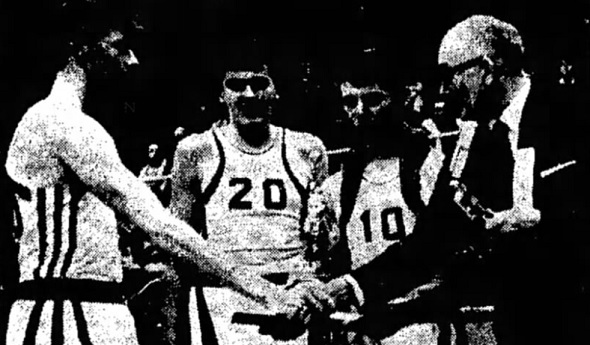
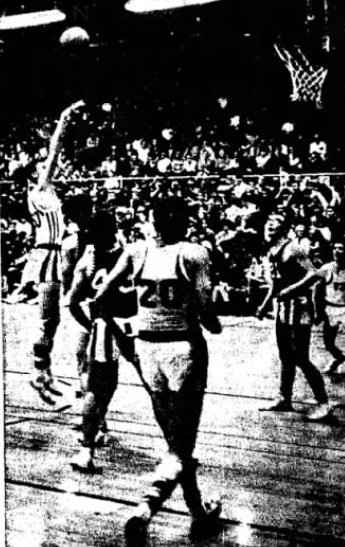
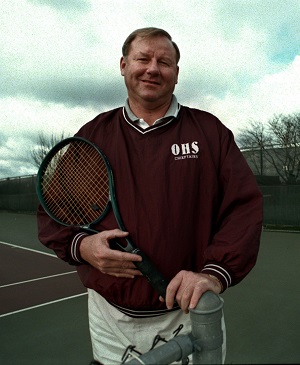
PHOTOS: (Top) Al Inkala, far left, accepts with his teammates the Class C District championship trophy during the 1967 season. (Middle) Inkala launches a free throw during the title game against Ontonagon. (Below) Inkala led his Okemos girls tennis teams to six MHSAA championships. (Top photos courtesy of the Ironwood Daily Globe; bottom courtesy of the Lansing State Journal.)
Breslin Bound: Boys Report Week 8
January 21, 2019
By Geoff Kimmerly
Second Half editor
It’s all relative until they meet each other on the court, of course.
 But there are some Michigan high school boys basketball teams absolutely dominating as we turn toward the final five weeks of the regular season.
A total of 22 teams remain undefeated. Bump that number to 55 counting teams that sit 10-2 or better. See below for crazy scoring stats for two of those high-achieving teams. And yet, every game is an opportunity – see Almont (8-3) handing Richmond (12-1) its first defeat Friday after Hemlock (6-5) did the same to Sanford Meridian (10-1) on Tuesday
Breslin Bound is powered by MI Student Aid and based on results and schedules posted for each school at MHSAA.com. To offer corrections or fill in scores we’re missing, email me at [email protected].
Week in Review
The countdown of last week’s five most intriguing results:
1. River Rouge 66, Flint Beecher 61 – A matchup of two MHSAA championship favorites, Division 2 River Rouge improved to 10-1 while sending Division 3 Beecher to 11-1 at the Horatio Williams Freedom Classic.
2. Muskegon Reeths-Puffer 63, Muskegon 59 (OT) – This is less an upset than a rarity because Reeths-Puffer is 11-1, but Muskegon won last season’s two meetings by 32 and 10 points.
3. Oxford 49, Pontiac 46 – Unbeaten Oxford gained a slight edge in the Oakland Activities Association Blue standings by handing Pontiac its first defeat; the rematch is Feb. 19.
4. Detroit U-D Jesuit 74, Detroit Catholic Central 62 – The Cubs made it a league season sweep of the surging Shamrocks and can clinch a share of the Detroit Catholic League Central title with a win Tuesday.
5. Detroit Martin Luther King 50, Detroit Cass Tech 48 – Both went on to lose Saturday showcase games, but this one pulled King into a tie for first in the Detroit Public School League Midtown after the Crusaders had fallen to Cass Tech by 14 on Dec. 18.
Watch List
With an eye toward March, here are two teams in each division making sparks:
DIVISION 1
• Clarkston (10-2) – The two-time reigning Class A champion graduated Mr. Basketball last spring and saw the third-winningest coach in state boys basketball history retire. But after opening this season with two losses, the Wolves have won 10 straight including over King on Saturday.
• Walled Lake Northern (11-0) – After finishing fourth last season, Northern appears to be closing in on the Lakes Valley Conference title with five straight double-digit league wins including one against second-place Waterford Mott. The Knights also will equal last season’s overall win total with their next victory.
DIVISION 2
• Benton Harbor (12-0) – The reigning Class B champion continues to roll, winning big most nights but also showing it can hold on for close victories. The Tigers edged Ferndale 90-81 at the Mayweather Basketball Classic on Saturday and also have wins over Henry Ford, Saginaw and Indiana contender South Bend Riley.
• Otsego (12-0) – The Bulldogs are outpacing the competition by an average of 25 points per game. They sit first in the Wolverine Conference North after the first run through the league schedule as they look to repeat in the league and improve on last year’s 19-2 overall finish.
DIVISION 3
• Madison Heights Madison (11-1) – Madison bounced back from starting last week with its lone loss, to Warren Lincoln, by beating Clinton Township Clintondale 88-84 in overtime to clinch a share of the Macomb Area Conference Silver title. It’s the Eagles’ second straight, and they can make it outright with a win over Eastpointe on Tuesday.
• Pewamo-Westphalia (12-0) – The Pirates were supposed to trail at least Dansville this season in the Central Michigan Athletic Conference after finishing second to Laingsburg a league ago. But P-W made it a season sweep of the Aggies with a 60-56 win last week and beat second-place Laingsburg by 33 in their first meeting.
DIVISION 4
• Flint International Academy (6-4) – The overall record isn’t stunning, but the reigning champion Phoenix lead the North Central Thumb League Stars thanks to a 12-point win over two-loss Kingston in December. The four losses came to nonleague opponents now a combined 41-7, including undefeated Brimley and Division 2 Bridgeport and Richmond.
• Marcellus Howardsville Christian (11-0) – A 41-point win over second-place New Buffalo last week gave Howardsville a two-game lead in the Berrien-Cass-St. Joseph Conference White. And that win has been the norm: the Eagles are winning by an average of 42 points per victory.
Can't-Miss Contests
Be on the lookout for results of these games coming up:
Friday – Beaverton (9-2) at Sanford Meridian (10-1) – Despite being stunned last week by Hemlock, that was nonleague and Meridian still leads the Jack Pine Conference with Beaverton just a game back.
Friday – Athens (11-0) at Bellevue (12-0) – The Broncos finished three games ahead of Athens a year ago to win the Southern Central Athletic Association West. The margin looks to be closer this time regardless of which team wins the title. Bellevue’s wins are all by double digits, and Athens has 10 victories by 10 or more.
Friday – Redford Thurston (7-4) at Redford Union (8-4) – They’re tied atop the Western Wayne Athletic Conference standings after Thurston won by eight in their first meeting in early December but fell Friday to Dearborn Heights Crestwood.
Saturday – Benton Harbor (11-0) vs. Detroit Edison (7-4) at North Farmington – The headliner of the Prep Ball Classic showcases a matchup of reigning champs, Benton Harbor in Class B (as noted above) and last season’s Class C winner Edison.
Saturday – Detroit U-D Jesuit (9-2) at Flint Beecher (11-1) – Beecher just suffered its only loss (see above), and Division 1 Jesuit’s defeats have been pretty strong as well to Division 2 contender New Haven and Chicago power Morgan Park.
Second Half’s weekly “Breslin Bound” reports are powered by MI Student Aid, a part of the Student Financial Services Bureau located within the Michigan Department of Treasury. MI Student Aid encourages students to pursue postsecondary education by providing access to student financial resources and information, including various student financial assistance programs to help make college more affordable for Michigan students. MI Student Aid administers the state’s 529 savings programs (MET/MESP) and eight additional aid programs within its Student Scholarships and Grants division. Click for more information and connect with MI Student Aid on Facebook and Twitter @mistudentaid.
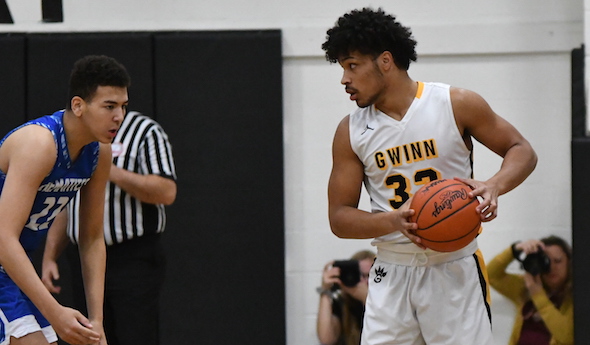
PHOTO: Gwinn's Tucker Taylor (32) – who needs four points to reach 1,000 for his career – considers his options last week while Ishpeming's Darius Yohe (22) defends. (Photo by Cara Kamps.)