

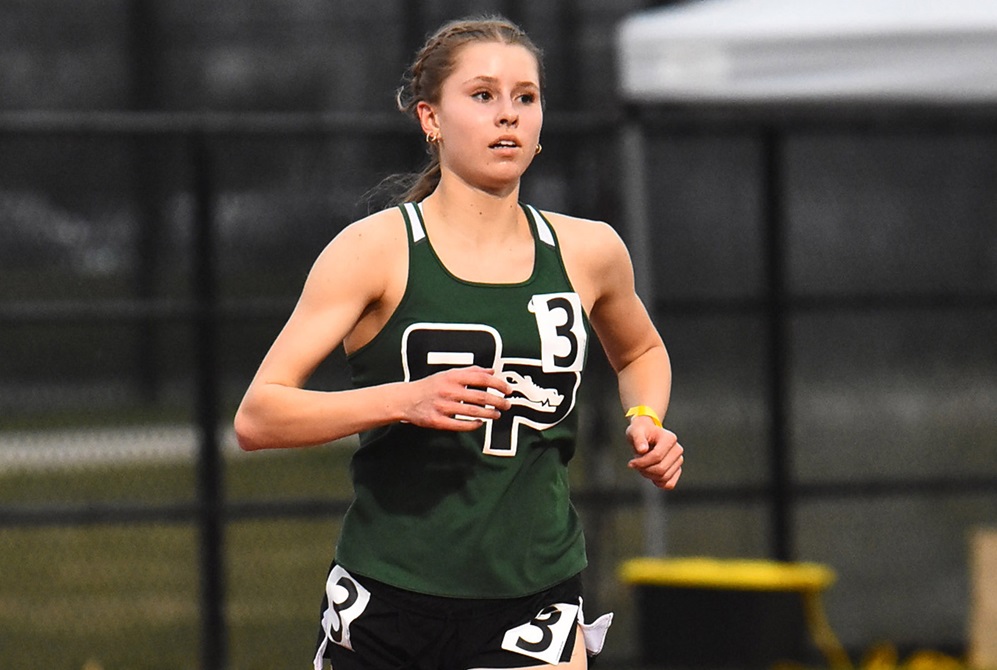
Bush Capping Championship Career as Arbor Prep's 1st Track Finalist
By
Doug Donnelly
Special for MHSAA.com
May 28, 2025
Eliza Bush admits it would be nice to have teammates, but the Ypsilanti Arbor Prep distance runner hasn’t let that stand in the way of a successful track season.
 The senior three-sport athlete qualified for Saturday’s Lower Peninsula Division 3 Finals in the 1,600 and 3,200.
“It doesn’t bother me, but it’s hard at times,” Bush said. “I don’t have anyone to run with or that is pushing me during my workouts. It’s made me more self-motivated. I’ve had to push myself.”
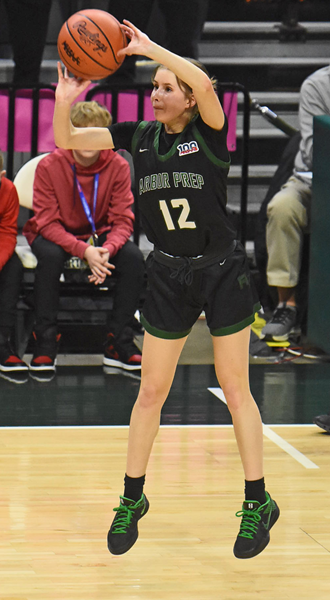
Bush has been all-state four consecutive years in cross country, finishing as LPD3 Final runner-up in the fall while just one of two Gators on the cross country team. She was an all-stater in basketball this winter when she led Arbor Prep to its second-straight Division 3 championship. During that Final she played all 32 minutes and scored 10 points, with three huge 3-pointers as the Gators defeated Rochester Hills Lutheran Northwest by 11.
This is Arbor Prep’s first season with an MHSAA-sanctioned track & field team.
“Our school never had track, and I’ve always done AAU basketball in the spring,” Bush said. “I basically had to beg (Arbor Prep athletic director Scott) Stine to let me do track.”
 When Stine said yes, she also had to find competition. Since Arbor Prep is not part of a conference, she helped make her own schedule. She competed at weekend events like the Farmington Invitational, Oakland University High School Invitational, Ann Arbor Greenhills April Showers Invitational and Ypsilanti Lincoln’s Railsplitter Invite.
“I would look for weekend events to go to, then ask Mr. Stine to register me,” she said. “I wanted to compete at races where I knew there would be good competition. Almost everywhere I went there were 30 to 40 other schools there. I want to race against good competition.”
She won the 3,200 and finished second in the 1,600 at her Regional.
Her personal best this season in the 1,600 was 5:00.31, which is second-fastest in LPD3 behind only 2024 champion Emmry Ross of Onsted. She’s also run second in LPD3 in the 3,200, about eight seconds behind Ross. She finished ahead of Ross in that race at the Regional at Adrian Madison.
“I’m hoping to get into the fours in the mile,” she said.
Stine is the official head coach of the Gators track team, but Bush did a lot of research about workouts and training on her own, with a major assist from cross country coach and school dean Stephanie Roberts.
“She was really helpful with timing and giving me splits,” she said. “I do appreciate everything she has done and being there. It has helped me a lot doing the research on my own, though, because I’ve learned so much from doing it.”
Last year, before Arbor Prep was allowed to run in postseason competition, Bush raced in four events when she could – the 400, 800, 1,600 and 3,200. She started this season running the 400 as well, but decided to go with her strength and focus on the two longest distances instead.
She’s not one to shy away from competition, which has been the mantra at Arbor Prep no matter the sport.
 “For some people it can be difficult when it gets (to be) higher competition, but I’m used to that,” she said. “Having such good competition in multiple sports is helpful.”
Bush lives in Dexter. She’s been part of the Arbor Prep sports program, however, since she was in the fifth grade when she became the ball girl for the Gators girls basketball team.
“I really liked going to their practices and games,” she said. “When I was younger, I would go to a lot of their games because they’ve always been so good. The team became like sisters to me, and it made me want to go there.”
Bush plans to run at Oakland University next season. She had debated playing basketball in college, but said she started looking more at track & field after Oakland contacted her last year. She wants to go into pre-medicine or study to become a physician’s assistant.
And she’s looking forward to having teammates again.
“It was a very hard choice. I think I’ve always focused more on basketball. I’m curious to see what it will be like doing (running) year-round,” Bush said. “I’m looking forward to running in college, to have teammates to work out with and push each other.”
 Doug Donnelly has served as a news and sports reporter at the Adrian Daily Telegram and the Monroe News for 30 years, including 10 years as city editor in Monroe. He's written a book on high school basketball in Monroe County and compiles record books for various schools in southeast Michigan. He is now publisher and editor of The Blissfield Advance, a weekly newspaper. E-mail him at [email protected] with story ideas for Jackson, Washtenaw, Hillsdale, Lenawee and Monroe counties.
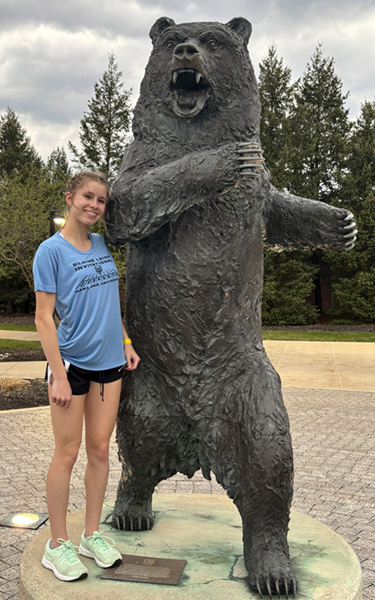
PHOTOS (Top) Arbor Prep senior Eliza Bush rounds a curve during a track race. (Middle) Bush puts up a jumpshot at the Breslin Center. (Below) Bush takes a photo during a visit to Oakland University. (Track photo by Dan Zeppa; Oakland photo courtesy of Bush family.)
Ironwood Savors Home-Track Advantage in LaBlonde Memorial Invitational Sweep
By
John Vrancic
Special for MHSAA.com
May 15, 2025
IRONWOOD — Most high school tracks have at least six lanes and are 400 meters.
 But there’s an exception to every rule.
That’s the case at Ironwood, where the Red Devils run on a 350-meter, five-lane asphalt surface.
“That’s something we’ve addressed,” Ironwood coach Cecilia Aho said “We’re probably the last ones who have a track this small, although the distances are the same. When we do mile repeats the kids don’t like it, but it’s better than not having a track. We make it work. Some of the smaller schools don’t have a track.”
Both Ironwood teams retained their titles Saturday afternoon at the Jim LaBlonde Memorial Invitational at Longyear Field, with the boys scoring 74 points to stay ahead of Hurley, Wis., at 57, and the Ironwood girls collecting 104 points to pull away from the field.
“The kids come here and have fun,” Aho said. “We have a nice group of kids who are working real hard.”
Ironwood junior Talon Hughes, who had a hand in four meet records, said the smaller track provides some challenges.
“It’s a pretty unique track,” he added. “We have different lanes and it’s hard to switch lanes. It can be intimidating for visiting teams. It’s sometimes hard for them to adapt, although we get used to it through practice. The biggest adjustment for us on 400-meter tracks is they have longer straightaways.”
Hughes won the 100-meter dash in 11.74 seconds and also took first in the 200 (24.42), 110 hurdles (16.84) and helped the Red Devils take the 800 relay (1:40.37).
“It’s a great feeling to win at home,” he said. “Many of your friends are here to cheer you on. We’re looking forward to our last few meets.”
The different exchange zones appeared to affect the Bessemer girls 800 relay the most. After a fast start, the Speedgirls struggled with all three handoffs, dropping them to third place (2:06.05), fewer than two seconds behind the winning team from Ironwood.
“I think it has a mental block on you,” Bessemer sophomore Sarah Hoffenberg said. “It really depends on the person. In my opinion, I think it helps if you don’t think about it. It’s really a learning experience.”
Hoffenberg later helped the Speedgirls bounce back with a victory in the 400 relay (1:01.38).
Ironwood senior Aubrey Smith, who will be attending classes at University of Michigan this fall, said it’s like having a homecourt advantage.
“It’s a little confusing,” she added. “It’s a little less than 4½ laps for a mile. It’s hard to tell where everyone is.”
Smith dominated the distances, taking the 800 (2:38.84), 1,600 (5:59.53) and 3,200 (11:58.87).
The Red Devils also ran in Wednesday’s Upper Peninsula Division 2 Regional at West Iron County, the boys team winning and the girls finishing runner-up to the host Wykons. Ironwood travels to Lake Linden-Hubbell for the Copper Mountain Conference meet Monday before ending the season at the Upper Peninsula Finals on May 31 at Kingsford.
“Our seniors are looking forward to their last couple meets,” Aho said. “I’m going to miss them. Our school is 100 years old. We started celebrating our centennial last July. We’re in the process of finishing up our celebration.”
 John Vrancic has covered high school sports in the Upper Peninsula since joining the Escanaba Daily Press staff in 1985. He is known most prominently across the peninsula for his extensive coverage of cross country and track & field that frequently appears in newspapers from the Wisconsin border to Lake Huron. He received the James Trethewey Award for Distinguished Service in 2015 from the Upper Peninsula Sportswriters and Sportscasters Association.
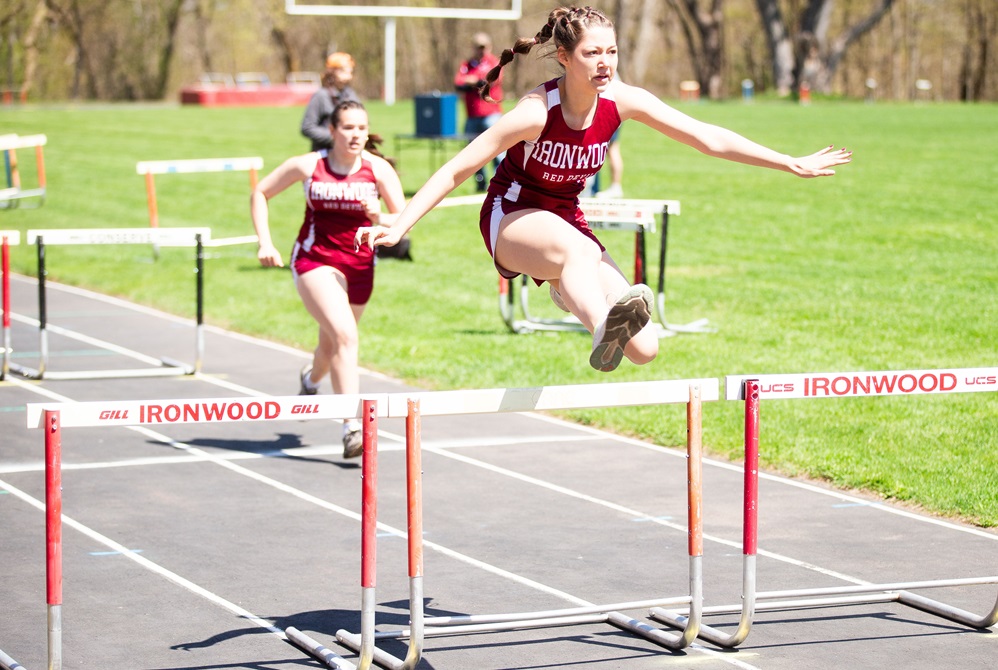
PHOTO Skyla Ballew clears a hurdle during a race at Ironwood High School. (Photo by Jason Juno/Ironwood Daily Globe.)