

Flashback 100: MHSAA Titles Just Start for NCAA Champion, Olympian Stark
May 6, 2025
In the time it takes to list just a few of Grace Stark’s achievements, the former White Lake Lakeland track star could blaze through the 100-meter hurdles race – twice.
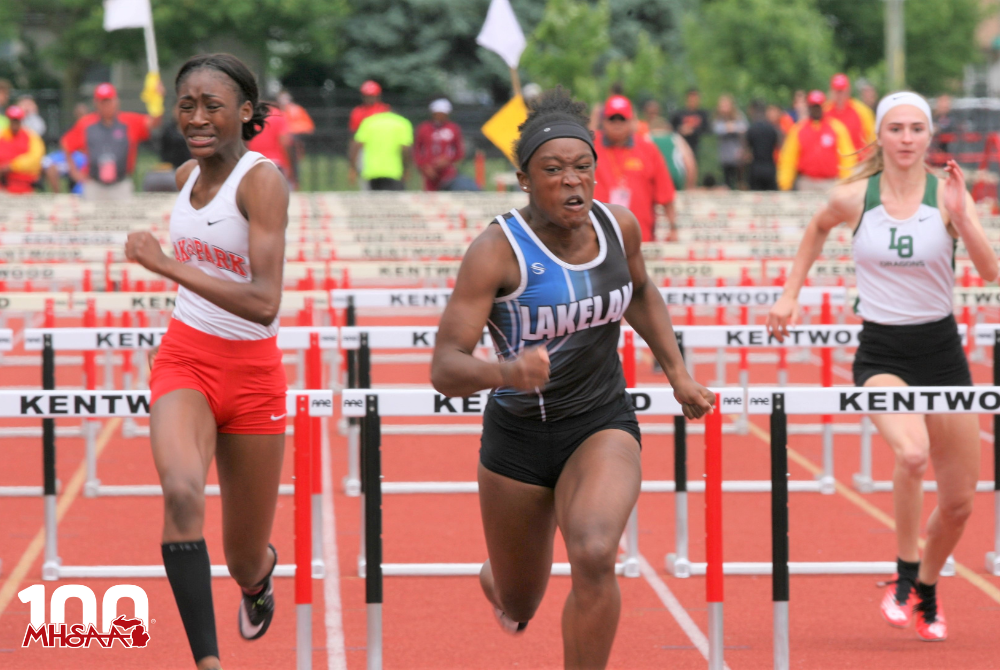
A 2019 graduate of Lakeland, Stark made her mark early. As a junior in 2018, she set an MHSAA Finals record in the 100-meter hurdles with a time of 13.16 seconds. That same year, she also captured the Lower Peninsula Division 1 title in the 100-meter dash. She returned as a senior to win a second championship in the 100-meter hurdles.
Stark continued her dominance at the University of Florida, where she rewrote the record books. She holds the fastest times in program history for the outdoor 100-meter hurdles, the indoor 60-meter hurdles and the indoor 60-meter dash. In 2024, she earned first-team All-America honors for both the indoor and outdoor seasons and was crowned NCAA champion in the outdoor 100-meter hurdles. She had previously won the NCAA indoor 60-meter hurdles title in 2022.
Stark reached the global stage at the 2024 Paris Olympics, placing fifth in the 100-meter hurdles while representing Team USA. She crossed the finish line just a tenth of a second behind gold medalist – and fellow American – Masai Russell. Stark's Olympic appearance followed another international highlight: She previously won the gold medal in the 100-meter hurdles at the 2018 Youth Olympic Games in Argentina.
Previous "Flashback 100" Features
May 1: Legendary Actor Played Multiple Sports Roles at Country Day - Read
April 23: Legacy Program Provided Start for Pioneering NBA Official Schroeder - Read
April 11: Rice's Championship-Winning Ways Started at Flint Northwestern - Read
March 28: Youngquist's Times Still Among MHSAA's Fastest - Read
March 18: After 40 Years, Coles' Shot Remains Among Century's Most Famous - Read
March 7: Walled Lake Northern's Hellebuyck Reigns as NHL's Elite Netminder - Read
Feb. 27: Zeerip's Mat Stats Remain Rarely-Challenged Chart Toppers - Read
Feb. 21: Before TV Stardom, Kerwin Excelled as All-State Skier - Read
Feb. 14: Detroit Central Star Voted into Pro Football Hall of Fame - Read
Feb. 6: Multi-Sport Star Look Becomes Super Bowl Officiating Legend - Read
Jan. 31: Johnson Family Put Magical Stamp on Michigan High School Hoops - Read
Jan. 24: Future Hall of Famers Face Off First in MHSAA Class A Final - Read
Jan. 17: First-Ever WNBA Draft Pick Rocked at Salem, Won Titles at Tennessee - Read
Jan. 10: Despite Launching Before 3-Point Line, Smith Still Tops Scoring List - Read
Jan. 3: Edison's Jackson Earns Place Among State's All-Time Elite - Read
Dec. 20: Future Olympian Piper Leads Grosse Pointe North to Historic Heights - Read
Dec. 13: The Other Mr. Forsythe in Michigan School Sports - Read
Dec. 6: Coleman's Legendary Heroics Carry Harrison Through Repeat - Read
Nov. 29: Harbaugh Brothers' Football Roots Planted in Part at Pioneer - Read
Nov. 22: 8-Player Football Finals Right at Home at Superior Dome - Read
Nov. 15: Leland Career Helps Set Stage for Glass' International Stardom - Read
Nov. 8: Future Baseball Pro Led Escanaba's Legendary Football Title Run - Read
Nov. 1: Michigan High School Baseball Trio Provide World Series Voices - Read
Oct. 25: Before Leading Free World, Ford Starred for Champion GR South - Read
Oct. 18: Mercy Links Legend Becomes World Golf Hall of Famer - Read
Oct. 11: Fisher Races to Finals Stardom on Way to U.S. Olympic First - Read
Oct. 4: Lalas Leaves High School Legacies on Ice & Pitch - Read
Sept. 27: Tamer's History-Making Run Starts in Dexter, Continues to Paris - Read
Sept. 20: Todd Martin’s Road to Greatness Starts at East Lansing - Read
Sept. 13: James Earl Jones, Dickson High Hoops to Hollywood Legend - Read
Sept. 6: Pioneers' Unstoppable Streak Stretches 9 Seasons - Read
Aug. 30: Detroit dePorres Rushes to 1995 Class CC Football Championship - Read
Williams Races to Place with All-Time Best
By
Paul Costanzo
Special for MHSAA.com
April 18, 2019
Bridgeport girls track coach Rick Popp said he believes his star sprinter Payten Williams has the potential to be a world champion.
 The high praise is something Williams appreciates, as she said it shows her coach has faith in her. But does the senior have that same faith in herself?
Williams was as quick to answer that as she is on the track: “Yes.”
“Payten is crazy fast,” Popp said. “She’s been the fastest girl in the state of Michigan the past two years. When you watch her run, her leg speed is insane. We don’t have a boy that can beat her in the 40 meters. The girl is just crazy lightspeed right now.”
While a world championship is a lofty goal, it’s hard to argue with Popp’s current assessment of Williams, the reigning MHSAA Lower Peninsula Division 2 champion in the 100 and 200 meters. During the past two years, she’s lost just two races, and both came at the MHSAA Finals her sophomore year. She placed fourth in both. She wasn’t unbeaten as a freshman, but she still finished first more than she didn’t and placed sixth at the Finals in the 200.
Her personal best in the 200 meters is 24.26 seconds, which she ran in July 2018 at the United States Track and Field Junior Olympics in North Carolina, placing 10th. That time would be an MHSAA Finals record in all but Division 1. Her personal best in the 100 is 12.06, which she ran at the 2018 MHSAA Finals, when she won by nearly half a second – second place came in at 12.55.
“Every state record should be gone,” Popp said, alluding to Williams breaking them. “Every all-time state record should be gone. When she’s dialed in, she’s lightspeed. She flies off her feet better than most anybody I’ve ever seen.”
Williams said she’s always been fast, but it took good coaching to help her reach these heights. That’s something she said she began to receive while in middle school from her AAU coaches, and that has continued into high school with them and Popp.
As things started to click, Williams started thinking big.
 “It felt great – it felt that I was going to become something,” Williams said. “I had a lot of people looking up to me, so I knew I had to keep going further. Making it all the way to the Olympics is something that’s big for me.”
She said she’s made a decision on which college she will be attending, but that she isn’t ready to make an announcement.
Her focus for now is on finishing her high school career strong. That includes breaking the 24-second and 12-second barriers in her respective races, although she was quick to note that the 100 isn’t really her race despite the fact she’s been dominant in it for two years.
“The 200 is my race,” she said. “I just like the race; it’s hard to explain it.”
She said that even after winning the 100 at last year’s Finals, she was more concerned with the 200 she still had to run. That doesn’t mean she wasn’t happy about the double.
“It felt great,” she said. “My mom was like, ‘You’re going to get this. You’re going to become a state champion.’ I was like, ‘No mom, don’t think that.’ But then she was right.”
The times are more important to Williams than winning races. With such lofty goals and recent championship results, focusing on racing the clock could be her best path to reaching them.
“I just focus on getting to the finish line and how I run,” she said. “I don’t think about anything else. I just think about myself and the track.”
Williams has yet to run an outdoor race this season, but she did win a pair of indoor races at Saginaw Valley State in late March, claiming the 60 meters in 7.74 seconds and the 200 in 25.41.
She said she’s been off to a slower start this season, as she’s had to devote more time to her family, specifically helping care for her grandfather. While she didn’t want to elaborate, she did say that she’s getting back to practicing full time and expects to have another strong season.
There’s plenty for her to work for, including repeat championships, state records, getting closer to her Olympic dreams, and her family.
“I’m pushing myself by using my strength as my motivation,” she said. “And I’m doing it for my granddad.”
 Paul Costanzo served as a sportswriter at The Port Huron Times Herald from 2006-15, including three years as lead sportswriter, and prior to that as sports editor at the Hillsdale Daily News from 2005-06. He can be reached at [email protected] with story ideas for Genesee, Lapeer, St. Clair, Sanilac, Huron, Tuscola, Saginaw, Bay, Arenac, Midland and Gladwin counties.
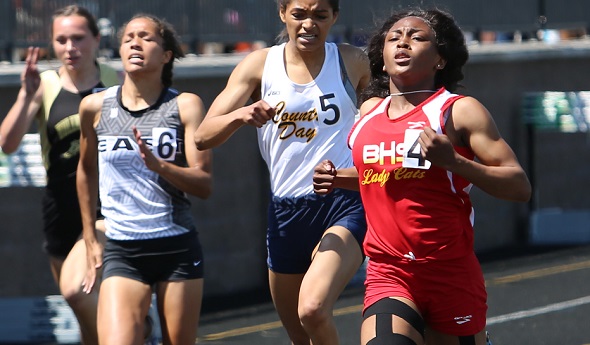
PHOTOS: (Top) Bridgeport's Payten Williams, far right, surges through the finish in winning the 200 meters at last year's Lower Peninsula Division 2 Finals. (Middle) Williams, middle, leads the 100 as contenders power through the final paces of that sprint. (Click to see more from RunMichigan.com.)