

Owner of State's All-Time Farthest Shot Put Aiming for National Record, Olympics
By
Paul Costanzo
Special for MHSAA.com
March 25, 2026
From the first time Montrose's Addyson Stiverson picked up the shot put at a sixth-grade track & field practice, it was clear there was something there.
 Even if she wasn’t quite clear on the name.
“I ran at the first couple practices, and was like, this wasn’t for me,” she said. “They said, ‘You’re strong, try the heavy ball thing.’ I honestly never threw it like a baseball. It wasn’t impeccable, but I kind of knew the basics. I definitely had some sore elbows and shoulders.”
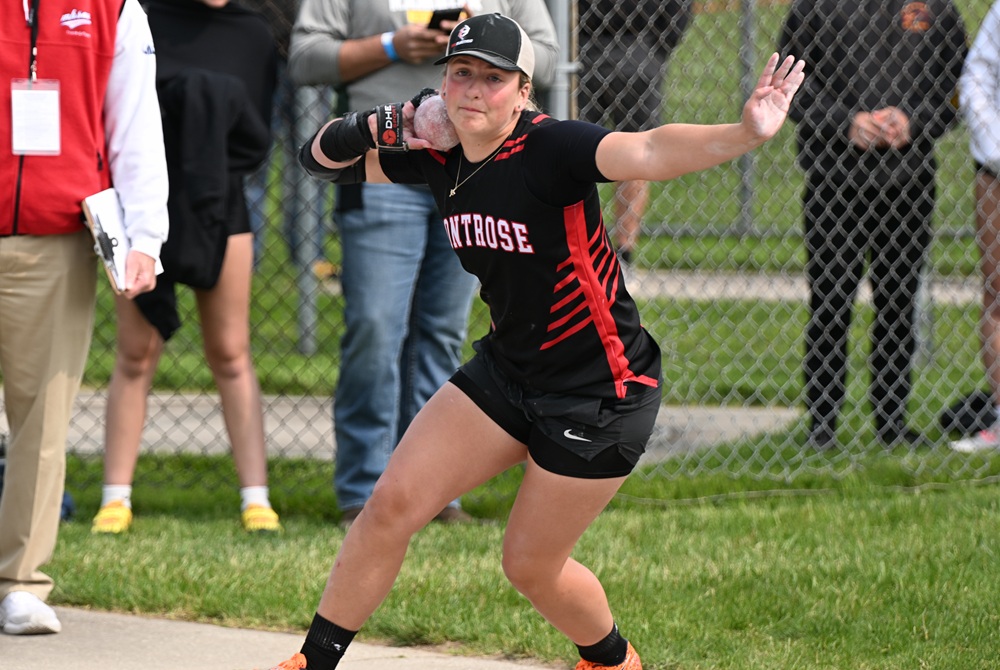
Five years later, Stiverson sits atop the record books as she’s thrown that heavy ball thing farther than any female in Michigan high school history.
Her personal best of 53 feet, 7½ inches, which she threw Dec. 13 at an indoor meet at Grand Valley State University, is nearly two feet farther than the previous record of 51-11 held by Byron great Sarah Marvin, according to MichTrack.org, which tracks records from all meets. (The MHSAA record book is for Finals meets only.)
And as she enters her junior outdoor season having already won the shot put twice and discus once at the Lower Peninsula Division 3 Track & Field Finals, Stiverson’s goals go well beyond the state’s borders.
“(Competing in the Olympics) is the goal,” Stiverson said. “Throwing in 2028 would be nice, but I think a good goal is to be a good contender in (2032). Even going to trials in 2028 and getting close to making the team would be a big win for me.”
It’s a huge goal, but not at all outlandish for Stiverson, who is already fielding scholarship offers from between 20 and 30 major Division I programs and is part of the Nike Elite Team, which includes 40 of the country’s top high school track & field athletes.
She also trains with Dane Miller at Throws University in Reading, Pa. Miller has trained two national champions and 12 World Team members.
“When he texted me like a month or two after we went out there and he was like, ‘I want to coach you,’ I was like, holy crap. I was kind of fan-girling for a moment,” Stiverson said. “He’s like one of the only reasons I throw as far as I do. When he first started coaching me, he was like, you’re not doing this anymore, we’re doing this. He cut out all the bad stuff.”
Stiverson’s 53-7½ would rank seventh all-time on the National Federation of State High School Associations list. The listed record there is 57-1¼, by Alyssa Wilson of New Jersey. But Wilson threw 58-1 during the summer after her senior year, and that’s the record Stiverson is chasing.
 Plus a little more.
“She always has that goal in the back of her mind of breaking that 58-1,” said Adam Stiverson, Addyson’s father and Montrose’s girls track coach. “She kind of has a little future goal that no one really talks about it: Could a high school female thrower ever hit 60 feet?
“She wants to compete in college no matter what, and she wants to get better. There’s always room for improvement. If she can fix some things, get a little bigger, a little stronger, 60 feet could be possible. But let’s get 55 feet out of the way, 56 feet out of the way, 57 feet out of the way. If we can get to 57, then we can talk about that 60, because then we’d know that 58-1 is coming.”
While chasing down national goals, Stiverson has been dominating locally.
She’s never been beaten in the shot put during the high school season, and she’s never finished lower than third in the discus, despite it being much less of a focus for her, as she doesn’t want it to affect her form in the shot.
“I’m not going to lie, I don’t touch a disc that much,” Stiverson said. “I give it maybe 75-25, maybe 70-30 during the season. I feel like if I give it too much attention, it could mess up my shot.”
While throwing is her main focus now, Stiverson did play varsity basketball as a freshman and sophomore at Montrose. She also played football all the way through freshman year.
At 5-foot-9, her all-around athletic ability and explosiveness are a great base for her throwing ability, and while she hasn’t shown it off in a while, she can run, too.
On the day she set the Montrose school record for the shot put as a freshman, she also won the 100 meters at a Mid-Michigan Activities Conference quad meet.
“That was for team points,” Stiverson said with a laugh. “Our coach said, ‘One of the girls didn’t show up, we need you to run.’ And I had my spikes with me, so I did.”
Stiverson was the Division 3 Finals champion in the shot put both of the past two years, and won the discus in 2025 as well. She was runner-up in the discus as a freshman.
There are still two full seasons to go, but she’s on pace to become the first female thrower in the Lower Peninsula to win four Finals titles in the shot put.
“I think that was my biggest goal when I came into high school; I wanted to be a four-time shot put state champ,” she said. “When it does happen, that would be one of the coolest things. That was a dream.”
 Paul Costanzo served as a sportswriter at The Port Huron Times Herald from 2006-15, including three years as lead sportswriter, and prior to that as sports editor at the Hillsdale Daily News from 2005-06. He can be reached at [email protected] with story ideas for Genesee, Lapeer, St. Clair, Sanilac, Huron, Tuscola, Saginaw, Bay, Arenac, Midland and Gladwin counties.
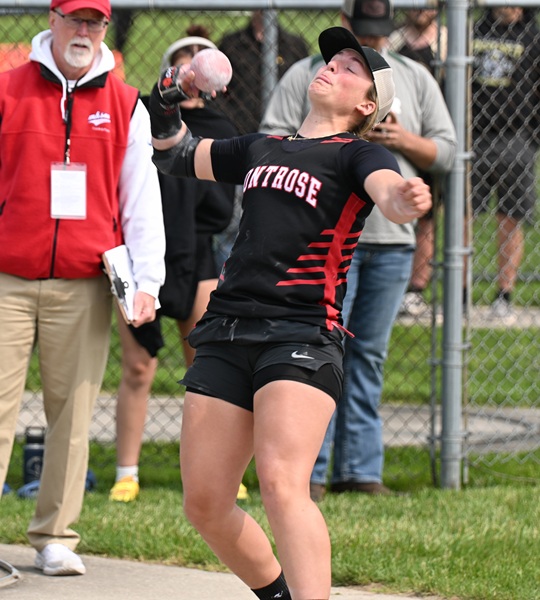
PHOTOS Montrose's Addyson Stiverson competes in the shot put at last season’s LPD3 Finals. (Photos by Mary Wilson/RunMichigan.com.)
Oak Park, Returning Individual Champs Lead Chase Again at Star-Filled Finals
By
Steve Vedder
Special for MHSAA.com
June 1, 2024
EAST KENTWOOD — Abby Russell has no problem throwing as the favorite with everyone else hoping to catch her.
In fact, the Allen Park senior embraces summoning up her best efforts in both the discus and shot put every time she lines up to throw. Russell said she's never equated success with the pressure of being a state champion.
"To be honest, no," said Russell, who closed out a stellar career by winning those two events at Saturday's Lower Peninsula Division 1 Finals at East Kentwood. "I just focus on myself. Going to see a sports psychologist has helped me a lot with that. We talk about the work you have to put in, and (success) being a consistency thing."
Whether it's pure talent or seeking professional guidance or the ability to deal with pressure, Russell finished off an outstanding career in winning the discus (156-6) and the shot (46-10) on Saturday. The two titles are added to a first as a sophomore and third as a junior in the shot. She's now a three-time champ in the discus.
The wins at East Kentwood were also personally rewarding to Russell, who didn't place in the shot as a freshman at Falcon Stadium. It's one of the few places where the University of Michigan-bound Russell figures she could have done better.
"I was real bad as a freshman, so I was happy to get back here again," she said. "I had a great time back then. I just didn't do what I wanted."
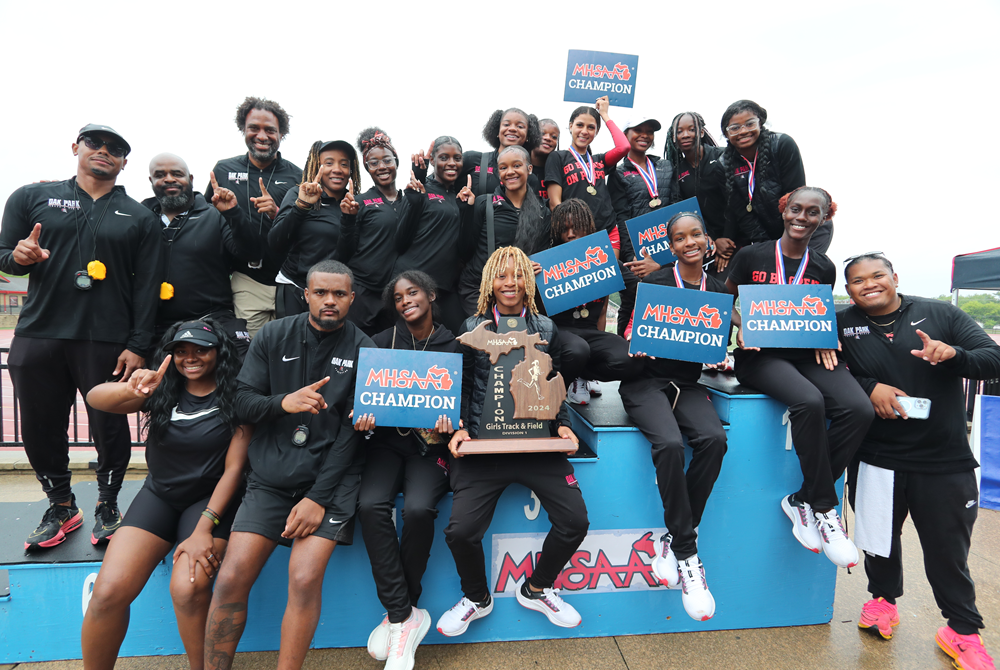
While Russell was among those dominating the individual meet Saturday, Oak Park was sweeping its way to a team title. The Knights finished with 88 points to easily outdistance runner-up Ann Arbor Pioneer's 42. Detroit Renaissance was third with 35 points, East Kentwood was fourth with 34 and Saginaw Heritage had 30.
Oak Park coach Brandon Jiles, whose team collected its eighth Finals title under his leadership, said he wasn't sure what type of showing a young team would make Saturday. Of the 35 athletes on the roster, just three are seniors.
Still, Jiles thought the team would be in the hunt along with Pioneer, Renaissance and Detroit Cass Tech. At least part of the success was winning the 800 (1:38.10), 400 (47.53) and 1,600 (3:47.99) relays. The other firsts were by senior Morgan Roundtree in the 300 hurdles (41.31), freshman Nevaeh Burns in the 400 (55.02) and senior Kylee King (2:10.53) in the 800.
 "We thought we had a shot. We just take it one event at a time and do what we have to do. We only have three seniors, but they're really good kids. We'll have some good girls back next year, and they know they'll have to step up and score," Jiles said.
"I'm a very competitive person when I see other teams that are good. I think the girls are like that too. We're ready when it comes to championship time."
Roundtree said her two chief goals at the meet were accomplished. She wanted to join a long list of successful Oak Park sprinters while also leading a young team to a championship.
"I want to motivate my teammates, and I think I was able to do that," said Roundtree, whose 300 time is ninth best in the country. "We've had some good sprinters here, and I really wanted to become one of them."
Among the other champions was Lena Cleveland of Rochester, who went from finishing fourth in the long jump a year ago to winning (18-2) that event Saturday. Cleveland is a former sprinter who traded the 100 and 200 for the long jump a couple of years ago.
"I wanted to try the long jump, and it's worked out," she said. "I put in a lot of hard work over the summer and in indoor. I also worked hard in strength training in the gym. I didn't used to have access to a (long jump) pit, but I was able to put in the work."
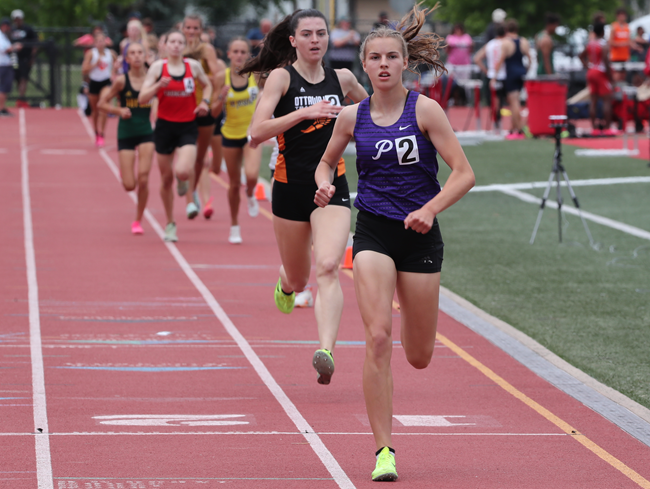
Rachel Forsyth of Ann Arbor Pioneer won the 1,600 (4:38.28) and 3,200 (10:15.57) to cap an outstanding four-year career. A two-time cross country Finals champ, Forsyth overcame illness to win the 1,600 a year ago. She was coming off a trip to the Trial of Miles meet in New York a couple of weeks ago, but said the Finals featured virtually no mental letdown.
"Maybe a little, but you can't control it," she said. "You can only control what you're doing that day. And I think I ran well. It was great because my sister was in the same three events I was in in 2017."
The other champions Saturday were Kamryn Tatum of West Bloomfield in the 200 (24.63), Brooke Bowers of Grand Rapids Forest Hills Central in the pole vault (12-9), Madison Morson of Salem in the high jump (5-10), Maya Rollins of Ann Arbor Pioneer (13.86) in the 100 hurdles, Willow Mason of Saginaw Heritage in the 200 (24.66) and Keyanna O'Tey of Sturgis in the 100 (12.08). West Ottawa won the 3,200 relay (9:00.27), and Fenton sophomore Molly Katic (100), Clarkston freshman Allison Thurman (200) and Sturgis freshman Vivian Massey (shot put) were the adaptive event champions.
PHOTOS (Top) Oak Park celebrates its latest LP Division 1 team championship Saturday at East Kentwood. (Middle) Ann Arbor Pioneer’s Rachel Forsyth leads the pack in the 1,600. (Click for more from John Brabbs/RunMichigan.com.)