

Track Gaining Speed Toward Future with Electronic Starting Devices
By
Steve Vedder
Special for MHSAA.com
May 23, 2023
Aubrey Greenfield thinks it might be the perfect time to reevaluate 130 years of tradition.
For a number of reasons, from technical to personal, the Oxford senior sprinter believes it makes sense for the crack of a starting pistol to be eliminated from high school track meets.
Because track meets would benefit in various ways from lowering costs to easier setup at meets to the human factor of competitors not having to flinch at the crack of a pistol shot, Greenfield believes the sport has a chance to embrace new technology – electronic starting devices (ESD).
In essence, an ESD replaces the starting pistol with a light flash, tone sound or both to begin a race.
"High school sports should put the athlete first," Greenfield said. "We should promote sports, and eliminating starting pistols promotes health in terms of PTSD or trauma for athletes and spectators and that would be good. I would like to think people would say that's a good idea."
In fact, Greenfield would go as far as to say if there was not an implementation of electronic starting devices, many of her teammates would have considered giving up the sport.
"If it's something that helps us compete safely, we're all for it," she said.
Greenfield's opinion apparently is spreading. Michigan High School Athletic Association senior assistant director Cody Inglis said the use of ESD makes it both affordable for meet starters and sensible for athletes and fans to rethink the use of starting pistols. While the MHSAA is not mandating electronic starting devices, it does promote the use of what Inglis calls "emerging technology." He notes that ESD are becoming the norm for organizations such as USA Track & Field, the NCAA and an increasing number of high schools.
 "I think we have to embrace new technology, and we think this will be something that takes hold," Inglis said.
A key part of embracing ESD is the human element. The tragic Oxford High School shooting Nov. 30, 2021, that took the lives of four students while injuring seven others should not be relived even for a fleeting instance at a high school sporting event. Oxford athletic director Tony DeMare said the school began using ESD at every meet, including the MHSAA Lower Peninsula Division 1 Finals last June. He said that decision was embraced by virtually all schools Oxford encountered.
"We were very convinced that the alternative (of ESD) would promote a healthy attitude," DeMare said. "We were overwhelmed with the positive response. If a school was on the fence about it or might not be for it, I think we've started to see the tide turn in favor of people willing to listen and learn about electronic starting devices."
Inglis said the MHSAA is acutely aware of what the crack of a starting pistol can mean to athletes and fans.
"It's unimaginable what Oxford went through, and this is a small way we can help," he said. "We look at a (starting pistol) and think, ‘Could we do something else?’ It's a way of helping to solve a problem."
Over the last several years, the MHSAA has embraced finding an alternative to starting pistols. Inglis noted the discussion started with the cost and diminishing availability of 32-caliber ammunition that meet starters use. A box of ammunition, if it can be found, is around $75 a box.
In addition to cost, there is potential damage from excessive exposure to 150-plus decibels of sound generated by the traditional 32-caliber blanks. Medical studies show damage to ears caused by decibel levels above 120 dB.
The tragedy at Oxford accelerated the conversation.
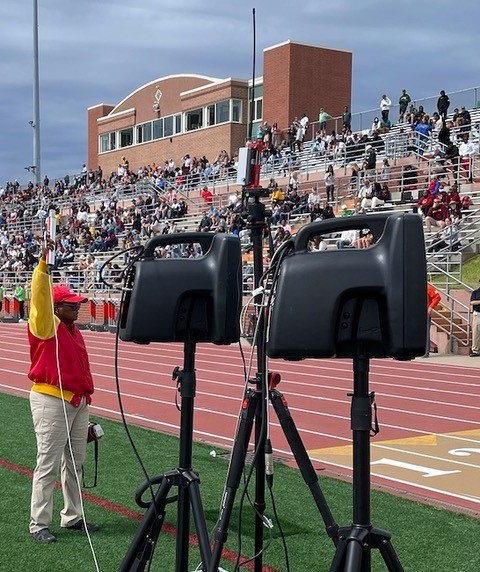
Inglis said the cost of ESD can be likened to a school sinking money into artificial surfaces at football fields. Yes, there is a great cost at first, but over time money is ultimately saved. An ESD system itself ranges between $200 and $500. Speakers also may need to be purchased, but with ESD starting events like the 800 and 1,600-meter relays positioned near the outside lanes 8, 7, 6 and 5 would result in improved hearing by athletes at the start of a race.
There is one challenge with ESD that track administrators are working to overcome – lighting conditions that lessen the ability to see the ESD’s LED light or strobe when the button is pressed by a starter to begin a race. But that vision difficulty resulting from clear blue skies and backgrounds of setting suns can be substantially improved by incorporating a black background with an ESD – something as simple as a starter holding up black cardboard behind the lighting mechanism at the start of an event.
Inglis said when all factors are considered, the use of ESD makes sense.
 "With the climate we live in nowadays, no lookalike guns is good," he said. "We're not mandating this. But people are saying this is affordable."
While switching to ESD would break 130 years of tradition, the timing could be a step forward, said Jeff Hollobaugh, co-author of the book "The Fleet Feet of Spring: Michigan's High School State Championships in Track & Field." He said while no definitive answer is possible, it's likely starting pistols were used at the inaugural state meet at the Jackson Fairgounds in 1895. The meet, which included events like tossing a 16-pound shot put, bike races and a 100-meter sprint, was sponsored by the Michigan Interscholastic Athletic Association (a predecessor to the MHSAA) and comprised mostly of the state's larger schools.
Hollobaugh's sentiments echo what many involved in today's high school track & field believe in terms of making a transition from starting pistols to electronic starting devices.
"It's a change, not necessarily good or bad, just different," he said. "It's not a drastic change, but it will take some getting used to. But it is the future. In the end, we'll all be fine."
DeMare believes the future of high school track will definitely include ESD.
"Our desire is that the practicality and sensibility of this will overcome the alternative," he said. "I think we'll see the automation and electronics taking hold of certain elements in track, and people will embrace it."
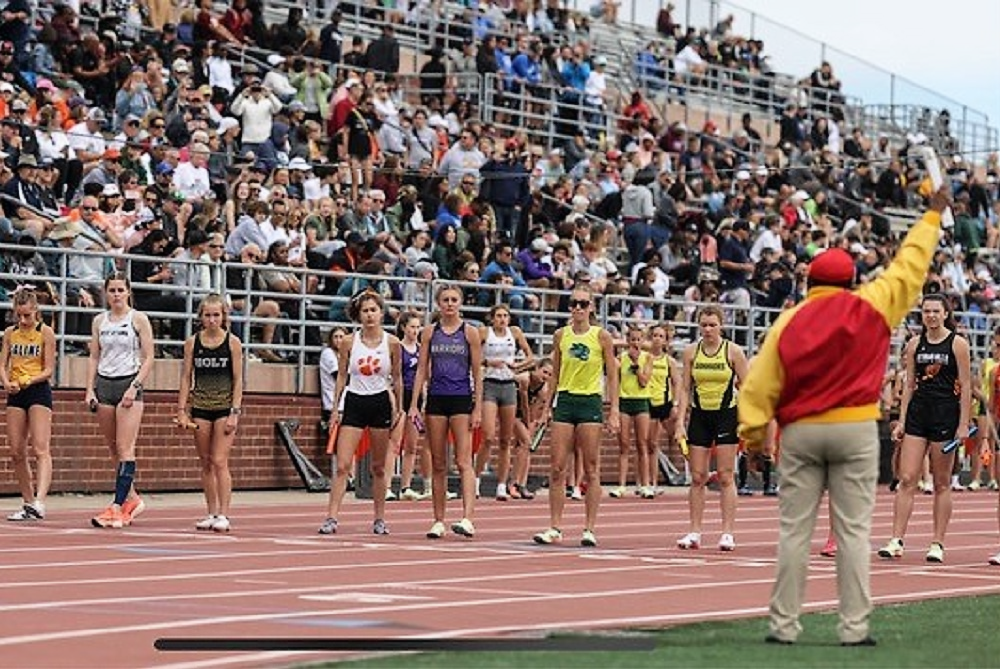
PHOTOS (Top) Runners watch official Bertha Smiley as they prepare to begin a race during last season's Lower Peninsula Division 1 Finals at Rockford. (Middle) An electronic starting device provided by VS Athletics was used to start those races. (Below) Smiley sets to begin an event. (Photos provided by David Kuderka/VS Athletics.)
Spring Lake Girls Win Meet's Final Race to Clinch 1st Finals Championship
By
Keith Dunlap
Special for MHSAA.com
May 30, 2026
HAMILTON — It’s not unusual for a track & field state championship meet to come down to the final event.
What was unusual Saturday was the number of teams that still had a chance to win going into the last event of this year’s MHSAA Lower Peninsula Division 2 Girls Finals.
Going into the 1,600 relay – the meet’s final event – the top four teams were separated by just three points, making for quite a dramatic finish.
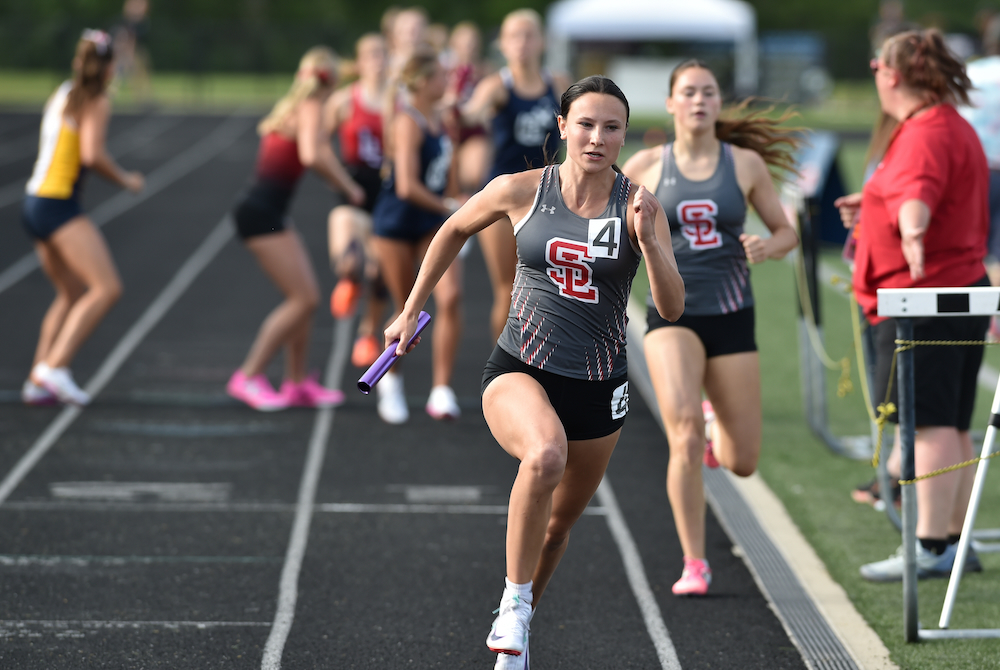
Leading by one point heading into the event, Spring Lake held on to the top spot, winning the 1,600 relay to clinch the team title with 42 points total.
The Spring Lake team of Cora Parker, Macy Subka, Kaleigh Clark and Meghan Guczwa won in an LPD2 Finals-record time of 3:55.25, breaking the old record of 3:56.07 set in 2000 by Battle Creek Lakeview.
Holland Christian was runner-up with 35 points, while Ludington was third with 31.
“I was a ball of anxiety up in the stands,” Spring Lake head coach Marina Samp said. “But it was great seeing them go out, get the early lead, hold on, never let go, hammer it home and get the record on top of it.”
It was Spring Lake’s first Finals title in girls track.
“We knew this was possible,” Samp said. “We were just like, ‘Can we make it to the end? Can we put together the perfect season? This is what we were going for.”
Both Dearborn Divine Child junior Aubrey Wilson and Ludington freshman Eliza Schwass made runs at winning three individual titles before settling with a pair apiece.
However, “settling” for two individual titles was still obviously thrilling for both.
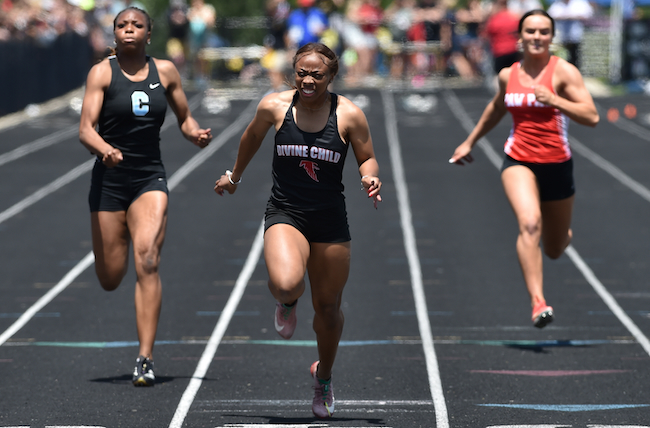
The 2025 champion in the 100 and 200-meter dashes, Wilson repeated in both, winning the 100 in a personal-best time of 11.50 and the 200 in 24.10.
 Wilson also was going for the title in the 400 dash, but didn’t quite have the energy in that race, finishing eighth. Haslett’s Chrstina Dixon finished first in 55.69 seconds.
However, after that result, Wilson quickly regrouped for the 200 and left no doubt in that sprint.
“I just kept walking and kept in focus,” Wilson said of bouncing back for the 200. “Even though I performed bad in one race, I didn’t bring it to my other one. I’m happy about that.”
Wilson said she might try to run the 400 and go for three individual titles again at next year’s Finals meet.
“It’s a lot of hard work and dedication, but hopefully next year I’ll perform better,” she said.
Schwass was attempting to win the 800, 1,600 and 3,200 and looked to be on track for that quest after winning the 1,600 in 4:53.12 and the 800 in a meet-record time of 2:08.62, topping the previous record of 2:09.92 set by Layla Jordan of Goodrich in 2024.
But as was the case with Wilson in the 400, Schwass just didn’t quite have enough left in the tank, although she still finished second in the 3,200 in a time of 10:43.09. Pinckney junior Jaelyn Ray won in 10:36.99.
Schwass said she determined earlier this year that she could go for the win in all three events, and nearly pulled it off in her first high school championship meet.
“I wasn’t too nervous,” she said. “I just kind of focused on my training and telling myself I was ready for this.”
The other multi-event winner Saturday was Subka, a junior who swept the two hurdles races after finishing third in the 300 and not placing in the 100 last year.
Subka said the big difference was a new indoor athletic center that the school opened during the winter, which took her training to a whole new level.
“I’ve been able to be there all winter,” she said. “I also play soccer in the spring. A lot of technical work, and soccer I get a lot of conditioning from.”
The field events saw a pair of repeat champions in Stevensville Lakeshore’s Leigha Whitman in the long jump and Wayland’s Evie Mathis in the pole vault.
Also claiming championships Saturday were Grand Rapids Christian in the 400 relay, Orchard Lake St. Mary’s in the 800 relay and Holland Christian in the 3,200 relay, Freeland’s Payton Maxey in the shot put, North Branch’s Aubree Deshetsky in the discus and Hastings’ Bella Friddle in the high jump. Sturgis' Vivian Massey won the adaptive shot put.
PHOTOS (Top) Spring Lake's Megan Guczwa sprints the final leg of the 1,600 relay Saturday at Hamilton. (Middle) Dearborn Divine Child's Aubrey Wilson pushes through the finish of a sprint championship. (Click for more from Dave McCauley/RunMichigan.com.)