

Track Gaining Speed Toward Future with Electronic Starting Devices
By
Steve Vedder
Special for MHSAA.com
May 23, 2023
Aubrey Greenfield thinks it might be the perfect time to reevaluate 130 years of tradition.
For a number of reasons, from technical to personal, the Oxford senior sprinter believes it makes sense for the crack of a starting pistol to be eliminated from high school track meets.
Because track meets would benefit in various ways from lowering costs to easier setup at meets to the human factor of competitors not having to flinch at the crack of a pistol shot, Greenfield believes the sport has a chance to embrace new technology – electronic starting devices (ESD).
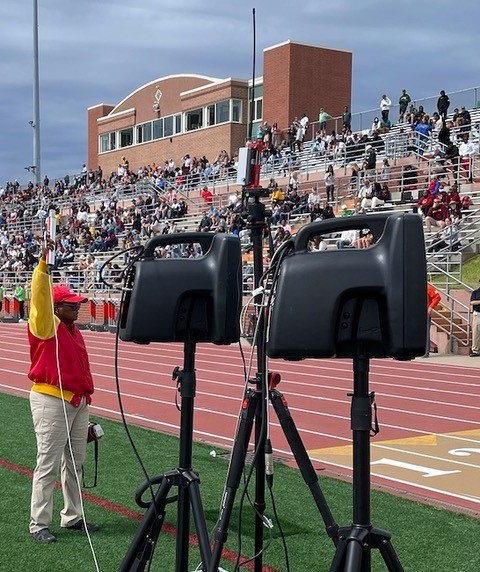
In essence, an ESD replaces the starting pistol with a light flash, tone sound or both to begin a race.
"High school sports should put the athlete first," Greenfield said. "We should promote sports, and eliminating starting pistols promotes health in terms of PTSD or trauma for athletes and spectators and that would be good. I would like to think people would say that's a good idea."
In fact, Greenfield would go as far as to say if there was not an implementation of electronic starting devices, many of her teammates would have considered giving up the sport.
"If it's something that helps us compete safely, we're all for it," she said.
Greenfield's opinion apparently is spreading. Michigan High School Athletic Association senior assistant director Cody Inglis said the use of ESD makes it both affordable for meet starters and sensible for athletes and fans to rethink the use of starting pistols. While the MHSAA is not mandating electronic starting devices, it does promote the use of what Inglis calls "emerging technology." He notes that ESD are becoming the norm for organizations such as USA Track & Field, the NCAA and an increasing number of high schools.
 "I think we have to embrace new technology, and we think this will be something that takes hold," Inglis said.
A key part of embracing ESD is the human element. The tragic Oxford High School shooting Nov. 30, 2021, that took the lives of four students while injuring seven others should not be relived even for a fleeting instance at a high school sporting event. Oxford athletic director Tony DeMare said the school began using ESD at every meet, including the MHSAA Lower Peninsula Division 1 Finals last June. He said that decision was embraced by virtually all schools Oxford encountered.
"We were very convinced that the alternative (of ESD) would promote a healthy attitude," DeMare said. "We were overwhelmed with the positive response. If a school was on the fence about it or might not be for it, I think we've started to see the tide turn in favor of people willing to listen and learn about electronic starting devices."
Inglis said the MHSAA is acutely aware of what the crack of a starting pistol can mean to athletes and fans.
"It's unimaginable what Oxford went through, and this is a small way we can help," he said. "We look at a (starting pistol) and think, ‘Could we do something else?’ It's a way of helping to solve a problem."
Over the last several years, the MHSAA has embraced finding an alternative to starting pistols. Inglis noted the discussion started with the cost and diminishing availability of 32-caliber ammunition that meet starters use. A box of ammunition, if it can be found, is around $75 a box.
In addition to cost, there is potential damage from excessive exposure to 150-plus decibels of sound generated by the traditional 32-caliber blanks. Medical studies show damage to ears caused by decibel levels above 120 dB.
The tragedy at Oxford accelerated the conversation.
Inglis said the cost of ESD can be likened to a school sinking money into artificial surfaces at football fields. Yes, there is a great cost at first, but over time money is ultimately saved. An ESD system itself ranges between $200 and $500. Speakers also may need to be purchased, but with ESD starting events like the 800 and 1,600-meter relays positioned near the outside lanes 8, 7, 6 and 5 would result in improved hearing by athletes at the start of a race.
There is one challenge with ESD that track administrators are working to overcome – lighting conditions that lessen the ability to see the ESD’s LED light or strobe when the button is pressed by a starter to begin a race. But that vision difficulty resulting from clear blue skies and backgrounds of setting suns can be substantially improved by incorporating a black background with an ESD – something as simple as a starter holding up black cardboard behind the lighting mechanism at the start of an event.
Inglis said when all factors are considered, the use of ESD makes sense.
 "With the climate we live in nowadays, no lookalike guns is good," he said. "We're not mandating this. But people are saying this is affordable."
While switching to ESD would break 130 years of tradition, the timing could be a step forward, said Jeff Hollobaugh, co-author of the book "The Fleet Feet of Spring: Michigan's High School State Championships in Track & Field." He said while no definitive answer is possible, it's likely starting pistols were used at the inaugural state meet at the Jackson Fairgounds in 1895. The meet, which included events like tossing a 16-pound shot put, bike races and a 100-meter sprint, was sponsored by the Michigan Interscholastic Athletic Association (a predecessor to the MHSAA) and comprised mostly of the state's larger schools.
Hollobaugh's sentiments echo what many involved in today's high school track & field believe in terms of making a transition from starting pistols to electronic starting devices.
"It's a change, not necessarily good or bad, just different," he said. "It's not a drastic change, but it will take some getting used to. But it is the future. In the end, we'll all be fine."
DeMare believes the future of high school track will definitely include ESD.
"Our desire is that the practicality and sensibility of this will overcome the alternative," he said. "I think we'll see the automation and electronics taking hold of certain elements in track, and people will embrace it."
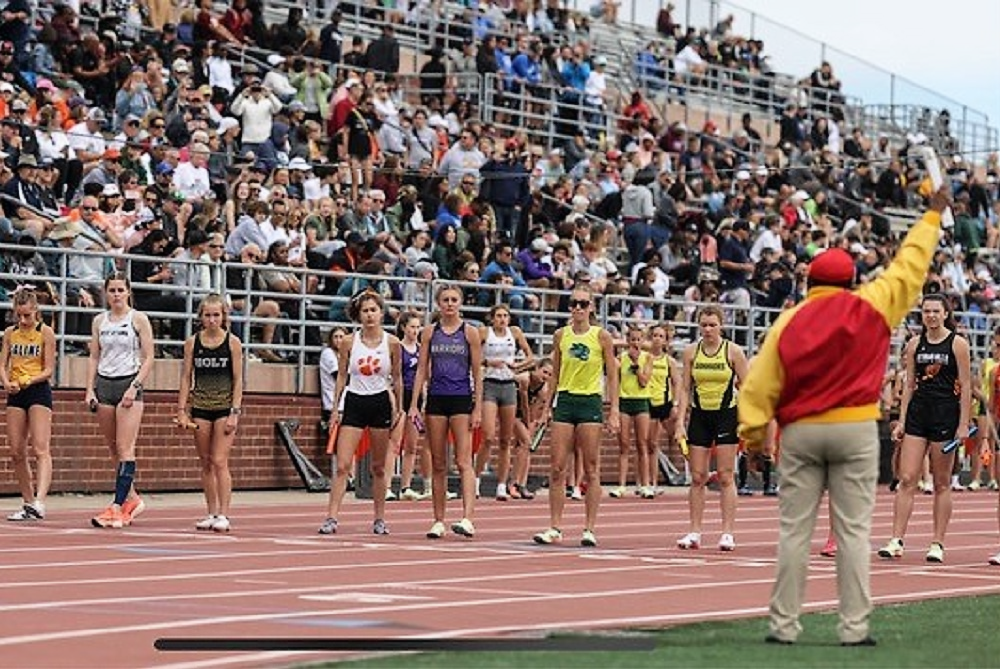
PHOTOS (Top) Runners watch official Bertha Smiley as they prepare to begin a race during last season's Lower Peninsula Division 1 Finals at Rockford. (Middle) An electronic starting device provided by VS Athletics was used to start those races. (Below) Smiley sets to begin an event. (Photos provided by David Kuderka/VS Athletics.)
Record-Setter Dzurka Dreaming Big, but First Focused on Goal #1: Stay Healthy
By
Paul Costanzo
Special for MHSAA.com
April 22, 2026
When it comes to end of season goals, Midland Dow senior Zach Dzurka is keeping it simple: Get there.
 To an outsider, that aspiration might seem overly simple for a runner who has the state’s fastest 300-meter hurdles time and is ranked fourth in the 110 hurdles this spring, regardless of division. But after the opportunity to compete at the MHSAA Lower Peninsula Division 1 Finals was taken away from him a year ago, Dzurka is taking nothing for granted.
“Just try to keep on PRing (setting personal records) and hope to not get injured,” Dzurka said. “I’ve always been super injury-prone for some reason. But the goal is to keep myself healthy until states.”
Dzurka set a pair of Dow records on April 17 at the Graves/Swayze Relay Meet in Midland, running the 300 hurdles in 37.82 and 110s in 14.47. His 300-hurdle time is the fastest in the state so far this year, and just 0.03 seconds off last year’s Division 1 Finals championship time, run by Will Smith of Belleville, who has since graduated.
“I wouldn’t say surprising is the right word; this is totally expected for him,” Dow coach Jenna Oskvarek said. “He’s been working his butt off to make sure he can reach his goals. It was kind of only a matter of time, we knew (times this fast were) going to happen, we just didn’t know when. We couldn’t be happier.”
Dzurka, who also holds the school indoor record for the 60-meter hurdles (8.33), had already claimed the 300 hurdles record a year ago and was unbeaten in both outdoor hurdles events throughout the 2025 season.
But a persistent hamstring injury ended his season early.
“It wasn’t anything so extensive that it was season-ending, but we didn’t want to push it and injure him more long-term,” Oskvarek said. “It was more of a conversation with Zach about, ‘This is why we’re making the decision we are, so what do we need to do to support you to get you back to where you want to be?’ As much as we wanted the team to have success and wanted him to run, it’s not about us. He was completely understanding. There was disappointment, of course, but he knew why we made the decision we made and was totally on board. He could see the long-term reasons.”
Dzurka said the injury was never fully diagnosed, but it also wouldn’t go away.
“One practice I was hurdling and I felt like a mild sharp pain, and it would not stop,” he said. “It hurt each time I would hurdle. I thought it was going to get worse if I kept going. I was doing all the hamstring exercises, but it wouldn’t stop. It was really weird, because it finally stopped, literally the day after (the Finals). That was annoying.”
 Dzurka said he has been battling smaller injuries since his sophomore year, when he suffered a bulging disc in his back during a soccer game. In that moment, his feet got crossed up after making a pass, and when he fell to the ground took all the impact on his knees, which triggered the back issue, as well as arthritis.
He believes a lot of the soft-tissue injuries he’s dealt with stem from that back injury, which he’s mostly managed, but does still continue to work through.
“I would look up online how to fix back pain or how to fix bulging discs,” he said. “Then I would just brute-force the exercises until the pain went away. I was a pretty good coach for myself.”
Dzurka gives a lot of credit to Oskvarek and the Dow coaching staff for helping him get healthy – and keep him that way.
“We’re staying hopeful and staying careful as we do with all our athletes, so we can maximize his success and make sure not to run him into the ground,” Oskvarek said.
When healthy, Dzurka continues to thrive on the track in events he wasn’t introduced to until he was a freshman. He recently signed to run at Saginaw Valley State, where Oskvarek believes the resources and training available will allow Dzurka to take another leap forward.
“We always talk about how, especially at Dow, we’ve had such luck with such amazing athletes over the years, but we tell them that if you’re having this much success in high school, once you get to college, it’s just another ceiling to be broken,” Oskvarek said. “We prepare them to know that you’re having so much success here, imagine what you can do in college.”
Dzurka said the 400 hurdles will likely be his specialty moving forward, as he’s already seeing he’s more built for longer races.
“Before the season I said I was going to go sub-14 in the 110s, and that’s something to shoot for,” he said. “But I have super long legs that take a long time to get going, so I don’t know about that. But before the season I was joking with my buddies that I was going to go sub-37 in the 300 hurdles, and that’s actually possible.”
Sub-37 seconds would put him in rare company, as just four Michigan runners have ever done it. And, if he accomplishes his first goal of getting to the Finals in good health, could very likely put him at the top of the podium.
“It really would mean a lot because of how much I know I’ve put into the sport,” Dzurka said. “Even at indoor states, I came in third place this year, and at indoor states last year, I had my first-ever false start. So, getting to redeem myself would be great.”
 Paul Costanzo served as a sportswriter at The Port Huron Times Herald from 2006-15, including three years as lead sportswriter, and prior to that as sports editor at the Hillsdale Daily News from 2005-06. He can be reached at [email protected] with story ideas for Genesee, Lapeer, St. Clair, Sanilac, Huron, Tuscola, Saginaw, Bay, Arenac, Midland and Gladwin counties.
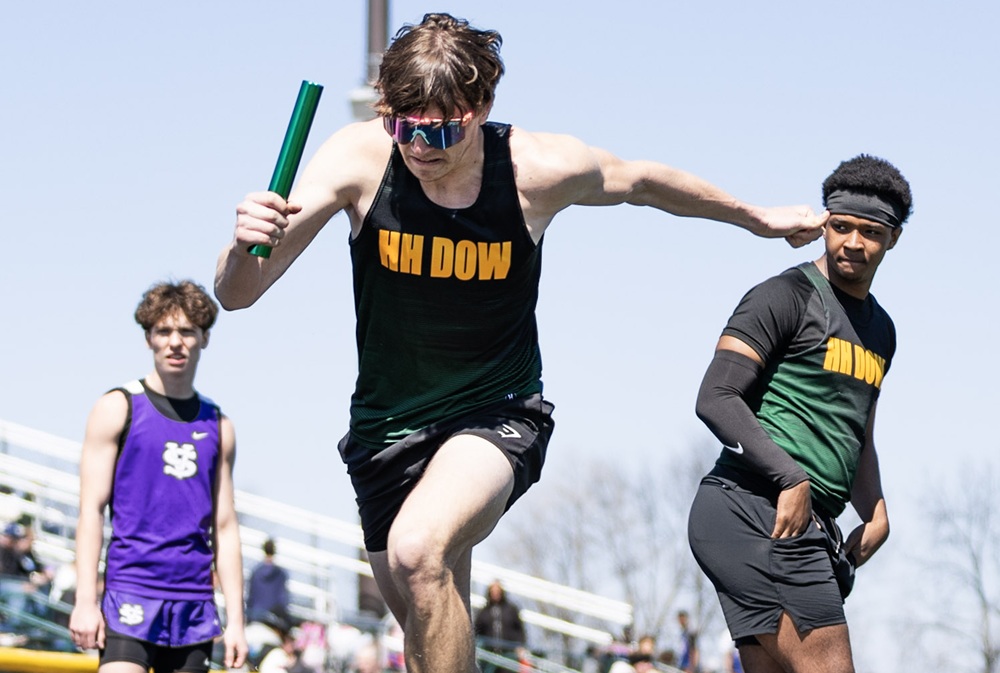
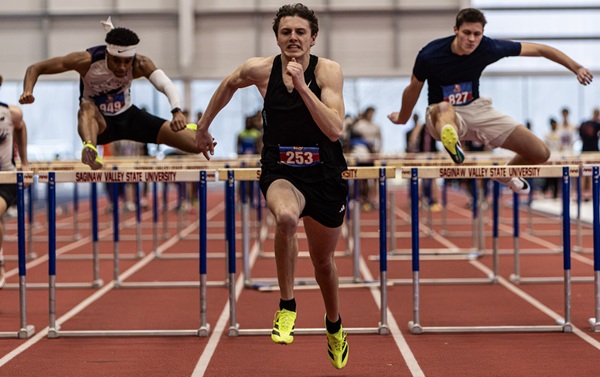
PHOTOS (Top) Midland Dow’s Zach Dzurka, with baton, takes off to start a relay race. (Middle) Dzurka, middle, leads a hurdles race during an indoor meet at Saginaw Valley State. (Photos courtesy of the Midland Dow athletic department.)