

Be the Referee: Libero
By
Paige Winne
MHSAA Director of Brand Management
September 17, 2024
Be The Referee is a series of short messages designed to help educate people on the rules of different sports, to help them better understand the art of officiating, and to recruit officials.
Below is this week's segment – Libero - Listen
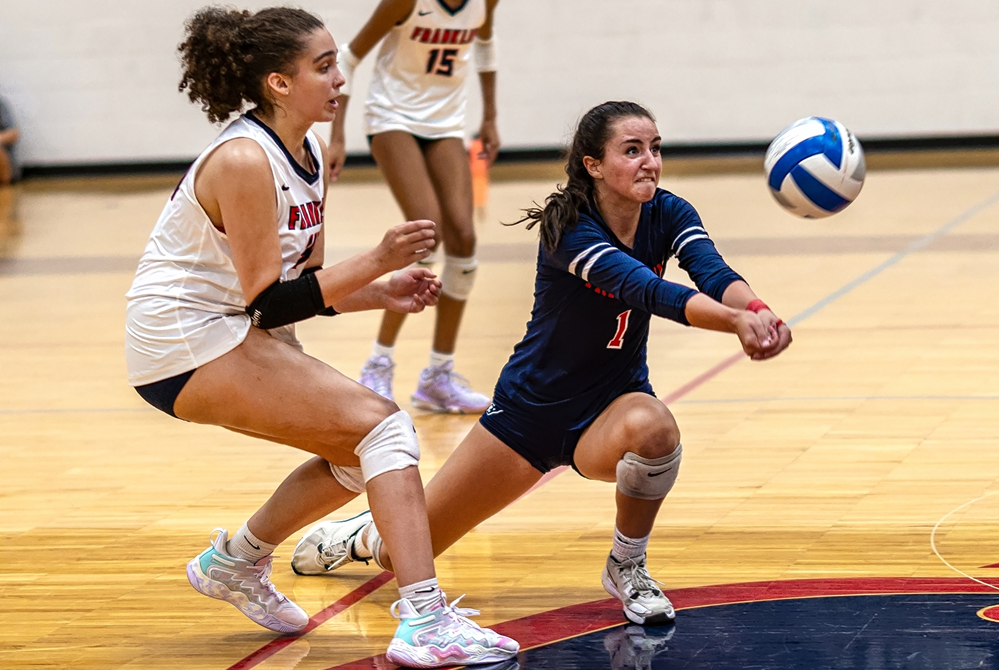
In volleyball, a libero is a defensive player who plays in the back row. It’s a fairly new position, as it was introduced in 1998 – and the libero plays by some unique rules:
► The libero wears a different color jersey from the rest of the team – so they are easily identifiable. Only one libero can be designated for each set of a match.
► The libero can serve, but can't perform an overhead set in front of the attack line, or complete an attack if the ball is above the net.
► The libero is never allowed to rotate to the front line.
► The libero is the first line of defense, often passing to the setter and covering open spaces.
► The libero can be replaced without restriction – but in the event of an injury, can only be replaced by the player the libero originally replaced.
Previous 2024-25 Editions
Sept. 10: Cross Country Uniforms - Listen
Sept. 3: Soccer Handling - Listen
Aug. 24: Football Holding - Listen
PHOTO Livonia Franklin libero Mckenna Moore (1) defends during her team's match against Livonia Churchill this season. (Photo by Douglas Bargerstock.)
Retired Official Gives Alpena AD New Life with Donated Kidney - 'Something I Had to Do'
By
Geoff Kimmerly
MHSAA.com senior editor
May 3, 2024
TAWAS CITY – Jon Studley woke up Feb. 20 with a lot of fond memories on his mind, which turned into a collection of 47 photos posted to Facebook showing how he’d lived a fuller life over the past year with Dan Godwin’s kidney helping power his body.
There was Studley at the beach, taking a sunset shot with wife Shannon and their 5-year-old daughter Maizy. In others Dad and daughter are at the ice rink, making breakfast and hitting pitches in the yard. Studley made it to Ford Field to cheer on the Lions, supported his Alpena High athletes at MHSAA Finals and traveled to Orlando for a national athletic directors conference.
Their faces are beaming, a far cry from much of 2021 and 2022 and the first few months of 2023 as the Studleys and Godwins built up to a weekend in Cleveland that recharged Jon’s body and at least extended his life, if not saved it altogether.
“People that saw me before transplant, they thought I was dying,” Studley recalled Feb. 21 as he and Godwin met to retell their story over a long lunch in Tawas. “That’s how bad I looked.
“(I’m) thankful that Dan was willing to do this. Because if he didn’t, I don’t know what would’ve happened.”
By his own admission, Studley will never be able to thank Godwin enough for making all of this possible. But more on that later.
Studley and Godwin – a retired probation officer and high school sports official – hope their transplant journey together over the last 23 months inspires someone to consider becoming a donor as well.
For Studley, the motivation is obvious. Amid two years of nightly 10-hour dialysis cycles, and the final six months with his quality of life dipping significantly, Studley knew a kidney transplant would be the only way he’d be able to reclaim an active lifestyle. And it’s worked, perhaps better than either he or Godwin imagined was possible.
For Godwin, the reasons are a little different – and admittedly a bit unanticipated. He’d known Studley mostly from refereeing basketball games where Studley had served as an athletic director. He’d always appreciated how Studley took care of him and his crew when they worked at his school. But while that was pretty much the extent of their previous relationship, some details of Studley’s story and similarities to his own really struck Godwin – and led him to make their lifelong connection.
“It’s been rewarding for me. I have told Jon, and I’ve said this to anyone who would listen, that I’m grateful and feel lucky that I’ve been part of this process,” Godwin said. “I don’t feel burdened. I don’t feel anything except a sense of appreciation to Jon that he took me on this journey. I didn’t expect that, but that’s how I feel.”
Making a connection
As of March, there were 103,223 people nationwide on the national organ transplant waiting list, with 89,101 – or more than 86 percent – hoping for a kidney, according to data from the U.S. Department of Health and Human Services and the Organ Procurement and Transplantation Network (OPTN). More than 46,000 transplants were performed in 2023, including the sharing of more than 27,000 kidneys.
Godwin giving one to Studley was among them.
Studley, 43, has served in school athletics for most of the last two decades since graduating with his bachelor’s degree from Central Michigan University. After previously serving as an assistant at Mount Pleasant Sacred Heart, he became the school’s athletic director at 2009. He moved to Caro in 2012, then to his alma mater Tawas in 2015 for a year before going to Ogemaw Heights. He then took over the Alpena athletic department at the start of the 2020-21 school year, during perhaps the most complicated time in Michigan school sports history as just months earlier the MHSAA was forced to cancel the 2020 spring season because of COVID-19.
He's respected and appreciated both locally and statewide, and was named his region’s Athletic Director of the Year for 2019-20 by the Michigan Interscholastic Athletic Administrators Association. Concurrently with serving at Sacred Heart and earning his master’s at CMU, Studley served as athletic director of Mid Michigan College as that school brought back athletics in 2010 for the first time in three decades. He also served four years on the Tawas City Council during his time at Tawas High and Ogemaw Heights.
 Toward the end of his senior year of high school in 2001, Studley was diagnosed with Type 2 diabetes. For the next two decades, he managed his diabetes primarily with insulin and other medication. But during that first year at Alpena, his health began to take a turn. Studley had been diagnosed with a heart condition – non-compaction cardiomyopathy – which led him to Cleveland Clinic for testing. A urine test in Cleveland indicated his kidneys might not be working like they should – which led to a trip to a specialist and eventually the diagnosis of kidney failure and the start of dialysis, with a kidney transplant inevitable.
Dialysis long has been a standard treatment for people with kidney issues. But it can take a toll. In Studley’s case, that meant being tired all the time – to the point of falling asleep at his desk or having to pull over while driving. He wasn’t receiving enough nutrients and was unable to lift things because of the port for the dialysis tube. Extra fluid building up that his body wouldn’t flush made him constantly uncomfortable.
The next step was transplant, and in July 2021 he was approved to receive a kidney.
The Studleys thought they had a prospect early on, as an aunt on Shannon’s side was a candidate for a paired match – her blood and tissue types weren’t a match for Studley, but matched another person on the waiting list whose donor would be a candidate to give Studley a kidney. But that didn’t work out.
Others showed interest and asked about the process, especially after Studley’s 20-year class reunion in 2021, but nothing concrete came about. Amid the early disappointment, Studley took some time to consider his next move – and then put out a plea over Facebook that fall to his close to 1,000 connections hoping that someone, anyone, might consider.
“I took a week to really think about it – this is what I’m asking for someone to do. I had to get over it in my mind that it was OK to ask,” Studley said. “I’m going to ask someone to make a sacrifice for me, and that’s not me. I always want to help everybody else.”
Godwin is that way too. And immediately after reading Studley’s post, he knew he needed to consider making a call.
Strong match
Godwin had moved to Tawas City from Midland in 2014, and after a few years off from officiating decided to get back on the court that following winter.
He thinks he and Studley may have crossed paths at some point during Studley’s tenures at Sacred Heart and Caro, but it was at Tawas where they got to know each other. Although Studley stayed at Tawas just one school year, Godwin continued officiating for him at Ogemaw Heights – and in fact, Godwin’s final game in 2018 was there, during the District basketball tournament. That night, during the first quarter, Godwin tore the plantar fasciitis in his left foot. He didn’t know if he’d be able to finish the game – the officials from the first game that night stuck around to step in just in case – but thanks in part to Studley connecting Godwin with the Alpena trainer during halftime, he was able to get through the final two quarters and finish his officiating career on his feet.
They’d become Facebook “friends” at some point, so Godwin had seen Studley’s posts over the years with Shannon and Maizy. And when he saw Studley ask for help, something hit him – “immediately.”
 “I have a 5-year-old granddaughter, almost exactly the same age as Jon’s, and I’m the dad of one child, a daughter, so there were those connections,” Godwin said. “It almost didn’t feel like there was a choice. It felt like it was something I had to do.”
Godwin is 66 and always has been in good health. He’s also always been an organ donor on his driver's license and given blood, things like that. But he had never considered sharing an organ as a living donor until reading Studley’s post.
He read it again to his wife Laurie. They talked it over. He explained why he felt strongly about donating, even to someone he didn’t know that well. After some expected initial fears, Laurie was in. Their daughter had the same fears – What about the slight chance something could go wrong? – but told Laurie she knew neither of them would be able to change her dad’s mind.
“It took me a while to get on board with it, even though I knew in the vast majority of cases somebody who donates an organ is going to be absolutely fine. It’s still major surgery,” Laurie said. “I guess he was just feeling so much like it was something he wanted to do, and he is a very healthy physically fit person. So I felt the odds were really good that he was going to be fine.
“And really, probably, the deciding factor was Maizy. We have a granddaughter the same age, so we were just thinking she needs a dad.”
After a few more days of contemplation, Dan called Cleveland Clinic to find out how to get started.
Then he texted Studley.
“I was nervous saying yes. At first, I didn’t know what to say – I just kept saying, ‘You don’t have to do this, but I appreciate it,’” Studley said. “I never want to have somebody do something for me unless (the situation is dire) … so I told him thank you and I appreciate it, and no pressure.”
Generally, Studley said, the donor and recipient don’t receive information on how the other person is progressing through the process. Godwin, however, kept Studley in the loop, which was a good thing. “But then you’re wondering if it’s going to happen,” Studley said, “if it’s truly a match.”
The initial blood test showed that Godwin wasn’t just a match, but a “strong” match, meaning they share a blood type – the rarest, in fact – and Godwin also didn’t have the worrisome antibodies that could’ve caused his kidney to refuse becoming part of Studley’s body.
That was amazing news. But just the start. “There was so much more we had to go through just to get to surgery day,” Studley said.
Long road ahead
Studley relates the transplant process to a job interview. After meeting with a potential boss, the candidate must wait for an answer – and it could come the next day, or the next week, or months later.
There were several more tests for both to take to make sure the transplant had not only a strong enough chance of being successful, but also wouldn’t be harmful for either of them.
“Right up until the time of the donation, (things) can happen. Like they did blood work on me the Friday before the kidney transplant on Monday, and if that had showed something they were going to send me home,” Godwin said. “So I just kept thinking, is this going to work? It seemed that there were more things that could go wrong than the possibility that it could go right. And that sets everybody up for disappointment – me, because I was invested in doing it, and of course Jon and his family because it was important to them.”
Godwin made a trip to Cleveland Clinic in November – about three months before the surgery. It wasn’t a great visit. His electrocardiogram showed a concern, and a few suspicious skin lesions were an issue because donors must be cancer-free. Almost worse, he couldn’t get in for a follow-up appointment for six weeks.
The wait felt longer knowing not only that there was a possibility for disappointment for Studley, but also the potential something could be unwell with Godwin. But then came good news – at his follow-up, Godwin aced his stress test, alleviating any heart concerns, and the dermatologist said the lesions were basal cell carcinoma and not considered risky to the transplant.
Over the next three months, both Godwin and Studley continued to do whatever they could to keep the transplant on track. To avoid COVID, Godwin and his wife isolated as much as they could, and Studley began wearing a mask frequently at work. Godwin cut out alcohol and coffee and began walking regularly to keep in tip-top shape.
In January 2023, both got the final OK, and the surgery was scheduled for Feb. 20.
But that wasn’t the end of the anxiety.
Studley also had undergone a series of tests and doctor visits, and two days before the transplant he had to get a tooth removed to avoid a possible infection.
Then, on the way from Alpena to Cleveland, Studley’s vehicle hit a deer.
“How is this going to go now?” he recalled thinking. “This is how it started. What’s going to happen now?”
Both arrived in Cleveland safely, eventually. The families stayed apart all weekend, Studley and Godwin communicating briefly by text to check in. There were a few more stop-and-go moments. Godwin’s Friday blood work showed something unfamiliar that ended up harmless. On the day of the surgery, Studley was wheeled to just outside the operating room – and then taken back to his hospital room for another 15 minutes of suspense. Once Studley made it into the operating room, his doctors had to pause during the surgery to tend to an emergency.
But finally, the transplant was complete. And seemingly meant to be. Godwin’s kidney was producing urine for Studley’s body before the surgeons had finished closing him up.
Back on his feet
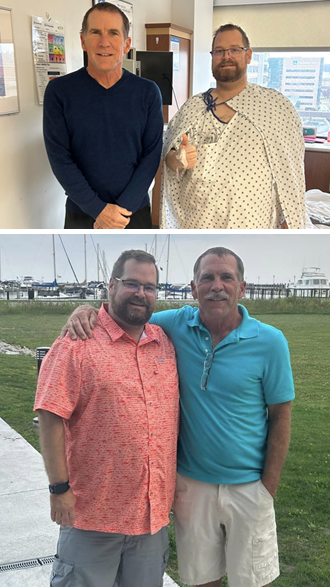
Studley said he knew he’d be fine once he could start walking the hallways at the hospital; he started doing so the next morning. Later that same day after transplant, on the way back from one of those walks, he saw Godwin for the first time since they’d both arrived in Cleveland. “It was absolutely emotional,” Godwin said.
Godwin went home four days after the surgery. Studley stayed the next month with appointments and labs twice a week. Shannon remained with him the first week, then friends Mike Baldwin and Josh Renkly and Studley’s father Larry took turns as roommates for a week apiece.
For the first three months, including his first two back in Alpena, Studley couldn’t go anywhere except for the trip to Cleveland every other week – which has now turned into every other month with virtual appointments the months in between. Total he missed about six months of work – and thanked especially assistant athletic director and hockey coach Ben Henry for shouldering the load in his absence.
Studley’s checkups are full of more good news. His body is showing no signs of rejecting the kidney. And as long as he keeps his diabetes under control, that shouldn’t affect his new organ either.
Shannon sees the difference while comparing a pair of family trips. The Studleys went to Disney World while Jon was on dialysis, and she said he made it through but got home just “depleted.” This past spring break, the family went to Gatlinburg, Tenn., and Jon had visibly more energy for hiking and other activities. The last six months of dialysis, Jon was sleeping a lot, but this spring he’s helping coach Maizy’s T-ball team and overall is able to spend more quality time with her.
“Most of (Maizy’s) life she’s only known him as sick Dad,” said Shannon, a counselor at Alpena’s Thunder Bay Junior High. “He wasn’t able to do a lot of things with her, and I’ve seen a lot more of that, and I think she notices.”
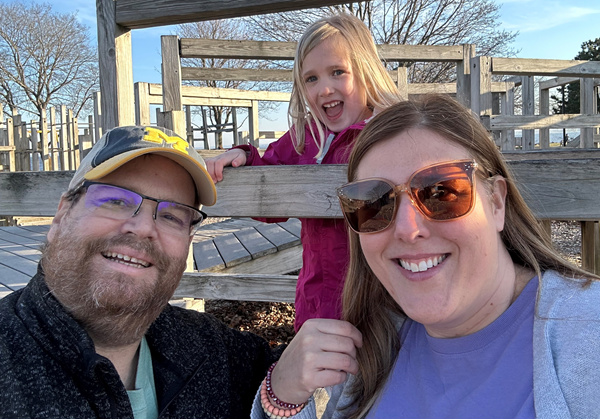 Jon will be taking anti-rejection medicine and a steroid every 12 hours for the rest of his life, but that and some other little life adjustments are more than worth it. All anyone has to do is look at those 47 photos from the Facebook post to understand why.
Godwin said he feels better now than he did even before surgery. He does his checkups with Cleveland Clinic over the phone. He also said that if Studley had been found at some point late in the process to be unable to except the kidney, Godwin still would’ve given it to someone else on the waiting list. “I was so invested at that point,” Godwin remembered. “That kidney was going.”
The two families got together for a reunion in August in Tawas, where they had lunch and walked the pier and the Godwins met Maizy for the first time. She doesn’t really get what’s transpired, but definitely notices Dad doesn’t have a tube coming out of his body at night anymore.
And it’s clear the two men value the connection they’ve made through this unlikely set of circumstances.
“His attitude has been inspiring,” Godwin said. “Because you’ve been through the mill (and) I’ve never heard a negative thing, ‘poor me’ or anything. And I think maybe that’s what helps keep you going.”
“You talk to people who know Dan, and they said, ‘That’s Dan. That’s what Dan does,’” Studley said, speaking of Godwin’s gift and then addressing him directly. “The hardest part for me, the biggest struggle … is there’s no way I’m going to ever be able to thank you for this.
“It’s like the post I posted yesterday on Facebook. I posted pictures of everything I had done in the last year, and a lot of it was stuff that I hadn’t done in a long time. My way to thank Dan is just living my life the best I can, enjoying my family. … For me, it’s changed my perspective.”
As lunch finished up, Godwin did have one ask in return – not for one of Studley’s organs, but to be part of a special moment that helped drive him to donate 12 months earlier.
“This isn’t the venue, but I’ve thought about this a lot. I’ve never asked for anything and I don’t want anything,” Godwin said, “but I would like to go to Maizy’s wedding.”
“Yeah, you … yes. Yes,” Studley replied. “You can go to anything you want to go to with my family.”
“I’d like to be there.”
“You will definitely be there.”
“I was at my daughter’s wedding,” Godwin said, noting again that connection between the men’s families, and the importance he felt in Studley being there for Maizy like he’d been there for his child.
“You say that, but there were times I didn’t know if I’d make it to Maizy’s wedding. I might not make it to see her graduate. So …” Studley trailed off, ready to take the next step in his life rejuvenated.
Studley emphasized the continuing need for kidney donors and refers anyone interested in learning more to the National Kidney Registry.
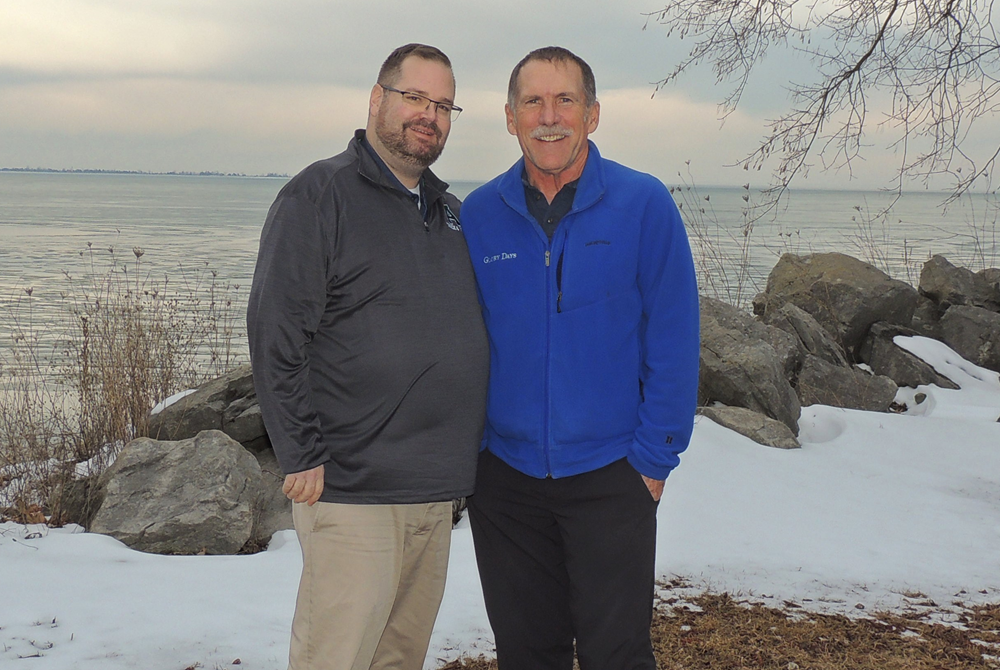
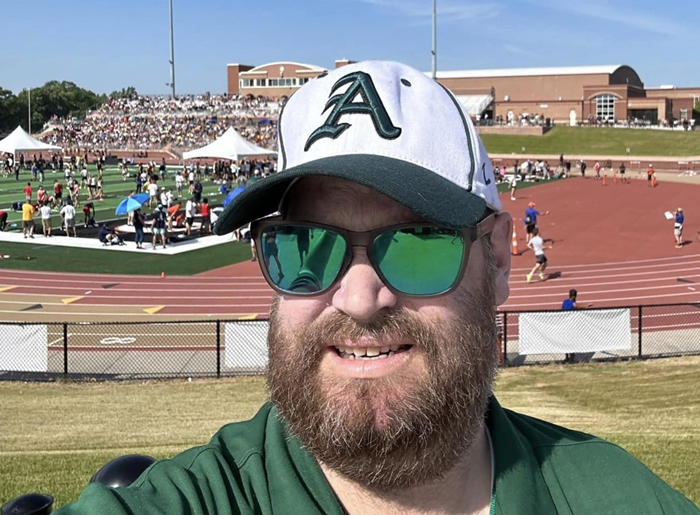
PHOTOS (Top) Alpena athletic director Jon Studley, left, and retired MHSAA game official Dan Godwin take a photo together on the shore of Lake Huron one year after Godwin donated a kidney to Studley. (2) Studley cheers on Alpena athletes during last season’s MHSAA Track & Field Finals at Rockford High School. (3) Godwin and Studley meet for the first time after the transplant, and again six months later. (4) Studley, his wife Shannon and daughter Maizy enjoy a moment after Jon had returned to good health. (Top photo by Geoff Kimmerly; other photos provided by Jon Studley.)