

Kingsford's Kreider Prepared for Next Level After Finishing Stellar Flivvers Career
By
John Vrancic
Special for MHSAA.com
June 19, 2025
KINGSFORD — After completing a successful high school volleyball career, Maddy Kreider is ready to take the next step.
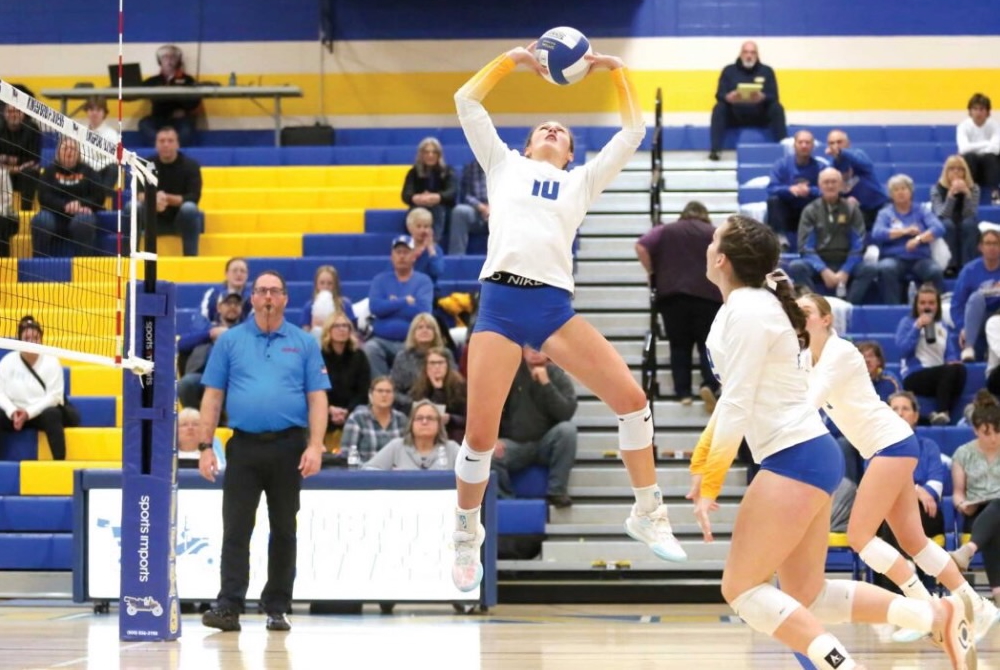
 The Kingsford senior is taking her talents to Michigan Tech, where she’s expected to continue primarily as a setter.
“That will be a big step for sure, but it’ll be exciting being with the girls,” she said. “The girls are taller in college. It will definitely be an adjustment, physically and mentally. We’ll be traveling longer distances, and it’ll be a matter of improving the mental part of my game.”
Kreider was selected the Upper Peninsula’s Defensive Player of the Year her final two seasons after the U.P. Sportswriters and Sportscasters Association began voting for all-U.P. volleyball.
“That’s quite an accomplishment,” she said. “It’s a real honor playing with girls I grew up with. We had a great season.”
The 5-foot-8 setter was a four-year starter and two-year team captain at Kingsford, leading the Flivvers to three Division 2 District titles and back-to-back undefeated Great Northern Conference championships. She twice was named GNC Player of the Year.
She was also selected all-state first team in the fall and all-state second team in 2023, and all-region throughout her prep career. Her serving percentage also topped .900 throughout her four seasons on varsity.
 Last fall, the Flivvers reached the Regional Semifinal at Manistique where they dropped a 3-2 decision to Kingsley.
“I thought we’d get through,” Kreider said. “We came out lights out in the first two sets, then it was close in the last three.”
Also among the team’s highlights this past fall was a victory at Calumet, approximately 2½ weeks after dropping a 3-1 decision to the Copper Kings on Kingsford’s home floor.
“We wanted to play them,” Kreider said. “They’re a great bunch of girls to play against. They’ve been the measuring stick up here for many years. Winning on their floor was super exciting. We knew we had to play well just to be competitive. That was a great confidence builder for our group. We were definitely on a high going into the District.”
The Flivvers opened their postseason with a 3-1 triumph over Houghton, then defeated Escanaba in straight sets in the District Final.
Kreider will join Calumet senior Maddie Torola at MTU this fall. Torola, who recorded a season-high 19 kills in the four-set victory at Kingsford, helped the Copper Kings finish 29-5 and reach the Division 3 Regional Final at Sault Ste. Marie where they dropped a 3-2 decision to Traverse City St. Francis.
“It was fun playing against her in high school,” Kreider said. “It will be even more fun playing as teammates. It’ll be exciting to be playing on the same team.”
Both will be playing under new head coach Cindy Pindral at Tech. Both of Kreider’s parents played for the Huskies, her mother (and Kingsford varsity coach) Jaclynn volleyball from 1998-2002 and her father Jason basketball from 1997-2000.
Maddy Kreider recently earned an additional honor when she was selected Female Athlete of the Year for Kingsford’s Class of 2025. She recently completed a solid track & field season for the Flivvers.
At the U.P. Division 1 Finals, Kreider placed fourth in the 100-meter dash (13.2) and anchored the Flivvers to a third-place finish in the 800 relay (1:51.57) and fourth in the 400 (53.03) on their home track.
Kreider was named one of 32 MHSAA/Farm Bureau Insurance Scholar-Athlete Award winners this winter and plans to study exercise science and kinesiology at MTU.
 John Vrancic has covered high school sports in the Upper Peninsula since joining the Escanaba Daily Press staff in 1985. He is known most prominently across the peninsula for his extensive coverage of cross country and track & field that frequently appears in newspapers from the Wisconsin border to Lake Huron. He received the James Trethewey Award for Distinguished Service in 2015 from the Upper Peninsula Sportswriters and Sportscasters Association.
PHOTOS (Top) Kingsford’s Maddy Kreider sets for her teammates during a match last season. (Middle) Kreider, right, takes a photo with Kingsford’s Male Athlete of the Year Gavin Grondin. (Photos provided by the Kingsford athletic department.)
Block Party: 2026 Girls Volleyball Week 8 Report
By
Geoff Kimmerly
MHSAA.com senior editor
October 14, 2026
Girls Volleyball District play begins in three weeks, and you won’t find any contenders slowing things down as we speed toward the beginning of the postseason.
Arguably this fall’s most prestigious tournament – the Beast of the East – will be played Saturday with all four state divisions sending ranked teams into the field, and the Upper Peninsula also is hosting one of its most competitive events this season, at Crystal Falls Forest Park. Several teams are attempting to put finishing touches on league championships, and many more have lined up other contenders as they prepare for the playoffs and the ultimatum of win to play again.
Records below are those reported and tracked on this website, and rankings referred to below reflect the latest polls posted by the Michigan Interscholastic Volleyball Coaches Association (MIVCA).
Week in Review
The countdown of last week’s five most intriguing results:
1. Bloomfield Hills Marian d. Farmington Hills Mercy (25-21, 25-23, 22-25, 25-17) After suffering two earlier losses to Mercy, Marian (28-3) took this match in four sets, clinched their Catholic High School League Tournament title and has taken over the No. 1 ranking in Division 1, sending the Marlins (20-4) to No. 2.
2. Parma Western d. Hanover-Horton (26-24, 25-17) Division 2 No. 3 Western’s 6-0 run through Hanover-Horton’s Karen Abbott Invitational pushed its record to 32-0 and also included wins over Division 3 No. 7 Grass Lake, No. 6 Traverse City St. Francis, Hudson, Brooklyn Columbia Central and Division 4 No. 1 Adrian Lenawee Christian, in addition to the Division 3 No. 10 Comets (21-7-5).
3. Midland Dow d. Saginaw Valley Lutheran (30-28, 20-25, 25-20) The Chargers (36-4-4) also handed Division 2 No. 4 Frankenmuth its first during this home quad, but the night’s most exciting set may have been the first one of this win over Division 3 top-ranked Saginaw Valley Lutheran (38-6-1).
4. Traverse City Central d. Grand Rapids South Christian (25-20, 25-18) The Trojans (22-2-1) finished 4-0 at the Hudsonville Unity Christian Invitational, with this sweep of the Division 2 No. 8 Sailors (22-7) the highlight but a three-set win over honorable mention Vicksburg also of note.
5. Roscommon d. Traverse City St. Francis (25-20, 25-15) These two top-10 teams in Division 3 locked up as part of a quad, with the No. 3-ranked and host Bucks (29-6-5) avenging last year’s loss to the No. 6 Gladiators (24-13-2).
Watch List
With an eye toward November, here are two teams in each division making sparks:
DIVISION 1
Clarkston (20-2) The Wolves have held down the No. 3 ranking in Division 1 since Sept. 8, trailing only Mercy and Marian after falling to both in August. Those are Clarkston’s only losses this season as it looks to bounce back from last year’s District exit against Oxford – which the Wolves defeated to start this season and again last week. A pair of wins over No. 8 Lowell and singles over No. 10 Grand Rapids Forest Hills Northern and No. 5 South Lyon East also pop off the page.
South Lyon East (25-5) The No. 5 Cougars’ most recent win also was the best of several memorable ones this fall, as they downed No. 2 Mercy in three sets last week after losing the first 25-12. They also have defeated No. 10 Forest Hills Northern twice, honorable mention Orchard Lake St. Mary’s and No. 9 Grand Haven once, and honorable mention South Lyon twice after the Lions ended East’s 2025 season in their District. Those two rivals are headed to the same District again next month.
DIVISION 2
Detroit Country Day (12-6-1) The Yellowjackets haven’t played as many matches as most contenders, but they’ve tested themselves against some of the state’s elite with losses to Division 1 No. 2 Mercy, top-ranked Marian and honorable mention St. Mary’s among others. The two-time reigning Division 2 champion is ranked No. 2 currently and tonight has an opportunity to avenge its Sept. 30 defeat against the Eaglets. Country Day also will see Division 1 No. 5 South Lyon East a second time Oct. 22 after winning their first matchup Sept. 3.
Marshall (23-9-1) The unranked Redhawks have navigated tough competition all season, going five sets before falling to No. 3 Parma Western in Interstate 8 Athletic Conference play, but defeating honorable mention Vicksburg, Division 3 No. 2 Plymouth Christian Academy, No. 4 Clinton and honorable mention Morley Stanwood and going 1-2 against Division 1 honorable mention Battle Creek Lakeview. Total, five defeats have come against teams ranked or honorable mention in Divisions 1 and 2.
DIVISION 3
Cass City (18-6-4) These Red Hawks have tested themselves substantially as they look next month to run their District title streak to six and potentially return to the season’s final weekend for what would be the fourth time this decade. Cass City went 2-2-1 at the opening Cadillac Invitational, 0-2-2 at the MI Elite Program Cup and 1-2-1 at the D3/D4 Showdown, facing elite and/or often much larger opponents at all three. The Red Hawks are otherwise 15-0 this fall.
Muskegon Western Michigan Christian (26-6) WMC matched up with a tough crew of larger opponents at the Unity Christian Invitational over the weekend and finished only 1-3 there. But the No. 5-ranked Warriors are otherwise 25-3 this season with a 5-0 day over a field that included honorable mention Hart and Fruitport in winning Mona Shores’ Best of the West, plus an earlier victory over Division 2 previously-honorable mention Fremont.
DIVISION 4
Atlanta (25-0) The Huskies are an honorable mention in this week’s poll and one of three teams statewide still undefeated. They’ve won Regional titles the last two seasons and this fall have lost only six sets. Atlanta went 5-0 winning all 10 sets during the Onaway Tournament and finished 6-0 winning all 12 sets it played at the Oscoda Invitational last month. The Huskies will travel Oct. 20 to face Hale, which delivered their only regular-season defeat of 2025.
Mount Pleasant Sacred Heart (23-6-3) The No. 2-ranked Irish have won nine of their last 10 matches, the lone loss during that time to Division 3 top-ranked Valley Lutheran, and they also defeated Division 4 No. 7 Ubly that day. Three losses total have come to Valley Lutheran, with the other three to Division 2 No. 8 North Branch, Division 3 No. 3 Roscommon and No. 9 Elk Rapids. Sacred Heart also can count a win over Division 4 No. 4 Traverse City Christian and a tie with No. 9 Crystal Falls Forest Park.
Can’t-Miss Contests
Be on the lookout for results of these matches and tournaments coming up:
Thursday – Grand Haven (26-8-1) at Hudsonville (28-3) – The best from the always-strong Ottawa-Kent Conference Red are the No. 9 Buccaneers and No. 6 Eagles, and Hudsonville won the first match Sept. 17 in three sets.
Thursday – Detroit Country Day (12-6-1) at Macomb Lutheran North (23-1) – The Nos. 2 and 6 teams in Division 2, respectively, face off in what could be a Regional Final preview.
Thursday – Elk Rapids (14-7-3) at Traverse City Christian (27-6) – The Division 3 No. 9 Elks and Division 4 No. 4 Sabres meet in one of northern Michigan’s most anticipated matchups of the season.
Saturday – Beast of the East at Trinity Health Sports Center – The field of 32 includes 18 teams currently ranked or receiving honorable mentions in Divisions 1-4, and a few others formerly in that group. Division 1 top-ranked Bloomfield Hills Marian and Division 2 No. 1 Grand Rapids Christian are among those taking the court.
Tuesday – Grand Rapids Forest Hills Central (11-18), Forest Hills Northern (22-8) at Grand Rapids Christian (22-3) – As noted above, the Eagles are ranked No. 1 in Division 2, and Forest Hills Northern is No. 10 in Division 1.
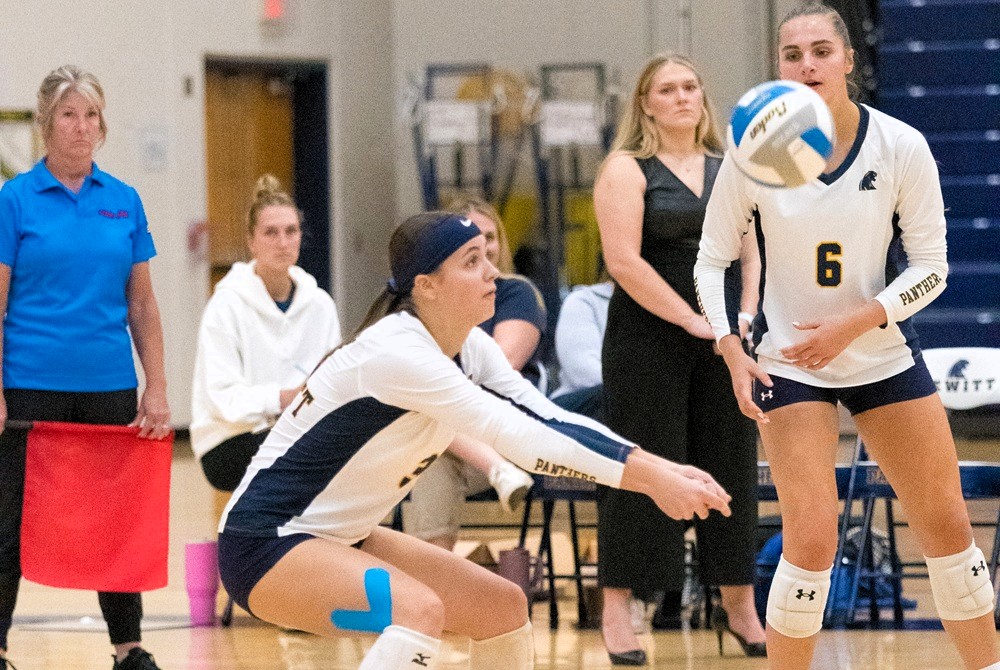
PHOTO (Top) DeWitt returns a volley during a match this season against Okemos. (Photo by TCP Photography.)