

CAAC, SW Teams Find Home in New League
By
Pam Shebest
Special for MHSAA.com
January 21, 2020
Two struggling hockey leagues found a perfect match, thanks to the behind-the-scenes work of commissioners, athletic directors and coaches.
 The Capital Area Activities Conference, a multi-sport league, had just four hockey teams.
The Southwest Michigan High School Hockey League was down to five.
Merging the two leagues was a no-brainer for all involved.
“We learned (the CAAC) was a small league like us,” Portage Northern athletic director Chris Riker said. “It’s tough to have a league with just five teams. By putting our two leagues together, and we had already played a lot of those teams, it just made a lot of sense.”
The new 10-team league, called the South Central High School Hockey League, is bringing a new excitement to both areas and came together very smoothly in less than a year.
Forming a new league boiled down to one thing: “survive and thrive,” said Randy Allen, a former MHSAA assistant director and retired CAAC commissioner.
“I’m tickled pink, and I give high marks to the coaches and athletic directors.”
The league is divided into the Central and South divisions, with five teams in each.
Most teams in the league are co-op teams with Jackson Lumen Christi in the Central and Mattawan, Portage Central and Portage Northern in the South the only teams made up of students from one school.
Other teams in the Central Division are the Capital City Capitals (DeWitt, Lansing Catholic, Mason, St. Johns), Mid-Michigan Marauders (Holt, Grand Ledge, Eaton Rapids, Portland, Potterville), East Side Stars (East Lansing, Williamston, Haslett, Bath, Laingsburg) and Okemos (with Fowlerville).
 Co-op teams in the South are the Kalamazoo Eagles (Gull Lake, Battle Creek Harper Creek, Battle Creek Pennfield, Paw Paw, Parchment, Plainwell) and Kalamazoo United (Loy Norrix, Kalamazoo Central, Hackett Catholic Prep).
The first big showcase event featuring all 10 teams is set for Friday and Saturday at Wings West in Kalamazoo.
“One of the other cool things about this new league is we’re bringing them all together for the ‘Annual Youth Hockey Fights for Autism’ at Wings West Feb. 15, and all 10 teams will be playing,” said Frank Noonan, commissioner of the old SWMHSHL and now commissioner of the new league.
Riker said the new league “creates some excitement the way we structured the season with playing in your division and playing crossover games.
“We’re going to have a big championship game where the two No. 1 teams play each other, the second-place teams meet and so on (Feb. 22 at Wings West).”
There are other benefits as well, Noonan said.
“The best thing for hockey in the area is they have set opponents they’re going to play every year and, for the kids who earn (end-of-season) awards, it means more,” he said.
“There are 10 teams competing for the awards rather than our typical six-team old division, so it’s more prestigious, more of an honor to win an award in the new league.”
MHSAA Assistant Director Cody Inglis, who took over administration of hockey for the Association when Allen retired in 2014, put Riker – a member of the MHSAA’s Representative Council – in touch with Allen. The two jump-started talks last March.
One key was getting the Eagles to become a school-based team rather than a club one.
“Karyn Furlong (Gull Lake athletic director) was willing to jump on and sponsor the Eagles,” Riker said. “She did all the leg work in getting the schools on board.
“The Eagles organization also deserves a lot of recognition for saying, hey, we’ve been in this club status and now we’re willing to come in and be a school sport.
“Now they have the opportunity to play in the state tournament, which they’ve never had.”
The MHSAA Semifinals and Finals are set for March 12-14 at USA Hockey Arena in Plymouth.
Allen, who went on to serve as commissioner of the CAAC until retiring at the start of this school year, first floated the idea of merging the two leagues to coaches from his conference.
“They were all in favor of it,” he said. “(Inglis) talked with (Riker), and we met to talk.
 “At the athletic directors conference (in March 2019), we kept inching closer to forming a new league. We did not hear one word of objection through the entire process. We had 110-percent backing.
“After everybody covered all the bases, we made it final and came up with the official name.”
Allen said the new league has “great leadership from the athletic directors and (Noonan), who took the lead on everything.”
He added that one perk of the new league is getting officials together. “Now we get officials to be part of one overall group, and there is a possibility of mentoring,” Allen added.
Capital City Capitals coach Travis Van Tighem likes the new league.
“It’s great to get some more natural rivals,” he said. “Our league got to be so small we played a lot of other (non-league) teams or showcase games.
“When more games have meaning or some substance to them, you can see kids growing and there are some natural rivalries that it creates, so it’s exciting.”
Travel is not a problem, Van Tighem added.
“For us in Mid-Michigan, it you go outside the Lansing area, it’s going to be an hour anyway. So coming to Kalamazoo, it’s an hour 20 or hour 15, but if we go anywhere else, except for Jackson, it’s going to be at least an hour,” he said.
“Athletic directors and coaches got together, and it really came together nicely. It’s been great so far.”
Other league facilities besides Wings West are Optimist Ice Arena (Jackson), Summit Sports and Ice Complex (Dimondale) and Suburban Ice (East Lansing).
 Pam Shebest served as a sportswriter at the Kalamazoo Gazette from 1985-2009 after 11 years part-time with the Gazette while teaching French and English at White Pigeon High School. She can be reached at [email protected] with story ideas for Calhoun, Kalamazoo and Van Buren counties.
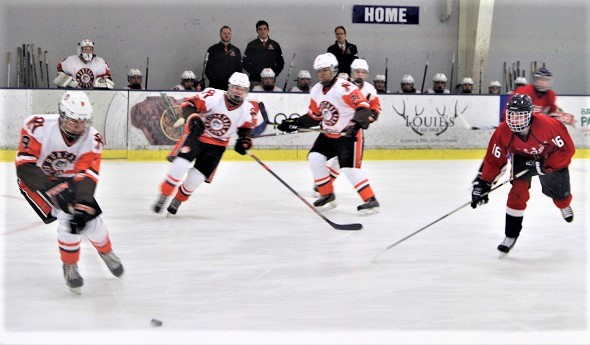
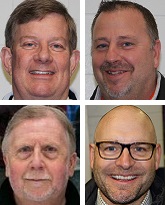
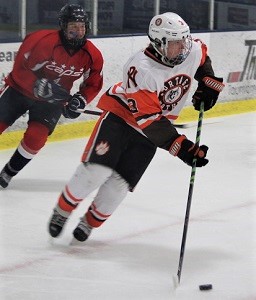
PHOTOS: (Top) Portage Northern and Capital City face off in an SCHSHL crossover Jan. 9 at Wings West. (Middle) Clockwise from top left: Frank Noonan, Chris Riker, Travis Van Tighem and Randy Allen. (Below) Northern’s Nolan McCarthy (3) charts his next move with the puck. (Photos by Pam Shebest.)
Shamrocks Complete Long-Awaited Repeat Run
By
Tim Robinson
Special for MHSAA.com
March 27, 2021
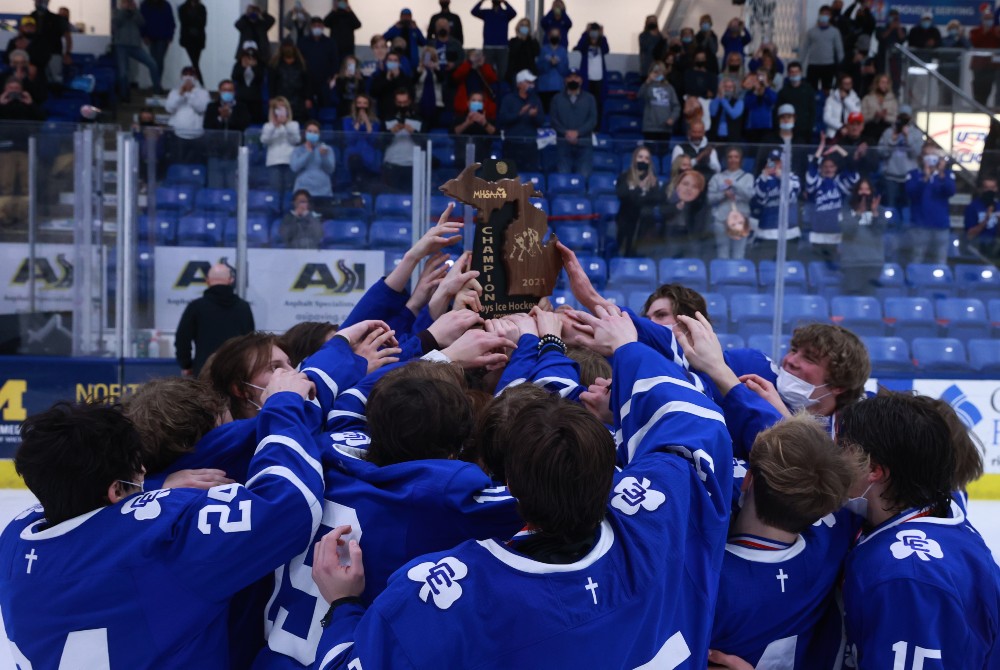
PLYMOUTH – It took two years, but Detroit Catholic Central finally was able to conclude its repeat hockey championship run Saturday.
The Shamrocks (18-1) did so by beating first-time finalist Rockford 5-1 at USA Hockey Arena.
"This was truly a program win," said coach Brandon Kaleniecki, who led DCC to a title for the third time in his six years as Shamrocks coach. "We found a way through."
He wasn't just blowing smoke. The Catholic Central varsity was sidelined last week due to the coronavirus, but the junior varsity stepped up to the challenge beating Berkley and Troy before the varsity was cleared to return for the Quarterfinal.
The Shamrocks also swallowed the bitterness of the sudden end of last season due to the virus.
"We wanted to win it for last year's seniors," co-captain Brenden Cwiek said.
"I was on the team that won in 2019, and it was the most fun team I ever played on in hockey," co-captain Nick Borchardt said. "This year is like the end of the perfect story."
The ending got off to a good start, with DCC scoring twice on special teams
Brennan Sass got the scoring started with a power-play goal at the 7:43 mark. A little over a minute and a half later, William Shields stole a puck during a Rockford power play and scored a shorthanded goal to make it 2-0.
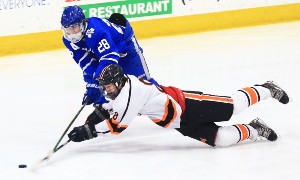
The Shamrocks scored two more in the second period, by Bret Beale and Ryan Wartuck to make it 4-0. Rockford's Carson Korte scored early in the third period to get the Rams back in range, but Kaden Hemme scored late in the third to put it away.
"I think we got a little too comfortable," Kaleniecki said of Korte's goal. "It was a good reminder of how we need to play.”
Rockford (15-6-1) became only the third school from the west side of the Lower Peninsula to reach the Division 1 Final, following Grandville (2015) and East Kentwood (2005).
"They're deep," Rockford coach C.J Pobur said. "There's not many public schools, if any, that can go four lines deep. We thought that 5-on-5 our group was ready to go, but their execution on special teams was exceptional tonight."
The Rams' run to Plymouth was fueled in part by a core of teammates who grew up playing together. Some of the players have been together nearly a decade. That cohesion, along with the addition of Korte and Owen DeVries this year from travel hockey, lifted Rockford to the best finish in school history.
Rockford and Division 2 runner-up Byron Center represented the west side of the state.
"I think it's a great area,” said Pobur, who like Kaleniecki is a Detroit Catholic Central graduate. "I think there's great hockey over there, but it's just not as big. You don't have as many big players. You might have two or three strong programs (on the west side), but they have 10 or 15 on the east side."
While they didn't get the result they hoped for, the Rams went home with heads held high.
"It wasn't a great result," DeVries said. " I think everyone in our locker room can say we gave it (our) all, and that's really all we ask for."
PHOTOS: (Top) Detroit Catholic Central celebrates its Division 1 championship Saturday at USA Hockey Arena. (Middle) DCC's Bret Beale (28) and Rockford's Owen DeVries work for possession. (Click for more from Hockey Weekly Action Photos.)