

EGR's Newton Returns to Rink Amid Speedy Recovery from Double Lung Transplant
By
Dean Holzwarth
Special for MHSAA.com
January 22, 2025
EAST GRAND RAPIDS – The last thing Chris Newton wanted to do was miss any time away from the hockey rink this season.
 But when the East Grand Rapids hockey coach received a 3 a.m. phone call last month, he knew it was inevitable.
Newton also knew he would be receiving the possibility for a longer life and an opportunity to continue his lifelong passion.
Newton, who was diagnosed with cystic fibrosis at 4 months old, received news that a set of donor lungs was available, and he began the process of undergoing a second double lung transplant.
“I get a call and it was a 616 number so I knew exactly what it was, but I was totally shocked,” Newton, 35, said. “I definitely didn’t go back to sleep after that, and my mom was there visiting and everyone was surprised that it happened so quickly. If they find a good set, you can’t pass on it.”
Newton, a former Farmington High School goalie and assistant coach, had his first double lung transplant eight years ago.
“It was always in the cards that I would need one,” said Newton, a senior on the 2007-08 team that reached the Division 2 Semifinals and later an assistant coach for his dad, the late Bill Newton, with the 2013-14 Falcons squad that won the Division 3 title.
“I have a weird CF gene, and I don't qualify for the really good medicine they make that has made a difference in a lot of people's lives. A transplant was my only option as my health was decreasing pretty rapidly. And then, after eight years, you get rejection and they call it CLAD (chronic lung allograft dysfunction). The body starts rejecting lungs even though they had been good for like six years.”
 Newton was diagnosed with CLAD two years ago, and it started slowly progressing.
He re-listed for another transplant in November, and 14 days later received the good news. It was two days after he collected his 100th career coaching victory.
“In comparison, the first time it was a 3½ month wait,” Newton said. “I had surgery on Dec. 10 at Corewell Health, and I came back to practice on Jan. 6. I missed two weeks of hockey with the three-week break we had, so it worked out.
“I feel great, and it's crazy to be back so quickly, but I feel good. The other sickness I have is coaching. I’m almost addicted to it when it's hockey season, and it’s really the only thing I think about. It’s what I do during these months, and it’s how I’m wired. When it happened, it was like this is perfect timing. I’m barely going to miss anything.”
The EGR hockey community has supported Newton throughout his transplant and recovery, and his players were motivated to give their best effort with their coach on the mend.
“Obviously it's been a long road for him, and it’s not the first time he has had this double lung transplant,” EGR senior center James Albers said. “It’s been pretty incredible, and all the guy wants to do is just coach hockey. He puts in all the fight, so I think the guys rally around him and want to do it for him, get big wins.
“We didn’t talk about it, but we wanted to play our best hockey for him because all he wants to do is show up at the rink for us. I have people at school ask me all the time how he’s doing, and it’s awesome to tell them that he looks incredible and is back on the ice after only a month.”
Senior Owen Stropkai has been on the varsity since his freshman year and has become close with his beloved coach.
“It’s great to have him back, and the positivity that he brings is awesome,” Stropkai said. “Every day it's a new level, and our team pushes for him. What he's been going through is horrible, but we think of him every day and grind together for him. He’s a great guy.”
Grant Newton, EGR’s associate head coach and no relation, took over the program in Chris Newton’s absence.
“We have a really good relationship, and we are close off the ice,” Chris Newton said. “I coached him at Farmington when we won a state championship, and he has helped me get the program to where it is.
“I went to him this summer, and we had a plan in place. I made sure he was comfortable taking over for me, and he did a great job.”
Chris Newton, whose family includes wife Jessie and sons Liam (6) and Carter (3), has transformed EGR into a perennial powerhouse the past few years.
 The Pioneers have made back-to-back appearances in the Division 3 Final. They lost to Bloomfield Hills Cranbrook-Kingswood 3-2 in triple overtime last year and suffered a 3-2 loss to Flint Powers Catholic in 2023.
EGR reeled off seven straight wins to open this season and is currently 12-3-1 and tied for first in the Ottawa-Kent Conference Rue despite heavy graduation losses last spring.
“The one thing that is great about this team is we haven’t stopped what we've been doing the last two years when we’ve had success,” Chris Newton said. “We’re sticking to details and making it more about the program than individuals.
“Our motto this year is being uncommon. I wanted that way back in the summer before this even happened. The motto has stuck to me, that I'm uncommon, but I wanted our kids to compete and be uncommon daily, and they’ve done that. It’s been a great group to be around and a group I wanted to get back to as quickly as I could.”
Chris Newton was blessed to have a superb transplant team help him navigate the process.
“The people there were great, and my surgeon was absolutely incredible,” he said. “They are good and talented people, and the nursing staff made it way easier than I expected.
“Obviously, no guarantees or anything, and everything is going well right now,” he added. “I’m still being seen a lot and being tested, but no number can be put on it. Eight years was a good run with the first set, but you just don’t know. I don’t have a crystal ball as to what will happen.”
 Dean Holzwarth has covered primarily high school sports for Grand Rapids-based WOOD-TV for five years after serving at the Grand Rapids Press and MLive for 16 years along with shorter stints at the Ionia Sentinel and WZZM. Contact him at [email protected] with story ideas for Allegan, Kent and Ottawa counties.
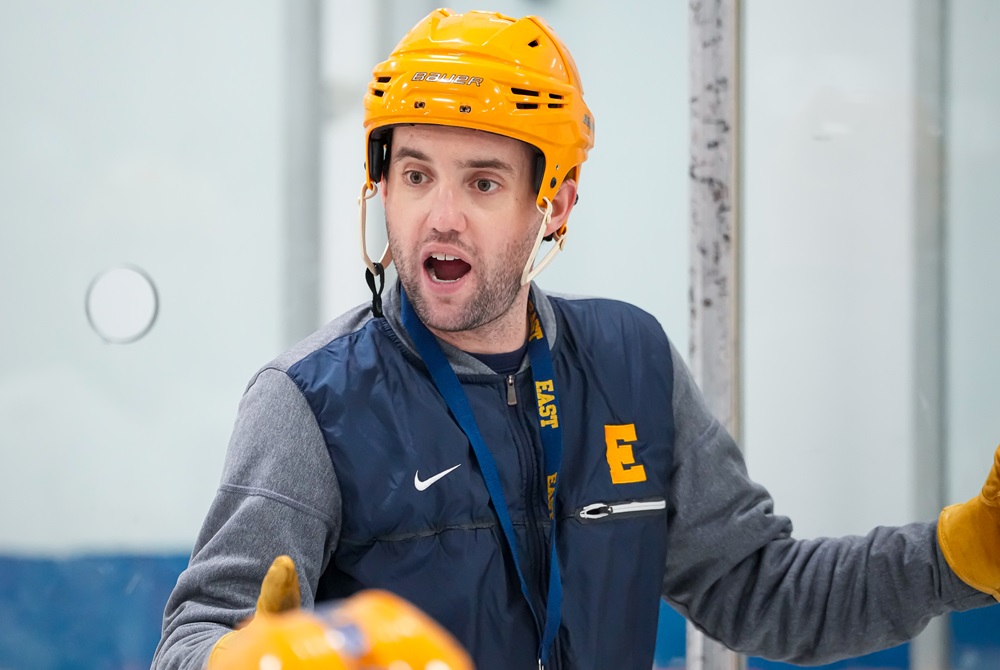
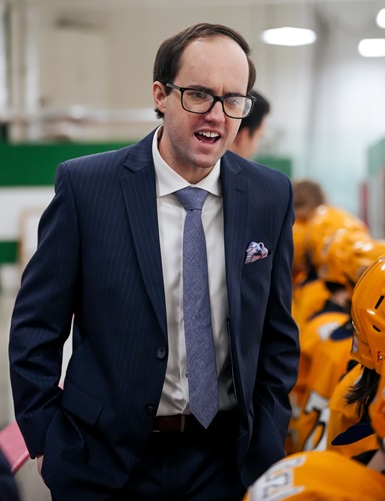
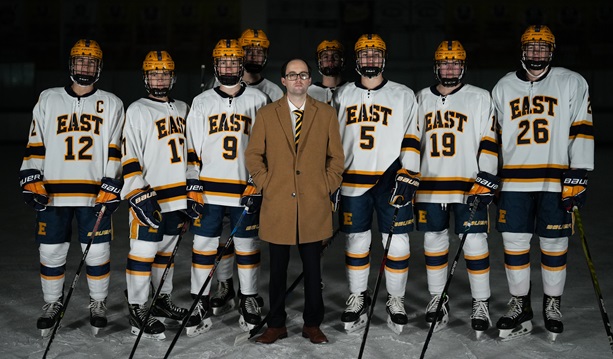
PHOTOS (Top) East Grand Rapids hockey coach Chris Newton instructs his team during a practice. (Middle) Newton directs his players on the bench during a game. (Below) Newton takes a photo with members of this season’s EGR team. (Photos by Grant Newton.)
Manning Up for Brother Rice Title Run
March 14, 2015
By Bill Khan
Special for Second Half
PLYMOUTH — For Matt Manning, there were no hard feelings.
From his standpoint, it was a clean hockey play, even though a penalty was called on his opponent.
He just happened to be on the wrong end of a devastating hit that nearly deprived him of his senior season at Birmingham Brother Rice and the opportunity to lead his team to an MHSAA championship.
In a scrimmage on Nov. 17, two days before the season opener against Livonia Stevenson, Manning was forechecking on a penalty kill when he got the puck and slipped it behind a defender. With his head down as he was chasing the puck, Manning never saw what was coming.
"This kid just came from my blind side," the 5-foot-6 Manning recalls. "He got me in the right spot. He was a lot bigger than me. He won that battle."
But Manning and his teammates were the ultimate winners Saturday. He was in the stands as a freshman when Brother Rice won its last MHSAA title, in 2012, but was a key reason why the Warriors won their fourth with a 6-3 victory over Livonia Stevenson at Compuware Ice Arena.
Manning didn't immediately realize he was injured back in November, but he felt sharp pain when he tried to move his left arm on his way back to the bench. His left collarbone had been broken in half, an injury that required a plate and seven screws to repair.
Manning experienced some dark days in the immediate aftermath of the injury.
"It killed my confidence, basically, because we were just starting the season," he said. "We hadn't played our first game. It was the first scrimmage, the third shift. I was getting down about it. After that, and getting through the therapy, realizing it was going to get better with all the sessions we had, it just got much better a lot quicker."
Manning was back in the lineup on Jan. 7, adding a high-end talent to a team already ranked No. 1 in Division 2.
Manning had only one assist Saturday, but makes an impact as a tenacious, high-energy forechecker that isn't always quantified on the scoresheet. Stevenson coach David Mitchell agreed that Manning's presence was a huge plus for Brother Rice, which beat Stevenson 4-3 in the teams' season opener on Nov. 19 in Livonia.
 "You saw some things around the net today where he made plays that were special hockey plays," Mitchell said. "It's tough playing an opponent like him, but I'm thrilled he's in high school hockey and he's helping high school hockey grow. Having a player like that in our game makes our game better and makes the level of competition better for everybody and more enjoyable for people to watch."
Brother Rice coach Lou Schmidt, in his 12th year with the Warriors, said Manning's comeback from a major injury was remarkable.
"I've never in my years seen anybody come back like he did," Schmidt said. "Usually, there's this very cautionary period where you don't want to get hit. He started skating five weeks after the injury; you never would've known he was out. He was a huge addition to our team. He made us deeper, he made us better."
Brother Rice wouldn't have had the opportunity to play for the title on Saturday had Manning not scored on a backhander 25 seconds into the fourth overtime to give the Warriors a 4-3 victory over Hartland in the Quarterfinals on Tuesday. It was one of two one-goal victories for the Warriors on their march to the championship.
Although Brother Rice won by three goals, the Warriors found themselves in another tough battle against a Stevenson team that was two years removed from an MHSAA championship.
Brother Rice dominated the early going, outshooting Stevenson 10-2 in the first period and taking a 2-0 lead just 53 seconds into the second period on a goal by Joey Vassallo.
The Warriors swarmed the Spartans' net after that in search of a knockout blow, only to be thwarted by junior goalie Cullen Barber.
After going without a shot on its first two power plays, Stevenson injected some life into the building when Alex Allen scored on the power play at 8:41 of the second period. The Spartans quickly tied it when Joe Alcantara scored at the 10:36 mark.
"I'm so proud of our guys," Mitchell said. "I think everybody saw it had the potential to get away when it was 2-0 and they were still carrying the play. But like we did all year, we answered back and made a game of it, which was great not only for us, but for the game of high school hockey. That second period was exciting. It's good that it was a good, solid hockey game that I hope did high school hockey proud."
Brother Rice regrouped and regained its two-goal lead on goals by Brendan Pyc at the 12:58 and 16:19 marks of the second.
"It was a big momentum shift when they scored their first one," said Brother Rice senior Nick Rosa, the only player remaining from the 2012 championship team. "When they got the second one, we knew we had to get the next one; that was big."
Stevenson got back within striking distance when Vince Glenn scored on the power play 44 seconds into the third period. Rosa's team-leading 25th goal of the year with 8:58 remaining in the game re-established Brother Rice's two-goal cushion.
Stevenson failed to click on two late power plays before the Warriors put an exclamation point on the championship with an empty-net goal by Jack Dansbury with 20.3 seconds to go.
"It's the longest journey ever," Rosa said. "Nine months ago, we started working out in the summer five days a week. We never stopped. This was our ultimate goal. We achieved it. Every day we came to practice and tried our best. I'm really proud of the boys."
Brother Rice was 3 for 4 on the power play, while Stevenson was 2 for 6.
"It was a special teams kind of day," Schmidt said. "We played well when we had to. We made it interesting there in the second — maybe for the fans, but not so much for the coaches."
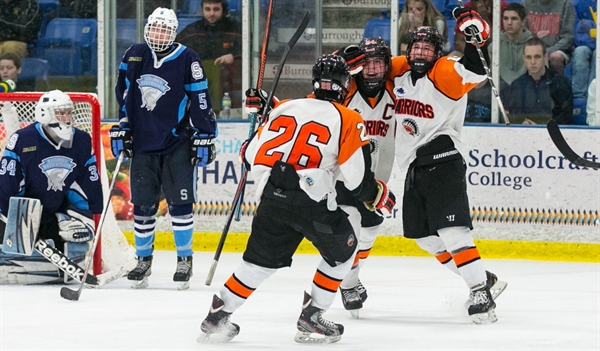
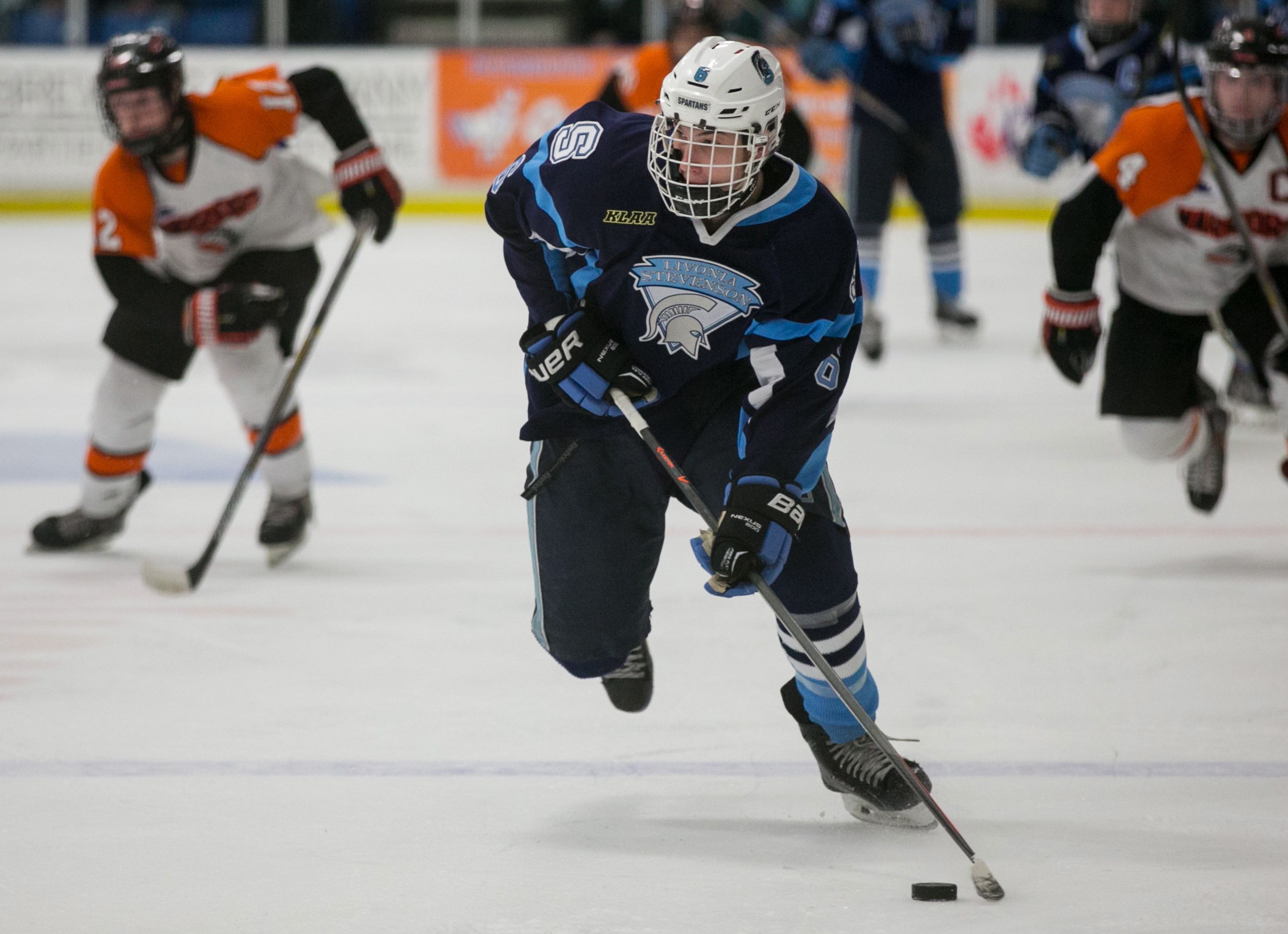
PHOTOS: (Top) Brother Rice celebrates one of six goals Saturday against Livonia Stevenson. (Middle) Stevenson’s Nate Sudek drives into the Warriors’ zone during the Division 2 Final. (Photos by Andrew Knapik/Southgate).