


MHSA(Q&)A: Frankenmuth softball coach Brad Walraven
May 31, 2012
 By Brian Spencer
Second Half
Brad Walraven initially wanted to coach baseball. And he planned on staying in his first softball job, at Bay City All Saints, just four seasons – long enough to coach his younger sister through her graduation from the school.
But though the last 33 seasons weren’t part of his original plan, there’s no question they’ve worked out well for hundreds of athletes who have come under his leadership.
Walraven has won four MHSAA softball championships and is among only six high school coaches in his sport nationwide with at least 1,000 career wins, according to the National Federation of State High School Associations. Walraven achieved that milestone when his Frankenmuth team swept Essexville-Garber 7-2 and 7-0 on May 21.
The victories made the Eagles 27-4 this season – and Walraven 1,000-276 in 33 seasons total, including the first 30 at All Saints. In MHSAA history, his career wins total is behind that only of Warren Regina’s Diane Laffey, who has a 1,048-395-3 record heading into this week’s District tournaments.
Walraven also has won 25 District and 16 Regional championships, and taken 10 teams into MHSAA Finals championship games – including the Eagles last season in Division 3. Frankenmuth now is 32-4 this spring, heading into Saturday’s District on its home diamond.
You started out coaching with the plan of sticking in it for four years. What about the game of softball and coaching it has kept you around for 33?
My priorities in coaching and philosophies have changed (over the years). In my fourth year of coaching, my sister was a senior. That year we turned the program around and started winning games. They were competing. The competition has had me coming back since, along with learning more about the game.
Did you always want to coach softball? If not, what did you want to do?
No; the funny thing is that I graduated from Bay City All Saints after I won a state championship in baseball. After I graduated, I wanted the baseball job at Bay City All Saints, but they said I was too young to coach baseball. However, they did want me to stick around, and they gave me the softball job.
In your 33 years of coaching, what has been the most important piece of advice you’ve been given?
I read this somewhere; if you just keep working hard, good things happen to good people. Though my philosophies have changed, this philosophy has been pretty solid. I’ve also had girls come back from playing with me that say how I had taught them discipline, and that they have carried that with them to the next steps in their lives. As a coach, hearing that from past players is very rewarding.
Are there specific seasons or teams that stick out more than the rest? If so, why?
In 1999, we won states at Bay City All Saints. We set the state record with a 44-3 record. This record I believe is still intact. (All Saints’ 44 wins that spring is now tied with the 2007 White Lake Lakeland team for the most in one season.)
Last year (2011), Frankenmuth got to the Finals and lost in Battle Creek (to Clinton, 4-2 in the Division 3 championship game). It was the first time Frankenmuth had been there since 1991.
What piece of advice can you give to aspiring coaches?
Listening is an important skill. Learn from other coaches. If you think you know it all, you don’t. Every time you go to clinics, you pick up something and learn something new. You must be able to adapt. Every season is different, as you get a new set of players and personalities to deal with.
How long do you plan on coaching?
This is a very open-ended date. I was actually going to quit three times in my career for various reasons, but I’m glad that I stuck it out. Given that my health stays good and I continue to wake up every morning excited about coaching, I would love at least another five years in Frankenmuth.
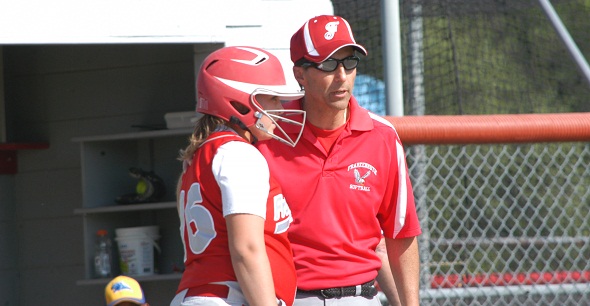
PHOTOS courtesy of The Frankenmuth News.
Rogers City Makes Dream Come True
June 14, 2014
By Kelsey Pence
Special for Second Half
EAST LANSING – Nikki Radke and Morgan Hall couldn’t have dreamed up a better senior season.
Rogers City has been out for revenge ever since Kalamazoo Christian eliminated the Hurons in last year’s Division 4 Semifinal.
Radke and Hall played a big part in making that dream come true Saturday as the Hurons beat the Comets 3-2 in to earn Rogers City its first MHSAA softball title.
“It’s my senior year, and I couldn’t have ended it any better way,” Hall said.
Kalamazoo Christian (28-17) scored first, in the first inning, but Rogers City responded in the third.
Logan Fleming and Courtney Streich both reached on Comets errors, and Sarah Meredith brought Fleming home with a single to left field. The Hurons (34-6) left three on base – but took the lead in the fifth inning.
Hall reached base and Alexa Quaine doubled down the third-base line to score her for the go-ahead run.
The Comets had a chance to put up another run in the sixth inning, but left two stranded.
“We have a fantastic infield, and the defense was there again today,” Hurons coach Karl Grambau said. “We knew they were going to put it in play and we were ready for it, and Nikki was just incredible.”
Radke pitched a complete game, striking out three, walking none and giving up five hits.
“Nikki is a great pitcher and a really underrated pitcher,” Grambau said. “She doesn’t strike out a lot of girls because the girls put a lot of balls in play.”
Meredith walked to start the seventh inning and Hall brought her home with a double to left field to give the Hurons a 2-run lead.
“It turned out the be a game-winning hit, and I could never have expected that and I am honored to have that opportunity now,” Hall said. “I am just glad Sarah ran her butt off to get in.”
 Hall’s hit was indeed a big one as Kalamazoo Christian found some magic with two outs left in the bottom of the seventh inning.
After Radke struck out the first two batters, Cara Knasel double to deep right field. Erica Block then singled to left, which put up another run for the Comets and pulled them within one of the lead.
“I really wasn’t nervous at all,” Radke said. “I lived in the moment and realized it was my last softball game ever. It got a little nerve-racking once they scored that run.”
Madison Locker connected on the next pitch, but it was caught in left field to end the ballgame.
“Our motto was to believe and achieve, and we definitely went in believing and we ended up achieving,” Radke said.
Hall praised her senior classmate.
“Nikki has been four years in the making,” Hall said of Radke. “She has dedicated her summers and her winter to pitching. She got us here last year and took us farther this year. We can never thank her enough.”
Rebekah VanDam took the loss for the 2013 champs, striking out four, walking three and giving up eight hits in seven innings of work.
“We knocked them out of the tournament last year, so it was kind of a revenge factor for them,” Kalamazoo Christian coach Terry Reynolds said. “They played hard against us earlier this year, and they repeated that again today. They played great defense, just wonderful defense.
“The pitcher kept us off-paced. She really didn’t surprise us with anything; we just couldn’t touch her. We couldn’t get that key hit when we needed it.”
Grambau said the win is one for the community.
“It’s unbelievable for us and northern Michigan to get this victory,” he said. “Last year we got shut out and then we beat them earlier this year in a tournament. We knew it was anybody’s game, and we are just happy to get this win. It means so much for our program and for our girls.”
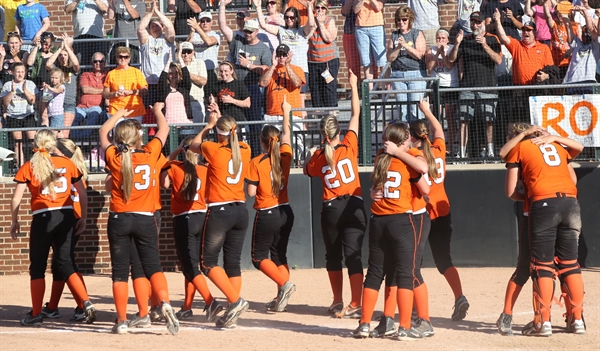
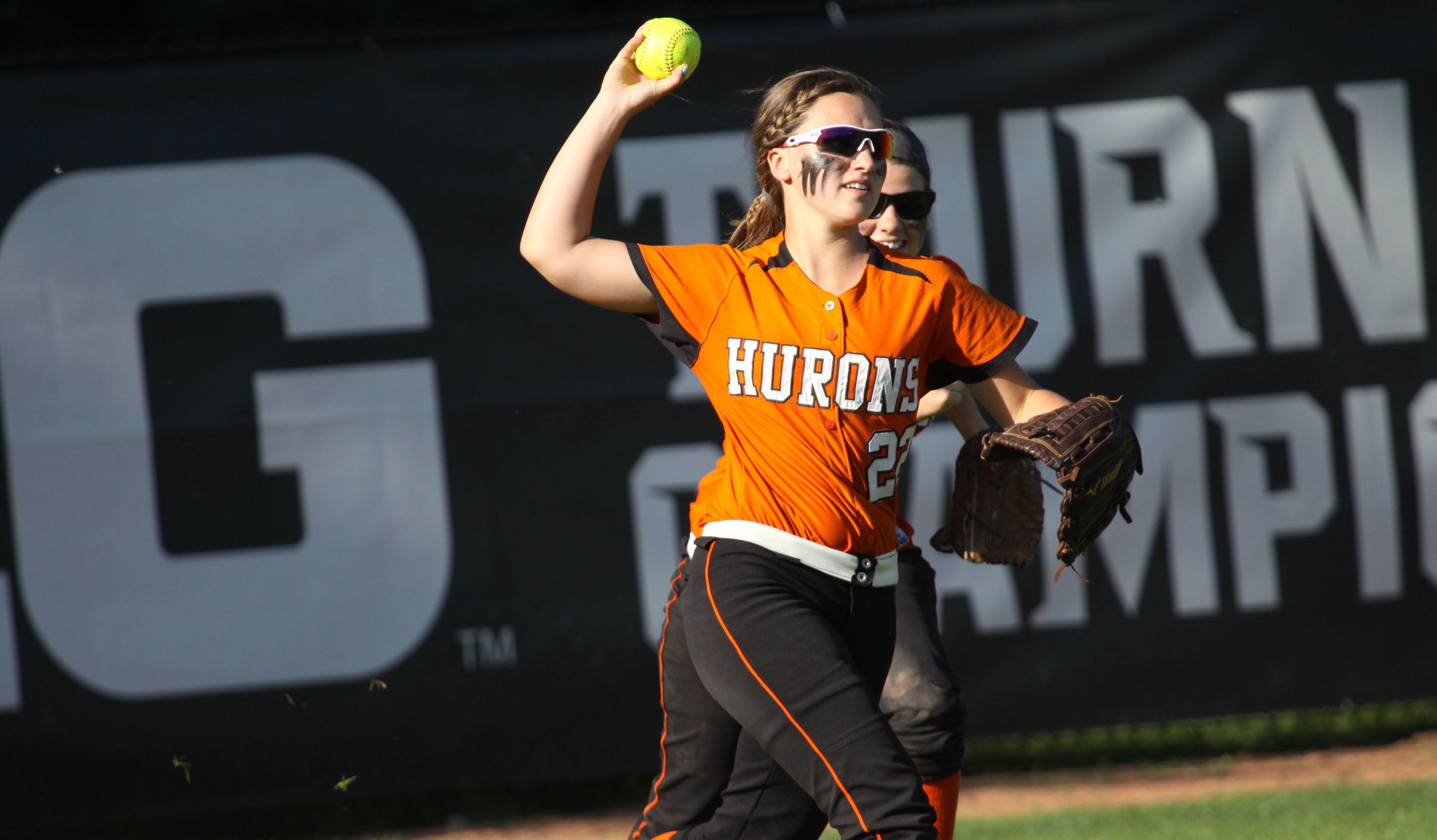
PHOTOS: (Top) Rogers City players are cheered on by their fans after winning the Division 4 championship at Secchia Stadium. (Middle) Hurons centerfielder Cassie Brege throws the ball in during Saturday’s Final.