


MHSA(Q&)A: Frankenmuth softball coach Brad Walraven
May 31, 2012
 By Brian Spencer
Second Half
Brad Walraven initially wanted to coach baseball. And he planned on staying in his first softball job, at Bay City All Saints, just four seasons – long enough to coach his younger sister through her graduation from the school.
But though the last 33 seasons weren’t part of his original plan, there’s no question they’ve worked out well for hundreds of athletes who have come under his leadership.
Walraven has won four MHSAA softball championships and is among only six high school coaches in his sport nationwide with at least 1,000 career wins, according to the National Federation of State High School Associations. Walraven achieved that milestone when his Frankenmuth team swept Essexville-Garber 7-2 and 7-0 on May 21.
The victories made the Eagles 27-4 this season – and Walraven 1,000-276 in 33 seasons total, including the first 30 at All Saints. In MHSAA history, his career wins total is behind that only of Warren Regina’s Diane Laffey, who has a 1,048-395-3 record heading into this week’s District tournaments.
Walraven also has won 25 District and 16 Regional championships, and taken 10 teams into MHSAA Finals championship games – including the Eagles last season in Division 3. Frankenmuth now is 32-4 this spring, heading into Saturday’s District on its home diamond.
You started out coaching with the plan of sticking in it for four years. What about the game of softball and coaching it has kept you around for 33?
My priorities in coaching and philosophies have changed (over the years). In my fourth year of coaching, my sister was a senior. That year we turned the program around and started winning games. They were competing. The competition has had me coming back since, along with learning more about the game.
Did you always want to coach softball? If not, what did you want to do?
No; the funny thing is that I graduated from Bay City All Saints after I won a state championship in baseball. After I graduated, I wanted the baseball job at Bay City All Saints, but they said I was too young to coach baseball. However, they did want me to stick around, and they gave me the softball job.
In your 33 years of coaching, what has been the most important piece of advice you’ve been given?
I read this somewhere; if you just keep working hard, good things happen to good people. Though my philosophies have changed, this philosophy has been pretty solid. I’ve also had girls come back from playing with me that say how I had taught them discipline, and that they have carried that with them to the next steps in their lives. As a coach, hearing that from past players is very rewarding.
Are there specific seasons or teams that stick out more than the rest? If so, why?
In 1999, we won states at Bay City All Saints. We set the state record with a 44-3 record. This record I believe is still intact. (All Saints’ 44 wins that spring is now tied with the 2007 White Lake Lakeland team for the most in one season.)
Last year (2011), Frankenmuth got to the Finals and lost in Battle Creek (to Clinton, 4-2 in the Division 3 championship game). It was the first time Frankenmuth had been there since 1991.
What piece of advice can you give to aspiring coaches?
Listening is an important skill. Learn from other coaches. If you think you know it all, you don’t. Every time you go to clinics, you pick up something and learn something new. You must be able to adapt. Every season is different, as you get a new set of players and personalities to deal with.
How long do you plan on coaching?
This is a very open-ended date. I was actually going to quit three times in my career for various reasons, but I’m glad that I stuck it out. Given that my health stays good and I continue to wake up every morning excited about coaching, I would love at least another five years in Frankenmuth.
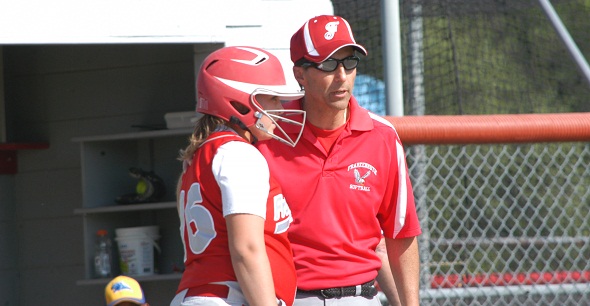
PHOTOS courtesy of The Frankenmuth News.
Dansville Believes – And Achieves
June 22, 2012
It's likely that few gave the Dansville softball team a shot to win the Division 4 championship last weekend, given the two-time reigning champion sitting on the opposite side of the bracket.
But the Aggies thought they had a chance. And that’s what longtime coach Mick Ream thinks made the difference in his team’s winning its first MHSAA title.
Dansville was making its third trip to Bailey Park in four seasons. The second trip, in 2010, ended with a nine-error performance and 10-1 loss to Petersburg-Summerfield – which went on to win the championship that season and again in 2011.
Those Bulldogs had been ranked No. 1 in every coaches poll this spring. But after surviving a late Rapid River to win Friday’s Semifinal 4-3, Dansville did the unexpected in Saturday’s championship game, winning 3-2.
“We were hoping to get back to the Semis, and I thought we were good enough,” said Ream, who finished his 31st season as coach. “Things always just have to fall into place. Once we got to the Semis, I really liked Rapid River. But we were just hanging in, and we did the same thing in the final game.
“With our success the last four years, and more than that, we leant ourselves to expectations. They’ve risen, not only by me, but by people in the community.”
The Aggies are recipients of the final team Second Half High 5 of the 2011-12 school year.
The championship was the first for a Dansville girls team and the third MHSAA team title for the Aggies in any sport, joining the wrestling teams that won MHSAA Class D Finals in 1980 and 1981 when Ream’s brother Dan was an assistant coach.
Although Dansville also draws from the rural area surrounding it, roughly 500 people live within the village limits. Families have known each other for years, and Ream retired from teaching in 2010 after 34. He also has coached in the football, baseball, volleyball and girls basketball programs and watched two sons become coaches – Aggies girls basketball coach Eric Ream and his brother Greg, who coaches the boys basketball team at Desert Ridge High in Mesa, Ariz.
Mick Ream's softball team was led by some who knew well how he runs the show. Seniors Rebekah Guy, Alison Schlicker and Addie Price all played four years of varsity. Junior Evy Lobdell has been a mainstay in the lineup since her first year of high school as well.
 Lobdell and Guy have eight school records between them, and Price and sophomore outfielder Hailey Mays each posted one of the seven total set by this season’s team. Guy returned to the all-state team as a catcher after hitting .422 and five home runs with an 8-1 record and 1.38 ERA pitching. Lobdel also was selected after hitting .500 with 54 RBI, as was sophomore pitcher Meagan Kelley, who went 23-4 with a 1.56 ERA and 204 strikeouts. Mays and senior outfielder Paige Galbreath both earned honorable mentions.
The high school itself has just shy of 300 students. But on top of having strong crowds all season, 200 supporters showed up for Thursday’s victory parade that included three fire engines, the band and player introductions.
The parade was just the start. The village proclaimed that every July 20 will now be known as Dansville Varsity Softball Day. Calls and letters have been coming in from people Ream hadn’t had contact with for years.
Former Bath coach Marc Kibby – who led the Bees to the Division 4 championship in 2002 and now coaches at Lansing Community College – called to say “welcome to the club” and remind Ream that the Aggies will always be listed among champions on the flag pole near the Bailey Park softball complex entrance.
“One thing I got loud and clear from everybody: there’s just a certain way we did things, and we didn’t waiver from it, and I think it paid off,” Ream said. “It paid off with how the kids represent the school, how they act when they go on the field and when they go off the field. I think that’s the starting point. And I always felt that if you get to know and care about them more as people than players, my philosophy is that they respond to that.”
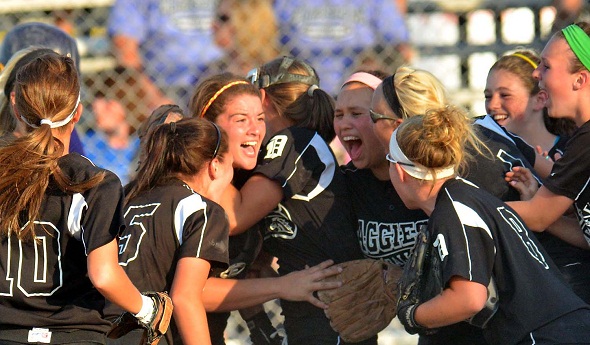
PHOTOS: (Top) Dansville players celebrate after Friday's 4-3 Semifinal win over Rapid River that earned them the school's first softball Final appearance. (Middle) Junior Evy Lobdell hits a drive during the Semifinal win. (Click to see more photos from High School Sports Scene.)