

Softball Gave Michigan Girls Opportunity
May 3, 2016
By Ron Pesch
Special for Second Half
In 1971, Jennifer Bradley, a 17-year-old senior at New Buffalo High School, attempted to play for the school’s varsity baseball team. Her request was rejected by the team’s coach. The story made national news.
Described as a better hitter than many boys, who could also run and field, Bradley was a player who local police chief and amateur baseball coach Dale Siebenmark felt would be an asset to any team.
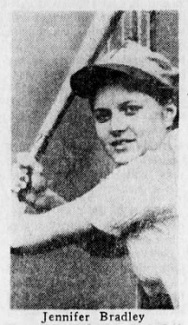 Siebenmark wrote the Michigan High School Athletic Association on her behalf, asking for clarification on her status. Bradley was told, via letter, by the MHSAA rules committee that “girls cannot engage in sports where part or all the membership of a participating team is composed of boys.”
Because she was a senior, Bradley opted not to push beyond.
“I hope in the future other girls who are interested will pursue the matter of girls trying to get on teams,” said Bradley, inadvertently foreshadowing a change that would arrive. “But, they should start when they are freshmen.”
Into this environment was born an expanding array of MHSAA state tournaments for girls.
Outside regional tournaments in alpine skiing, started during the 1953-54 school year and staged for both boys and girls, gymnastics was the first sport for females to receive a statewide MHSAA-sponsored championship tournament. It began with the 1971-72 school year – the school year prior to the signing of the United States Education Amendments, which included Title IX, in July 1972.
MHSAA golf, tennis, swimming & diving and track & field championships were added for girls during the 1972-73 school year. Basketball arrived the following year. Skiing moved to a statewide championship in February 1975.
That spring also would see the first MHSAA Finals for one of the state's fastest-growing girls sports.
According to press reports, 182 high schools in the Great Lakes State had softball teams during the 1972-73 school year. One year later, the number had jumped to 331. With the announcement of the first MHSAA-sponsored softball tournament in the spring of 1975, the total increased again to 410.
“Some of the finest facilities in the state are being used for the championships,” noted the Detroit Free Press, indicating that this was the fifth anniversary of the MHSAA title games for baseball and the first for softball. “The Class A girls softball playoffs, for instance, are being played at Lansing’s Ranney Park, a fine outstate park for 40 years.”
It was one of four separate sites used for the final rounds of softball. Class B games were hosted at Dickinson Field in Kalamazoo, Class C games were held at Manchester High School and Class D at Plangger Field in Benton Harbor. Semifinal games were scheduled at 10 a.m., noon and 12:30 p.m., with the championship contests scheduled for 3 p.m., 3:30 or 4 p.m. of the same day, depending on the site.
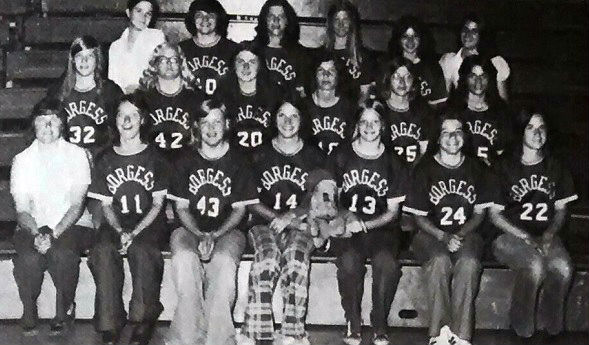
 In Class A, all-around athlete Mary Kay Itnyre (who in 2015 was inducted into Michigan State University’s Athletic Hall of Fame for her stellar college basketball career) tossed back-to-back no-hit games for Redford Bishop Borgess in regional play. Itnyre, a 6-foot junior, then added a third consecutive no-hitter as the Spartans topped Bay City Central in the Semifinals, 7-0. (Bay City’s girls wore volleyball uniforms that doubled as their softball uniforms, illustrating the inequality between the boys and girls athletics that existed at the time).
“If the Detroit Tigers ever begin drafting females, pitcher Mary Kay Itnyre may be the first on the list,” wrote a United Press International writer covering that first tournament.
Later in the day, Itnyre allowed only four hits as the Borgess girls downed Portage Central, 15-3, for the title. Itnyre opened the game with three innings of no-hit ball while Borgess pounded out 12 runs, including a home run by Sue Janus in the second inning. Lori Tremonti and Itnyre each added three hits for the victors. Ann Nolan had a two-run homer for the Mustangs in the seventh. Despite the loss, the opportunity to compete for a championship game capped a 24-year physical education career for Portage Central’s Jean Smith. Long an advocate for girls sports, Smith became the school’s first softball coach with the passage of Title IX.
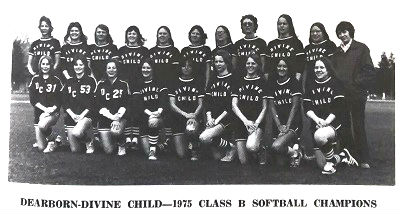
Dearborn Divine Child finished the 1974 season with a 6-3 record, earning the “Best Sportsmanship” trophy from the Sterling Heights Women’s Softball Association. A year later, thanks to the changes in high school athletics, they were Class B state champions.
Catcher Sheryl Tominac notched two home runs and tallied six RBI as Divine Child crushed Grand Rapids Catholic Central, 14-2, in the Semifinal. Divine Child continued the offensive assault with 13 hits in a 14-4 pounding of Tecumseh for the title. Tominac again led the Falconettes with a single in the second inning, another home run in the fourth, and a triple in the fifth inning of the championship game.
The Detroit Catholic League continued its dominance of that first tournament, as Riverview Gabriel Richard pitcher Donna Dallos held Kalamazoo Christian to a single hit, a double by Lois Talsma, in a 5-0 victory in the Class C Final at Manchester. Mary Kay Raubolt went 2 for 4 in the game with a two-run single, while Maureen Dalton went 2 for 3 with a double. Dallos, team Most Valuable Player, finished the year with a 13-2 record and an ERA of 1.50. Gabriel Richard posted a 15-2 record on the season and earned the trip to the title game with a 14-5 win over Lakeview earlier in the day.
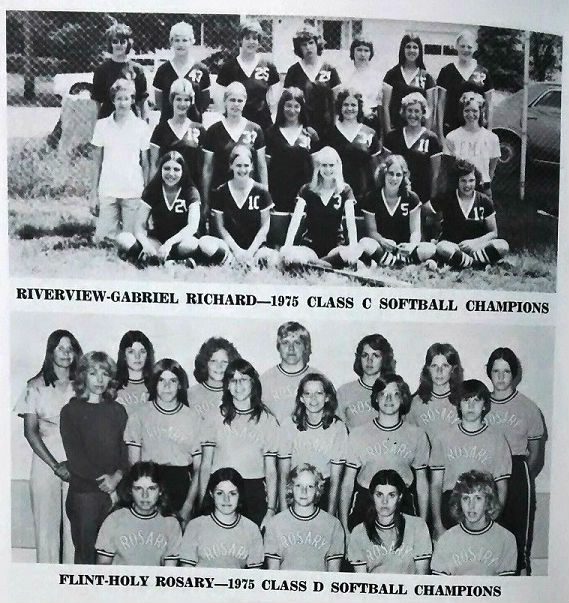 Freesoil entered the final weekend of softball competition with a flawless 35-0 record over three years of Western Michigan D League play. Trailing 9-8 in the seventh inning of the Semifinal game with Waterford Our Lady of the Lakes, the Pirates rallied for a 10-9 win and a chance at the Class D title. Their victory ensured that the Detroit Catholic League didn’t sweep the tournament.
Flint Holy Rosary entered the final inning of its Semifinal game leading 8-1 when Fowler erupted for five runs. According to Associated Press newspaper coverage, Fowler had the bases loaded with two outs when leftfielder Kelli Gerard “tossed out a runner at the plate following a bases loaded hit to nip a last inning rally,” to advance with an 8-6 victory.
In the championship game, Freesoil jumped out to a 2-1 lead behind junior Helen Shereda’s triple in the bottom of the first inning. Shereda, who pitched both the Semifinal and Final, would later become a three-sport star at Oakland University, where she earned All-America honors in basketball. Flint Holy Rosary quickly bounced back with four runs in the second inning to gain a 5-2 lead, then added three more at the top of the fifth, making it 8-2.
Freesoil bounced back with four runs in the bottom of the fifth, to pull within two, 8-6, but couldn’t grab the lead. Single runs in both the sixth and seventh innings by the Wolverines sealed the win, 10-6, and completed an incredible school year for the female athletes at Holy Rosary. Earlier, the Wolverines had won the MHSAA Class D girls basketball title, then represented Michigan in the U.S.A. Volleyball regional at Ball State University. (The MHSAA did not sponsor a volleyball state tournament until the winter of the 1975-76 school year.) The softball team included a number of athletes from the basketball and/or volleyball teams, including Gerard, Sally Lipp, catcher Patty Bentoski and pitcher Sandy Histed.
For Holy Rosary coach Anita “Jo” Lake – who had arrived as a volunteer in 1964, a year after the school’s opening – the season included yet another victory. After three operations, she had beaten breast cancer.
Since that first softball tourney, a host of other girls championship tournaments have been added by the MHSAA: Cross Country in 1979, Soccer in 1983, Competitive Cheer in 1994, Bowling in 2004 and Lacrosse in 2005.
Today, Michigan ranks 10th nationally in population, yet ranks 7th in girls and boys student participation in high school athletics. The numbers are truly impressive, especially when one considers them from the historical perspective of 45 years ago.
 Ron Pesch has taken an active role in researching the history of MHSAA events since 1985 and began writing for MHSAA Finals programs in 1986, adding additional features and "flashbacks" in 1992. He inherited the title of MHSAA historian from the late Dick Kishpaugh following the 1993-94 school year, and resides in Muskegon. Contact him at [email protected] with ideas for historical articles.
PHOTOS: (Top) Redford Bishop Borgess was the first MHSAA Class A softball champion, in 1975. (Middle top) New Buffalo's Jennifer Bradley. (Middle below) Dearborn Divine Child won the 1975 Class B softball title. (Below) Riverview Gabriel Richard and Flint Holy Rosary won the Class C and D titles, respectively, in 1975.
Richmond, Ida Earn Saturday Return
June 15, 2017
By Geoff Kimmerly
Second Half editor
EAST LANSING – Even reigning champions get a little nervous returning to the diamond of their greatest accomplishment.
But it took Richmond only a couple innings to get comfortable again at Secchia Stadium while kicking off Thursday’s Division 2 Semifinals.
The Blue Devils, ranked No. 2 at the end of the regular season and expected to reach this point all season after emerging to win their first title a year ago, will get a chance to play for another thanks to a 4-2 win over No. 3 Escanaba – last year’s Semifinal opponent as well.
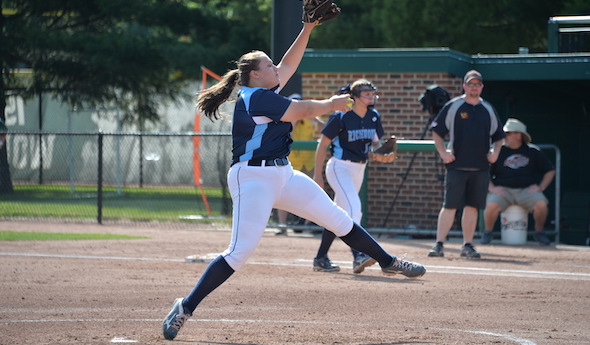
Richmond had won its last three games all in extra innings, but put up four runs during the third Thursday. Escanaba rallied for two runs in the fifth inning before sophomore pitcher Erin Shuboy – the star of last season’s championship run – finished locking down the Eskymos for the second year in a row.
“Making it here once is something special. And now to be here twice … I think the returners got rid of the jitters a little bit, (and) all of the other people are starting to settle in,” Richmond senior shortstop Carley Barjaktarovich said. “They score a couple of runs (and you tell yourself) relax, you’ve got a little bit of cushion. You’ve got another at bat. I wasn’t nervous at all. I know Erin; she’s going to bear down and she’s going to get it done. And we go back in and we have our bats.”
Richmond (33-4) will face Ida (36-7) in Saturday’s first championship game, at 10 a.m.
A year ago, the Blue Devils entered the tournament as honorable mentions in the final state rankings, but reached MSU and downed Escanaba 6-2 in a Semifinal.
The teams should have recognized a number of faces in the opposing dugout. Longtime Richmond coach Howard Stuart also caught up with Saginaw Swan Valley’s Tom Kennelly, whose top-ranked Vikings were downed by Escanaba in Tuesday’s Quarterfinal, and felt as prepared as possible heading into the rematch.
Richmond got to Eskymos senior starting pitcher Katie Ross only in the third inning, and freshman Gabbi Salo threw three scoreless to finish the game. But that one frame was enough. A walk, infield single by Barjaktarovich and error loaded the bases, and after a fielder’s choice knocked in the first run junior catcher Evelyn Swantek doubled in the next three.
Escanaba scored its two runs in the fifth inning and loaded the bases again with two outs. But Shuboy got a pop out to end that rally and allowed only one hit in each of the final two innings.
“I felt sorry for (Escanaba), because I thought that was a great team,” Stuart said. “We just had one good inning. We had one key hit, and that’s all it took.”
Barjaktarovich finished 2 for 3, and junior leftfielder Emma Caperton also had a double. Shuboy struck out seven and gave up four hits.
Sophomore rightfielder Lexi Chaillier and senior centerfielder Emily Bruntjens drove in runs for Escanaba (33-5). Junior Maddie Griffin walked twice and scored.
Ida 3, Stevensville Lakeshore 2
How did it feel for unranked Ida to down No. 6 Lakeshore in its first Semifinal since 2006, to make its first MHSAA Final in softball since that spring more than a decade ago?
“This is what you play for. This is what they started out wanting when they were kids. Look at their parents – they wanted the same thing, and here we are,” Ida coach Dawn Forter said, pointing out an enthusiastic bunch waiting to greet the team. “I’m numb. I’m proud of every one of those kids, all 15.”
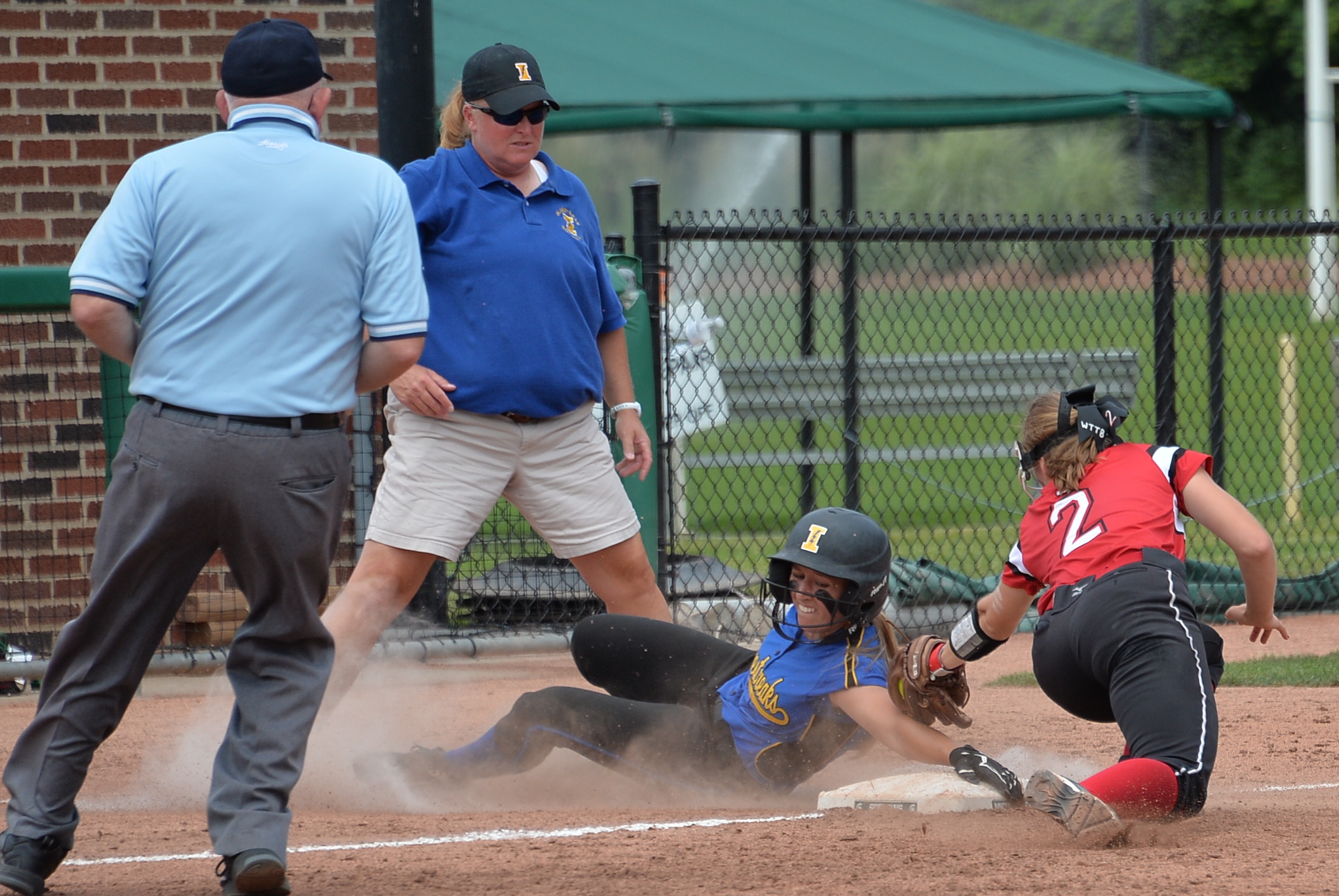 The Bluestreaks came back after Lakeshore jumped in with a run in the first inning, scoring one in the fourth and two in the fifth, and then withstood a last-inning Lancers rally to close out the victory.
Lakeshore scored that run when junior leftfielder Karlee Lambert misplayed a single by senior Olivia Freehling. But Lambert certainly made up for the brief miscue with a pair of triples, the second setting up her score on junior Hannah Tuller’s triple. Tuller kept going and scored on a throwing error to take the advantage up to 3-1.
“That’s a hard-hit ball and the field plays fast, and it got to (Lambert) a little quicker than she thought it was going to. She stuck with it though – she knocked it down,” Forter said of Freehling’s hit. “That’s the way every kid wearing a Bluestreak shirt has been all year. If they make a mistake on one side, they pick it up on the other.”
Ida’s first run came when senior Mallorie Duvall drove in senior Brooklyn Woelmer in the fourth inning. Woelmer, Lambert and Duvall all were 2 for 3 at the plate, and junior Lauren Kreps gave up only one earned run throwing all seven innings.
Junior third baseman Cassidy Zavoral and freshman designated player Sierra Ciesielski were 1 for 3 and scored for the Lancers (33-7-1). Junior Taylor Simon struck out four allowing only two earned runs while tossing a complete game.
PHOTOS: (Top) Richmond pitcher Erin Shuboy prepares to fire during Thursday's Division 2 Semifinal win over Escanaba. (Middle) Ida's Karlee Lambert gets to third base ahead of a tag after hitting one of her two triples Thursday.