

#TBT: Before They Were Olympians
By
Geoff Kimmerly
MHSAA.com senior editor
August 25, 2016
Michigan athletes enjoyed another banner showing at the Summer Olympics in Rio de Janeiro that wrapped up Sunday. We cheered for them all – but paid special attention to a handful who previously competed in MHSAA sports before achieving more at the international level.
Much of the following was taken from a recent series of MHSAA Instagram posts that highlighted our state’s Olympians with MHSAA ties. Athletes are listed with high school and graduation year.
Men’s Basketball
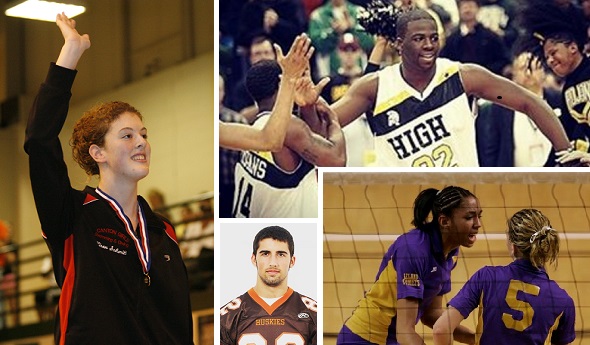
Draymond Green, Saginaw, 2008 – Green got a taste for championships in leading Saginaw to back-to-back Class A titles in 2007 and 2008 before starring for Michigan State University and now for the Golden State Warriors. He averaged nearly 10 minutes per game off the bench for the U.S. team, playing in all eight games during the undefeated gold medal march.
Women’s Swimming & Diving
Allison Schmitt, Canton, 2008 – Schmitt won the 200 and 500-yard freestyle championships at the Lower Peninsula Division 1 Finals in both 2006 and 2007 and continues to hold the all-Finals records in both events; she then went on to shine at University of Georgia. She helped the U.S. 800-meter freestyle relay to gold and the 400 freestyle relay to silver, bringing her personal medal count to eight over the last three Olympics.
Women’s Crew
Grace Latz, Jackson Northwest, 2006 – Latz played volleyball during her high school career at Northwest. She took up rowing at University of Wisconsin and helped her quadruple sculls team to a fifth-place finish in Rio.
Grace Luczak, Ann Arbor Pioneer, 2007 – Luczak also was a high school volleyball player and rowed on Pioneer’s team (although crew is not an MHSAA-sponsored tournament sport, some schools have teams) before going on to University of Michigan and then Stanford University. She finished fourth in the pair at Rio.
Ellen Tomek, Flint Powers Catholic, 2002 – Tomek played basketball and softball for the Chargers and also made the Olympics in 2008 after taking up rowing at Michigan. She finished in sixth place this time in doubles sculls after finishing fifth in Beijing.
Men’s Track & Field - Discus
Andrew Evans, Portage Northern, 2009 – Evans played football, ice hockey and participated in track & field for the Huskies, winning discus at the Lower Peninsula Division 1 Finals in 2008 and 2009. He finished 16th in qualifying at Rio, just missing the top 12 who advanced to the final competition.
Women’s Volleyball
Alisha Glass, Leland, 2007 – Glass remains arguably the top player in MHSAA volleyball history with records still for career kills, single-season aces and career aces (accomplished during the rally scoring era beginning in 2004). She led Leland to the Class D title in 2006 and then played at Penn State University – and this month set the U.S. team to a bronze medal in Rio.
Lauren Paolini, Saline, 2005 – Paolini was both a volleyball and basketball standout for Saline before moving on to the University of Texas. She served as an alternate for this Olympic team.
Additional Olympians with MHSAA ties
Cindy Ofili, Ann Arbor Huron, 2012, Great Britain – Ofili won three LP Division 1 championships and was on a winning relay in 2012 before going on to run at Michigan. She took fourth in the 100 hurdles in Rio.
Tiffany (Ofili) Porter, Ypsilanti, 2005, Great Britain – Porter still owns MHSAA LP Division 2 Finals records in the 100 and 300 hurdles and shares the record in long jump after winning six individual Finals championships over her four-year varsity career. Porter finished seventh in the 100 hurdles in Rio and also ran in the 2012 Olympics. She also attended Michigan.
Alex Rose, Ogemaw Heights, 2009, Samoa – Rose was the 2009 LP Division 2 champion in shot put before also competing at Central Michigan University. Like Evans, he also threw discus in Rio but did not qualify for the final with his top throw coming in 29th.
PHOTOS: (Clockwise from left): Allison Schmitt waves to the crowd during her last MHSAA Finals; Draymond Green is introduced before a Class A Final at the Breslin Center; Alisha Glass confers with a teammate during a Class D Volleyball Final; Portage Northern grad Andrew Evans.
Comerford, Cranes Repeat as D3 Champs
November 17, 2012
By Gary Kalahar
Special to Second Half
YPSILANTI – By the time she is finished with her high school career, perhaps Plainwell’s Mallory Comerford will be an MHSAA champion in all eight individual swimming races.
Sounds a bit far-fetched to be sure. But after Comerford’s performance Saturday in the MHSAA Lower Peninsula Division 3 meet at Eastern Michigan University, would anyone care to bet against her?
Comerford, a sophomore, made it four championships in four different races by winning the 200 freestyle and 500 freestyle in dominant, record-breaking fashion.
Bloomfield Hills Cranbrook-Kingswood used its outstanding depth – scoring at least 15 points in every race – to swim away with its second consecutive Division 3 team title. The Cranes scored 361 points, and Bloomfield Hills Lahser finished second with 211.
As a freshman, Comerford was the champ in the 50 freestyle and 100 freestyle. Plainwell coach John DuBois said with another excellent long-distance freestyler last year, Comerford was placed in the sprints to give the Trojans the potential for more points.
“So we trained her in sprints, but her love is distance,” DuBois said. “It wasn't a hard transition at all.”
It certainly didn't look like it, especially on the final weekend.
“I was real happy with how I did,” Comerford said. “I’m very excited. I felt smooth going in the water Friday, and it was the same way (Saturday).”
In the 200 freestyle, Comerford set the Division 3 record with a 1:50.92 in the preliminaries and lowered it to 1:48.07 to win the final by more than six seconds.
“In my heart, I thought she could go 1:48,” DuBois said. “But I didn't know it would be that easy. Easy as in the way she swam – it was so effortless. She was in a groove.”
Comerford’s 4:58.18 in the 500 freestyle preliminaries established a meet record. That one lasted about 24 hours, too, as she went out fast and never slowed down in a 4:53.14 final. She won by 13 seconds with a time that would have made her a winner at the day’s Division 1 or Division 2 Finals.
“That was a surprise to me,” Comerford said.
Ten minutes after that race, Comerford was back on the blocks for the anchor leg of the 200 freestyle relay, boosting the Trojans from sixth place to fourth.
“I had to be there for my team,” Comerford said. “I just had the belief that I was fresh and I could do it."
She brought Plainwell from seventh to fourth on the final leg of the 400 freestyle relay, but the Trojans were disqualified.
“I knew it would be tough, but it was definitely worth it,” Comerford said about switching her focus to the longer distances. “It was a lot more yardage, a lot tougher on your body to be prepared for the longer races. My coaches, John DuBois here and Jeff Russell with USA Swimming, have pushed me as hard as I could go. I couldn't do what I've done without them.”
DuBois, whose team finished fifth with 140 points, said Comerford’s willingness to swim the events where she could most help the team is representative of her attitude.
“She’s a phenomenal athlete, she has great character and she’s an unbelievable worker,” he said. “She obviously is gifted, and we’re lucky to have her at Plainwell. She’s been a model academically and athletically. She’s all the things coaches love to have.”
Another thing all coaches would love to have is the depth of Bloomfield Hills Cranbrook-Kingswood rode to the team title. The Cranes had no divers but had girls swimming in every final race. In nine of the 11 events, they scored at least 23 points.
“A lot of it goes to the competition that we started with the first day of practice,” first-year Cranbrook-Kingswood coach Chris Bagley said. “It’s unbelievable to think about how deep we are.”
Senior Kylie Powrie swam on teams that finished second in Division 3 her freshman and sophomore years and won titles the last two.
“It’s amazing,” Powrie said. “Our team has come so far. We've improved so much over the years. I never would have thought this was possible my freshman year. When I started, it was hard for us to fill up all the events.”
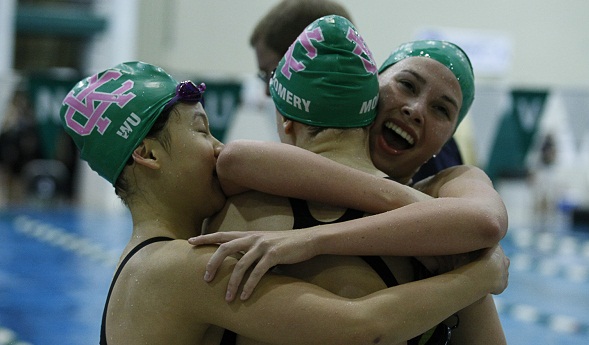
Powrie, the 2011 champion in the two races won by Comerford this year, finished her career by helping the 200 freestyle and 400 freestyle relay teams to victory, the latter in a Division 3-record 3:33.63.
“We just wanted our team record, and we got it and got the state record,” Powrie said.
Lara Kokubo was Cranbrook-Kingswood’s lone individual champion, winning the 100 freestyle. She also swam on the two winning relay teams.
“We knew we were going to have high expectations, but to do what we did, the way we did it, is just unbelievable,” Bagley said. “We set our goals at the beginning of the year, and we never talked about winning a state title. We talked about being the most improved team in the state, and I think we did that.”
Ines Charles led runner-up Bloomfield Hills Lahser. She repeated as champion in the 100 backstroke, helped her 200 medley relay team to a second straight title and finished second in the 100 butterfly.
PHOTO: Members of the Cranbrook-Kingswood 400-yard freestyle relay team celebrate their LP Division 3 Final record time Saturday. (Click to see more from HighSchoolSportsScene.com.)