


MHSA(Q&)A: St. Johns wrestling coach Zane Ballard
March 4, 2012
 This weekend had to resemble, at least slightly, a typical dual match for St. Johns coach Zane Ballard – except he was at The Palace of Auburn Hills for the MHSAA Individual Wrestling Finals.
But with 13 qualifiers, Ballard guided all but one of his regular line-up at some point over the tournament’s three days. Seven Redwings won championships and two more finished runners-up, just more reminders of how his program has evolved over the last four seasons from solid to arguably the state’s strongest.
St. Johns was 59-51 in the four seasons before these seniors entered high school. The Redwings finished 121-7 during their four-year run and won a third-straight MHSAA Division 2 team title Feb. 25. They haven’t lost to an in-state opponent since 2010. And four of those champions -- plus three more Finals placers -- should be back next season.
Second Half caught up with Ballard on Saturday after one final podium appearance – and the placing of one last medal around the neck of four-time undefeated champion Taylor Massa.
Did you ever imagine you’d have almost your entire line-up at the Individual Finals?
I never envisioned it in the past. But this year, I knew it was possible to do it. This is one of those tournaments, it’s so tough. It’s grueling. … To pull that all together to get nine guys to the Finals, that’s unimaginable. Everything has to go right.
How has coaching changed for you in the last four years, as opposed to first four of five at St. Johns?
It’s like an almost entirely different job. I’ve grown as much or more as any of the wrestlers have. Before four years ago, we had a middle school program but they came in pretty fresh wrestlers. The last four years, kids have been coming in with the capabilities to win a state championship right off the bat.
Is it more fun to coach now, or just different?
Winning’s fun. But it’s different. You’ve got to train them. You’ve got to keep them focused. You have to create workouts for them to keep their attention. They might think they have an easy weekend, and you have to keep them focused. And there’s a lot that plays into it behind the scenes than just the training part.
How do you guys improve on this? How do you keep them coming back for more?
It’s cliché, but we’ll take it one year at a time. We’ll come back next year and have a great showing and do whatever we can to get back. It’s not going to be for lack of training, because if I know these guys, probably most of them will work out tomorrow. They’re ready to go.

Greer, Tri-County Aim for Big 2016 Finish
January 1, 2016
By Dean Holzwarth
Special for Second Half
HOWARD CITY – Tri-County High School sophomore Dakota Greer remembers being soundly beaten by teammate Nick McGhan throughout their childhood.
 The two began wrestling together before they could barely write their own names. McGhan always would have the upper hand on the mat over his younger friend.
“He was way better than me when we were little,” Greer said, “but him beating up on me made me better.”
As the years passed, they continued to grapple on a daily basis. Greer quickly improved. The matches became more even.
“It got to the point where we were wrestling nose-to-nose,” Greer said. “We made each other better.”
Greer and McGhan became high school teammates for the first time last season, and both made their marks on the biggest stage at The Palace of Auburn Hills.
Greer became the first freshman in school history to win an MHSAA Individual Final when he defeated Corunna’s Emilio Campos 9-6 in the Division 3 championship match at 103 pounds.
Meanwhile, McGhan, a junior last season, lost in the semifinals at 112 pounds before recovering to take third place.
“It felt really good to be the first freshmen in school history to do that,” said Greer, who started wrestling when he was 4 and was inspired by his talented older twin cousins, former Carson City-Crystal standouts Darren and Dillen Decker.
“I always had big goals, and at the beginning I knew I had a little bit of a chance. But it wasn’t till later on when I realized I could do it.”
Greer finished the season with a 42-1 record, although he never really lost a match.
Midway through the season, Greer had appendix surgery and was forced to miss a few matches. During one dual meet, his coaches put him in the lineup thinking the other team would void at that weight.
Instead, the opposing coach opted to place a wrestler in the match. Greer lost on an injury default since he was unable to wrestle.
“Coach still called me undefeated,” Greer said.
Tri-County wrestling coach Corey Renner, in his 10th season, said he wasn’t surprised by Greer’s rare feat. He had been standing by patiently for the time when Greer could showcase his abilities at the high school level.
“I’ve known him since fifth or sixth grade, and we’ve just been waiting for him to get to high school,” Renner said. “He beat a kid from Shelby early in the year, who at the time was the favorite to win it. He beat him pretty handily, and at that point I knew he could probably win it.
 “You never know, though. Kids can get hurt or sick, and strange things can happen, but I felt like if everything went the way it should then he could win it. He’s dedicated, and he just does everything you ask and more.”
Greer and McGhan have returned for one more season together and are currently leading the 9th-ranked team in Division 3.
The Vikings entered this week’s Grandville Invitational with a perfect 9-0 mark, which included a win at Tri-County’s team invitational.
They also placed third at the Chippewa Hills individual tourney.
Greer has picked up where he left off. He currently owns an unblemished 11-0 record while moving up to 119 pounds.
“I still have a lot of goals I want to reach,” Greer said.
Tri-County hasn’t reached the MHSAA Team Quarterfinals since 2003, but this year’s team has the potential to break the dry spell with the return of several starters.
“This is the best team we’ve had in a long time,” Renner said. “We still have some holes to fill, but when we get everyone healthy and ready to go then we will be really tough.
“Whitehall is in our Regional, and they’re really good every year, but I think we can compete with them if we can get everybody where they need to be. We can give them a run for their money, that’s for sure.”
Greer also likes this year’s group, and has high hopes for the rest of the season.
“We lost a couple good kids, but we still have a lot of good juniors and seniors and a couple freshmen and sophomores who are doing really good,” Greer said. “We have good kids all the way through so we should be strong for a while.”
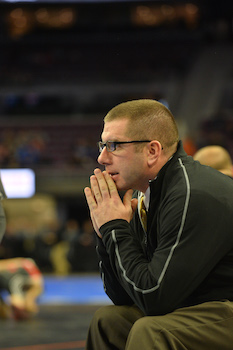
PHOTOS: (Top) Howard City Tri-County's Dakota Greer prepares to take a shot during last season's Division 3 championship match at 103 pounds. (Middle) Tri-County coach Corey Renner is in his 10th season leading the program. (Click for more photos from HighSchoolSportsScene.com.)