


Wrestling’s Next Big Thing
August 13, 2013
“The next big thing” is what marketers often seek. But it’s what school sports administrators usually dread because the “next big thing” is routinely a problem.
And so it is with the sport of wrestling which, at the high school level, has had an admirable record of solving the big issues that have threatened the sport’s existence.
School-based wrestling addressed unhealthy practices for weight loss, first with rules about what could not be done – e.g., rubber suits were banned from practices – and then with rules about what must be done, including a weight management program.
Twenty years ago, MHSAA member schools became one of the early adopters of policies and procedures that include the training of skinfold assessors who are employed to do measurements of all wrestlers, from which each wrestler learns his/her lowest allowed weight and the rate at which he/she may descend to that weight and still remain eligible to compete. These rules, and a nutrition education program, saved interscholastic wrestling from much public criticism and, possibly, from continuing drops in participation.
In addition, the Wrestling Committee has been unique among MHSAA sport committees in recognizing that a season that is too long is neither healthy for nor desired by student-athletes; and the committee has reduced the length of season and number of matches. All of this, combined with the MHSAA team tournament, have greatly increased the sport’s popularity among both participants and spectators.
But in spite of all this, the sport of wrestling is “one communicable skin disease outbreak from extinction,” according to those discussing the state of high school wrestling at a national meeting in June. We’ve already seen an outbreak lead to the suspension of all interscholastic wrestling for two weeks in Minnesota during the 2006-07 school year.
To avoid this next big thing, the rule makers have banned taped headgear, because tape can’t be properly cleaned. The NFHS Sports Medicine Advisory Committee, which is the MHSAA’s advisory body as well, is urging schools to mandate that all participants shower or perform an antiseptic wipe-down after every match.
The MHSAA will make this issue a point of special emphasis in its online, print and face-to-face communications this fall. In addition, an excellent free webinar is provided by the National Wrestling Coaches Association. Click here for the webinar.
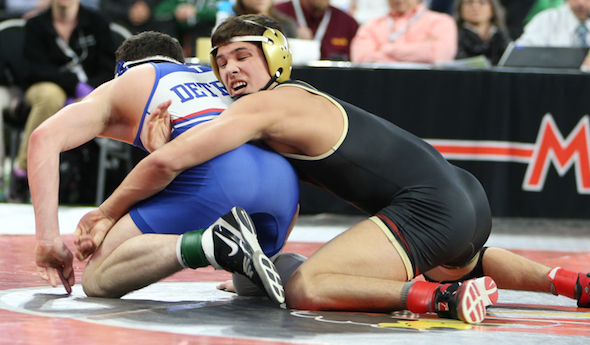
Freshman Facundo Starts Title March
March 3, 2018
By Jeff Chaney
Special for Second Half
DETROIT – Alex Facundo knew the wrestler and the impressive wrestling resume he had in front of him.
But that didn't faze the Davison freshman.
Facundo, who came in with a pretty impressive youth resume of his own, and a top-10 national ranking, won one of the most anticipated matches of the weekend at the MHSAA Individual Finals at Ford Field when he beat Detroit Catholic Central two-time champion Cameron Amine, 4-2, in their Division 1 152-pound title match Saturday evening.
"He was a two-time state champ, so he was pretty good, but look at my stuff," said Facundo, who ended his freshman season with an umblemished 29-0 record. "I love the underdog role. I had nothing to lose out there. I was a freshman coming in wrestling a junior, a two-time state champ, so I just went out and had fun."
Facundo showed talent on his feet, and scored the lone takedown of the match.
"The key were my shots," said Facundo, who ended his year with a 29-0 record. "He tried to be a bully, pushing me around and stuff, so I had to become a bully, too."
Amine ended his year at 43-3.
103
Champion: Brock Prater, Macomb Dakota, Soph. (51-3)
Decision, 8-2, over Blake Noonan, Rochester Hills Stoney Creek, Soph. (46-1)
The Macomb Dakota wrestling program has molded many talented wrestlers in the recent past, but none were able to win that elusive title.
That was until Prater beat Noonan 8-2 in their title match.
"I have never felt this way before," said Prater after his win. "I won five MYWAY state titles, but that never really felt this good. I'm really kind of speechless. I have been working for this all year long. There were a lot of time where I wanted to give up, but I stuck with it."
112
Champion: Andrew Chambal, Davison, Soph. (35-3)
Decision, 7-1, over Nick Alayan, Macomb Dakota, Jr. (49-2)
Last weekend at the MHSAA Team Finals in Kalamazoo, Chambal had a rough weekend, bumping up a weight and losing two matches.
But he came back strong this weekend, winning all four of his matches and taking home the 112-pound title.
"I was wrestling up a weight class last weekend, but I was also doing it to get better," Chambal said. "I learned from my losses, and I worked harder this week. (I was) more crisp on my shots."
119
Champion: Benyamin Kamali, Detroit Catholic Central, Sr. (35-1)
Decision, 9-4, over Mark Brado, Waterford Kettering, Jr. (44-6)
It's on to the University of Virginia for Kamali, who ended his highly successful high school career by winning his third championship.
"This is special, you know," Kamali said. "To be mentioned with all of the other three-timers, that's special. It proves that all the hard work that I have put in has paid off. It feels great. I wrestled my match.
"I'm excited to bring this momentum to the Division I level," Kamali added. "I want to wrestle the same way there. I want to dominate."
125
Champion: Michael Mars, Westland John Glenn, Sr. (52-0)
Decision, 5-1, over Kyle Kantola, Hartland, Jr. (55-2)
Mars is his own harsh critic.
The Westland John Glenn senior had just won his third title Saturday evening with a hard-fought 5-1 win over Kantola, but didn't like how he performed – showing a mentality that no doubt contributed to his becoming a multi-year champion.
"I feel good, but I wish I did better in that finals match," Mars said. "I won, so I am proud of it. I thought I wrestled pretty good this year, so I am proud of that, too. I just wish I could have wrestled better in that finals match."
130
Champion: Joshua Edmond, Detroit Catholic Central, Soph. (24-0)
Decision, 7-4, over Jared Riggins, Jackson, Jr. (35-3)
Two highly athletic and talented wrestlers took to the mat during the 130-pound final, and the Detroit Catholic Central sophomore showed he had just a little more in his tank while also going back to the basics.
"I just needed to stay on pace and keep in good position," Edmond said. "Also hand fighting, I knew I needed to stay in good position and keep hand fighting. It was stuff like that, staying to the basics."
135
Champion: Derek Gilcher, Detroit Catholic Central, Soph. (39-5)
Decision, 8-5, over Sergio Borg, Oxford, Sr. (46-6)
Not many times was a Detroit Catholic Central wrestler considered an underdog this weekend.
That may have been the case in the 135-pound final.
But Gilcher showed just how much he has learned in the DCC practice room, as he pressured his way into an 8-5 win and his first title.
"I feel very excited with how I performed," Gilcher said. "I just didn't let off the whole time. I always try and keep constant pressure, and that's what gave me the win."
140
Champion: Nick Freeman, Walled Lake Central, Sr. (29-0)
Decision, 2-0, over Anthony Gibson, Westland John Glenn, Sr. (51-5)
Winning MHSAA titles is a Freeman family tradition.
One year after his older brother Ben Freeman won his fourth MHSAA championship for Walled Lake Central, senior Nick Freeman won his second.
"We are competitive, and we like to win," Nick Freeman said of his family. "Every single competition we enter, we give it our all. If that doesn't work out, whatever."
It has worked out the past five years for the Freeman family.
145
Champion: Kevon Davenport, Detroit Catholic Central, Jr. (41-3)
Decision, 7-1, over Vic Schoenherr, Bay City Western, Jr. (47-3)
Just like last week at the Team Finals, when Detroit Catholic Central gets on a roll, it's hard to stop.
That was the case Saturday at Ford Field, as Davenport was the fourth straight Shamrock to win a championship, claiming his third with a decisive 7-1 win over Schoenherr.
"This feels great," Davenport said. "To follow suit with the rest of my teammates. We already had three guys that won, and I wanted to do whatever it took to keep that momentum going."
160
Champion: William Marano, Dearborn Edsel Ford, Sr. (56-0)
Decision, 10-5, over River Shettler, Hartland, Jr. (44-4)
Edsel Ford senior Marano did something Saturday that hadn't been accomplished in 33 years.
He won an MHSAA wrestling title for his school.
"The last state champ at the school was in 1985; it was Scott Wyka," Marano said. "He was a heavyweight, and he was up in the stands. I had a lot of friends and family here for my support, and this feels so amazing."
And he left little doubt.
"All season I wanted this like no on else," Marano said. "I just kept the pressure on and kept moving out there."
171
Champion: Layne Malczewski, Macomb Dakota, Sr. (54-0)
Decision, 5-0, over Cal Stefanko, Davison, Jr. (40-4)
The fourth time was the charm for Malczewski
This weekend was his fourth trip to the Finals. In his three previous three, he came home with medals, but not that elusive championship.
"Those years in the past helped me for this year," Malczewski said. "Obviously I have been working hard, but this summer I put extra time in, and that helped out."
189
Champion: Benjamin Cushman, Flushing, Sr. (53-0)
Major Decision, 16-5, over Jacob Ransom, Traverse City West, Sr. (44-6)
Not many times in the upper weight divisions do you see a wrestler drop down a weight class to compete. Most of the time, a body's growth dictates that the big men keep growing.
That wasn't the case for Cushman, who won a Division 1 title at 215 pounds last year, then came back this year and won at 189.
"We kind of flip a coin every year, and last year Coach wanted me to go 215 pounds, so I did it," Cushman said. "And this year it didn't matter as much, so we decided I go 189 pounds."
Asked which title was harder to win, there was no hesitating.
"Two hundred and 15 pounds, they were bigger," Cushman said.
215
Champion: Easton Turner, Detroit Catholic Central, Jr. (36-1)
Fall, 5:28, over Blake Wingate, Temperance Bedford, Jr. (41-9)
Sacrifice is a regular part of wrestling.
This past fall, Turner gave up football to concentrate on his winter sport – and won his first MHSAA Finals championship.
"All the extra work I put in after practice, and not playing football to put in extra work, it all paid off in the end,” Turner said.
285
Champion: Austin Emerson, Temperance Bedford, Sr. (48-3)
Decision, 5-1, over Steven Kolcheff, Detroit Catholic Central, Soph. (31-8)
Last season, Emerson lost at the Finals to a Detroit Catholic Central wrestler.
He wasn't going to let that happen again.
A year after dropping a heart-wrenching 3-2 loss to the Shamrocks’ Nicholas Jenkins, Emerson beat DCC sophomore Kolcheff 5-1.
"I just kept working on repetitions on what I was drilling, putting myself in situations," Emerson said. "And I also blew my lungs out, really working on my conditioning. That really helped me this year."
PHOTO: Davison freshman Alex Facundo locks up Detroit Catholic Central’s Cameron Amine on the way to claiming his first Division 1 title. (Click for more from HighSchoolSportsScene.com.)