


Wrestling’s Next Big Thing
August 13, 2013
“The next big thing” is what marketers often seek. But it’s what school sports administrators usually dread because the “next big thing” is routinely a problem.
And so it is with the sport of wrestling which, at the high school level, has had an admirable record of solving the big issues that have threatened the sport’s existence.
School-based wrestling addressed unhealthy practices for weight loss, first with rules about what could not be done – e.g., rubber suits were banned from practices – and then with rules about what must be done, including a weight management program.
Twenty years ago, MHSAA member schools became one of the early adopters of policies and procedures that include the training of skinfold assessors who are employed to do measurements of all wrestlers, from which each wrestler learns his/her lowest allowed weight and the rate at which he/she may descend to that weight and still remain eligible to compete. These rules, and a nutrition education program, saved interscholastic wrestling from much public criticism and, possibly, from continuing drops in participation.
In addition, the Wrestling Committee has been unique among MHSAA sport committees in recognizing that a season that is too long is neither healthy for nor desired by student-athletes; and the committee has reduced the length of season and number of matches. All of this, combined with the MHSAA team tournament, have greatly increased the sport’s popularity among both participants and spectators.
But in spite of all this, the sport of wrestling is “one communicable skin disease outbreak from extinction,” according to those discussing the state of high school wrestling at a national meeting in June. We’ve already seen an outbreak lead to the suspension of all interscholastic wrestling for two weeks in Minnesota during the 2006-07 school year.
To avoid this next big thing, the rule makers have banned taped headgear, because tape can’t be properly cleaned. The NFHS Sports Medicine Advisory Committee, which is the MHSAA’s advisory body as well, is urging schools to mandate that all participants shower or perform an antiseptic wipe-down after every match.
The MHSAA will make this issue a point of special emphasis in its online, print and face-to-face communications this fall. In addition, an excellent free webinar is provided by the National Wrestling Coaches Association. Click here for the webinar.
Preview: Hundreds of Hopefuls, 56 Champs
March 1, 2018
By Geoff Kimmerly
Second Half editor
A total of 23 reigning champions will return to this weekend’s MHSAA Individual Finals, and all 56 who will be crowned will be celebrated by their schools and communities.
But as is often true on this biggest stage, the crowd’s focus will turn nearly in full when a pair of contenders take to the mats one last time at the high school level.
Dundee’s Brandon Whitman and Lake Fenton’s Jarrett Trombley will be among hundreds of hopefuls at Ford Field for the start of the two-day competition Friday. They also are the only two this season who can join 22 others as four-time Finals champions.
Below, we look at 10 contenders to watch in every division, plus list everyone who finished at least as a runner-up in 2017 and all of the top seeds heading into this weekend. Even then, we surely missed a few who will end up rising to the top of the podium Saturday – but come back to Second Half early Sunday as we’ll interview and report on all 56 champions.
The “Grand March” on Friday begins at 11:45 a.m., with five rounds wrestled throughout the day including the semifinals at 7:30 p.m. Wrestling picks back up with consolation rounds at 9 a.m. Saturday, and concludes with the championship matches that afternoon at 3 p.m.
Follow all matches on a subscription basis live on MHSAA.tv, and click here for results at MHSAA.com.
Division 1
112: Nick Alayan, Macomb Dakota junior (46-1) – He just missed winning the 103 championship last season, falling 4-3 in the title match, but enters this weekend as the top seed at 112.
119: Benyamin Kamali, Detroit Catholic Central senior (31-1) – Kamali is looking to finish his career with a third individual title after winning 103 as a sophomore and 112 last winter, and he’s the top seed again this weekend.
125: Michael Mars, Westland John Glenn senior (49-0) – The top-seeded Mars also is working for a third individual title after winning 103 as a freshman and 112 as a sophomore but finishing runner-up at 119 last year; he’s 208-8 over his career.
140: Nick Freeman, Walled Lake Central senior (25-0) – While brother Ben Freeman was winning his fourth individual championship last season, Nick was locking down his first at 125; now he’s a combined 60-1 over the last two seasons and the top seed at 140.
145: Kevon Davenport, Detroit Catholic Central junior (37-3) – The top seed at 145 won 119 as a freshman and 130 last year, and is a combined 127-9 over his first three seasons so far.
152: Cameron Amine, Detroit Catholic Central junior (40-2) – Amine also is looking to add a third title after winning 125 as a freshman and 145 last year, and enters as the top seed at 152 with a 124-14 career record.
160: William Marano, Dearborn Edsel Ford senior (51-0) – The top seed at 160 just missed his first championship last year losing a 6-4 decision at this weight; he also placed at the Finals as a freshman and sophomore and is 204-13 entering this weekend.
171: Layne Malczewski, Macomb Dakota senior (51-0) – Malczewski will try to add a first individual title after placing third twice and fourth once over his first three seasons; he’s the top seed at 171 and enters with a career record of 217-22.
189: Benjamin Cushman, Flushing senior (49-0) – The top seed at 189 was last season’s champ at 215 and is a combined 105-0 over the last two winters.
285: Austin Emerson, Temperance Bedford senior (44-3) – Two of the top seed’s losses were to Dundee three-time champ Brandon Whitman; Emerson was the runner-up at 285 last season and he’s 93-5 combined over the last two.
Other 2017 runners-up: 130 Joshua Edmond, Detroit Catholic Central sophomore (20-0, 135 in Division 2 in 2017 wrestling for Orchard Lake St. Mary's); 140 Anthony Gibson, Westland John Glenn senior (46-4, 135 in 2017).
Additional No. 1 seeds: 103 Blake Noonan, Rochester Hills Stoney Creek sophomore (43-0); 130 Joshua Edmond, Detroit Catholic Central sophomore (20-0); 135 Derek Gilcher, Detroit Catholic Central sophomore (35-5); 215 Easton Turner, Detroit Catholic Central junior (35-1).
Also undefeated: 135 Isiah Berry, Southfield Arts & Technology senior (44-0); 152 Alex Facundo, Davison freshman (27-0); 189 Chris Hackney, Fraser senior (18-0).
Division 2
103: Riley Bettich, Stevensville Lakeshore sophomore (39-2) – Last season’s runner-up at this weight lost in sudden victory to Chayse LaJoie (see below) but will come back this weekend as the top seed.
112: Chayse LaJoie, Gaylord sophomore (42-4) – He’s following his graduated brother Dominic’s three titles by going for a second straight after winning 103 last year; he sits at 94-7 over his first two and is seeded first at this weight.
119: Austin Franco, Niles senior (40-0) – Franco is hoping to add a championship to runner-up finishes at 119 last season and 112 as a freshman (and a third place at 112 as a sophomore); he’s 160-5 for his career and a top seed.
125: Chaise Mayer, Warren Woods Tower junior (47-1) – Mayer has finished runner-up at 103 and 112 the last two seasons, respectively, but is the top seed at 125 with a 148-10 career record.
130: Branson Proudlock, Gibraltar Carlson senior (42-1) – A fourth-place finisher at 103 as a freshman, runner-up at 112 as a sophomore and champ at 119 as a junior, he’s top-seeded at 130 and brings a 196-7 record into his final weekend as a high school competitor.
135: Corbyn Munson, Chelsea senior (50-0) – Last season’s runner-up at 125 is 102-3 over the last two seasons and a top seed this weekend.
145: Austin Boone, Lowell sophomore (40-1) – Boone is 80-4 over the last two seasons and the top seed at this weight after winning 135 a year ago over DCC’s Edmond (see above).
152: Alec Rees, Sparta junior (43-0) – Rees is another top seed, coming off a runner-up finish at 145 last season after losing a tie-breaker to Austin O’Hearon (see below) in the championship match; that was his only loss of the last two seasons, and he’s 138-6 over his career.
160: Austin O’Hearon, Eaton Rapids senior (43-1) – The top-seeded O’Hearon will try to add one more title to last season’s exciting win and has placed all three years of high school in building a 180-20 career record.
160: Dustin Gross, Dearborn Heights Annapolis senior (55-0) – A three-time placer and two-time runner-up, Gross is on the opposite side of the 160 bracket from O’Hearon as he seeks his first title and to add to a 211-12 career record.
Additional No. 1 seeds: 140 James Whitaker, St. Johns junior (35-1); 171 Ryan Ringler, Cedar Springs junior (49-1); 189 Drake Pauwels, New Boston Huron senior (46-0); 215 Tyler Moore, Three Rivers senior (53-2); 285 Tyler Hill, Stevensville Lakeshore senior (35-2).
Also undefeated: 112 Vincent Perez, Tecumseh junior (50-0).
Division 3
103: Hunter Assenmacher, Ida sophomore (49-0) – Last season’s runner-up at this weight is now the top seed and hasn’t lost again since falling to Sean Spidle (below) by 7-3 decision in that championship match.
112: Sean Spidle, Flint Powers Catholic sophomore (36-3) – Spidle won the matchup of freshmen over Assenmacher to claim last year’s title at 103 and now enters as the top seed at 112.
125: Dakota Greer, Howard City Tri-County senior (39-2) – Top-seeded Greer is looking to finish his career with a third championship after winning 103 as a freshman, failing to advance as a sophomore because of an injury but then coming back to win at 119 a year ago.
130: Jarrett Trombley, Lake Fenton senior (55-0) – Trombley is another top seed and looking to add this title to the others won at 112, 119 and 130 his first three seasons; he enters the weekend with a 191-1 record and hasn’t lost since freshman year.
130: Mitchel Christensen, Essexville Garber junior (49-2) – Anyone in Trombley’s bracket has an uphill battle, but Christensen is among the most capable for climbing it after winning the title at 112 last year.
145: Sean Trombley, Lake Fenton junior (45-1) – In addition to being Jarrett’s brother, Sean Trombley placed at 135 as a freshman and was the runner-up at 140 last season before earning the top seed at this weight this weekend.
152: Zachary Bellaire, Dundee senior (39-7) – Bellaire won the 140 championship last season in a decision over Sean Trombley and enters with a top seed and 77-12 record over the last two winters.
160: Tylor Orrison, Dundee senior (41-3) – Orrison is hoping to close with a title at 160 to go with his championship won last season at 145 and top-six placings as a freshman and sophomore; he’s 160-32 for his career.
215: Brandon Whitman, Dundee senior (43-0) – Whitman will go after his fourth title as a top seed and carrying a 193-2 career record; his first three championships came at 189 twice and 171.
285: Tyler Marino, Richmond senior (27-5) – Marino will enter his last Finals as a top seed after coming in runner-up at 215 a year ago; he’s 74-11 over the last two.
Other 2017 runners-up: 215 Colton McKiernan, Richmond senior (37-2, 189 in 2017).
Additional No. 1 seeds: 119 Noah Cantu, Hart junior (47-0); 135 Stoney Buell, Dundee freshman (39-4); 140 Matthew Lipka, Montague senior (46-1); 160 Gavin Morgan, Mount Morris sophomore (39-0); 171 Owen Guilford, Portland junior (36-1); 189 Ethan Weatherspoon, Napoleon junior (50-0).
Also undefeated: 103 Robbie Altland, Hart junior (48-0); 130 Adam Bruce, Gladstone junior (39-0); 189 Jamane Smith, Coloma senior (44-0), 215 Joe Nagle, Comstock Park senior (49-0).
Division 4
112: Reese Fry, Manchester senior (52-1) – Fry is the top seed at 112 after winning 103 last season and also finishing runner-up at that weight as a sophomore; he’s 147-9 over the last three seasons.
125: Noah Comar, Clinton junior (54-2) – Comar is a repeat top seed after winning at 112 last season and finishing runner-up at that weight as a freshman; he’s 160-6 over his first three seasons.
130: Jordan Hamdan, Hudson junior (48-0) – The top seed at 130 won 119 last year and 112 as a freshman and enters 147-8 for his career.
130: Robert Rogers, Burton Bentley senior (37-2) – Rogers is the reigning champ at 130 and won 125 as a sophomore; he enters his final weekend of high school competition 172-8 for his career.
135: Skyler Crespo, Mendon sophomore (51-1) – The top seed at this weight won last year at 125 against a 2016 individual champion; Crespo is 107-2 for his career so far.
145: Jayce Kuehnlein, St. Louis senior (41-3) – Last season’s runner-up at 135 is the top seed at 145 and also placed as a sophomore; he’s 135-17 over the last three years.
152: Gerrit Yates, Hesperia senior (35-5) – The top seed at 152, Yates is the reigning champ and also finished runner-up as a freshman (135) and sophomore (145); he’s 176-15 entering his final high school tournament.
160: Zach Young, Hesperia senior (47-0) – Young has made a jump in his final season from third place at 140 last year to the top seed at this weight and hasn’t lost since falling in last season’s semifinal.
160: Zack Menck, Lawton senior (51-2) – Menck was the runner-up at 152 last season and also a placer as a sophomore; he’s 149-13 over the last three winters.
215: Eric Cassiday, Beaverton senior (44-1) – Eric is the oldest of three Cassiday brothers who will compete this weekend and enters as the top seed at 215; he placed sixth at 189 last season.
Other 2017 runners-up: 119 Jamison Ward, Carson City-Crystal sophomore (48-1, 103 in 2017); 140 Nick Felt, Shelby junior (47-4, 130 in 2017); 145 Braxton Seida, Carson City-Crystal junior (45-3, 140 in 2017).
Additional No. 1 seeds: 103 AJ Baxter, Clinton freshman (51-2); 119 Khalil Moten, Flint Beecher junior (37-2); 140 Austin Wolford, New Lothrop junior (48-2); 152 Jake Davis, St. Louis senior (40-3); 171 Wyatt Cool, Mendon senior (49-2); 189 Kyle Cassiday, Beaverton junior (52-1); 285 Jackson Schenk, Mayville senior (44-2).
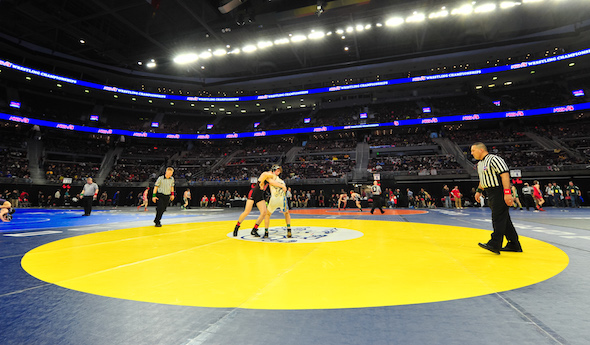
PHOTO: Wrestlers square off during the 2015 Individual Finals at The Palace of Auburn Hills. (Click for more from HighSchoolSportsScene.com.)