


High 5s: 11/28/12
November 28, 2012
The final MHSAA championships of the Fall 2012 season give us our final High 5s before heading into winter. This week, we recognize both an individual and a team that achieved new heights.
 Drake Harris
Grand Rapids Christian junior
Football
A 6-foot-4, 180-pound receiver who has committed to play both football and basketball at Michigan State beginning in 2014, Harris posted one of the finest receiving season in MHSAA history capped by playing a huge role in his team's first MHSAA championship. The Eagles beat Orchard Lake St. Mary's 40-37 in overtime Saturday for the Division 3 title. His eight catches for a Finals-record 243 yards and a touchdown put his unofficial season totals at 91 catches for 2,015 yards and 25 scores. Once confirmed, the season yardage will rank as the most in MHSAA history and 12th nationally for one season (his yards per game rank fourth and yards per catch sixth on the NFHS lists). Harris also ranked fourth for catches and second for touchdown catches on the MHSAA single-season lists.
Just ducky: "I'm probably more energized now after he hit that kick," Harris said after teammate Joel Schipper's winning field goal Saturday. "I was probably more tired a little bit during the game. But we condition all practice. We play fast. We play like Oregon, move the ball, (at) a high tempo. We're all in condition, so we really weren't that tired."
Bring on the new guy: Harris has caught more than 3,000 yards worth of passes from senior Alex VanDeVusse over the last two seasons, but will play with a new quarterback in 2013. "I've been with Alex since sophomore year. I guess I have to start over and work hard all next season and hope to get back here."
Be like Calvin: "Calvin Johnson, I want to be just like him when I get older. I know I'm a little skinny right now, but when I get to college, I know they'll put weight on me. I watch film on him all the time, watch him running routes. So I take my game after him. He's the best wide receiver in the NFL right now, probably one of the best wide receivers to play the game, in my opinion."
 Portland football
The Raiders, unranked despite entering the postseason 8-1, finished with their first MHSAA title won in their first trip to the Finals. Portland defeated Grand Rapids West Catholic 12-9 in the Division 5 championship game after knocking out 2011 champion Flint Powers Catholic in the Regional Final. For the playoffs, Portland outscored its five opponents 169-66 while holding three to nine or fewer points. In finishing 13-1 and setting a school record for wins, the Raiders beat nine playoff teams total including eventual Division 3 Semifinalist DeWitt.
Previous 2012-13 honorees:
- Julia Bos, Grand Rapids Christian cross country - Click for more
- Morgan Bullock, Zeeland swimming - Click for more
- Nathan Burnand, Waterford Mott cross country - Click for more
- Aaron Chatfield, Burt Lake Northern Michigan Christian soccer - Click for more
- Erin Finn, West Bloomfield cross country - Click for more
- Alex Grace, Saginaw Swan Valley football - Click for more
- Billy Heckman, Portage Central tennis - Click for more
- Codi Jenshak, Escanaba tennis - Click for more
- Amanda McKinzie, Battle Creek St. Philip cross country - Click for more
- Connor Mora, Cedar Springs cross country - Click for more
- Kelsey Murphy, Plymouth golf - Click for more
- Dewey Lewis, Rockford soccer - Click for more
- Nick Raymond, Erie Mason cross country - Click for more
- Jacqueline Setas, Lansing Catholic golf - Click for more
- Michael Sienko, Williamston tennis - Click for more
- Carli Snyder, Macomb Dakota volleyball - Click for more
- Beal City volleyball - Click for more
- East Kentwood soccer - Click for more
- Flint Beecher football - Click for more
- Grand Blanc boys soccer - Click for more
- Holland girls swimming and diving - Click for more
- Ithaca football - Click for more
- Lansing Everett football - Click for more
- Ludington boys tennis - Click for more
- Muskegon Mona Shores girls golf - Click for more
Workout Basics: Warm-Ups & Cool-Downs
February 3, 2021

By Nick Parkinson, M.Ed., AT, ATC, TSAC-F
Henry Ford Health Systems
You may know a good warm-up — and cool-down — are essential to getting a good workout. You may also know that warming up your muscles and stretching them out after exercise can help prevent injury and keep you at the top of your game.
They’re the two bookends that help maximize a workout. Unfortunately, a lot of exercise enthusiasts don’t know how to warm up and cool down correctly.
Warm-Up Basics
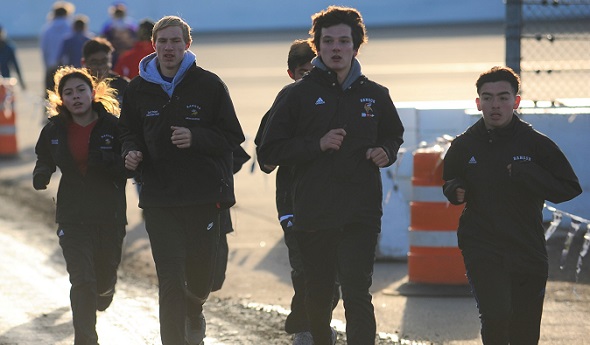
A warm-up is exactly what it sounds like: The goal is to warm up your muscles and prepare your body for whatever you’re asking it to do. Warming up increases your body temperature and helps blood flow to the muscles that you’re using.
So if you’re going to play soccer, your warm-up should touch all of the muscles in your legs and core. Shooting hoops? You’ll need to add shoulders and arms to your routine. Circuit training at the gym? Choose a warm-up that flexes all of the muscles you’re about to use.
The thing that all warm-ups have in common is that they require dynamic (or constantly moving) motion, not static stretching (holding poses for a certain amount of time). In fact, static stretching prior to a workout can inhibit power and strength, especially if you’re doing something like weightlifting.
The anatomy of a solid warm-up:
• Before any activity, do about 10 minutes of light cardiovascular activity, whether walking, biking or jogging.
• Dynamic stretches. After you get your muscles moving, do a series of lunges, jumping jacks or toe touches to stretch a bit.
• Dive in. When you start your workout, begin slowly and gradually increase power and speed.
Cool-Down Basics
After you’ve put your body through a challenge, a good cool-down is essential. It helps slow down your heart rate gradually, relax your muscles and stretch them out.
Cool-down routines should always include some type of motion before you get to static stretching, especially if you’ve just finished a high-intensity workout. Static stretching improves flexibility and performance and it can also help stave off future injury.
As with warm-ups, the right cool-down exercises depend on the activity you engaged in. If you biked for 20 miles, you might coast on your cycle for a while before coming to a stop. If you ran, you might jog or walk before you begin stretching. As with your warm-up, the key is addressing every muscle group you worked during your workout.
The anatomy of a solid cool-down:
• At the end of your workout, slow the pace and intensity of whatever activity you’re doing. So, if you’re running, slow to a jog and then a walk for 5 to 10 minutes before stopping.
• Stretch out the muscles you work, but don’t push past the point where you feel tight. Then, hold the position for at least 30 seconds. That’s how long it takes for the body to overcome its stretch reflex.
• Breathe through your stretches and make sure to finish your cool-down with deep, belly breaths.
Running short on time? Target muscle groups you may have injured in the past or that tend to get sore after activity. Cooling down will preserve your athleticism — and your ability to participate in daily activities — over the long term.
Be Good to Your Body
While there’s some controversy about whether warming up and cooling down can help prevent injury, there’s little dispute that they can help you ease in and out of activity.
The key is to find something that works for you. Your warm-up could be as simple as walking to the gym and doing a set of jumping jacks when you arrive. Your cool-down might just involve ending your workout 10 minutes early so you can slow down.
It doesn’t have to be complicated. It just has to give your heart and blood vessels a chance to breathe before and after activity.
Nick Parkinson, M.Ed., AT, ATC, TSAC-F, is the Supervisor of Athletic Training with Henry Ford Sports Medicine and also leads Sports Performance training at the William Clay Ford Center for Athletic Medicine. Learn more about Nick.
Want to learn more? Henry Ford Health System sports medicine experts are treating the whole athlete, in a whole new way. From nutrition to neurology, and from injury prevention to treatment of sports-related conditions, they can give your athlete a unique game plan.
Visit henryford.com/sports or call (313) 972-4216.