

10 to Remember: Fall 2014
December 12, 2014
By Geoff Kimmerly
Second Half editor
This fall saw the start of numerous championship legacies all over the Michigan, the continuation of a few more and the end of one that likely will be recalled for decades to come.
All championship runs are memorable for those fortunate enough to achieve them. But because of historical reference, dramatic impact or in rare cases national significance, some stay in our discussions a little bit longer.
Below is one person’s thoughts on the most memorable finishes from this fall’s MHSAA Finals.
10. Novi, East Kentwood Rise to the Top
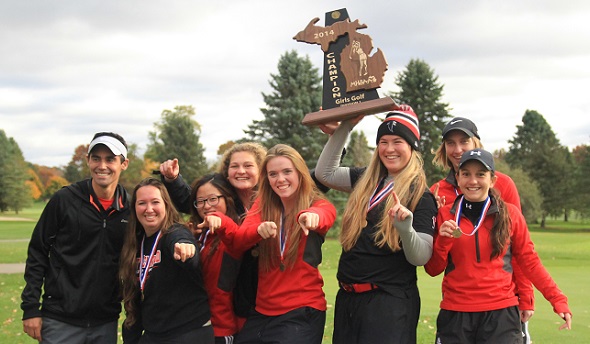
Among a number of first-time champions this fall, the Novi boys tennis team and East Kentwood girls golf team celebrated taking final steps after some recent close misses. Novi had finished second at the 2013 Lower Peninsula Division 1 Final, by a point, as Ann Arbor Huron won its third straight title. The Wildcats clinched their first ever this season, by eight points, while the East Kentwood golfers finished 22 strokes better than their LP Division 1 field after finishing 10th and sixth the last two seasons, respectively. Senior Emily White capped her high school career with a 51-foot putt to win the individual title.
9. Saline Clinches on Final Swim
The Saline girls swimming and diving team trailed reigning champion Farmington Hills Mercy by a half-point entering the final event of the LP Division 1 Final. But the Hornets outpaced Mercy by three seconds in the 400-yard freestyle relay to move ahead and claim the team championship by 5.5 points. Saline had finished runner-up to Mercy by 20 points in 2013.
8. St. Mary’s Football Keeps Promise
From an incredible story point of view, Orchard Lake St. Mary’s 7-0 win over Muskegon in the Division 3 Football Final was easily the most memorable of the fall. Showing immense courage, Eaglets running back Brandon Adams took the field only two days after his mother died after fighting cancer. He scored the game’s lone points midway through the first quarter.
7. Kestrels Give Coach Best Retirement Gift
Monroe St. Mary Catholic Central’s Diane Tuller coached teams to 595 wins over 17 seasons – and in her final match took the Kestrels to their fifth MHSAA championship. St. Mary downed Schoolcraft in four sets despite dropping the first to claim its third Class C title in five seasons. The Kestrels became the eighth team to win at least five MHSAA titles, claiming all five under Tuller’s guidance.
6. Concord’s Hersha Joins Elite Company
Only 14 runners in MHSAA boys cross country history have won at least three individual championships. Concord’s Jason Hersha became the latest, claiming the LP Division 4 title in 15:23.0, the second-fastest time in LP Division 4 Finals history. He became only the third to win three boys titles since team and individual qualifiers began running the same race in 1996; he also finished first as a sophomore and junior.
5. Canton Never Loses on Division 1 March
Just one on-target kick can change a soccer game. That makes Canton’s undefeated run to this season’s Division 1 boys championship even more impressive. Finishing without a loss in any sport is something – but the Chiefs defeated Rochester Adams 1-0 in the Final to end 24-0-3 and as the 13th undefeated champion in MHSAA boys soccer history. Canton posted 16 shutouts this fall.
4. Spring Lake Surges to First Championship
Despite trailing annual power Bloomfield Hills Cranbrook-Kingswood by six strokes after the first round, Spring Lake rolled through the second at the LP Division 3 Girls Golf Final to best the field by a final margin of 18 strokes and claim the school’s first MHSAA golf championship. The achievement was a crowning one for the program started by George Bitner, who has coached at the school since 1968 and fielded his first girls team in 1980.
3. Fisher Finishes Among Fastest in MHSAA History
Grand Blanc senior Grant Fisher finished his high school career with a second straight Lower Peninsula Division 1 championship – and the third-fastest time since the Finals moved to Michigan International Speedway 19 seasons ago. Fisher finished in 14:52.5, 1.5 seconds off the second-fastest time in MHSAA Finals history since 5K (3.1 miles) became the distance in 1980. The only runners who have come in faster than Fisher went on to the Olympics (Dathan Ritzenhein) and top American finishes (twice) at the Boston Marathon (Jason Hartmann).
2. St. Philip Stands Alone with 9 Straight Titles
Battle Creek St. Philip continued its near-decade dominance of Class D, but this time with another historical twist. The Tigers downed Leland in four sets in this season’s Final to win their ninth straight MHSAA championship – setting a record for consecutive titles after formerly being tied with the Marysville teams from 1997-2004. St. Philip entered the postseason ranked No. 3 in D but defeated both No. 2 Mendon and the top-ranked Comets during the final week.
1. Monroe St. Mary Ends Ithaca’s Record Run
Much of the credit for this topping the list goes to Ithaca, which brought a 69-game winning streak into the Division 6 Football Final. The streak was the longest active streak nationally among 11-player football teams, and a win would've allowed the Yellowjackets next fall an opportunity to break the MHSAA winning streak record of 72. But St. Mary controlled the clock with a workmanlike running game and held an Ithaca offense averaging 43 points to nearly a quarter of that in winning 22-12.
PHOTO: The East Kentwood girls golf team raised its first MHSAA Finals championship trophy this October. (Click for more from HighSchoolSportsScene.com.)
Resilient Shelby Turning Struggles Into Strength During 1st Playoff Run in 12 years
By
Tom Kendra
Special for MHSAA.com
November 6, 2025
SHELBY – Not many football teams could sustain back-to-back heartbreaking losses to end the regular season – compounded with losing their senior starting quarterback to a broken hand during the first of those defeats – and still go on a playoff run.
 But not many football programs have endured half the adversity Shelby has over the past 10 years.
“Show me a place of struggle, and I’ll show you a place of strength,” said fifth-year Shelby coach Phil Fortier, who started as an assistant in 2009 at the Oceana County school, located near the towering Silver Lake Sand Dunes.
“We struggle with a lot of things here at Shelby, but there is a resilience. These kids don’t quit, and they are used to bouncing back.”
Shelby (6-4) shook off season-ending road losses at Mason County Central and Muskegon Orchard View with an impressive, 20-2 road victory at LeRoy Pine River in last weekend’s Division 7 District Semifinal – the school’s first playoff win in 12 years.
The Tigers will travel a little farther north this Friday to Harrison (8-2), seeking their first District championship since advancing to the Semifinals in 2012 and 2013.
What has transpired with Shelby football since that high-water mark is a case study in what can happen at a small, rural school when things start snowballing in the wrong direction. The Tigers have not won more than three games over the past 11 years, with five winless seasons.
 When Fortier stepped up to the head coaching job in 2021, he had his eyes on a dynamic group of middle schoolers who could turn things around.
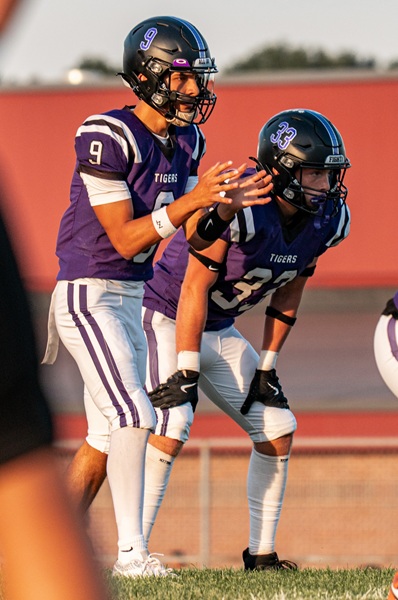
Among that special group are senior Isaac Garcia and junior Jaylin Henderson, who have led the Tigers’ turnaround season by sharing the crucial quarterback spot in the veer-option offense.
While a two-quarterback system is not unique, one that is split exactly 50-50 certainly is rare. Garcia and Henderson both have attempted 67 passes and completed 35 of them, with Henderson having a slight edge in passing yardage (624 to 620) and Garcia the edge in touchdown passes (6 to 4).
Garcia has leadership skills galore – he is the one his teammates look to in times of trouble, and he is also extremely accurate in the short-passing game.
Henderson, an MHSAA Individual Wrestling Finals qualifier last winter at 157 pounds, has athletic ability coming out of his ears, according to Fortier. He can throw a deadly deep ball on one play, then run over a linebacker on the next.
“I have been watching Tony Annese up at Ferris using all types of different quarterbacks in this offense,” said Fortier, who works closely with offensive coordinator Forrest Courtright. “Here we are with these two super-talented kids who bring different skills to the position, so why not use them both?”
In addition, Garcia was serving as a mentor for his talented, but younger, teammate.
“Isaac has really helped me a lot with my reads,” explained Henderson, who is second on the team with 95 carries for 617 yards and 10 touchdowns. “He gives me feedback and helps me to get better every week.”
The system was working beautifully, as Shelby raced to a 5-2 start, highlighted by a 28-18 win over rival Hart and a 44-8 manhandling of Muskegon Catholic Central.
Then came the first half of the Week 8 game at Mason County Central, when Garcia’s right (throwing) hand got crunched against a helmet on a kickoff, resulting in a broken metacarpal bone.
Just like that, the training wheels were off for Henderson, who is now Shelby’s all-the-time QB and has responded with his legs against Orchard View (19 carries for 144 yards and two TDs) and his arm against Pine River (8-of-14 passing for 155 yards and one TD).
It helps that the Tigers have a pair of 6-3 wide receivers in Trevor Weiss and Evan Waller, dangerous slot receiver DayDay Garcia and the constant threat of junior fullback and leading rusher Brody Fessenden (140 carries for 786 yards and 11 TDs).
 “At this point in the season, our chemistry is really good,” said Henderson. “I trust all of our receivers. If I give them a chance, they will make the catch.”
Meanwhile, Garcia has been fitted with a club to protect his right hand and is back starting at safety, where he came up with a huge sack on third down and a pass deflection on fourth down to stop a late Pine River drive during last week’s playoff opener.
His return to the field has energized and motivated his teammates, who are watching their leader refuse to let even a broken throwing hand stop him in his senior year.
“At first, when the injury happened, I was very sad and depressed and didn’t want to leave my room,” said Garcia, a three-sport athlete who also competes in basketball and track.
“Then when they told me that I could play with a club, that brought my mood way up. It’s kind of like our team, we’re not gonna let anything stop us.”
 Tom Kendra worked 23 years at The Muskegon Chronicle, including five as assistant sports editor and the final six as sports editor through 2011. E-mail him at [email protected] with story ideas for Muskegon, Oceana, Mason, Lake, Oceola, Mecosta and Newaygo counties.
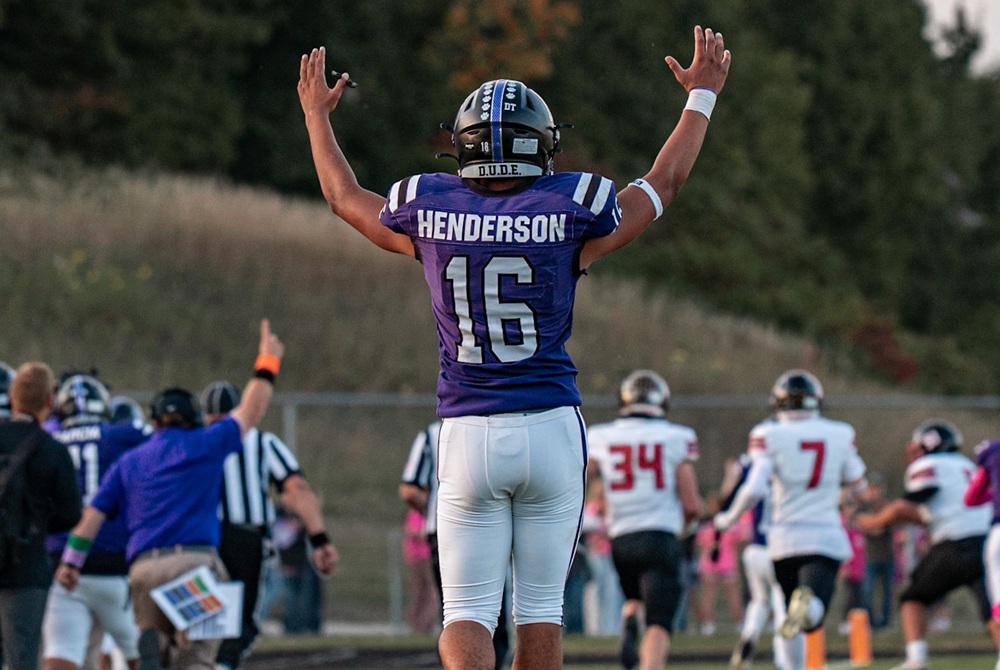
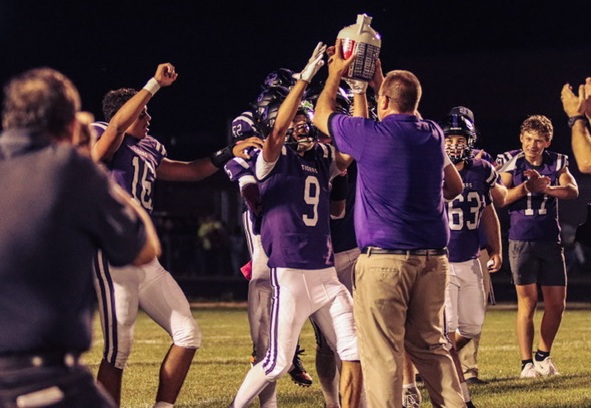
PHOTOS (Top) Jaylin Henderson celebrates a Shelby touchdown during the Tigers' 28-18 win over rival Hart in Week 3. (Middle) Isaac Garcia waits for the snap as running back Brody Fessenden stands ready. (Below) Garcia and coach Phil Fortier celebrate with the "Blood, Sweat & Tears" trophy after Shelby's win over Hart. (Photos courtesy of the Shelby football program.)