


AD Inducted to National Hall of Fame
May 7, 2014
By Geoff Kimmerly
Second Half editor
Winter gets hectic so quickly that we’re forced to save some intriguing items that come our way for a sunnier day – and that day is today.
Following are news, notes and a few key links collected over the last few months, including the national Hall of Fame induction of a longtime Michigan athletic director, local recognition for another and statewide acclaim for a group of students putting their video production equipment to good use benefiting all.
Ann Arbor AD Honored Nationally
Former Ann Arbor Huron athletic director Jane Bennett was among five inducted into the National Interscholastic Athletic Administrators Association Hall of Fame in December.
Bennett served 26 years as a teacher, coach, athletic director and assistant principal in Michigan before spending the last decade as a principal at two schools in Montana. She served as athletic director at Huron for 15 years through 2002-03. The NIAAA reported that during her final decade in that position, participation in athletics doubled.
Bennett, who received her bachelor’s and master’s degrees from the University of Michigan, began her career at Huron in 1977 as varsity softball coach and became a math teacher and the co-director of athletics a year later. She coached the softball team 14 seasons before moving into the full-time athletic director position. Bennett was co-founder of the Michigan High School Softball Coaches Association and served as MHSSCA president from 1982-87.
Among other achievements at Huron, Bennett was a leader in a successful campaign to gain voter approval of a $60 million bond package, which included $20 million to improve and expand athletic facilities. She also developed curriculum for an annual varsity captains/head coaches leadership training program and composed handbooks/guidebooks for coaches, athletes and parents.
Bennett also was a valuable contributor to the Michigan Interscholastic Athletic Administrators Association and the NIAAA. She was president of the MIAAA in 1993-94 and a state conference speaker on several occasions. Bennett also served in various NIAAA leadership positions including on the committee that developed the Leadership Training Institute in 1996.
Bennett was named MIAAA Athletic Director of the Year in 1998 and received its State Award of Merit in 1997. She received the MHSAA’s Women in Sports Leadership Award in 1995 and was inducted into the MHSSCA Hall of Fame in 1995. Prior to her selection to the NIAAA Hall of Fame, Bennett was honored with the NIAAA Distinguished Service Award in 1998 and the NIAAA Thomas E. Frederick Award of Excellence in 2000. In 2005, she was inducted into the National Council of Secondary School Athletic Directors Hall of Fame, having served as its president in 2003 and been selected as its Athletic Director of the Year in 1998.
PSL's Ward: 'Pillar' of Detroit Athletics
Alvin Ward, the executive director of athletics for the Detroit Public School League and a member of the MHSAA Representative Council, received a 2014 Pillar in the Community Award in April from the Coast II Coast All-Stars, a Detroit-based pro basketball team that plays in the American Basketball Association.
Ward has served as a teacher, assistant principal and principal as well for Detroit Public Schools, and directs programs with a combined 500 coaches and 4,500 athletes.
Linked up
- This winter, the MHSAA Representative Council adopted a number of football practice rules changes aimed at improving player acclimatization at the start of fall and reducing head trauma and injuries. The Adrian Daily Telegram’s Doug Donnelly got responses from a number of coaches from that area of the state; click to find out why they feel these changes are important.
- Port Huron Times Herald writer Paul Costanzo let people know about our Student Advisory Council through the experience of Marlette’s Connor Thomas, one of our juniors and a great contributor this school year.
Power of Awareness
The Kimberly Anne Gillary Foundation works to educate Michigan schools on sudden cardiac arrest and train personnel in CPR and the use of an AED (automated external defibrillator). The video below teaches us again about the importance of awareness.
Saginaw Heritage was awarded $5,000 in April as the winner of the Gillary Foundation’s High School AED Contest. Students were asked to create a 3-minute video emphasizing the importance of Michigan high schools being adequately prepared to respond to a sudden cardiac arrest or related event on school property.
Randy and Sue Gillary created the foundation after their 15-year-old daughter Kimberly – an athlete at Troy Athens – died after suffering sudden cardiac arrest in 2000. The contest judges were Kimberly’s sisters Emily Kucinich, Jennifer Gregroy and Katie Gillary.
As of April 1, the Gillary Foundation had raised $1.2 million and donated 650 AEDs to schools – with three lives having been saved with donated AEDs. For more, click www.kimberlysgift.org.
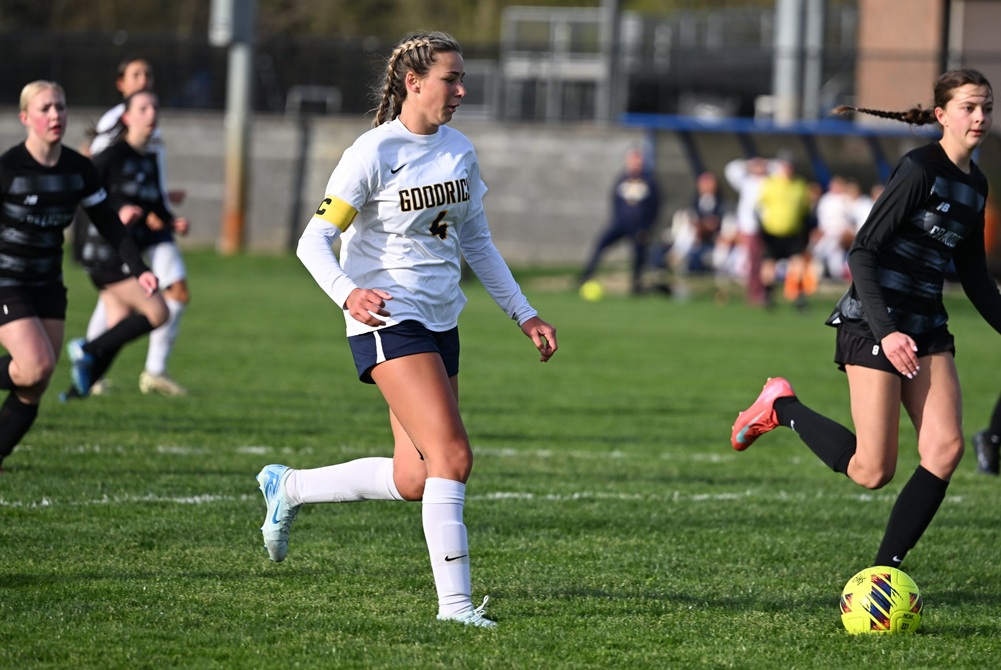
Puzzle Coming Together as Goodrich Aims to Claim School's 1st Girls Soccer Title
By
Paul Costanzo
Special for MHSAA.com
May 6, 2026
Baylor Lauinger just can’t get enough of winning at Goodrich.
 The junior has earned a pair of Finals titles with the Martians, as part of the Division 2 girls cross country champion in 2024 and the Division 2 girls basketball champion this past March.
Now, Lauinger and her Goodrich soccer teammates are looking to add to the school’s overflowing trophy case.
“I mean, it’s hard not to do all three of them when all three teams are very successful,” Lauinger said. “That’s just something that you want to be part of when you have a winning culture like we do. If you see a team having that success, I feel like other girls would want to join that. And it makes us push harder when we see all these other teams in our school that are winning.”
Behind a strong core of returning players in the midfield and back end who have been joined by a talented group of newcomers up front, Goodrich is off to a 10-2-1 start to the season and ranked No. 1 in the latest Michigan High School Soccer Coaches Association Division 3 poll.
That combination of talent and the depth of his roster have Goodrich coach Josh Back excited about the opportunities ahead.
“I always say I have all my puzzle pieces,” Back said. “This is the fifth year I’ve had (the program), and I have lots of puzzle pieces that I get to play with.”
Lauinger leads that returning group as an attacking midfielder. She’s already dished out 13 assists despite missing four of the Martians’ 13 matches, including both of their losses (Clarkston and Oxford).
“Last year, she was our goal scorer,” Back said. “She’s an awesome leader. These younger kids that come in, it doesn’t faze her one bit that the other girls are doing the scoring. She just wants to win.”
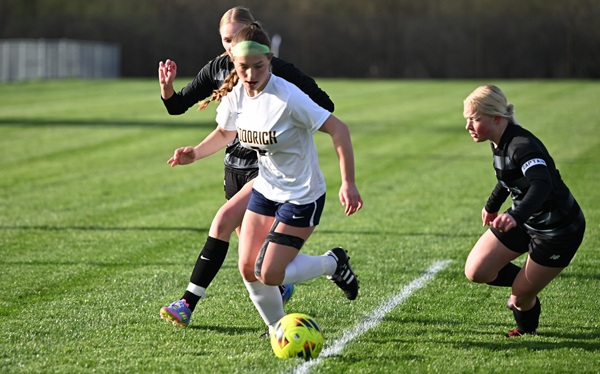 She’s finding success playing the ball forward to a completely new starting front line for Goodrich, which features freshmen Elliana Back and Sydney Place, as well as sophomore Bristol Cook.
Back has 18 goals and eight assists already, while Place has added seven goals. All three have years of club experience.
“This is the most soccer-savvy group I’ve had,” Josh Back said. “At times, there’s a learning curve with freshmen, but this year, they’ve stepped right in. They have that savviness and understanding of the game at the highest level. We lost our whole offense last year, and those two came in with our sophomore (Cook). As young as they are, the experience is there.”
The varsity experience is behind them, particularly at center back where Goodrich starts a pair of seniors in Lily May and Kaylee Eickhoff. They lead a defense in front of sophomore keeper Abigail Gagnon, who Josh Back called a “rockstar who doesn’t get enough praise,” who has allowed just eight goals through 13 games and has eight shutouts.
“They’re very important,” Lauinger said. “They’re the foundation of our back line, and they keep us ready. I think those two have been playing together for a long time now. Honestly, their defense really helps us with the goals, too. Their defense translates to offense.”
The pieces didn’t have much time to come together before being thrown into the fire. Not only were the newcomers asked to get up to speed early, but six members of the basketball team – Lauinger, Eickhoff, May, Place, junior Olivia Millerd and freshman Katerina Frederick – were playing in the season opener two days after claiming their Finals title at the Breslin Center.
And it wasn’t exactly a warm-up.
The Martians opened against Pontiac Notre Dame Prep, the No. 6-ranked team in Division 3, and followed that up with a trip two days later to Troy Athens, which is ranked No. 13 in Division 1.
They came out of their opening week 1-0-1, defeating NDP 6-0 and playing Athens to a 1-1 draw.
“I just think those two games were kind of like a wake-up call to show what we can do,” Lauinger said. “It shows how we can compete with high-level teams and shows the state what we are able to do. It definitely gets us ready for later.”
Later is coming up quickly, as the District tournament begins May 26 at Lake Fenton. Goodrich has won four straight District titles after not having won one since 2004. But Josh Back knows this team is capable of taking the next step, as all of the last four years ended with Regional losses, including shootout defeats against DeWitt both of the past two years.
“Hopefully this could be the first state title for Goodrich (in girls soccer),” he said. “But we have to get through the Districts and Regionals first – just one game at a time. The kids, they’re focused on the next one up. They just worry about tomorrow’s game. But I still think our goal of a state title is well within reach.”
 Paul Costanzo served as a sportswriter at The Port Huron Times Herald from 2006-15, including three years as lead sportswriter, and prior to that as sports editor at the Hillsdale Daily News from 2005-06. He can be reached at [email protected] with story ideas for Genesee, Lapeer, St. Clair, Sanilac, Huron, Tuscola, Saginaw, Bay, Arenac, Midland and Gladwin counties.
PHOTOS (Top) Goodrich’s Baylor Lauinger (4) leads a rush downfield during a game this season against Ortonville Brandon. (Middle) The Martians’ Elliana Back (4) makes a move toward the net. (Photos by Tonya Wyczalek.)